


Why a 12-Month Cash Flow Statement is Your Business’s Lifeline
A 12 month cash flow statement is a vital tool that shows how money moves in and out of your company, helping you keep your business healthy and growing. It’s the pulse of your business, and understanding it is key to survival. Many small businesses fail not because they aren’t profitable, but because they run out of cash.
Think of your business as a car. Profit is the engine, but cash flow is the fuel. Without fuel, you’re not going anywhere. A 12 month cash flow statement is your fuel gauge, helping you anticipate when you’ll need a top-up. This foresight allows you to make smarter decisions, identify trends, plan for large expenses, and spot liquidity bottlenecks before they become crises. To learn more about setting up your financial foundation, check out our guide on Small Business Accounting 101: A Guide for New Entrepreneurs.
I’m Michael J. Spitz, and with over 15 years in corporate accounting, I’ve seen how crucial a 12 month cash flow statement is for business success.
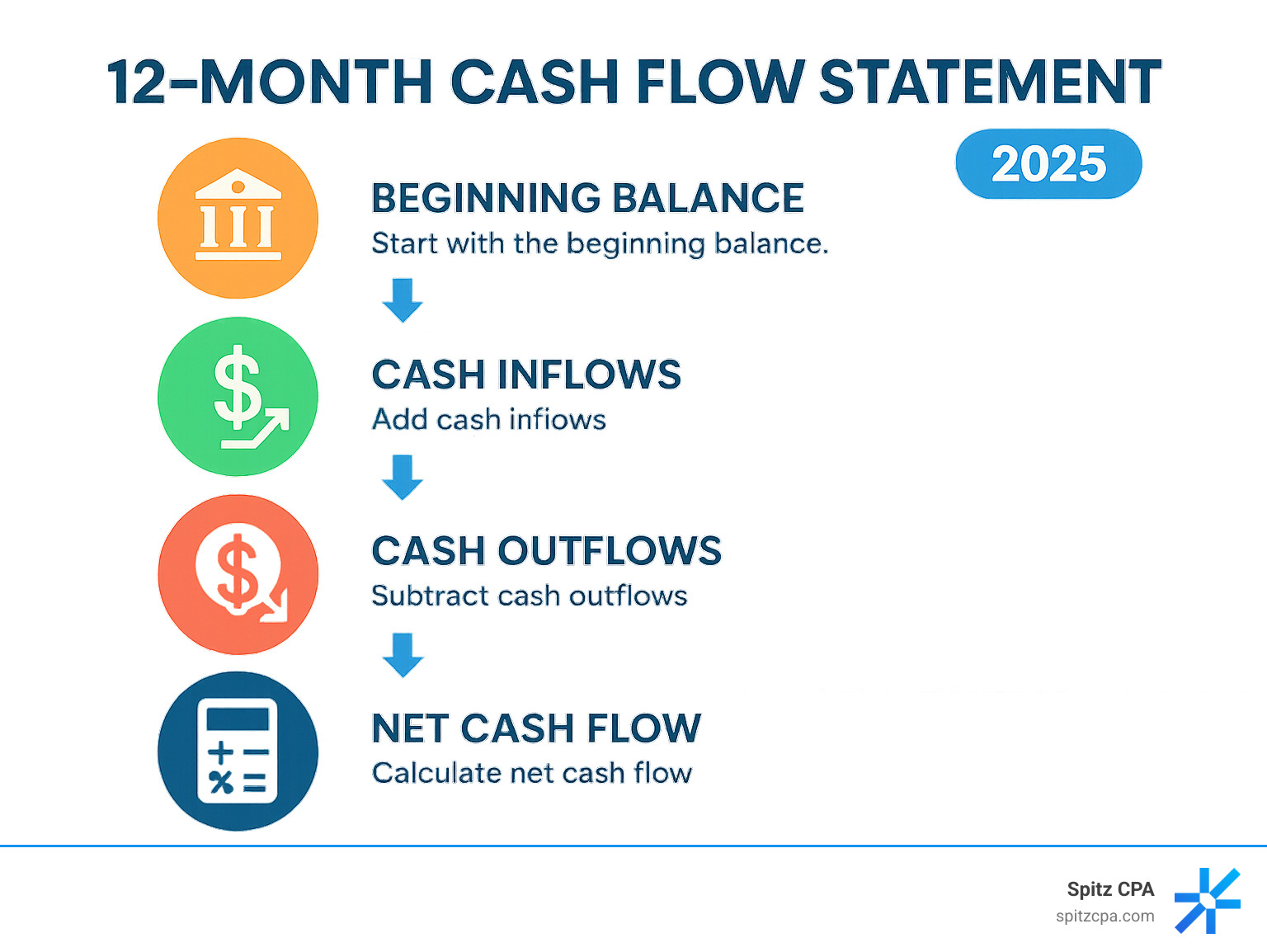
Understanding the Key Components of a 12-month cash flow statement
A 12 month cash flow statement is organized into three main sections that detail where your cash comes from and where it goes.
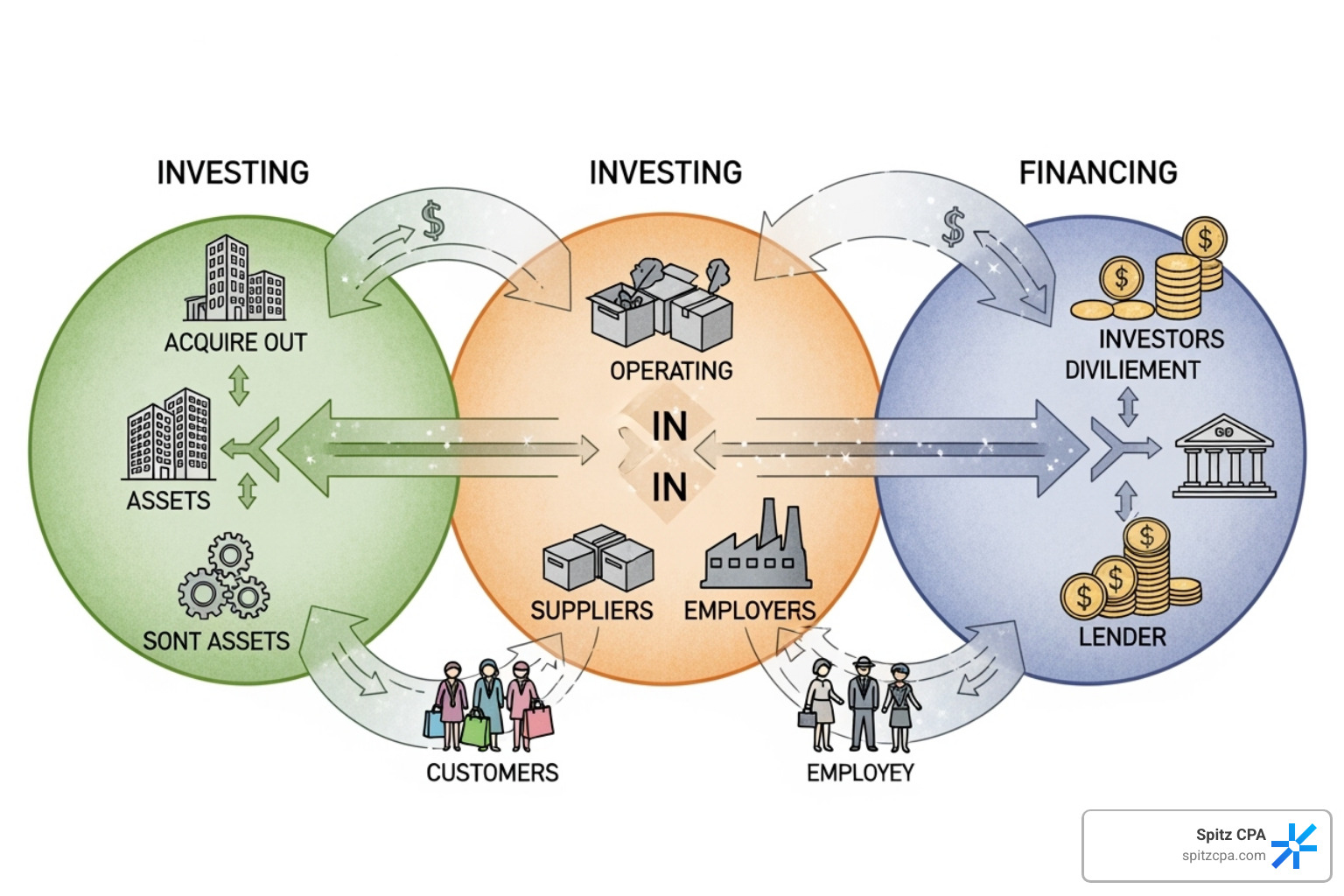
- Cash Flow from Operating Activities: This is cash generated from your core business operations, like sales, minus cash paid for inventory, payroll, and rent. It shows if your main activities generate enough cash to sustain the business.
- Cash Flow from Investing Activities: This covers cash used for or generated from buying and selling long-term assets like equipment or property. Negative cash flow here can be a good sign for a growing business investing in its future.
- Cash Flow from Financing Activities: This deals with cash from debt and equity, such as receiving loan funds or owner investments, and paying out loan principal or dividends. It reveals how you’re funding operations and growth.
Beyond these, the statement tracks your Beginning Cash Balance (your starting point each month) and Ending Cash Balance (your finish line), creating a continuous 12-month picture.
Cash Flow Statement vs. Profit and Loss (P&L) Statement
It’s easy to confuse a cash flow statement with a Profit and Loss (P&L) statement. The P&L tells you if you’re profitable, while the cash flow statement tells you if you have cash.
Here’s a quick rundown of their key differences:
| Feature | Cash Flow Statement | Profit and Loss (P&L) Statement |
|---|---|---|
| Primary Purpose | Shows liquidity and actual cash movement | Shows profitability over a period |
| Accounting Method | Cash basis (records transactions when cash is exchanged) | Accrual basis (records transactions when they occur, regardless of cash) |
| Key Question | Do we have enough cash to pay our bills? | Are we making money? |
| Timing | Focuses on when cash comes in or goes out | Focuses on when revenue is earned and expenses are incurred |
| Key Items Included | Loan principal repayments, owner’s drawings, actual cash received/paid | Depreciation, amortization, credit sales, accrued expenses |
| Non-Cash Items | Excludes non-cash expenses (e.g., depreciation) | Includes non-cash expenses (e.g., depreciation) |
The biggest distinction is timing. A P&L might show revenue from a credit sale before you’ve received the cash. It also includes non-cash expenses like depreciation. This is why a business can appear profitable on its P&L but still fail due to a lack of cash. A cash flow statement provides a realistic picture of your ability to pay bills, which is essential for day-to-day operations. For a deeper dive, explore our Accounting resources.
How to Create Your 12-Month Cash Flow Statement Step-by-Step
Creating a 12 month cash flow statement is a manageable process of mapping out your business’s finances for the next year. This forecast shows when money will come in and go out, highlighting times of surplus and potential shortfalls. It’s a living document that you’ll update as the year unfolds, making it a powerful tool for growth.
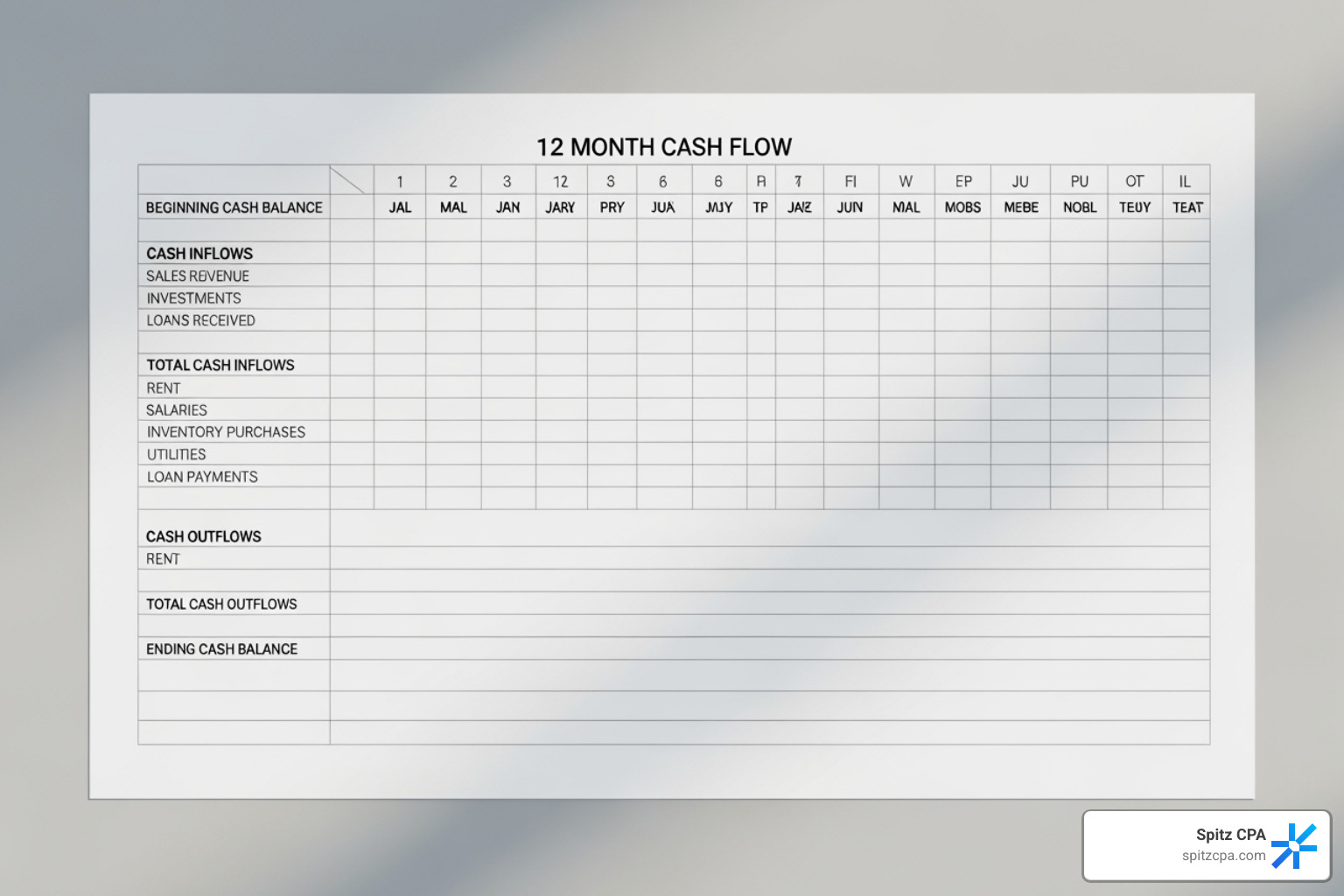
You don’t have to start from scratch. Using a template is a smart move. For example, you can Download a free template from SCORE to get a solid foundation.
Step 1: Determine Your Starting Cash Balance
Your starting point for the first month is your current cash balance. This includes all money in your business bank accounts plus any cash on hand. For every subsequent month, the starting balance is simply the ending balance from the previous month. This creates a continuous flow, allowing you to track your cash position all year.
Step 2: Forecast Your Monthly Cash Inflows
Next, realistically estimate all the cash you expect to receive each month. It’s better to be conservative than overly optimistic. Base your forecast on past performance and any known future changes.
Common cash inflows for your 12 month cash flow statement include:
- Sales Revenue: Cash from sales. If you sell on credit, only count cash you expect to receive in a given month.
- Debtor Receipts: Payments from customers for past credit sales.
- Loan Proceeds: New funds from loans or lines of credit.
- Owner Investments: Your own capital contributions to the business.
- Grants or Subsidies: Expected funds from grant awards.
- Interest Income: Interest earned on business bank accounts.
- Asset Sales: Cash from selling old equipment or other assets.
For detailed tracking of these inflows, our Bookkeeping services can help.
Step 3: Estimate Your Monthly Cash Outflows
List all the cash you expect to pay out each month, recording costs in the month you anticipate the payment will be made, not just when you receive a bill.
Common cash outflows include:
- Payroll: Wages, salaries, commissions, and related payroll taxes. Our Payroll services can manage this for you.
- Rent/Lease Payments: For your office or workspace.
- Inventory Purchases: Goods you buy to resell.
- Utilities: Electricity, water, internet, etc.
- Marketing Costs: Advertising and promotion expenses.
- Loan Payments: Both principal and interest.
- Taxes: Income, sales, or property taxes.
- Professional Fees: Payments to accountants, lawyers, etc.
- Insurance Premiums: Note large annual payments that fall in a single month.
- Operating Expenses: Office supplies, software, travel, etc.
- Capital Expenditures: Major purchases like new machinery.
- Owner’s Draws/Dividends: Cash you take out of the business.
Step 4: Calculate Net Cash Flow and Ending Balance
Now, bring it all together for each month on your 12 month cash flow statement.
- Calculate Net Cash Flow: Subtract your total monthly cash outflows from your total monthly cash inflows. A positive number is a cash surplus; a negative number is a cash deficit.
- Calculate Ending Balance: Add the Net Cash Flow to that month’s Starting Cash Balance. This is your cash position at the end of the month.
This Ending Balance then becomes the Starting Cash Balance for the next month. Repeating this for 12 months gives you a clear picture of your financial trajectory, allowing you to spot potential shortfalls early and plan accordingly. This proactive approach is key to staying in control.
Analyzing and Using Your Cash Flow Statement for Growth
Once you’ve built your 12 month cash flow statement, the real work begins: analysis. This is a powerful tool for financial management, strategic planning, and problem-solving. It helps you assess liquidity, determine true cash generation, and make informed decisions about investments and funding.
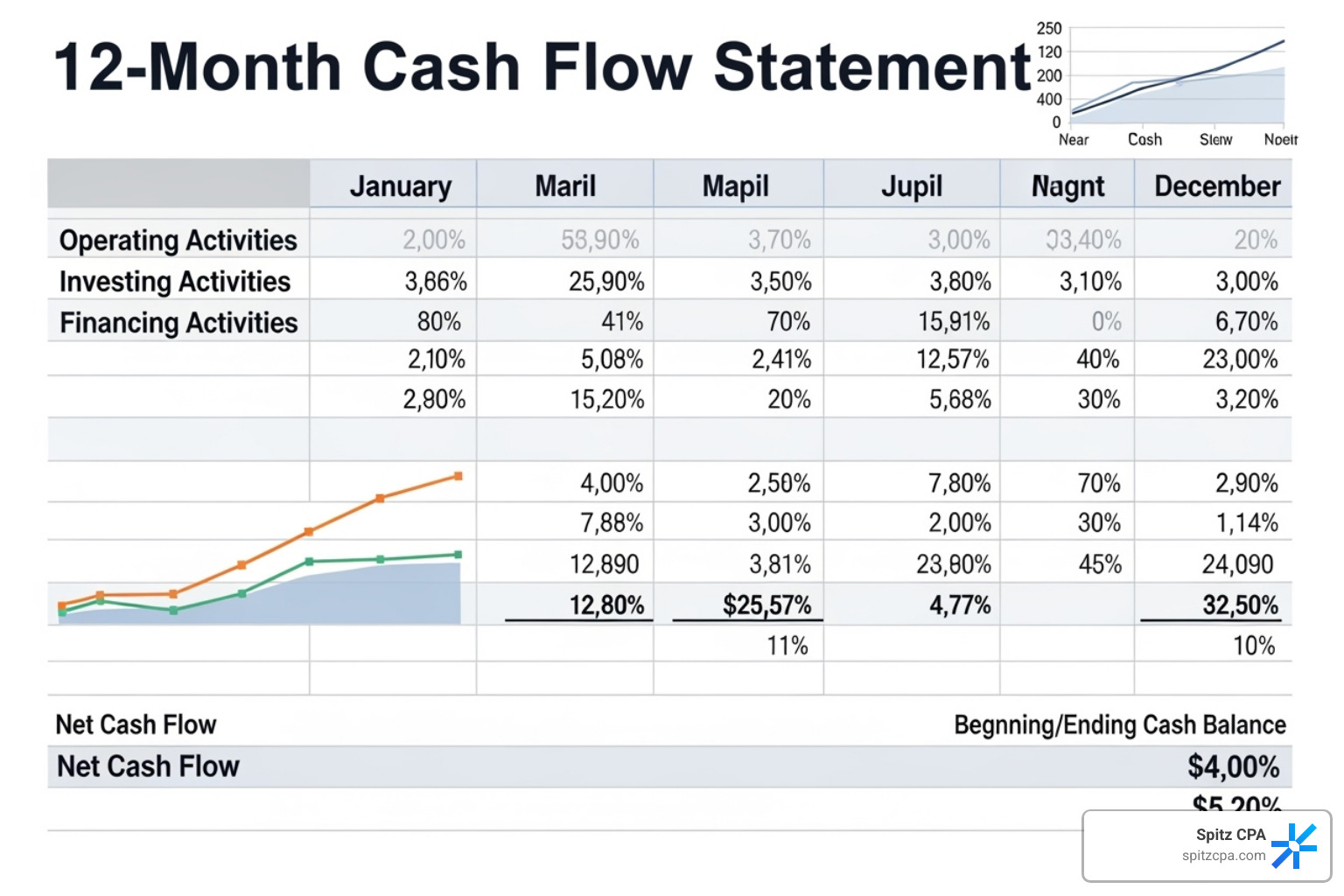
An Excel Accounting and Bookkeeping Template can be a fantastic resource for this analysis.
Direct vs. Indirect Method: What’s the Difference?
There are two methods for preparing the operating activities section of a cash flow statement:
- The Direct Method: This method lists all major cash inflows (e.g., cash from customers) and outflows (e.g., cash paid to suppliers). It provides a clear, itemized view of cash movements and is often preferred for internal management and forecasting.
- The Indirect Method: This method starts with net income and adjusts for non-cash items (like depreciation) and changes in working capital. It reconciles net income to cash flow and is commonly used for external reporting because it’s easier to prepare from accrual-based statements.
For a proactive 12 month cash flow statement, the direct method typically offers more actionable insights.
Addressing Common Cash Flow Challenges
Your statement is an early warning system for common challenges:
- Seasonal Fluctuations: Many businesses have predictable highs and lows. Your forecast will show these patterns, allowing you to build cash reserves during peak seasons to cover expenses during leaner months.
- Slow-Paying Customers: If customers don’t pay on time, your cash flow suffers. The statement highlights delayed collections, prompting you to improve your accounts receivable processes.
- Unexpected Expenses: A broken piece of equipment or a surprise bill can be disruptive. Your statement encourages building a contingency fund to absorb these shocks.
- Over-Investing in Inventory: Buying too much inventory ties up cash. The statement helps you track this outflow against sales so you can adjust your purchasing strategy.
Identifying these issues early gives you time to implement corrective measures and keep your cash flowing smoothly.
Best Practices for Maintaining Your 12-month cash flow statement
To keep your 12 month cash flow statement a valuable tool, follow these best practices:
- Review Regularly: Look at your statement at least monthly to compare actuals to projections and make timely adjustments.
- Update Projections: As new information arises, update your forecast to keep it relevant.
- Compare Forecast to Actuals: At the end of each month, analyze variances between your projection and actual results to refine future forecasting.
- Plan for Contingencies: Always include a buffer for the unexpected. A cash reserve or line of credit is a crucial safety net.
- Ensure Accuracy: Precise data entry is essential. Garbage in, garbage out.
- Roll Forward: Systematically carry each month’s ending balance forward to become the next month’s beginning balance.
Frequently Asked Questions about Cash Flow Statements
Here are answers to some of the most common questions we hear from business owners about cash flow.
How often should I update my cash flow statement?
For the best control, you should update your 12 month cash flow statement at the beginning of each month. This creates a “rolling forecast.” Business conditions change, and monthly updates ensure your forecast remains accurate, allowing you to react quickly to shifts in sales or unexpected costs. For highly dynamic businesses, weekly updates can be even better.
What’s the biggest mistake businesses make with cash flow?
The biggest mistake is ignoring it until it’s too late. Many owners focus on profitability but neglect their actual cash position. A business can show a profit on paper but fail if it can’t pay its bills. This often happens due to:
- Overly optimistic forecasts.
- Not collecting payments from customers quickly enough.
- Failing to plan for seasonal dips or unexpected costs.
- Operating without adequate cash reserves.
Proactive monitoring is the key to avoiding these common pitfalls that lead to business failure.
Can a business be profitable but still have negative cash flow?
Yes, absolutely. This is a crucial concept that highlights the difference between a P&L statement and a 12 month cash flow statement. A business can be profitable but have negative cash flow if, for example, it has a lot of unpaid customer invoices (accounts receivable), is investing heavily in new equipment, or is making large principal payments on debt. These activities use cash but don’t necessarily appear as expenses on the P&L. This is why your cash flow statement is indispensable for understanding your true ability to operate and pay your bills.
Take Control of Your Financial Future
We hope this guide has demystified the 12 month cash flow statement. It’s more than a spreadsheet; it’s your financial compass and a clear roadmap to sustainable business growth. Diligent cash management is vital for every business, at every stage.
By consistently monitoring your cash flow and making informed decisions, you are actively steering your business toward financial stability and achieving your growth goals.
That’s where we come in. At Spitz CPA in Gilbert, AZ, we are passionate partners dedicated to helping businesses like yours thrive. We offer comprehensive accounting, tax, and financial advisory services designed to boost your cash flow, provide financial clarity, and help you achieve significant growth. With personalized guidance and expert accounting clean-up, we can help you build a more confident financial future.
Don’t let cash flow worries hold you back. It’s time to take control of your financial destiny. Ready to feel truly in charge? Achieve financial clarity with expert guidance from Spitz CPA.


