


Why Accounts Payable Management is Critical for Your Business
Accounts payable management is the process of tracking, verifying, and paying the money your business owes to vendors and suppliers. Effective AP management delivers:
- Improved cash flow through optimized payment timing
- Stronger vendor relationships via timely, accurate payments
- Cost savings from early payment discounts and reduced processing expenses
- Fraud prevention through robust internal controls
- Better financial visibility for strategic decision-making
- Regulatory compliance and audit readiness
With many businesses processing over 1,000 invoices monthly, strategic AP management is critical. It’s more than just paying bills; it’s a tool for optimizing working capital and driving growth. Poor AP practices, however, can lead to late fees, damaged supplier relationships, and cash flow problems.
While often seen as an administrative burden, strategic accounts payable management directly impacts your bottom line, credit rating, and ability to negotiate favorable terms. Despite its growing importance, many businesses still rely on manual, error-prone processes that waste time and money.
I’m Michael J. Spitz, and with over 15 years of corporate accounting experience managing accounts payable across various industries, I’ve seen how optimizing AP processes can free up working capital and strengthen business operations. My approach focuses on implementing practical systems that reduce errors, prevent fraud, and give you clear visibility into your financial obligations.
Related financial topics:
Why AP Management is More Than Just Paying Bills
If you think accounts payable management is just about paying bills on time, you’re missing a powerful opportunity. Your AP process isn’t just a back-office chore—it’s a strategic tool that can open up cost savings, strengthen your supply chain, and drive real bottom-line growth.

Let me share what happens when you treat accounts payable as the strategic function it is.
Better cash flow management starts with paying bills strategically, not just as late as possible. Early payment discounts can save you 2-3% per invoice, while synchronizing payables with receivables creates breathing room. This is why we recommend a Business Financial Health Check to see the full picture of your cash flow.
Stronger vendor relationships are built on trust. When you consistently pay accurately and promptly, you earn tangible benefits: better pricing, faster delivery, and preferential treatment during supply shortages. As one supplier told me, “The better you treat us, the better deals you get.”
Cost savings go beyond discounts. The hidden expense in most AP departments is the manual process itself—paper, postage, and staff hours. Streamlining how you handle invoices saves resources that can be redirected toward growing your business.
Fraud prevention is critical. In 2023, losses caused by fraudulent activity increased by $1.2 billion to $10.0 billion. Your AP process is a prime target. Strong controls, verification processes, and automation dramatically reduce your exposure.
Improved accuracy matters. Manual data entry creates errors that can throw off your budgets, tax returns, and strategic planning. Automated systems catch these mistakes, ensuring your financial reports reflect reality.
Better financial visibility changes how you run your business. With real-time insight into spending patterns and payment obligations, you can stop flying blind and start making decisions based on actual data.
Regulatory compliance protects your business. Proper documentation and clear audit trails ensure you’re ready for questions from auditors, tax authorities, or potential buyers.
The Core Components of Effective Accounts Payable Management
To transform your accounts payable, you need to master its fundamental components.
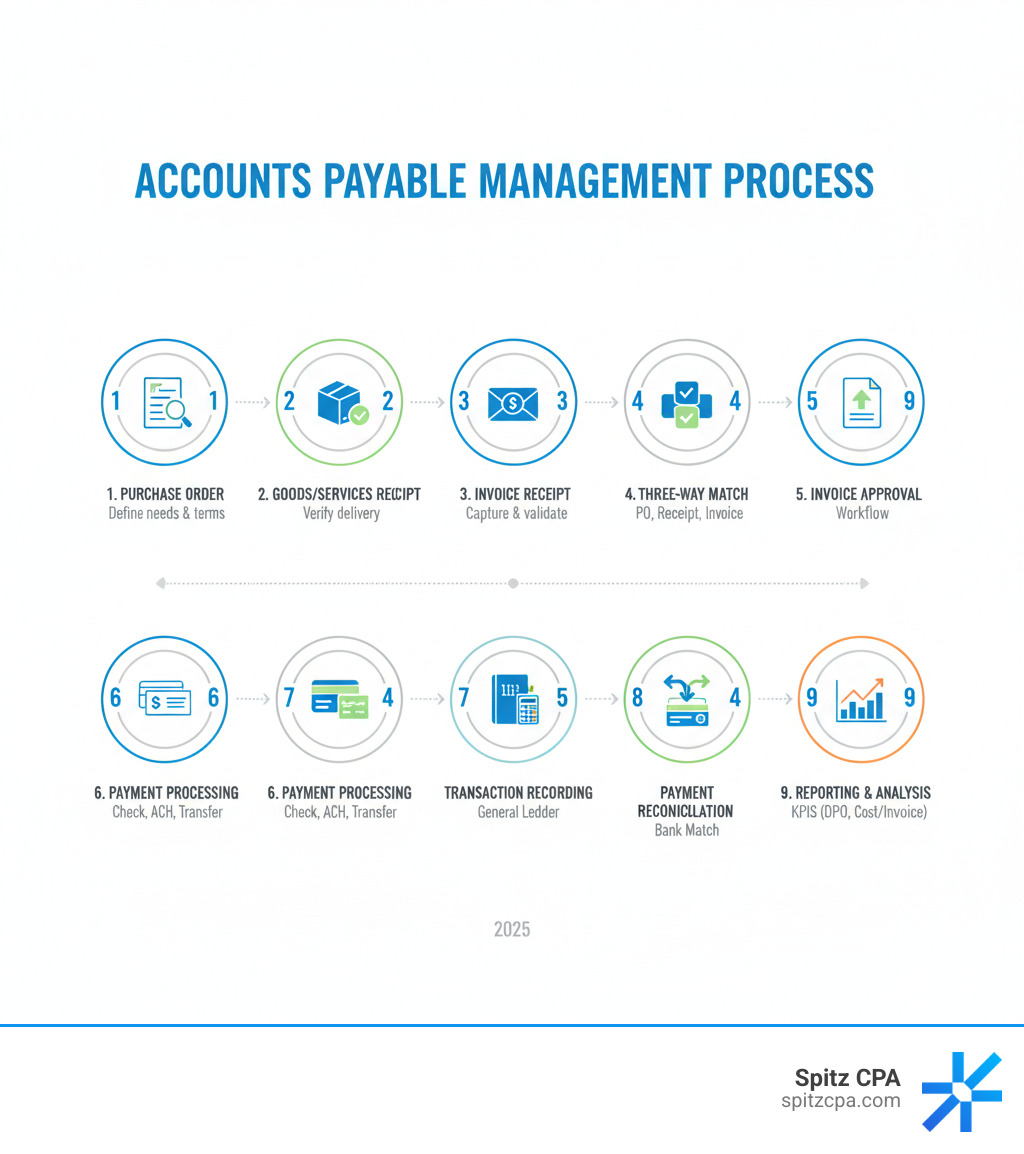
Invoice processing is where it all begins. This involves capturing invoice details, verifying them against purchase orders, and routing them for approval. When this process works well, payments are timely and accurate.
Vendor record maintenance is the essential work of keeping supplier information—contact details, payment terms, tax IDs—accurate and up-to-date to prevent payment delays and misdirected funds.
Payment preparation requires choosing the right payment method (check, ACH, etc.) and scheduling payments to optimize cash flow, such as by capturing early payment discounts.
Record-keeping and reconciliation provides the foundation. Every transaction must be accurately recorded in your general ledger, and all documentation needs secure storage for audit trails. Regular reconciliation ensures your records match your bank statements.
Supplier communication keeps relationships strong. Open communication helps you address issues quickly, confirm payment statuses, and resolve disputes before they escalate.
Tracking and reporting gives you the insights needed to improve. Monitoring key performance indicators (KPIs) like days payable outstanding and on-time payment rates reveals where your process needs work.
Managing these components can be overwhelming with manual systems. That’s why our Bookkeeping Services focus on creating streamlined, integrated systems to handle these functions efficiently.
Common Risks in Accounts Payable Management
Even well-intentioned businesses face serious risks in their accounts payable management. Understanding these risks is the first step toward protecting your business.
Manual data entry errors are silent profit-killers. A single mistake can lead to incorrect payments and flawed financial reports. Industry surveys show 21% of AP teams cite manual data entry as their top challenge.
Invoice processing delays create a domino effect. Lost invoices or slow approvals lead to missed payments, late fees, and strained vendor relationships. Research shows 20% of businesses experience operational delays because of AP challenges.
Duplicate payments are more common than you think. Simple oversights can lead to paying the same bill twice, and recovering those funds is time-consuming and sometimes impossible.
Late payment penalties are entirely preventable expenses that directly hurt your profitability. Missing due dates, even by a day, can trigger fees that add up to real money.
Strained supplier relationships have real consequences. When vendors can’t rely on you for timely payment, you lose negotiating power, and they may tighten your terms or stop doing business with you altogether.
The threat of fraud has grown dramatically. The FTC reported that losses caused by fraudulent activity increased by $1.2 billion to $10.0 billion in 2023. AP processes are prime targets for both internal and external schemes, and manual processes with weak controls make these frauds easier to execute.
If these risks sound familiar, consider our Accounting Clean-Up Services to get your AP processes on solid ground.
Strategic Accounts Payable Management: Best Practices and Automation
In today’s business environment, strategic accounts payable management is transformative—it shifts AP from a reactive burden into a proactive driver of business value.
At Spitz CPA, we’ve seen how optimizing AP is a cornerstone of improving business profitability. Our services to Improve Business Profitability can help you get there.
The foundation of strategic AP begins with three critical practices. Centralizing AP functions eliminates chaos, reduces costs, and provides a unified view of your financial obligations. Adopting strong governance establishes clear policies and procedures as your defense against fraud and your framework for consistent operations. Creating a paperless environment by moving to automation eliminates human error, speeds up processing, and gives you real-time visibility into spending.
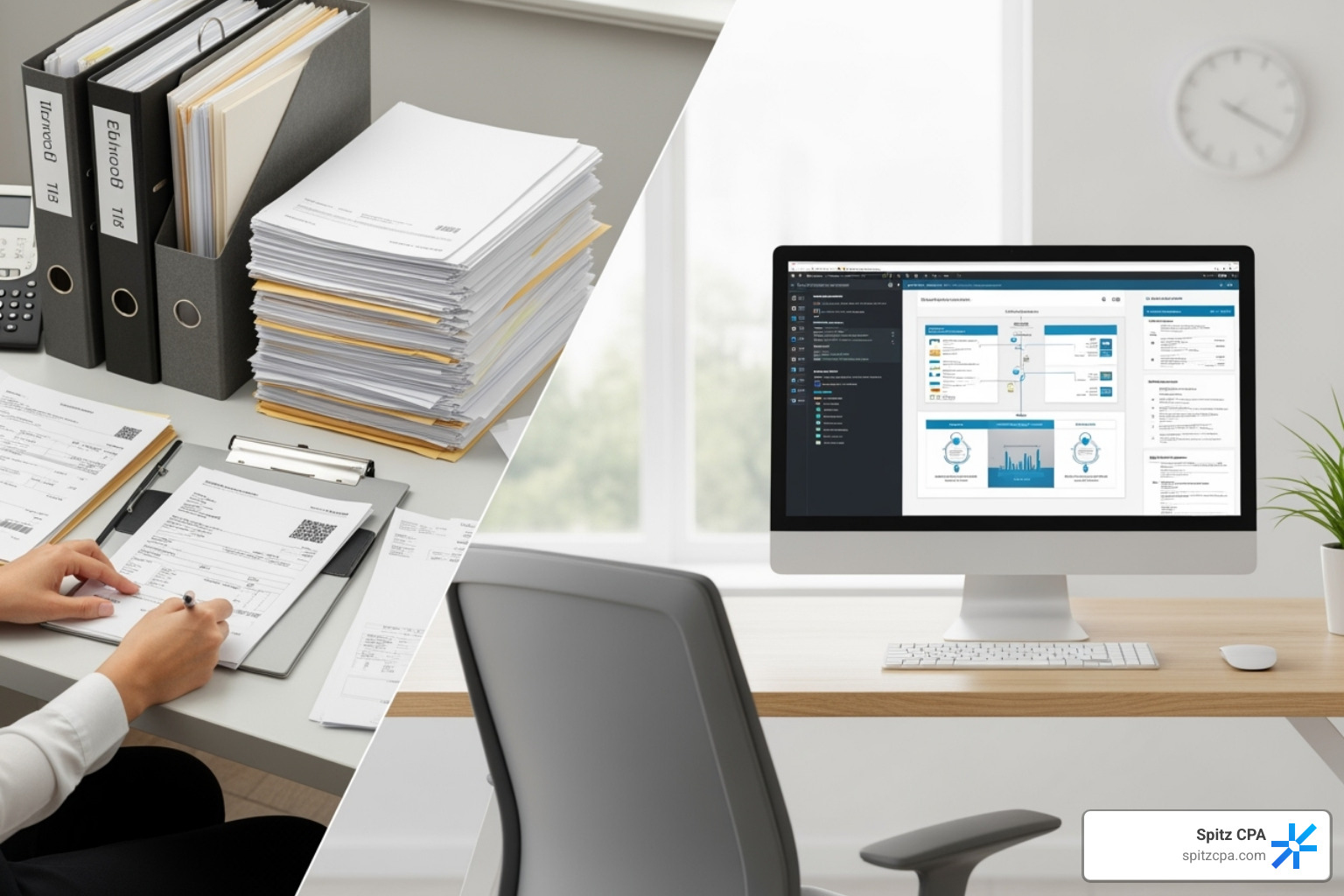
The difference between manual and automated processes is stark:
| Feature | Manual AP Process | Automated AP Process |
|---|---|---|
| Speed | Slow, prone to delays (5-7 invoices/hour) | Fast, real-time (15-20 invoices/hour, 80% faster) |
| Accuracy | High risk of human error, data entry mistakes, duplicate payments | High accuracy (85-90% data accuracy), reduced exceptions |
| Cost | High (labor, paper, printing, late fees) | Lower (reduced labor, fewer errors, early payment discounts) |
| Visibility | Limited, fragmented, difficult to track | Real-time, centralized, comprehensive reporting |
| Fraud Risk | High (manual controls, lack of audit trail) | Low (strong internal controls, audit trails, AI detection) |
| Scalability | Difficult to scale with growth | Highly scalable, handles increased volume |
| Vendor Relations | Potentially strained due to delays/errors | Strengthened by timely, accurate payments |
Automating your accounts payable process can save you thousands on invoice processing. Companies using it have achieved 85–90% data accuracy and seen a 3x increase in invoice approval speed. This changes your financial operations from a cost center into a strategic asset.
Establishing Clear Policies and Procedures
Think of AP policies as the guardrails that keep your financial operations on track. We help businesses establish these crucial frameworks.
Segregation of duties is your first defense against errors and fraud. No single person should control an entire transaction. When one person approves invoices and another processes payments, you create natural checkpoints.
Defined approval workflows bring structure to spending. Thresholds (e.g., department head approval for <$1,000, executive approval for >$10,000) ensure proper scrutiny without creating bottlenecks.
Standard Operating Procedures (SOPs) document every step of your AP process. They ensure consistency, provide a training guide, and serve as a reference when issues arise.
Purchasing approval levels define authority limits before purchases happen, preventing unauthorized spending and keeping expenditures aligned with your budget.
For smaller businesses, developing these policies is essential for growth. Our Small Business Accounting services help you implement these critical controls.
Leveraging Technology for Peak Efficiency
Managing accounts payable manually is no longer competitive. Technology is essential for efficiency, accuracy, and security.
AP automation software is the centerpiece of modern AP. It streamlines everything from invoice capture to payment, reducing processing time by up to 80% and virtually eliminating human error.
Optical Character Recognition (OCR) technology reads invoices and extracts data, converting them into digital format instantly with up to 99% accuracy.
AI-powered validation takes automation further by flagging duplicate invoices, identifying unusual payment patterns that might indicate fraud, and validating data against your purchase orders.
Centralized invoice management provides a single digital platform for all AP documents. Everything lives in one place with complete visibility, making collaboration and auditing straightforward.
ERP integration ensures your AP system connects with your accounting system (like QuickBooks or NetSuite), so data flows seamlessly and financial reporting stays accurate.
These automated systems provide valuable insights through analytics that were impossible with manual processes. Our Outsourcing Services can guide you through implementing these powerful solutions.
Nurturing Strong Vendor Relationships
Technology streamlines processes, but strong vendor relationships remain at the heart of effective accounts payable management.
Timely payments form the foundation of trust. Consistently paying on time demonstrates reliability and translates into tangible benefits like better pricing and preferential treatment.
Open communication channels are crucial. Addressing invoice issues promptly and being transparent about any payment delays maintains trust even when challenges arise.
Negotiating favorable terms becomes easier with a strong payment history. You can request extended payment periods or secure early payment discounts to improve your cash flow.
Implementing supplier portals gives vendors self-service capabilities. They can submit invoices and check payment status online, reducing inquiries to your staff and improving their satisfaction.
Strong vendor partnerships lead to streamlined processes, minimized supply chain disruptions, and better deals. The better you treat your suppliers, the better terms you get.
Using KPIs and Audits for Continuous Improvement
Even the best accounts payable management system needs ongoing refinement. You can’t improve what you don’t measure.
Key Performance Indicators (KPIs) offer objective insights into AP performance. Important KPIs include:
- Days Payable Outstanding (DPO): The average time it takes to pay your bills.
- Cost per invoice processed: The total cost to process a single invoice.
- On-time payment rate: The percentage of invoices paid by their due date.
- Invoice cycle time: The time from invoice receipt to payment.
- Early payment discount capture rate: The percentage of available discounts you take.
Regular process audits complement KPIs by identifying inefficiencies, bottlenecks, and control weaknesses. An AP audit helps you review procedures against best practices, pinpoint fraud risks, and ensure alignment with company goals.
By consistently tracking KPIs and conducting audits, you create a feedback loop that drives continuous improvement and optimizes your AP department’s contribution to your financial health.
Frequently Asked Questions about AP Management
We hear a lot of questions about accounts payable management from business owners. These are the most common.
How does accounts payable management differ from accounts receivable management?
These two concepts are opposite sides of your business’s credit transactions.
Accounts payable (AP) is the money your business owes to suppliers for goods or services received on credit. It’s money flowing out of your business and appears as a current liability on your balance sheet. AP management focuses on optimizing how and when you pay these debts.
Accounts receivable (AR) is the money customers owe you for goods or services you’ve provided on credit. It’s money flowing into your business and appears as a current asset on your balance sheet. AR management focuses on collecting payments from customers efficiently.
In short, AP represents your debts to others, while AR represents others’ debts to you. Both are crucial for healthy cash flow.
When should accounts payable be recorded?
If you use the accrual basis of accounting—which most businesses should—accounts payable should be recorded the moment you receive goods or services on credit. This is typically triggered by receiving an invoice and happens before you make the payment.
This matters because accrual accounting recognizes expenses when they’re incurred, not when cash changes hands. For example, if a supplier delivers inventory on March 15th with 30-day terms, you record the payable on March 15th, even though you won’t pay until April.
Recording payables promptly gives you an accurate picture of your current liabilities, which helps you forecast cash needs and maintain accurate financial statements.
What are the main functions of an accounts payable department?
An effective accounts payable management operation handles four essential functions to ensure your business pays its debts accurately and on time.
Invoice processing involves receiving invoices, capturing relevant data, verifying accuracy (often through three-way matching against purchase orders and receiving reports), and routing them for approval.
Payment processing comes after approval. The AP team prepares and schedules payments, selecting the appropriate method—check, ACH, wire, or credit card—to optimize cash flow and capture any available discounts.
Vendor management is critical for smooth operations. This includes setting up new vendors with accurate information (contact details, banking info, W-9s), maintaining current records, and handling inquiries about payment status.
Record keeping and reporting ensures everything is documented. Transactions are recorded in the general ledger, supporting documents are stored for audit trails, and reports are generated to provide insights into spending and AP performance.
Conclusion: Transform Your AP from a Cost Center to a Strategic Asset
We’ve uncovered a fundamental truth: accounts payable management isn’t just about paying bills. It’s a strategic tool that can reshape your financial landscape. When you optimize your AP processes, you open up working capital, build stronger supplier partnerships, guard against fraud, and gain the visibility needed for confident business decisions.
The journey from manual, error-prone processes to streamlined, automated systems is about changing how your business operates. By establishing clear policies, leveraging technology, nurturing vendor relationships, and tracking KPIs, you ensure continuous improvement that compounds over time. The businesses that thrive are the ones that recognize accounts payable as a strategic asset waiting to be optimized.

As Michael J. Spitz, I’ve spent over 15 years helping businesses across industries transform their financial operations. I’ve seen how the right AP systems can free up cash flow, prevent costly errors, and provide the clarity needed to drive significant growth. My approach focuses on practical, implementable solutions that deliver real results.
At Spitz CPA, we’re passionate about helping businesses gain financial clarity and achieve their growth potential. Whether you’re dealing with slow manual processes, concerned about fraud risks, or want to optimize your cash flow, we’re here to provide personalized guidance. We don’t just clean up your books—we help you build systems that support your long-term success.
If you’re ready to transform your accounts payable management from a back-office burden into a strategic advantage, let’s talk. Your financial clarity and business growth are waiting.
Ready to take control of your finances and drive your business forward? Get expert help with your accounting services today.


