


Understanding Business Valuation in Arizona: What You Need to Know
Business valuation Arizona is the process of determining the economic worth of a company based on financial data, market conditions, and operational factors specific to Arizona’s business environment. Here’s what you need to know:
Key Facts About Arizona Business Valuations:
- Cost Range: Professional valuations typically cost $2,500 to $5,000+ for small businesses
- Common Methods: Market approach (comparable sales), Income approach (cash flow/earnings), and Asset approach (net asset value)
- Timeline: Most valuations take 1-2 weeks after the initial client interview
- Required Credentials: Look for appraisers with CPA/ABV, CVA, ASA, or CBA certifications
- Main Purposes: Selling/buying a business, securing financing, tax planning, estate planning, divorce proceedings, and succession planning
Many business owners don’t know what their company is worth—unlike their home or retirement account. Yet this number drives almost every major financial decision you’ll make.
Arizona’s economy presents unique opportunities. The state hosts diverse industries including logistics, manufacturing, healthcare, and technology, all experiencing steady growth with competitive labor costs. Cities like Phoenix, Tucson, Mesa, and Gilbert each have distinct economic characteristics that influence business values. Local factors like increasing taxes, regulations, and regional industry trends all impact what your business is truly worth.
Whether you’re preparing to sell, planning for succession, securing a loan, or simply want clarity on your largest asset, understanding business valuation is critical. The process considers everything from your financial statements and cash flow to intangible assets like customer relationships and brand reputation. And in Arizona’s growing market, knowing this number can unlock strategic opportunities you might be missing.
As Michael J. Spitz, I bring over 15 years of corporate accounting experience, including extensive work in financial modeling, strategic planning, and preparing businesses for major financial decisions. Throughout my career working with diverse industries, I’ve seen how proper financial clarity—including understanding business valuation Arizona standards—directly impacts a company’s ability to grow and capture opportunities.
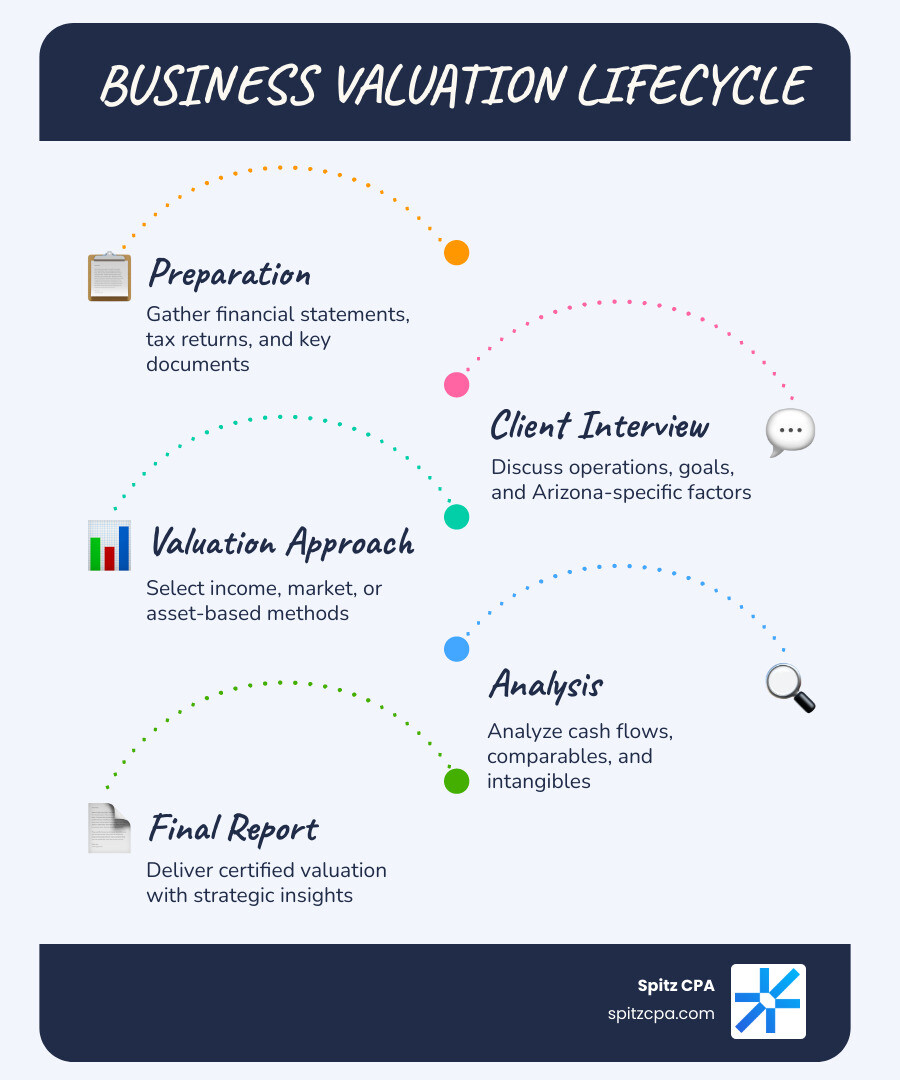
Know your business valuation Arizona terms:
Why a Business Valuation Arizona is Essential for Growth
Think of a business valuation as a high-definition X-ray of your company. It doesn’t just show the “bones” (your assets); it shows the “heartbeat” (your cash flow) and the “brain” (your systems and goodwill). For many business owners in Gilbert and the surrounding Phoenix area, a valuation is often triggered by a specific event, like a looming retirement or a knock on the door from a potential buyer. However, we believe that understanding your value is a fundamental tool for strategic growth.
When you know your number, you gain financial clarity. You can identify which parts of your business are driving value and which are dragging it down. This is where business valuation services become a roadmap for the future. By focusing on the “value drivers” identified in an appraisal, we’ve seen businesses achieve significant growth—sometimes even a 10x increase in value—by the time they are actually ready to exit.
Valuations are also vital for ownership transitions. Whether you are bringing on a new partner in a tech startup or passing a family-owned manufacturing plant in Mesa to the next generation, you need a defensible, objective number. Without it, you’re just guessing, and guessing leads to disputes. Buy-sell agreements, which are the “prenuptial agreements” of the business world, rely entirely on a clear valuation formula to ensure that if a partner leaves, the remaining owners aren’t left in a financial lurch.

To help you understand when you might need to look into a business valuation Arizona, we’ve put together this quick comparison:
| Purpose Type | Common Situations | Key Focus |
|---|---|---|
| Internal / Strategic | Exit planning, identifying growth areas, internal buy-outs | Maximizing future value and operational efficiency |
| External / Compliance | SBA loans, IRS tax filings, estate planning | Meeting regulatory standards and lender requirements |
| Transactional | Selling to a third party, Mergers & Acquisitions (M&A) | Determining a fair asking price and negotiating terms |
| Legal / Dispute | Divorce, shareholder disputes, litigation support | Providing a defensible “fair market value” for the court |
The Role of Fair Market Value
In business valuation Arizona, “Fair Market Value” is the gold standard. It’s defined as the price at which a property would change hands between a willing buyer and a willing seller, neither being under any compulsion to buy or to sell and both having reasonable knowledge of relevant facts.
Why does this matter? Because the IRS and the courts don’t care about “sweat equity” or what you think your business is worth based on your hard work. They care about economic data and supportable facts. A professional valuation provides risk mitigation against IRS audits, especially during estate and gift tax planning. If you’re donating shares or transferring ownership to heirs, having a certified appraisal ensures you aren’t hit with unexpected tax penalties later.
For those looking to sell, the Arizona Business Brokers Association notes that arriving at a proper asking price is critical. Unrealistic expectations are the number one reason businesses fail to sell. A formal valuation bridges the gap between a broker’s “opinion of value” and the rigorous, litigation-ready analysis required by sophisticated buyers and lenders.
Primary Methodologies for Determining Company Worth
Determining what a business is worth isn’t about picking one magic formula; it’s about looking at the company through different lenses. Professional appraisers typically use three main approaches. Think of it like valuing a house: you look at what it cost to build (Asset), what similar houses sold for (Market), and how much rent it could generate (Income).
Each method has its place. For a asset-heavy business like a construction firm in Gilbert, the asset approach might carry more weight. For a high-growth software company in Scottsdale, the income approach is usually the star of the show. To stay on top of the latest thinking in these methodologies, many professionals utilize resources like the Business Valuation Update Subscription to ensure their reports reflect current market realities.
The Income Approach for Business Valuation Arizona
The Income Approach is perhaps the most common method for profitable, ongoing businesses. It asks one simple question: “How much cash is this business going to put in my pocket in the future, and how risky is it to get that cash?”
We focus heavily on EBITDA (Earnings Before Interest, Taxes, Depreciation, and Amortization). This provides a “clean” look at the company’s operating performance. Appraisers then apply a “multiple” or a “capitalization rate” to these earnings.
- Cash Flow: We look at historical trends and future forecasts.
- Risk Assessment: If the business relies 90% on one customer, the risk is high, and the value goes down. If the business has a diverse, recurring revenue stream, the value goes up.
- Capitalization Rates: This is a math-heavy way of saying “what is the expected rate of return for a buyer?”
In Arizona’s competitive market, a company with strong, documented cash flow and a clear path to future earnings will always command a premium.
Market and Asset-Based Strategies
The Market Approach is all about “comparables.” We look at what similar businesses in Arizona and across the country have sold for recently. This involves searching transaction databases for companies of similar size, industry, and profit margin. The “Transaction Method” is particularly useful for middle-market businesses (those with sales between $5MM and $500MM) because there is enough data to make a valid comparison.
The Asset-Based Approach, or “Adjusted Book Value,” is different. It calculates the value of the business by subtracting the fair market value of liabilities from the fair market value of assets.
- When to use it: This is often the floor for a business’s value. It’s commonly used for holding companies, underperforming businesses, or those with significant real estate or equipment holdings (like a family farm or a large-scale manufacturing plant).
- Liquidation Value: This is the “worst-case scenario”—what would be left if we had to sell everything off tomorrow.
The Impact of Intangible Assets and Goodwill
Here is where things get interesting. In many modern Arizona businesses, the most valuable things they own aren’t things you can touch. We’re talking about Goodwill.
Goodwill is an intangible asset that represents the “extra” value a business has beyond its physical assets. It’s the reason why two coffee shops with the exact same equipment can have vastly different values. One has a famous brand, a loyal customer list, and proprietary roasting processes; the other is just a shop.
Key components of goodwill include:
- Brand Equity: Recognition in the local Gilbert or Phoenix community.
- Human Capital: Your trained, skilled workforce (which is a huge factor in Arizona’s tight labor market).
- Customer Relationships: Long-term contracts or a high “Net Promoter Score.”
- Intellectual Property: Patents, trademarks, or even just “secret sauce” operational systems.
Enterprise vs. Personal Goodwill in Business Valuation Arizona
This is a critical distinction that can save (or cost) you millions in a sale.
- Enterprise Goodwill: This is the value that stays with the business if the owner walks away. It’s tied to the brand, the systems, and the staff. Buyers love this because it’s transferable.
- Personal Goodwill: This is value tied directly to you. If clients only do business with the company because they like you personally, that value is hard to transfer.
In a business valuation Arizona, personal goodwill can sometimes be used for tax efficiency in an asset sale, potentially allowing a portion of the sale proceeds to be taxed at lower capital gains rates rather than corporate rates. However, for a buyer to pay top dollar, they often want to see that personal goodwill transitioned into enterprise goodwill through “earnout” structures or long-term transition agreements.
Valuing Arizona’s Key Industries
Arizona isn’t just desert and golf courses; it’s a powerhouse of diverse industries. Each has unique valuation drivers:
- Tech Hubs: In Phoenix and Scottsdale, tech valuations are driven by “scalability” and intellectual property.
- Healthcare Demand: With our aging population, medical and dental practices are in high demand. Valuations here often focus on patient retention rates and the regulatory environment.
- Manufacturing & Logistics: Our proximity to California and the Mexican border makes Gilbert and Mesa prime spots for logistics. Here, “throughput” and supply chain efficiency are key value drivers.
- Aerospace & Defense: This sector relies heavily on long-term government contracts and highly specialized human capital.
Preparing for Your Professional Appraisal
If you decided to sell your house, you’d probably paint the walls and fix the leaky faucet first, right? The same logic applies to your business. You want it to look its best before the appraiser arrives.
Preparation starts with an accounting clean-up. At Spitz CPA, we emphasize that “clean books” are the foundation of a high valuation. If your personal car lease, family vacations, and home internet are all being run through the business, it muddies the water. An appraiser has to “normalize” these expenses, and if the records are messy, they will apply a “risk discount” to your value. In other words, messy books literally cost you money.
Selecting a Qualified Appraiser
Don’t just hire the cheapest person you find. You need someone whose report will stand up to scrutiny from the IRS, a skeptical buyer, or a judge. Look for these credentials:
- CPA/ABV: A Certified Public Accountant who is also Accredited in Business Valuation (this is the gold standard for financial rigor).
- CVA: Certified Valuation Analyst.
- ASA: Accredited Senior Appraiser.
A qualified professional uses more than just a calculator; they use professional judgment. They understand the nuances of the Arizona market and can provide an independent, objective report that tells the true story of your company.
Common Pitfalls to Avoid
We’ve seen it all. Here are the most common mistakes business owners make during the business valuation Arizona process:
- Personal Expenses: Running too many non-business items through the company.
- Inconsistent Reporting: Having your tax returns say one thing while your internal “pro-forma” says another.
- Outdated Legal Docs: If your operating agreement hasn’t been touched since 1998, it’s a red flag.
- Unrealistic Expectations: Basing your value on what your neighbor sold his (completely different) business for.
- Data Gaps: Not being able to produce a clean customer list or equipment schedule.
Frequently Asked Questions about Arizona Business Valuations
How much does a business valuation cost in Arizona?
The cost generally ranges from $2,500 to $5,000 for a small business appraisal. However, for complex middle-market companies with multiple entities or significant intangible assets, the fee can be higher. The price depends on the “standard of value” required and whether you need a simple “calculation of value” or a full, certified “conclusion of value” report.
What documents are required for a valuation?
You should be prepared to provide:
- At least 5 years of Federal Tax Returns.
- 5 years of Year-End Profit & Loss (P&L) statements and Balance Sheets.
- Current interim financial statements.
- A list of all equipment and significant assets.
- Operating agreements, buy-sell agreements, and articles of incorporation.
- Details on any “add-backs” (owner’s salary, personal expenses, one-time legal fees).
How long does the valuation process take?
Once all the documents are collected, the typical timeline is 1 to 2 weeks. This includes the time for the appraiser to analyze the data, conduct a client interview (usually about 45-60 minutes), and draft the report. The “data collection” phase is usually what takes the longest, depending on how organized your records are.
Conclusion
Understanding your business valuation Arizona is about more than just a number on a page; it’s about financial clarity and peace of mind. Whether you are in Gilbert, Phoenix, or anywhere in the East Valley, knowing what you have built allows you to make decisions from a position of strength.
At Spitz CPA, we don’t just give you a report and send you on your way. We use these insights to help you improve cash flow and implement an accounting clean-up that sets the stage for massive growth. Our goal is to help you see that 10x value increase by providing personalized guidance every step of the way.
If you’re ready to unlock the true value of your company, I’m here to help. My name is Michael J. Spitz, and we are dedicated to helping Arizona business owners achieve the growth they deserve.
Learn more about our accounting and advisory services to see how we can prepare your business for its next big milestone.


