


Why Smart Tax Planning Matters for S Corporation Owners
S corporation tax planning strategies can significantly reduce your tax burden and improve your business’s bottom line. If you’re operating as an S Corp, you’re already benefiting from pass-through taxation—but that’s just the starting point. Here’s what you need to know:
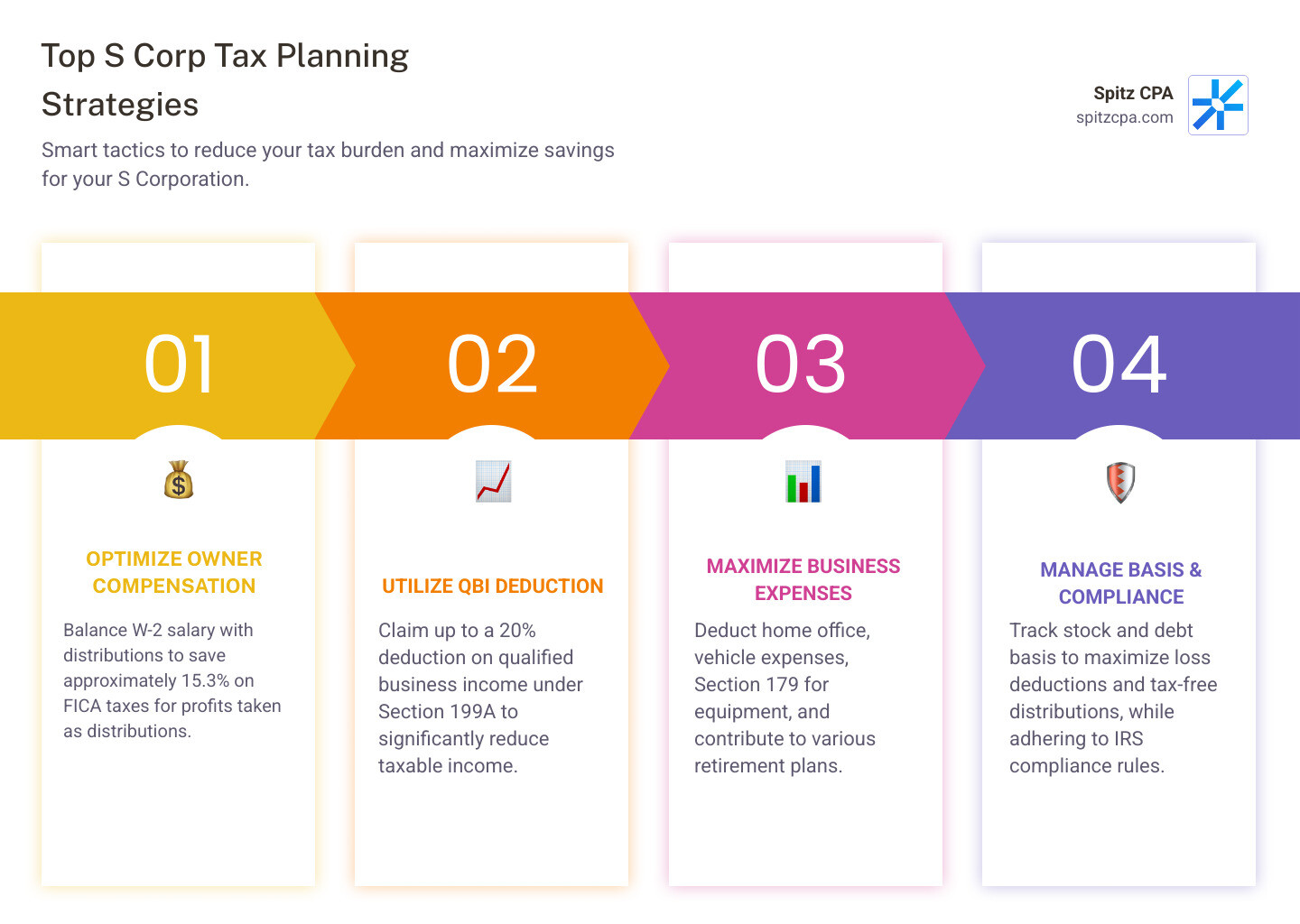
Top S Corporation Tax Strategies:
- Balance salary vs. distributions – Pay yourself a reasonable W-2 salary (subject to payroll taxes), then take remaining profits as distributions (not subject to FICA taxes—saving roughly 15.3%)
- Claim the QBI deduction – Deduct up to 20% of qualified business income under Section 199A
- Maximize business deductions – Home office, vehicle expenses, Section 179 equipment purchases, and retirement contributions
- Leverage fringe benefits – Health insurance premiums, accountable plans, and tax-free employee benefits
- Manage shareholder basis – Track stock and debt basis to maximize loss deductions and tax-free distributions
- Mind compliance rules – Understand Built-In Gains Tax, reasonable compensation requirements, and loss limitations
The difference between basic S Corp compliance and strategic tax planning can mean thousands—or tens of thousands—in annual tax savings. Many S Corp owners leave money on the table simply because they don’t know these strategies exist or how to implement them properly.
I’m Michael J. Spitz, and over my 15+ years in corporate accounting and tax strategy, I’ve helped countless business owners implement sophisticated tax plans that reduce taxes while maintaining full IRS compliance. My expertise spans everything from basic compliance to complex multi-entity structures, and I specialize in translating tax code complexity into actionable strategies that actually work.
Related Tax Planning Topics:
The S Corp Advantage: Understanding Pass-Through Taxation
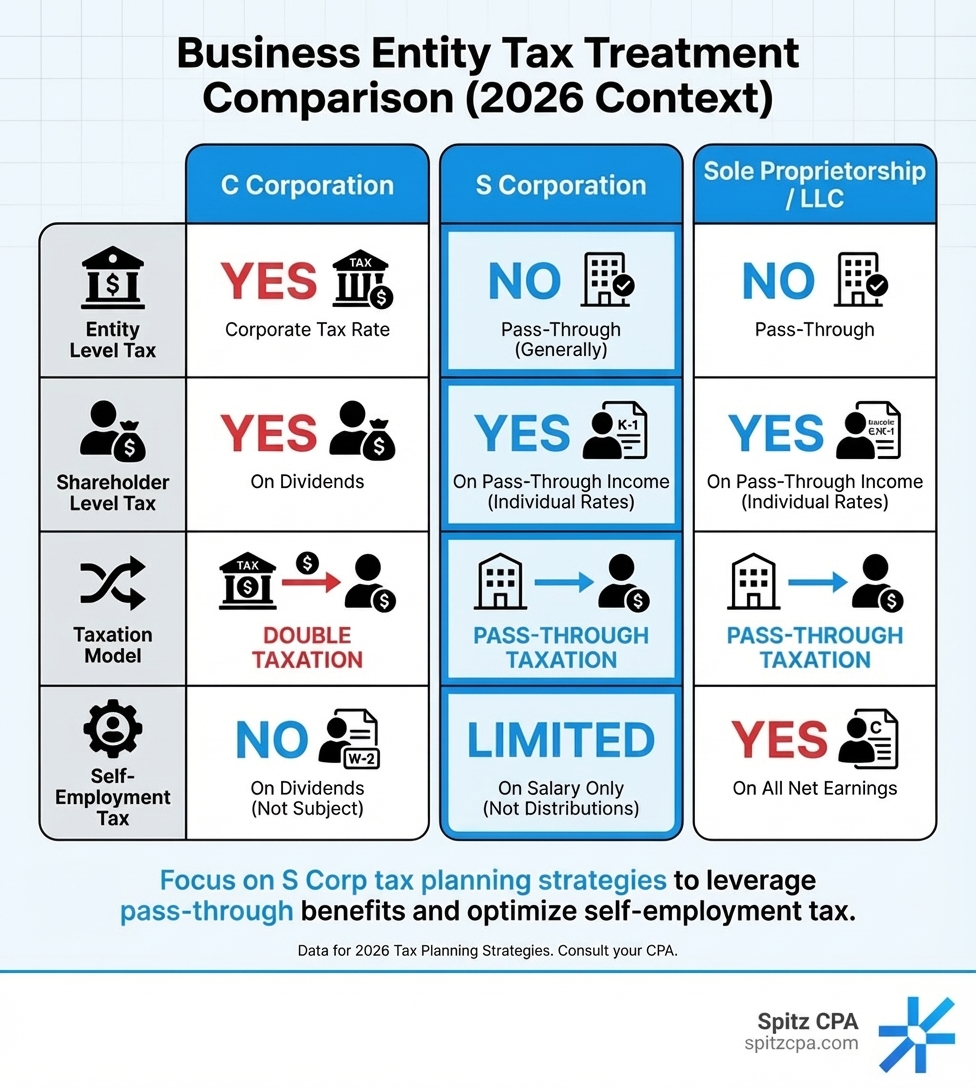
Operating as an S corporation (S Corp) offers distinct tax advantages, primarily its pass-through taxation model. Unlike C corporations, which face “double taxation” (tax at the corporate level and again at the shareholder level when profits are distributed), an S Corp’s income, deductions, credits, and losses are passed directly through to its shareholders. This means the business itself generally isn’t taxed at the federal level; instead, shareholders report these items on their personal tax returns and are taxed at individual income tax rates. This structure is a cornerstone of effective s corporation tax planning strategies.
The pass-through model significantly affects both corporate and shareholder tax liabilities. For the corporation, it eliminates federal income tax at the entity level, simplifying tax calculations and avoiding the punitive double taxation of C Corps. For shareholders, it means direct responsibility for tax on their share of the business’s profits, but also the ability to deduct losses against other income (subject to certain limitations). This makes S Corps an attractive choice for many small to medium-sized businesses looking to optimize their tax position.
This unique structure is why many entrepreneurs choose an S corporations for their ventures.
How Income and Losses Affect Your Personal Taxes
As an S Corp shareholder, your share of the company’s income, losses, and deductions is reported to you annually on Schedule K-1 (Form 1120-S). This document details your pro-rata share of the business’s performance. You then report this information on your personal tax return, IRS Form 1040, specifically on Schedule E, which handles supplemental income and loss.
A critical concept for S Corp shareholders is “shareholder basis.” This is essentially your investment in the company, adjusted annually for income, losses, and distributions. Your basis determines two crucial things: the amount of losses you can deduct and the taxability of distributions you receive. You, as the shareholder, are responsible for tracking your basis. If your share of losses exceeds your basis, those losses are suspended and carried over to future years until you have sufficient basis to deduct them. Understanding and managing your basis is a key element of effective tax planning for your S corp.
Key IRS Forms and Filing Deadlines
For S corporations, the primary tax form is IRS Form 1120-S, the U.S. Income Tax Return for an S Corporation. For calendar year taxpayers, this form is due by March 15th each year. If you need more time, you can file an extension using IRS Form 7004, which typically grants an additional six months.
It’s also important to note that, effective for returns required to be filed on or after January 1, 2024, S corporations that are required to file 10 or more returns in a calendar year must e-file their Forms 1120-S. Staying on top of these deadlines and requirements is fundamental to compliant and effective tax management.
Foundational S Corporation Tax Planning Strategies
At Spitz CPA, we believe that smart s corporation tax planning strategies begin with diligent record-keeping and proactive expense tracking. Before we dig into the more complex maneuvers, let’s establish the foundational strategies that can significantly reduce your tax burden. Our goal is to help you Maximize Tax Deductions and keep more of your hard-earned money.

Optimizing Owner Compensation: Salary vs. Distributions
One of the most powerful s corporation tax planning strategies revolves around how you pay yourself. As an S Corp owner, you are legally required to pay themselves a W-2 salary that is considered “reasonable compensation” for the services you provide. This salary is subject to payroll taxes, including Social Security and Medicare (known as Federal Insurance Contributions Act (FICA) taxes, at a combined rate of 15.3%).
However, any additional profits you take out of the business as distributions are not subject to these FICA taxes. This is a significant advantage over sole proprietorships or LLCs taxed as sole props, where all business profits are subject to self-employment tax. Many S Corp owners use a “60/40 rule” as a general guideline, where roughly 60% of their compensation is salary and 40% is distributions. This isn’t a hard-and-fast rule, but it illustrates the concept.
The key is “reasonable compensation.” The IRS closely scrutinizes S Corps that pay owners an unreasonably low salary to avoid payroll taxes. What’s reasonable? It’s the going rate for an employee in your position with your experience and job duties, based on industry or marketplace standards. Setting your salary too low can lead to the IRS reclassifying distributions as wages, resulting in back taxes, penalties, and interest. We help our clients in Arizona determine an appropriate salary to ensure compliance and maximize tax savings.
Maximizing Business Deductions and Credits
A core component of any effective tax plan is maximizing every legitimate business deduction and credit available. This reduces your taxable income, and thus your tax liability.
- Home Office Deduction: If you use a portion of your home exclusively and regularly for your business, you may be able to claim a home office deduction. This allows you to deduct a corresponding percentage of expenses such as rent or mortgage interest, utilities, insurance, and depreciation.
- Vehicle Expenses: Keep meticulous records of business mileage. You can deduct actual expenses (gas, oil, repairs, insurance, depreciation) or use the standard mileage rate.
- Section 179 Expensing and Bonus Depreciation: These powerful tools allow S Corps to deduct the full purchase price of qualifying equipment and software in the year it’s placed in service, rather than depreciating it over several years. While 100% bonus depreciation was available through 2022, it is phasing down (e.g., 40% in 2025). Planning your asset purchases can yield significant immediate deductions.
- Research & Development (R&D) Tax Credits: If your S Corp invests in developing new products, improving processes, or enhancing technology, you might qualify for R&D tax credits. These are often overlooked but can provide substantial savings.
- Other Business Tax Credits: The IRS offers a variety of IRS Business Tax Credits. We can help you identify which ones your S Corp might be eligible for.
- Professional Service Fees: Don’t forget that the cost of hiring professionals like lawyers, accountants (like us!), and consultants is fully deductible.
Leveraging Retirement Plans and Fringe Benefits
Retirement plans and fringe benefits offer excellent avenues for reducing your S Corp’s taxable income while also providing valuable benefits to you and your employees.
- Retirement Plans: Establishing a retirement plan like a SEP-IRA, Solo 401(k), or SIMPLE IRA allows your S Corp to contribute pre-tax dollars. These employer contributions are tax-deductible for the business. For example, a SEP-IRA lets you contribute up to 25% of your W-2 wages. For 2024, elective deferrals to a 401(k) can be up to $23,000, or $30,000 if you’re aged 50 or older. Plus, your business may be eligible for The Retirement Plan Startup Costs Tax Credit.
- Health Insurance Premiums: If you’re an owner-employee holding more than 2% of the S Corp, the business can reimburse your health insurance premiums. These premiums are deductible as a business expense, and you can then deduct them on your personal tax return using the self-employed health insurance deduction. This strategy makes healthcare costs tax-efficient.
- Other Fringe Benefits: Many fringe benefits offered to employees (and often to owner-employees) are tax-deductible for the business and tax-free for the recipient. Examples include education reimbursement, cell phone stipends, and certain dependent care benefits.
- Accountable Plans: Implementing an accountable plan for employee reimbursements (including for owner-employees) ensures that business expenses are reimbursed tax-free to the employee and are deductible for the S Corp. This requires expenses to have a clear business purpose, proper documentation, and any excess reimbursement to be returned promptly.
Advanced Tactics for Significant Tax Savings
Once the foundational s corporation tax planning strategies are in place, we can explore more advanced tactics that can yield substantial savings, especially for high-earning business owners. These strategies require careful planning and often a deeper understanding of tax law, making professional guidance invaluable for entrepreneurs. For more in-depth insights, explore our resources on Tax Planning for Entrepreneurs.
Advanced s corporation tax planning strategies for High Earners
High-income S Corp owners have unique opportunities to optimize their tax situation:
- Qualified Business Income (QBI) Deduction (Section 199A): This deduction allows eligible S Corps to deduct up to 20% of their pass-through income. It’s a powerful tool that can significantly reduce your taxable income. However, for high-income earners (above certain thresholds, roughly $200,000 for single filers and $400,000 for married filers in 2024), the deduction can be limited to 50% of the W-2 wages paid by the business. This means paying yourself a reasonable, but sufficiently high, W-2 salary can be crucial to maximize your QBI deduction. For Specified Service Trade or Business (SSTB) entities (like health, law, accounting, consulting), the deduction phases out or is entirely eliminated for high-income taxpayers. We can help you steer these complexities to ensure you claim every dollar you’re entitled to under Section 199A.
- Pass-Through Entity Tax (PTET) Election: The Tax Cuts and Jobs Act (TCJA) introduced a $10,000 cap on state and local tax (SALT) deductions for individuals. To circumvent this, many states have enacted PTET elections. If your S Corp operates in a state with a PTET, the business can elect to pay state income taxes at the entity level. This payment becomes a deductible business expense for the S Corp, effectively bypassing the individual SALT cap and providing a federal tax deduction that might otherwise be limited. This is a powerful strategy for S Corp owners in Arizona.
Unique Strategies: Hiring Family and Renting Your Home
Sometimes, the most clever s corporation tax planning strategies involve leveraging your personal resources in conjunction with your business.
- Hiring Family Members: Employing your children can be a fantastic way to shift income and reduce your overall family tax burden. Their wages are a deductible business expense for your S Corp. Each child can earn up to a certain amount (e.g., $12,950 in 2022) without paying federal income taxes. Plus, you can offer them untaxed fringe benefits like health coverage or educational fees. This allows your business to deduct these expenses while providing tax-free income and benefits to your children, reducing the business’s total taxable income. Just ensure they’re doing legitimate work for reasonable pay.
- Renting Your Home to Your S Corp (Augusta Rule): This often-overlooked strategy, sometimes called the “Augusta Rule,” allows your S Corp to rent your home from you for business purposes (e.g., meetings, board retreats) for up to 14 days per year. The S Corp can deduct the rental expense, and you, as the homeowner, receive that rental income tax-free! This is a unique way to collect tax-free rental income and create a deduction for your business. Proper documentation, including a formal lease agreement and charging fair market rent, is crucial to withstand IRS scrutiny. We can help you perform a Business Financial Health Check to see if this strategy is right for you.
Navigating Complex Rules and Potential Pitfalls
While s corporation tax planning strategies offer immense benefits, they also come with complex rules and potential pitfalls. Failure to comply can lead to audits, penalties, and unexpected tax liabilities. That’s why meticulous documentation and sound Small Business Accounting are not just good practice—they’re essential safeguards.
Understanding Shareholder Loss Limitations and Special Taxes
Several limitations can impact an S Corp shareholder’s ability to deduct losses, and certain taxes can apply at the entity level:
- Shareholder Loss Limitations (Stock/Debt Basis, At-Risk, Passive Activity, Excess Business Loss): Your ability to deduct S Corp losses is limited by your S corporation stock and debt basis. If your losses exceed your basis, they are suspended and carried forward. Additionally, “at-risk” rules limit losses to the amount you are personally at risk of losing, while “passive activity loss” rules can prevent deducting losses from passive activities against active income. Finally, the “Excess Business Loss (EBL)” limitation, introduced by the TCJA, caps individual business loss deductions against other income at certain thresholds ($500,000 for married filing jointly and $250,000 for individuals). Disallowed EBLs are carried forward as net operating losses (NOLs).
- Built-In Gains (BIG) Tax: This tax applies to S corporations that were previously C corporations. If a former C Corp converts to an S Corp and then sells appreciated assets (assets that had appreciated in value before the S election) within five years of the conversion, the S Corp may owe BIG tax. This tax is levied at the highest corporate tax rate (currently 21%) on the recognized built-in gain, preventing companies from avoiding corporate-level tax on pre-S election appreciation.
- Net Investment Income Tax (NIIT): A 3.8% tax on certain net investment income applies to individuals, estates, and trusts above statutory income thresholds. For S Corp shareholders, if you do not materially participate in the business, your share of the S Corp’s income might be considered net investment income and subject to the NIIT, adding another layer of tax liability.
Why Professional Guidance is Crucial
The intricate nature of S corp tax planning makes professional guidance not just beneficial, but crucial. Tax laws are constantly evolving, and a misstep can be costly.
- Determining Reasonable Compensation: As discussed, the IRS scrutinizes this. An expert can help you determine reasonable compensation based on industry standards, your role, and your business’s financial health, protecting you from reclassification and penalties.
- Navigating Evolving Tax Laws: Tax legislation, like the TCJA, brings significant changes (e.g., bonus depreciation phase-down, EBL limitations). Staying current and understanding how these changes impact your S Corp requires specialized knowledge.
- Strategic Entity Structuring: We can help you understand how your S Corp election interacts with other tax provisions and ensure your overall business structure is optimized for tax efficiency and growth.
- Preventing Pitfalls: Many of the advanced strategies, such as the Augusta Rule or PTET elections, have specific requirements and potential downsides if not implemented correctly. An experienced CPA can guide you through these complexities, ensuring compliance and maximizing benefits.
At Spitz CPA, we offer comprehensive CPA Services for Businesses in Gilbert, Arizona, and the surrounding areas. We empower business owners to achieve financial clarity and significant growth by expertly navigating the tax landscape.
Frequently Asked Questions about S Corp Taxes
What is a “reasonable salary” for an S Corp owner?
A “reasonable salary” is the amount the IRS expects an S Corp owner to pay themselves as W-2 wages, commensurate with their position, experience, and job duties. It’s not a fixed number but is determined by factors like industry averages for similar roles, the company’s earnings and profits, and the specific responsibilities of the owner. The IRS requires this to prevent owners from taking an unreasonably low salary to avoid payroll taxes, then distributing the rest as tax-free distributions. If your salary is deemed unreasonable, the IRS can reclassify distributions as wages, leading to back taxes, penalties, and interest.
Can I deduct my health insurance premiums in an S Corp?
Yes, if you are an owner-employee holding more than 2% of the S Corp, you can deduct your health insurance premiums. The S Corp will typically pay for the premiums and include them as part of your W-2 wages. You then claim this amount as a self-employed health insurance deduction on your personal IRS Form 1040, provided you meet the eligibility criteria for that deduction. This strategy allows the S Corp to deduct the cost, and you avoid paying income tax on the premium amount.
What happens if I only take distributions and no salary?
If you, as an S Corp owner, only take distributions and no salary, you risk severe IRS scrutiny. The IRS views this as an attempt to avoid payroll taxes. They can reclassify your distributions as wages, subjecting them to FICA taxes (15.3%), along with penalties and interest for underpayment of payroll taxes. This can be a very costly mistake. It’s crucial to always pay yourself a reasonable salary that reflects the fair market value of your services to the business.
Conclusion: Take Control of Your S Corp’s Financial Future
Mastering s corporation tax planning strategies is not just about compliance; it’s about proactively optimizing your financial position to foster growth and increase your business’s value. From balancing owner compensation to leveraging deductions, credits, and advanced strategies like the QBI deduction or the Augusta Rule, the opportunities to save are substantial.
At Spitz CPA, we are dedicated to helping business owners like you achieve financial clarity and long-term success. We understand the nuances of S Corp taxation and can craft personalized strategies to minimize your tax burden. Don’t leave money on the table. Take control of your S Corp’s financial future today.
Schedule a consultation with our tax experts to build your strategy.


