


Why Budgeting and Forecasting Are Essential for Business Success
Budgeting and forecasting are the foundation of sound financial management for any growing business. While they’re often mentioned together, they serve distinct but complementary roles in guiding your company’s financial future.
Quick Answer:
- Budgeting = A static financial plan that sets revenue and expense targets for a specific period (usually 12 months)
- Forecasting = A dynamic projection that uses real-time data to predict future financial performance
- Budget Forecasting = A hybrid approach that projects outcomes if the budget is followed exactly, enabling variance analysis
Key Differences:
| Aspect | Budget | Forecast |
|---|---|---|
| Purpose | Sets financial goals and limits | Predicts likely outcomes |
| Timeframe | Annual (fiscal year) | Rolling (monthly/quarterly) |
| Flexibility | Static once approved | Updated regularly |
| Basis | Historical data + goals | Real-time data + trends |
| Use | Resource allocation | Course correction |
Without effective financial planning, businesses often face cash flow surprises, missed growth opportunities, and difficulty explaining performance gaps to stakeholders. Research shows that 82% of finance teams still rely on offline Excel spreadsheets for these critical activities, yet 54% are unhappy with their processes.
I’m Michael J. Spitz, and over 15+ years I’ve helped businesses implement effective financial planning systems, from early-stage startups navigating seed rounds to established companies managing complex financial models. Throughout my career in FP&A, I’ve seen how the right approach to these processes transforms financial chaos into strategic clarity.
Financial planning terms made easy:
The Strategic Role of Budgeting and Forecasting

Think of a budget as your roadmap and a forecast as your GPS. A roadmap tells you where you intend to go before you leave the driveway. A GPS, however, tells you where you are actually heading based on traffic, road closures, and how fast you are driving right now. In finance, budgeting and forecasting work in this exact tandem to keep your business from driving off a cliff.
The budget is your financial baseline. It is typically prepared before the start of a fiscal year and reflects management’s goals. It answers the question: “What do we want to achieve this year?” On the other hand, forecasting is a dynamic assessment. It is updated throughout the year to reflect current performance and market conditions.
For businesses in Gilbert, AZ, and throughout the Phoenix metro area, maintaining high-level Cash Flow Management requires both. A budget helps you allocate resources like marketing spend or new hires, while a forecast warns you if a seasonal dip in revenue might make those hires unsustainable.
Defining Budgeting and General Forecasting
Budgeting is a structured process of planning your company’s revenue and expenses. It involves setting revenue targets and expense limits. At its core, it’s about control. You are deciding, in advance, how much you are willing to spend on various departments to reach a specific profit goal.
General forecasting is different. It doesn’t care about your “goals” as much as it cares about reality. It assesses historical data and current potential to estimate where the numbers will actually land. To do this effectively, finance pros often use four commonly used forecasting methods, which range from simple trend analysis to complex econometric modeling.
What is Budget Forecasting?
You might hear the term “budget forecasting” and wonder if it’s just a redundant way of saying the same thing. It isn’t. Budget forecasting is a specific projection of the budget itself. It predicts what the financial outcome will be if the business follows the budget exactly as written.
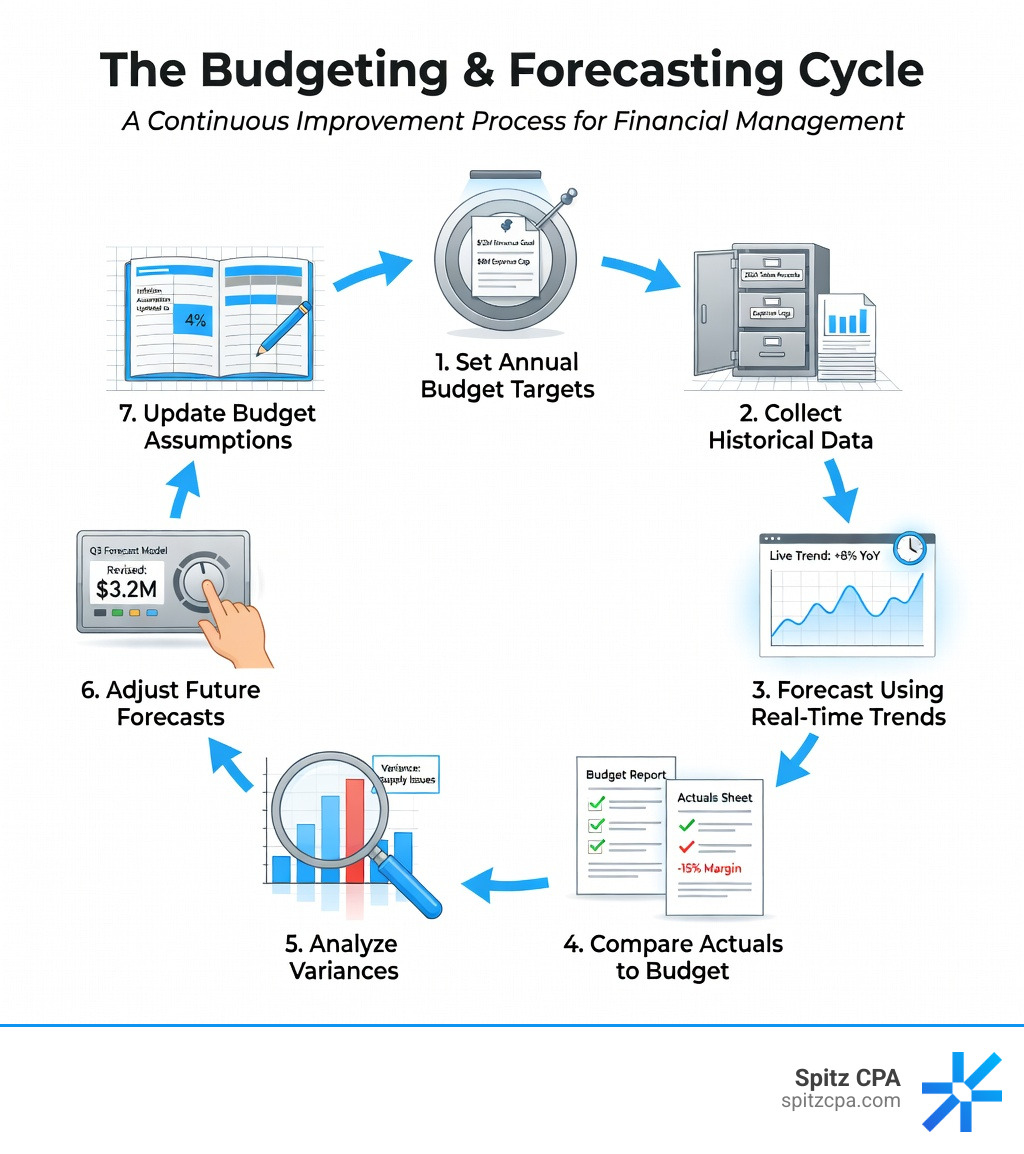
This is a vital component of variance analysis. By comparing your budget forecast (the “plan”) against your actual performance (the “reality”), you can identify exactly where you are overspending or underperforming. It’s the ultimate performance management tool because it highlights the gap between your intentions and your results.
Key Features and Characteristics of Financial Planning Tools
To succeed, you need tools that provide both financial direction and reliability. In our experience at Spitz CPA, the most successful businesses are those that move away from “gut feeling” and toward data-driven [KPIs](https://online.hbs.edu/blog/post/financial-performance-measures#:~:text=Financial%20KPIs%20(key%20performance%20indicators,solvency%2C%20efficiency%2C%20and%20valuation.).
A strong financial planning system relies on accurate Cash Flow Calculation. If you don’t know exactly how cash moves through your business, your budget is just a wish list, and your forecast is just a guess.
Characteristics of a Strong Budget
A robust budget isn’t just a list of numbers; it’s a strategic document. It typically features:
- A Dual Approach: It combines a “top-down” approach (where leadership sets targets) with “bottom-up” bids (where department managers explain what they need to succeed).
- Detailed Cost Categorization: It clearly separates fixed costs (rent, insurance, salaries) from variable costs (materials, shipping, commissions).
- Safety Nets: Every good budget includes contingency funds. In business, the unexpected is the only thing you can truly count on. Whether it’s a sudden equipment failure or a shift in Arizona tax laws, having a rainy-day fund is essential.
- Static Nature: Once approved, the budget stays the same. This provides a fixed “yardstick” to measure performance against for the rest of the year.
Characteristics of a Dynamic Forecast
While the budget is static, the forecast must be fluid. Key characteristics include:
- Rolling Periods: Instead of looking only at the current year, a rolling forecast might always look 12 months ahead, adding a new month as the current one ends.
- Real-Time Data: It incorporates current sales trends, vendor price increases, and economic shifts.
- Predictive Analytics: Modern forecasting uses historical patterns to predict future outcomes with high accuracy.
- Focus on Cash: A 12-Month Cash Flow Statement is often the heart of a good forecast, showing exactly when money will enter and leave the bank account.
How to Build a Robust Financial Roadmap
Building a roadmap for a business—especially a startup or a rapidly growing company—requires more than just a spreadsheet. It requires stakeholder alignment and a deep understanding of your business model. This is where a CFO for Startups becomes invaluable, providing the high-level strategy needed to turn raw data into a growth plan.
If you’re feeling overwhelmed, looking into a Financial Modeling Consulting Firms Guide can help you understand the level of detail required for professional-grade planning.
Step-by-Step Process for Budgeting and Forecasting
To create a budget that actually works, follow these steps:
- Examine Revenue Streams: Don’t just look at the total. Break it down by product line, service type, or customer segment.
- Understand Your Fixed Expenses: List everything you have to pay regardless of sales volume. This includes rent, payroll, and taxes.
- Factor in Variable Costs: Estimate costs that fluctuate with your activity level.
- Plan for “Big Ticket” Items: Are you planning a large catering budget for a 500-person client appreciation event? Do you intend to increase your employee education allowance to attract better talent? These need to be line items.
- Draft the Projection: Create an Example of Cash Flow Projection for 12 Months to see if your plan is actually feasible.
Building and Updating a Dynamic Financial Forecast
Once your budget is set, you start forecasting. This isn’t a one-time event; it’s a habit.
- Gather Trends: Look at your sales growth over the last three years. If you’ve consistently grown at 30%, a forecast of 35% is reasonable. A forecast of 100% might be “overly optimistic,” a common reason forecasts miss the mark.
- Monitor Market Shifts: If interest rates rise or a new competitor enters the Gilbert market, update your forecast immediately.
- Scenario Modeling: What happens if your biggest client leaves? What if your raw material costs double? We use the Cash Flow from Assets Formula and other tools to model “Best Case,” “Worst Case,” and “Most Likely” scenarios.
Overcoming Challenges with Modern Technology
One of the biggest hurdles in budgeting and forecasting is “spreadsheet fatigue.” When 82% of teams are using offline Excel, version control becomes a nightmare. You end up with files named “BudgetFinalv14ACTUALv2.xlsx,” and nobody knows which one is right.
Furthermore, 57% of finance teams struggle with data silos. This happens when the sales team uses one system, the warehouse uses another, and the accounting team is stuck in the middle trying to make sense of it all.
This is why we often recommend Fractional CFO Services. A professional can help you implement cloud-based systems that automate data collection. For instance, better Accounts Payable Management software can feed directly into your forecast, giving you real-time visibility into upcoming outflows.
Leveraging Variance Analysis for Financial Planning
Variance analysis is where the magic happens. It is the process of comparing your “Actuals” to your “Budget.”
- Favorable Variance: You spent less than planned or earned more. (Yay!)
- Unfavorable Variance: You spent more than planned or earned less. (Time to investigate.)
By performing a Business Financial Health Check monthly, you can catch performance gaps before they become crises. If your marketing spend is $5,000 over budget in Q1, you can adjust your Q2 forecast to either cut spending elsewhere or find ways to increase revenue to cover the gap.
Best Practices for Financial Accuracy
To keep your numbers reliable, follow these industry best practices:
- Collaborate Across Departments: Finance shouldn’t build a budget in a vacuum. Talk to the people on the front lines.
- Use Cloud Software: Move away from offline spreadsheets. Cloud tools allow for real-time collaboration and “single source of truth” data.
- Track KPIs Constantly: Don’t wait until the end of the year to see if you hit your goals.
- Seek Expert Advice: Sometimes you need an outside perspective to spot the risks you’re too close to see. Our Financial Reporting Advisory Services are designed to provide exactly that kind of clarity.
Frequently Asked Questions about Financial Planning
Should budgeting or forecasting come first?
While it’s a bit of a “chicken and egg” scenario, most experts—including us—suggest that forecasting should come first. You need to understand your historical trends and current market reality (the forecast) to set realistic goals and limits (the budget). If you set a budget without a forecast, you’re essentially picking numbers out of a hat.
How often should a business update its forecast?
At a minimum, you should update your forecast quarterly. However, in volatile industries or during periods of rapid growth, monthly updates are the gold standard. This allows you to implement “rolling forecasts” that always give you a clear view of the next 12 months.
What are the main challenges in budgeting?
The “big three” challenges are:
- Manual Processes: Spending more time entering data than analyzing it.
- Disconnected Teams: Different departments working toward different goals.
- Static Thinking: Treating the budget like it’s carved in stone rather than a tool for growth.
Conclusion
Budgeting and forecasting are not just administrative tasks; they are the engine of strategic growth. By distinguishing between your static goals and your dynamic reality, you gain the “financial superpower” of being able to see around corners.
At Spitz CPA, Michael J. Spitz and our team provide the personalized guidance and accounting clean-up expertise you need to gain true financial clarity. Whether you’re looking for a Business Financial Health Check or comprehensive Fractional CFO Services, we are here to help your Gilbert-based business thrive.
Ready to stop guessing and start growing? More info about accounting services is just a click away. Let’s build a financial roadmap that actually leads to success.


