


Why Business Entity Formation Matters for Your Success
Business entity formation is the legal process of creating a formal business structure recognized by your state and the IRS. Starting a business without the right structure is like building a house without a foundation. The choice you make today will impact your taxes, personal liability, and ability to raise money for years to come.
Here are the essential steps you’ll need to take:
- Choose your structure – LLC, Corporation, Partnership, or Sole Proprietorship
- Register your business name with your state
- Appoint a registered agent to receive legal documents
- File formation documents (Articles of Organization or Incorporation)
- Obtain a Federal Tax ID (EIN) from the IRS
- Maintain ongoing compliance with state and federal requirements
The business structure you choose influences everything from day-to-day operations to taxes and personal liability. Choosing the wrong one can cost you thousands in unnecessary taxes or put your personal assets at risk in a lawsuit.
Your entity choice affects whether you pay taxes once or twice on profits, how easily you can attract investors, and whether your personal home and savings are protected if the business faces legal trouble.
I’m Michael J. Spitz, and with over 15 years of corporate accounting experience, I’ve helped numerous businesses steer business entity formation decisions that optimize their tax position and protect their assets. My expertise spans everything from strategic financial planning to the technical details of entity structures, ensuring you make the right choice from day one.
Understanding the Most Common Business Structures
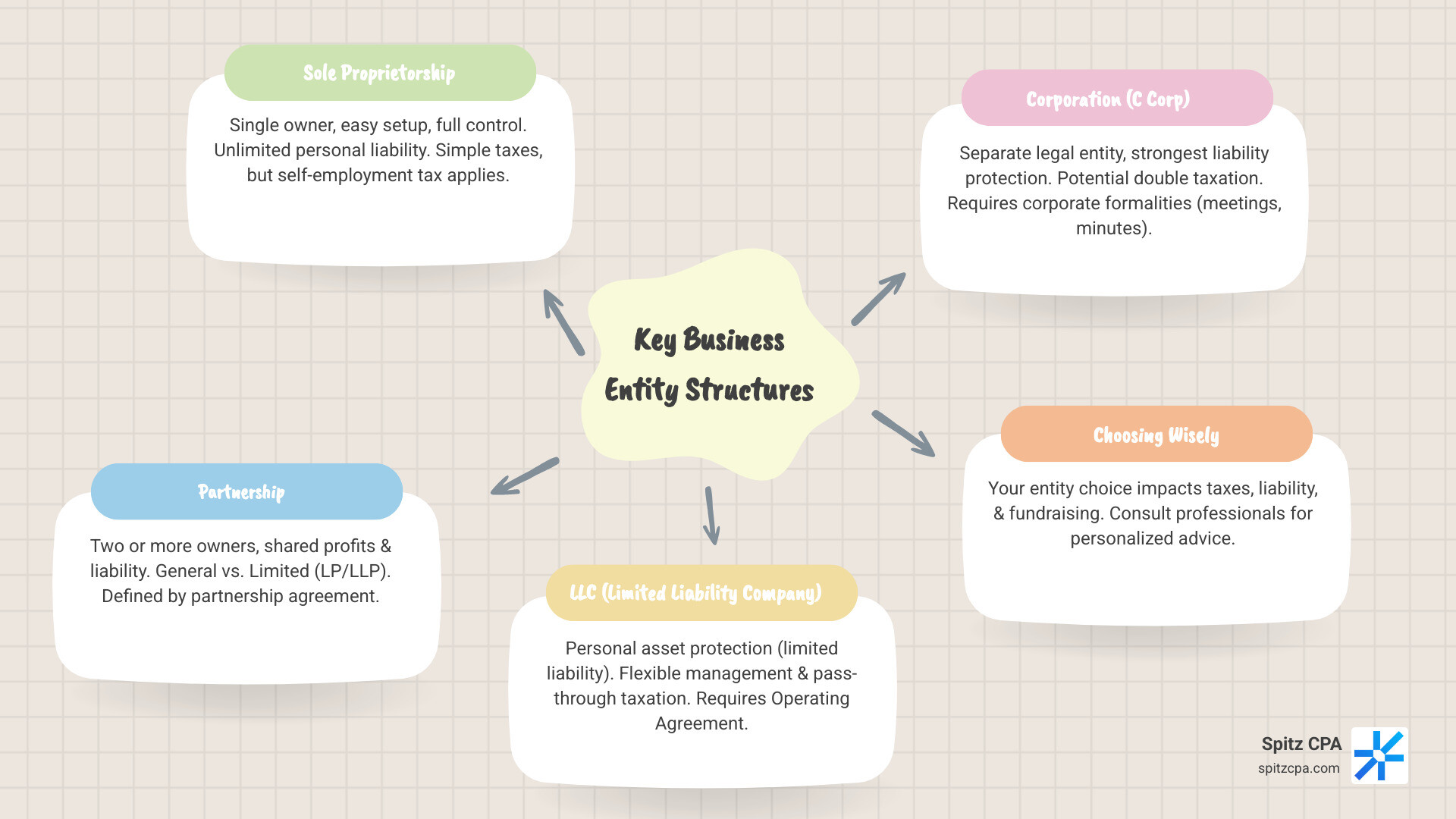
Choosing your business entity formation is like picking the right foundation for your house. Most businesses fit into one of four main structures: sole proprietorship, partnership, LLC, or corporation. Each offers different benefits regarding taxes, liability protection, and paperwork.
| Feature | Sole Proprietorship | Partnership | Limited Liability Company (LLC) | C-Corporation |
|---|---|---|---|---|
| Ownership | Single owner | Two or more partners | Members (can be 1 or many) | Shareholders |
| Liability | Unlimited personal | Unlimited personal (General) / Limited (LP/LLP) | Limited personal | Limited personal (strongest) |
| Taxation | Pass-through (personal) | Pass-through (personal) | Pass-through (personal) | Double taxation (corporate & personal) |
| Formation Complexity | Very easy | Easy | Moderate | Complex |
| Management | Owner | Partners | Flexible (member/manager) | Board of Directors |
| Fundraising | Difficult | Difficult | Moderate | Easiest (stock issuance) |
Want to dive deeper into the details? The SBA has an excellent resource that walks through each option: Choose a business structure.
Sole Proprietorship
A sole proprietorship is the simplest way to start a business. The biggest advantage is complete control and easy setup. The major drawback is unlimited personal liability. Since there’s no legal separation between you and the business, your personal assets—house, car, savings—are at risk if the business is sued or incurs debt. Taxes are reported on your personal return, but you’ll also pay self-employment tax on your profits. This structure is best for low-risk business ideas. Need help understanding the tax side of things? Check out our guide: More info about tax planning.
Partnership
A partnership is formed when two or more people go into business together. It’s relatively easy to set up, but a solid partnership agreement is crucial to define roles, profit splits, and exit strategies. In a general partnership, all partners share in management and have unlimited personal liability. Other forms, like limited partnerships (LPs) and limited liability partnerships (LLPs), offer some liability protection for certain partners. Like sole proprietorships, partnerships use pass-through taxation, where profits are reported on the partners’ personal tax returns.
Limited Liability Company (LLC)
The LLC is a popular hybrid structure, offering the liability protection of a corporation with the tax simplicity of a partnership.

Its biggest selling point is personal asset protection, which separates your personal finances from business debts. LLCs also offer flexibility in management and profit distribution. They use pass-through taxation, so the business itself doesn’t pay income tax, avoiding the double taxation of corporations. An Operating Agreement is a vital internal document that outlines the LLC’s rules and is often required by banks. For most small businesses, an LLC provides the ideal balance of protection and simplicity.
Corporation (C Corp)
A C Corporation is a completely separate legal entity, offering the strongest liability protection. This structure completely separates your personal assets from business obligations. This makes corporations attractive for businesses planning significant growth or seeking outside investment, as they can raise capital by selling stock. However, C Corps face double taxation: the corporation pays taxes on its profits, and shareholders pay taxes again on dividends they receive. They also require strict corporate formalities, including regular board meetings, keeping minutes, and maintaining bylaws, making them the most complex structure to manage.
Key Factors in Your Business Entity Formation
Choosing the right business entity formation is a critical decision that supports your goals today and your growth tomorrow. The right choice can save you thousands in taxes and protect everything you’ve worked for. The four key factors are tax implications, asset protection, fundraising potential, and operational requirements. There’s no single “best” choice, as a freelance designer’s needs differ from a tech startup’s.
Our goal is to help you pick a structure that keeps more money in your pocket while protecting your personal assets. When you’re ready to dive deeper, check out our comprehensive services: More info about our services.
How Your Choice Affects Taxation
Your business structure determines whether you pay taxes once or twice on your profits. Pass-through taxation, used by sole proprietorships, partnerships, and LLCs, means business profits flow directly to your personal tax return. The business itself doesn’t pay income tax; you pay tax at your individual rate, plus self-employment taxes for Social Security and Medicare.
Double taxation is unique to C Corporations. First, the corporation pays tax on its profits. Then, when those profits are distributed as dividends, shareholders pay personal income tax on them again. While this sounds like a disadvantage, C Corps can deduct certain business expenses, like health insurance premiums, that pass-through entities cannot, which can sometimes offset the tax burden.
Understanding these differences is crucial. If you’re feeling overwhelmed, our guide can help: Small Business Accounting 101: A Guide for New Entrepreneurs.
S Corp vs. C Corp: What’s the Difference?
This is a common question. Both S Corps and C Corps are legally incorporated entities, but they are taxed differently. A C Corp is the standard corporation subject to the double taxation described above. An S Corp is a corporation that elects a special tax status with the IRS (using Form 2553) to allow profits and losses to be passed through directly to the owners’ personal income without being taxed at the corporate level.
This combination of corporate liability protection and pass-through taxation is very appealing. However, the IRS has strict rules for S Corps: they can have no more than 100 shareholders, all of whom must be U.S. citizens or residents, and can only issue one class of stock. An LLC can also elect to be taxed as an S Corp, offering a blend of flexibility and potential tax savings, though this move typically makes sense only for businesses with significant profits.
Before making an S Corp election, review the full eligibility requirements: Check the IRS eligibility requirements.
Other Important Structures
While most businesses use one of the main four structures, specialized options exist for unique situations. These include Benefit Corporations for social missions, Nonprofit Corporations for charitable work, and Professional Corporations (PCs) or PLLCs for licensed professionals like doctors and lawyers. Another common term is a Doing Business As (DBA), which is simply a registered trade name, not a legal structure. A DBA allows a sole proprietor or other entity to operate under a different name but offers no liability protection, making an LLC a much safer choice for asset protection.
The 5-Step Process for Registering Your Business
Once you’ve chosen your business entity formation, it’s time to make it official. While each state has its own specific requirements, the fundamental process is consistent across the country. This roadmap makes the process much more manageable.

Let’s walk through each step to ensure your business entity formation is set up for smooth operation.
Step 1: Choose and Register Your Business Name
Your business name is your legal identity. Every state requires your business name to be unique within its borders. You can’t register a name that’s already in use. Additionally, states have naming rules, such as requiring LLCs to include “LLC” or corporations to include “Inc.” in their names.
Before settling on a name, check its availability using your state’s online database. For Arizona businesses, you can search here: Search the AZ database of registered business names. If you plan to operate under a different name than your legal one, you may need to file a DBA (Doing Business As).
Step 2: Appoint a Registered Agent
Every formal business entity (LLC or corporation) must have a Registered Agent. This is a state law requirement. The Registered Agent is your business’s official point of contact for receiving legal documents, such as lawsuit notifications and official state correspondence. They must have a physical street address in your state of formation and be available during normal business hours. You can serve as your own agent or hire a professional service for privacy and convenience.
Step 3: File Your Business Entity Formation Documents
This is the step that officially creates your business. You’ll file specific documents with your state’s Secretary of State office. For LLCs, you’ll file Articles of Organization. For corporations, you’ll file Articles of Incorporation. These documents include your business name, registered agent, and other basic details. State filing fees vary, and most states now offer convenient online filing, which is typically much faster than mailing paper forms. Once your documents are approved, your business is officially a legal entity.
Step 4: Obtain a Federal Tax ID (EIN)
Next, you’ll get an Employer Identification Number (EIN) from the IRS. This is your business’s federal tax ID, similar to a Social Security number for an individual. You will need an EIN if you have employees, operate as a corporation or partnership, or file certain tax returns. Many banks also require an EIN to open a business bank account. Applying for an EIN is free and can be done instantly on the IRS website: Apply for an EIN online.
Step 5: Understand Ongoing Compliance
Forming your business is just the beginning. To maintain your liability protection, you must meet ongoing compliance requirements. Most states require annual reports to keep your business information current. A new federal requirement as of 2024 is Beneficial Ownership Information (BOI) reporting to FinCEN, which applies to many small businesses. Corporations have additional formalities, like holding regular board meetings. Failing to meet these requirements can result in penalties or even the dissolution of your business, putting your personal assets at risk.
For details on the new BOI reporting rules, visit: Get more information on BOI from FinCEN.
Frequently Asked Questions about Business Entity Formation
Entrepreneurs tend to ask similar questions when exploring their business entity formation options. Here are the most common questions we hear, along with our insights.
What’s the main difference between an LLC and a Sole Proprietorship?
This is the most common question we get. The primary difference is liability protection. An LLC is a separate legal entity that creates a legal wall between your business and personal life. This protects your personal assets (home, car, savings) from business debts and lawsuits. A sole proprietorship offers no such separation, leaving your personal assets at risk.
With an LLC, your business becomes its own entity. While you can still lose what you’ve invested in the business, your personal assets are generally protected. The small upfront cost and paperwork of forming an LLC buys you priceless peace of mind and financial security.
Can I change my business structure later?
Yes, you can often convert from one entity type to another, such as from a sole proprietorship to an LLC or an LLC to a corporation. However, the process can be complex, involve significant paperwork, and have important tax consequences. The SBA warns that conversions “may result in tax consequences and unintended dissolution, among other complications.”
It’s often more efficient and less expensive to choose the right structure from the start. A little extra planning now can save you significant headaches and costs down the road.
Do I need a lawyer or CPA for business entity formation?
While you can file the paperwork yourself, consulting with professionals is highly recommended. State agencies that handle business registrations cannot offer legal or financial advice. A lawyer can ensure your formation documents are drafted correctly and advise on legal matters. As your CPA, we provide invaluable guidance on the tax implications of each structure, helping you minimize your tax burden from day one.
This combined expertise ensures you choose the best structure for your specific goals, minimize taxes, and protect your assets effectively. Think of it as building a house: you want an expert to handle the foundation to ensure everything built on top of it is secure. Your business entity formation is that foundation.
Conclusion
Choosing the right business entity formation is one of the most important decisions you’ll make as an entrepreneur. It’s the foundation that will support your business’s future, affecting your taxes, liability, and growth potential.

We’ve covered the key structures, from sole proprietorships to corporations, and the critical factors like taxation and liability that guide your choice. We’ve also outlined the essential steps to make your business official, from choosing a name to staying compliant.
You don’t have to figure this out alone. The complexity of tax implications, liability protection, and compliance can feel overwhelming, and that’s why we’re here.
At Spitz CPA, we’ve helped countless businesses steer these critical early decisions. We help you understand how your structure affects your bottom line and your peace of mind. Whether you’re a solo consultant wondering if you need an LLC or a growing company considering a corporate structure, we provide the personalized guidance you need.
Your entrepreneurial journey is just beginning. The time you invest in getting your business entity formation right today will pay dividends for years to come.
Ready to build a strong financial foundation for your business? Get expert help with your business accounting.


