


Why Smart Tax Planning is Essential for Business Success
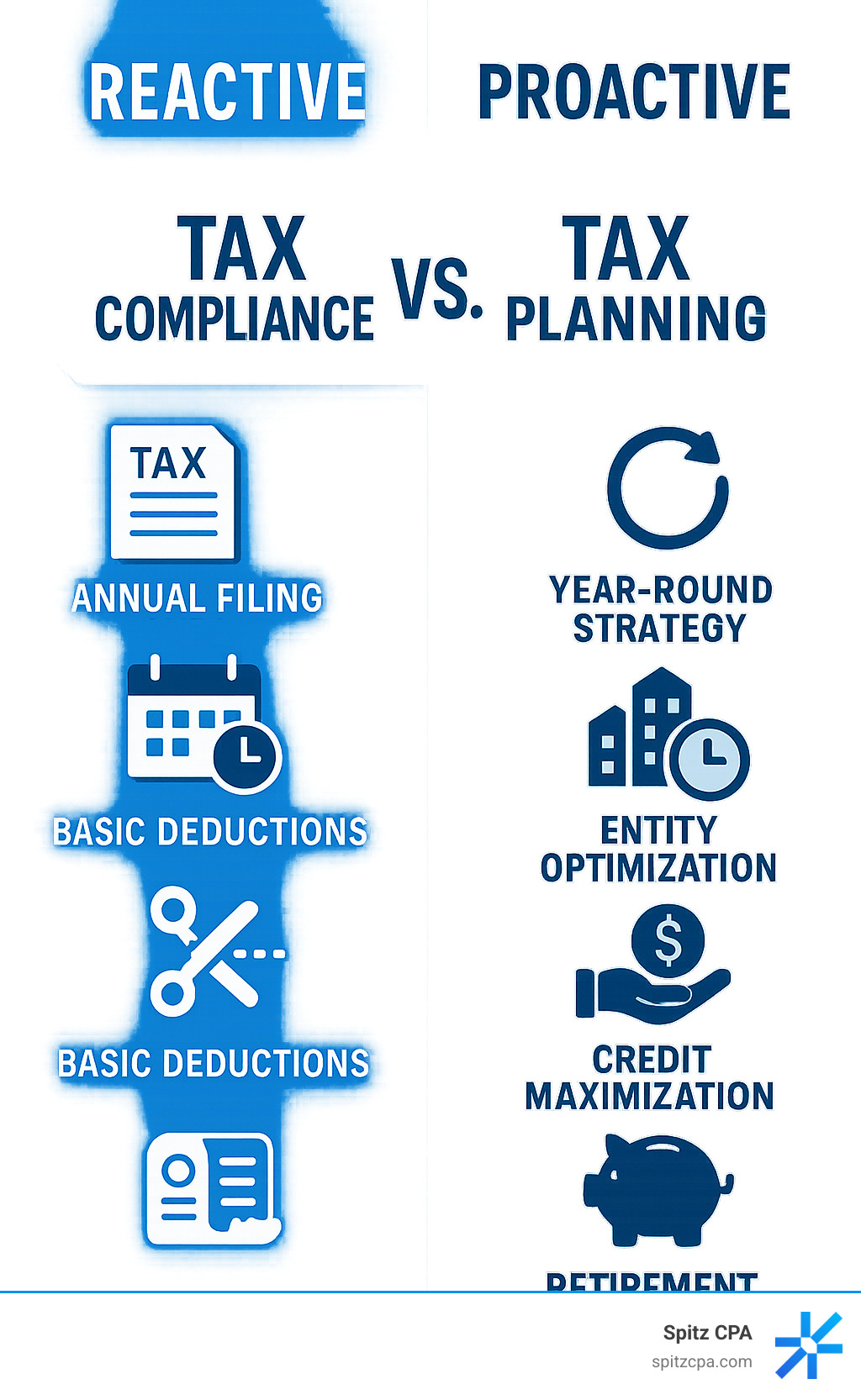
Business tax strategies are key to building a profitable company. While basic tax compliance means filing on time, strategic tax planning turns your tax obligations into competitive advantages that fuel growth and maximize after-tax profits.
Key Business Tax Strategies at a Glance:
- Structure Optimization: Choose the right entity (LLC, S-Corp, C-Corp).
- Deduction Maximization: Claim all eligible business, home office, and vehicle expenses.
- Tax Credit Utilization: Leverage R&D, green energy, and employee retention credits.
- Strategic Timing: Defer income and accelerate expenses to manage tax brackets.
- Asset Depreciation: Use Section 179 and bonus depreciation (60% for 2024).
- Retirement Planning: Implement tax-advantaged plans like SEP-IRAs and 401(k)s.
- Pass-Through Benefits: Use PTE tax elections to bypass SALT deduction limits.
The numbers tell the story: the average small business pays an effective tax rate of 19.8%, while C-corporations face a flat 21% rate. Businesses that implement comprehensive tax strategies can significantly reduce their rates, improving cash flow and reinvestment capacity.
Successful entrepreneurs view tax planning as year-round financial optimization, not an annual scramble. They legally reduce tax obligations while supporting goals like expansion, equipment purchases, and talent retention.
I’m Michael J. Spitz, and with over 15 years of corporate accounting and FP&A experience, I’ve helped businesses implement effective business tax strategies that align with their growth goals. My approach combines deep technical knowledge with practical business sense to deliver both immediate tax savings and long-term financial clarity.
Foundational Tax Planning: Structure, Compliance, and Records
This section covers the essential building blocks for an effective tax strategy, from choosing the right legal structure to maintaining impeccable records.
Choosing Your Business Structure
Your business structure is one of the most important business tax strategies you’ll decide. It’s the foundation of your tax house.
- Sole proprietorships are simple but expose you to personal liability and a 15.3% self-employment tax on all profits, on top of income tax.
- Partnerships are similar for multiple owners, with profits and self-employment tax liability flowing through to the partners’ personal returns.
- LLCs offer personal liability protection with the tax flexibility of a sole proprietorship or partnership. You can also elect to be taxed as an S-corporation or C-corporation.
- S-corporations offer significant tax savings. You get pass-through taxation, but you only pay self-employment tax on a reasonable salary, not on profit distributions. On a $100,000 profit, an S-corp owner taking a $60,000 salary could save over $6,000 in self-employment taxes compared to a sole proprietor.
- C-corporations face double taxation (a flat 21% corporate rate, plus tax on dividends), but they are ideal for businesses that plan to retain earnings for growth or offer extensive employee benefits.
The IRS provides guidance on choosing the right business structure for your company, but professional analysis is key. At Spitz CPA, our tax services include entity selection analysis to ensure you’re maximizing every tax advantage.
Mastering Tax Compliance and Record-Keeping
Once your structure is set, the next pillar is compliance and meticulous records. Think of it as building on a solid foundation instead of quicksand.

Businesses handle four main tax types: income tax, self-employment tax (15.3%), employment taxes (for employees), and excise taxes (for specific industries).
Estimated tax payments are required quarterly (April 15, June 15, September 15, and January 15) if you expect to owe $1,000 or more. Missing these deadlines leads to penalties.
Good record-keeping is your best friend. Separating business and personal finances with dedicated bank accounts and credit cards is essential. Accounting software automates expense tracking and reporting, saving significant time. Generally, you should keep records for at least three years.
If you have employees, payroll obligations are critical. Accurate withholdings, timely deposits, and proper reporting (W-2s, Form 941) are legal requirements with serious penalties for mistakes. The IRS offers guidance on best practices for recordkeeping.
Good records provide the financial clarity to make smart business decisions. Our Small Business Accounting 101: A Guide for New Entrepreneurs shows how proper accounting foundations improve cash flow and growth.
Core Business Tax Strategies for Maximizing Savings
Now that we’ve covered the basics, let’s dive into actionable strategies to reduce your taxable income by leveraging deductions, credits, and smart timing. These are the active business tax strategies that put money back in your pocket.
Essential Business Tax Strategies for Deductions and Credits
Every dollar you legally deduct is a dollar you don’t pay tax on. A deductible business expense must be both “ordinary and necessary.”
- Operating Expenses: This includes rent, utilities, office supplies, insurance, advertising, professional fees, and employee salaries.
- Home Office Deduction: Deduct expenses for a part of your home used exclusively and regularly for business, using either a simplified or actual expense method.
- Vehicle Expenses: Deduct vehicle costs using either the standard mileage rate (70 cents per mile for 2025) or actual expenses. Meticulous mileage records are crucial.
- Business Travel: Airfare, lodging, and transportation costs are fully deductible for trips that are primarily for business.
- Business Meal Deduction: For 2025, you can deduct 50% of the cost of business meals. Keep receipts and note the business purpose.
- Health Insurance Premiums: Self-employed individuals can often deduct health insurance premiums, reducing adjusted gross income.
- Other Deductions: Interest on business loans and employee-related expenses are also deductible.
| Section 179 Deduction vs. Bonus Depreciation |
|---|
| Section 179: Up to $1.25M immediate deduction for qualifying equipment/software purchases |
| Bonus Depreciation: 60% for 2024, 40% for 2025 of eligible new or used business property |
| Best Strategy: Often combine both for maximum first-year deduction |
For a comprehensive list, see the IRS’s guide to business expenses. Our rule: if it’s for your business, track it!
Leveraging Tax Credits and Asset-Related Deductions
Tax credits are more powerful than deductions because they reduce your tax bill dollar-for-dollar.

- Research and Development (R&D) Tax Credits: Available if your business develops new or improved products, processes, or software. Many industries, not just tech, can qualify.
- Green Energy Credits: The Inflation Reduction Act offers substantial credits for installing solar panels, buying electric vehicles, or investing in other green technologies.
- Hiring Credits: The Employee Retention Credit and Work Opportunity Tax Credit provide incentives for hiring and retaining employees from certain groups.
For asset-related deductions, the Section 179 deduction allows an immediate write-off of up to $1.25 million for qualifying equipment. Bonus depreciation lets you deduct 60% for 2024 and 40% for 2025 of eligible property costs upfront. Cost segregation studies can accelerate depreciation on building components, and tax-loss carryforwards let you use a current year’s loss to offset up to 80% of future taxable income.
Strategic Timing of Income and Expenses
Timing when you recognize income and expenses can significantly influence your tax liability.
- Accounting Method: Most small businesses use the cash method (income/expenses recognized when cash moves), which offers great timing flexibility. The accrual method (income/expenses recognized when earned/incurred) is less flexible for tax timing.
- Deferring Income: If you expect a lower tax bracket next year, consider delaying invoices until after year-end.
- Accelerating Expenses: If profits are high this year, purchase equipment before year-end to take advantage of Section 179 or bonus depreciation. You can also prepay up to 12 months of expenses like rent or insurance.
Advanced & Specialized Tax Strategies
For businesses looking to optimize further, this section explores sophisticated strategies related to employee benefits, international operations, and long-term financial planning.
Using Retirement Plans and Benefits for Tax Advantages
Offering retirement benefits is one of the smartest business tax strategies, creating a win-win by reducing your tax burden while building employee loyalty. Your contributions are tax-deductible, and your employees get valuable benefits.

- 401(k) Plans: Employer contributions are tax-deductible. For 2025, employees can contribute up to $23,500 (plus a $7,500 catch-up if over 50), with a combined employer/employee limit of $70,000.
- SEP-IRAs: Ideal for the self-employed, these plans allow tax-deductible contributions of up to 25% of compensation, capped at $70,000.
- SIMPLE IRAs: A good option for businesses with 100 or fewer employees, offering a simplified alternative to a 401(k).
The government offers a tax credit of up to $5,000 per year for three years to cover start-up costs for new retirement plans. An additional $500 annual credit is available for plans with automatic enrollment.
Other benefits like health insurance premiums, student loan repayments (through 2025), childcare assistance, and tuition reimbursement can also be structured for tax advantages.
Advanced Business Tax Strategies for Growth and Succession
As your business grows, your tax planning needs to evolve.
- Pass-Through Entity (PTE) Tax Election: This strategy helps business owners bypass the $10,000 state and local tax (SALT) deduction cap. The business elects to pay state taxes at the entity level, making the payment federally deductible. For example, a business paying $60,000 in state taxes can deduct this amount federally, saving thousands.
- Charitable Giving: C-corporations can deduct contributions up to 25% of taxable income. For pass-through entities, the deduction flows to the owners. A smart strategy is to donate appreciated assets (like stock) to get a full deduction while avoiding capital gains tax.
- Business Succession Planning: The higher estate and gift tax exemptions from the Tax Cuts and Jobs Act are set to expire after December 31, 2025. This creates a limited window to transfer business ownership or wealth with significant tax savings. Planning the timing of a business sale is critical; for more, see our guide on What to Prepare If You’re Selling Your Business.
Navigating International and Remote Work Tax Complexities
In today’s global and remote work environment, geographic expansion creates tax complexities.
Having remote employees in different states can trigger state tax nexus, creating corporate income and sales tax obligations in those states. Payroll rules also vary by state, adding compliance burdens.
For multinational corporations, specialized rules for transfer pricing, tax treaties, and foreign tax credits are essential to avoid double taxation and ensure compliance. The Treasury Department offers detailed guidance on understanding international tax obligations. Proactive planning is crucial to manage these complexities successfully.
Proactive Planning and Professional Guidance
Stay ahead of the curve by anticipating tax law changes, understanding common mistakes, and knowing when to bring in an expert.
Staying Ahead of Tax Law Changes
Tax laws are constantly changing. The biggest change on the horizon is the expiration of many Tax Cuts and Jobs Act (TCJA) provisions after December 31, 2025. This could mean higher individual income tax rates and lower gift and estate tax exemptions, directly impacting owners of pass-through entities and those planning for succession.
Proactive planning is your secret weapon. By acting now, you can accelerate income into lower-tax years or complete wealth transfers before exemptions drop. Instead of tracking every bill yourself, partner with professionals who monitor these changes for you.
We recommend a comprehensive review of your business tax strategies annually, ideally in the third quarter. This allows for strategic adjustments before year-end. For more on this, see our guide on Tax Planning for Entrepreneurs.
Common Pitfalls to Avoid and When to Seek Help
Even well-intentioned owners make costly tax mistakes. Here are the most common pitfalls:
- Mixing personal and business finances: This creates a record-keeping nightmare and can jeopardize your liability protection.
- Poor record-keeping: Without proper documentation, legitimate expenses can be disallowed in an audit.
- Misclassifying employees as independent contractors: This can lead to severe penalties, including back payroll taxes and interest.
- Ignoring estimated tax payments: The IRS expects you to pay as you go, and underpayment penalties add up quickly.
- Missing deadlines: Late filing and payment penalties can be as high as 5% of unpaid taxes per month.
When should you call in the professionals? Seek help if you’re spending too much time on bookkeeping, facing major business changes (like rapid growth or expansion), or have complex finances. Expert guidance is an investment, not an expense.
At Spitz CPA, we provide the financial clarity and peace of mind that allows you to focus on your business. We’ve seen businesses dramatically increase their value by getting their financial house in order with smart business tax strategies. The investment in professional help almost always pays for itself through tax savings, penalty avoidance, and better business decisions.
Frequently Asked Questions about Business Tax Strategies
Here are answers to common questions about business tax planning.
How do tax strategies differ for small businesses versus large corporations?
Small businesses focus on practical savings. Their business tax strategies typically involve:
- Maximizing deductions (home office, vehicle).
- Using pass-through entities (LLC, S-Corp) to avoid double taxation.
- Managing cash flow and using retirement plans like SEP-IRAs.
Large corporations deal with greater complexity:
- Navigating a flat 21% C-corp tax rate.
- Managing international tax treaties and transfer pricing.
- Handling multi-state and multi-national compliance with dedicated tax departments.
What are the most effective tax strategies for small business owners?
- Choose the right entity: An LLC taxed as an S-Corp can save thousands in self-employment taxes.
- Maximize deductions: Track every business meal (50% deductible for 2025), home office, and vehicle expense.
- Use asset deductions: The Section 179 deduction allows an immediate write-off of up to $1.25 million for equipment.
- Fund retirement plans: A SEP-IRA or 401(k) reduces your taxable income while you save for the future.
- Time income and expenses: Defer income and accelerate expenses to manage your tax bracket.
- Claim tax credits: Look into the PTE tax election, R&D credits, and green energy incentives.
How can a business strategically use charitable giving for tax benefits?
Charitable giving can be a powerful tax-reduction tool.
- C-corporations can deduct contributions up to 25% of their taxable income.
- For pass-through entities (S-Corps, LLCs), the deduction flows to the owners’ personal returns.
- A key strategy is donating appreciated assets (like stock held over a year). You can deduct the full market value and avoid paying capital gains tax on the appreciation.
- Donor-Advised Funds (DAFs) offer flexibility. You get an immediate tax deduction when you contribute to the fund, then recommend grants to charities over time.
Conclusion: Achieve Profit and Peace of Mind
Think of business tax strategies as your financial GPS, guiding you toward your goals. Effective tax planning is a year-round discipline that transforms a burden into a competitive advantage.
It starts with solid foundations like choosing the right business structure and keeping good records. From there, you can implement core strategies like maximizing deductions, using tax credits, and timing your income and expenses. For growing businesses, advanced strategies involving retirement plans, PTE elections, and succession planning open up even more opportunities.
Successful entrepreneurs understand that staying ahead of tax law changes and avoiding common pitfalls requires expertise. This allows them to focus on what they do best—running their business.
At Spitz CPA, we’ve seen how proper tax planning transforms businesses. It’s not just about paying less tax; it’s about gaining the financial clarity and cash flow to make better decisions and achieve peace of mind. We become your strategic partner, helping you see the bigger financial picture and make informed decisions that drive real growth.
Your business deserves more than just tax compliance. It deserves a comprehensive strategy that aligns with your goals. For personalized guidance to ensure your business is as tax-efficient as possible, explore our comprehensive accounting services and find out how we can help transform your tax burden into a strategic advantage.


