

Why Understanding Your Business’s True Worth is Essential

Business valuation services provide a professional, objective assessment of your company’s economic worth, which is crucial for making informed decisions about its future. Whether you’re planning to sell, seeking investment, or navigating a legal matter, understanding your business’s true value is the first step. A surprising 46% of Canadian entrepreneurs don’t know what their business is worth, leading to missed opportunities and costly mistakes. A professional valuation goes beyond simple calculations, analyzing your financials, market position, and industry trends to provide a comprehensive and defensible assessment.
Key Business Valuation Services:
- Transaction Support – M&A, buying/selling, partnership changes
- Tax & Compliance – Estate planning, gift tax, IRS requirements
- Legal Support – Divorce proceedings, shareholder disputes, litigation
- Strategic Planning – Growth assessment, financing, succession planning
- Financial Reporting – Regulatory compliance, impairment testing
As a CPA with over 15 years of experience, I’ve helped countless businesses steer complex financial decisions. My expertise in financial modeling, due diligence, and corporate accounting provides a unique insight into what drives business value and how to communicate that effectively to stakeholders.
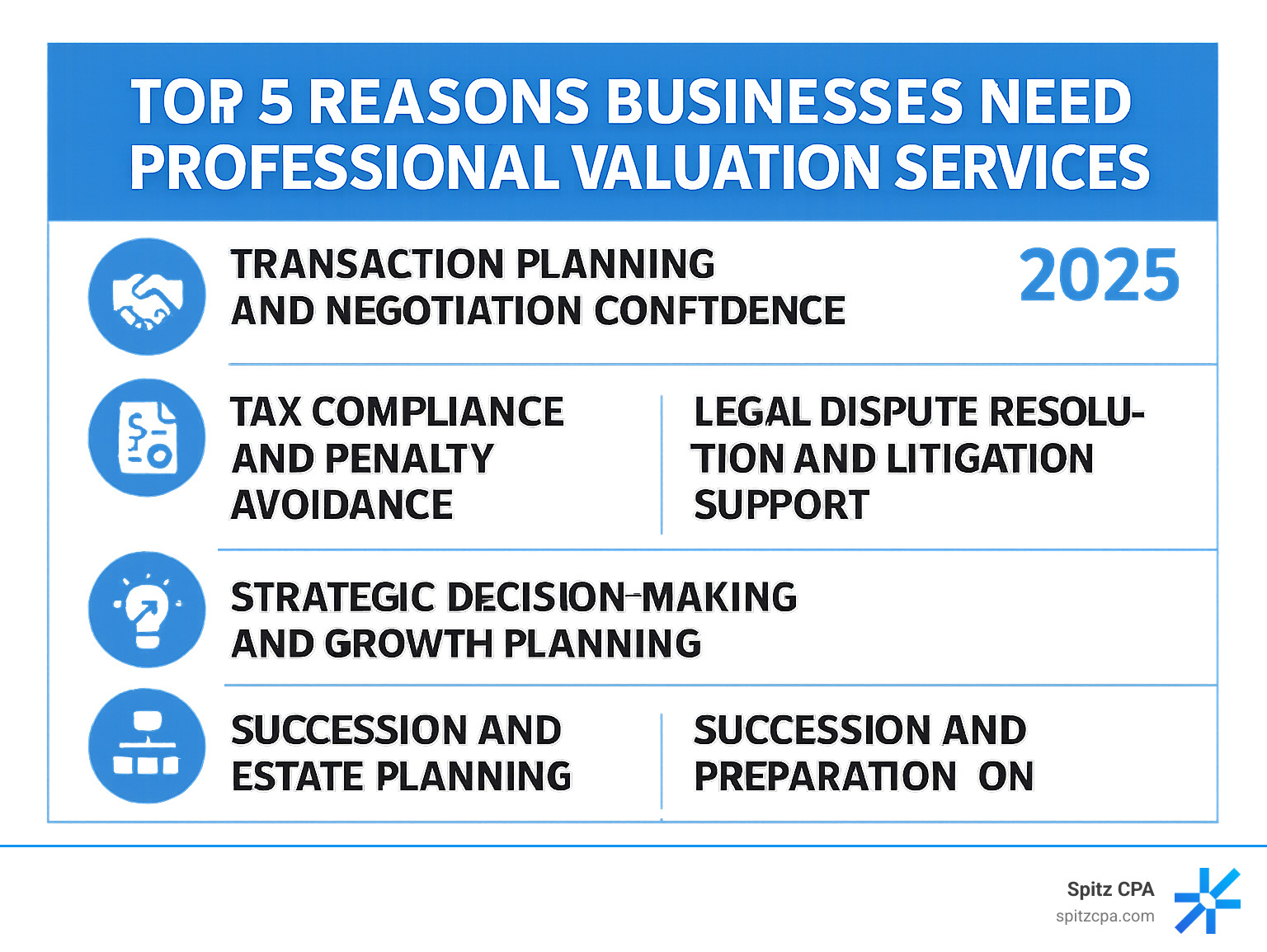
Why a Business Valuation is a Critical Strategic Tool

Think of a business valuation as a financial GPS for your company. It provides an objective assessment that cuts through emotion, offering the clarity needed for sound strategic decisions. A valuation can help you identify hidden risks, uncover new opportunities, and confidently steer your business’s future.
For Transactions and Transitions
When buying, selling, or restructuring, a professional valuation is your most powerful tool.
- Mergers & Acquisitions: A valuation helps determine a fair price, whether you’re buying or selling, and provides the basis for a smooth transaction.
- Buying or Selling a Business: For buyers, it validates the purchase price. For sellers, it provides the confidence to negotiate effectively.
- Partnership Buy-ins/Buy-outs: It establishes a fair, objective value for partnership shares, preventing disputes during transitions.
- Succession & Exit Planning: A valuation is the cornerstone of any successful exit strategy, ensuring you can plan for retirement or your next venture with a clear understanding of your company’s worth. For more on this, see our guide on What to Prepare if You’re Selling Your Business.
For Tax Planning and Compliance
Navigating tax regulations without a proper valuation can be risky and expensive.
- Estate and Gift Tax: The IRS requires a formal valuation when transferring business interests to family or trusts, ensuring you meet all legal requirements and avoid penalties.
- IRS Requirements: Valuations are often necessary for specific corporate actions, such as S-Corp elections or issuing stock options under IRC Section 409A, to ensure compliance and proper tax treatment.
- Avoiding Penalties: An accurate valuation helps you determine fair market value, minimizing your tax liability and keeping you in good standing with tax authorities. For more on tax strategies, explore our Tax Planning for Entrepreneurs.
For Legal and Dispute Resolution
In legal situations, an independent valuation provides the objective evidence needed to resolve conflicts.
- Divorce Proceedings: A professional valuation can help ensure a fair and equitable division of assets when a business is involved, often saving time and legal fees.
- Shareholder Disputes: It provides a clear, unbiased assessment of share value, which is crucial for resolving disagreements and facilitating buyouts.
- Litigation Support & Expert Witness Testimony: We provide robust valuation reports and expert testimony to support your case in legal proceedings, from commercial litigation to damage quantification.
The Core Components of Professional Business Valuation Services

A professional business valuation is a comprehensive process that goes beyond surface-level numbers. It involves a deep dive into your company’s financial health, market position, and operational efficiency to determine its true worth. This includes gathering financial data, analyzing industry trends, and making necessary adjustments to reflect the business’s real economic performance.
The Valuation Process Step-by-Step
Our process is designed to be thorough and transparent:
- Initial Consultation: We begin by discussing your specific needs and the purpose of the valuation.
- Document Request: We provide a clear list of necessary documents, such as financial statements and tax returns.
- Financial Analysis & Recasting: We analyze your financials, making adjustments for non-recurring items to accurately reflect your company’s earning power.
- Applying Valuation Methodologies: We use multiple valuation approaches to get a comprehensive view of your business’s value.
- Report Preparation: We compile our findings into a detailed, easy-to-understand report.
- Delivery and Review: We walk you through the report, ensuring you understand the valuation and its implications.
The entire process typically takes 2 to 5 weeks, depending on the complexity of your business.
Key Factors That Influence Business Value
Several key factors determine your company’s worth:
- Financial Performance: Consistent revenue growth, profitability, and strong cash flow (often measured by SDE or EBITDA) are crucial. A 12-Month Cash Flow Statement can provide valuable insights.
- Intangible Assets: Brand reputation, customer relationships, and intellectual property can significantly boost value.
- Management Team: A strong, independent management team is a major asset.
- Customer Concentration: A diverse customer base is less risky and more attractive to buyers.
- Market Position: Your competitive advantage and industry growth potential are key considerations.
- Working Capital: Efficient management of working capital is essential for ongoing operations.
Common Valuation Methodologies
Professional business valuation services use three main approaches, often combining them for the most accurate picture.
- Asset-Based Approach: Calculates value based on the company’s net assets (assets minus liabilities). It’s often used for asset-heavy businesses or when considering liquidation value.
- Market-Based Approach: Compares your business to similar companies that have sold recently. We use proprietary databases and market experience to find truly comparable transactions.
- Income-Based Approach: Focuses on your business’s ability to generate future cash flow. The most common method here is Discounted Cash Flow (DCF), which projects future earnings and adjusts them for risk and the time value of money.
Understanding Valuation Reports and Professionals

When you invest in business valuation services, you’re not just getting a number—you’re getting a comprehensive report that tells the story of your company’s worth. Understanding what goes into these reports and choosing the right professional to create them can make all the difference in achieving your goals.
Types of Business Valuation Reports
Not all valuation reports are created equal. The type of report you need depends on your specific situation and its intended use.
| Report Type | Scope | Assurance Level | Typical Use Case |
|---|---|---|---|
| Calculation Report | Basic analysis with limited procedures | Lowest assurance – preliminary estimate | Internal planning, initial discussions |
| Estimate of Value Report | Moderate analysis with standard procedures | Moderate assurance – suitable for most purposes | Business transactions, tax planning |
| Comprehensive Report | Extensive analysis with detailed procedures | Highest assurance – defensible conclusion | Litigation, major transactions, regulatory compliance |
Qualifications to Look for in a Valuation Expert
Choosing the right valuation professional is just as important as selecting the right type of report. You want someone who combines technical expertise with real-world experience and unshakeable integrity.
- Professional Credentials: Look for designations like CPA (Certified Public Accountant), CVA (Certified Valuation Analyst), or ABV (Accredited in Business Valuation). These credentials show that the professional has invested in specialized training and maintains ongoing education in valuation standards.
- Industry Experience: A professional who understands your specific industry will recognize nuances that others might miss. They’ll know which multiples are realistic, what risks are typical, and how market conditions affect businesses like yours.
- Litigation Support Experience: If there’s a chance your valuation might end up in court, professionals with courtroom experience know how to build bulletproof reports and can defend their conclusions under pressure.
- Independence and Objectivity: Your valuation professional should have no financial interest in the outcome and should be willing to deliver honest results, even if they’re not what you hoped to hear. This independence protects the credibility of the entire process.
At Spitz CPA, we bring all these qualifications together with a deep understanding of how valuations fit into your broader financial strategy. Learn more About Us and how we can help with your valuation needs.
Frequently Asked Questions about Business Valuations
How does a business valuation differ for public vs. private companies?
While the core principles are similar, valuing a private company is different from valuing a public one. Public companies have readily available financial data, making it easier to use market-based valuation methods. Private companies, on the other hand, require more in-depth analysis to gather financial information and assess risk. This often leads to a “marketability discount” to account for the fact that their shares are not easily traded.
What is the difference between a valuation for financial reporting and a transaction price?
A valuation is an objective estimate of what a business is worth based on established methodologies, often referred to as its “Fair Market Value.” A transaction price is the actual amount a business is sold for. The final price can be influenced by factors not included in a standard valuation, such as strategic value to a specific buyer (synergies), the negotiating power of each party, and the overall market conditions at the time of the sale.
How can technology be leveraged in business valuation services?
Technology has made business valuations more efficient and accurate. We use advanced software for:
- Data Analysis: Quickly processing large volumes of financial data to identify trends.
- Market Research: Accessing extensive databases of comparable company sales for more reliable market-based valuations.
- Financial Modeling: Creating sophisticated models to project future performance and test different scenarios.
- Collaboration: Using secure platforms to streamline communication and document sharing with our clients.
This allows us to deliver more robust and defensible valuations faster. For a tool to help you get started, check out our Excel Accounting and Bookkeeping Template.
Conclusion: Empower Your Business with Financial Clarity
Understanding your business’s true worth is essential for making smart decisions and planning for the future. A professional valuation provides a clear, objective roadmap, highlighting your company’s strengths, weaknesses, and opportunities.
Whether you’re planning to sell, seeking financing, or navigating a legal dispute, a valuation gives you the confidence to act decisively. It transforms uncertainty into a clear, actionable strategy.
At Spitz CPA, we specialize in helping business owners like you open up their company’s full potential. We combine rigorous financial analysis with a deep understanding of your goals to deliver valuations that are not just numbers, but powerful tools for growth.
Don’t leave your business’s future to chance. Get expert accounting and valuation guidance from Spitz CPA today and find what your business is truly worth.
The Core Components of Professional Business Valuation Services
A thorough business valuation is a meticulous process that goes deep into the financial and operational fabric of your company. It’s not just about crunching numbers; it’s about understanding the story those numbers tell in the context of your industry and the broader economy. This involves extensive data gathering, rigorous financial analysis, in-depth industry research, consideration of current economic conditions, and crucial normalization adjustments to ensure the financials accurately reflect the business’s true earning power.
The Valuation Process Step-by-Step
Our approach to business valuation services is systematic and transparent, ensuring you understand every step of the journey:
- Initial Consultation: We begin by discussing your specific needs and the purpose of the valuation. This helps us tailor our services to your unique situation. We aim to make our advice accessible and approachable.
- Document Request: We’ll provide a comprehensive list of required documents. Typically, this includes financial reports from the past three years, such as profit and loss statements, balance sheets, and tax returns. The more complete the information you provide, the smoother and more accurate the process will be.
- Recasting Financial Statements: Our experts carefully recast your financial statements. This involves adjusting for discretionary or non-recurring expenses and income, ensuring that the financials accurately reflect the underlying economic performance of the business, rather than specific owner decisions.
- Applying Valuation Methodologies: Based on the collected and adjusted data, we apply appropriate valuation methodologies. This is where the art and science of valuation truly come together, considering various approaches to arrive at a well-supported value. We ensure all three valuation approaches, as required by professional standards, are considered.
- Report Preparation: We compile a detailed valuation report. This comprehensive document outlines our findings, the methodologies used, the data analyzed, and the rationale behind our conclusions. Our reports are data-driven and checked against top business valuation models for accuracy.
- Delivery and Review: We deliver the report and walk you through its contents, answering any questions you may have. We ensure you fully understand the valuation and its implications for your business. We aim to deliver standard reports within 3-10 business days, depending on complexity and data availability.
We work efficiently, aiming to complete reports within reasonable timeframes, typically 2 to 5 weeks, depending on the complexity and the timely receipt of all necessary documents.
Key Factors That Influence Business Value
Beyond the raw financial data, several qualitative and quantitative factors significantly influence your business’s value:
- Financial Performance: Consistent profitability, strong revenue growth, and healthy margins are foundational. We analyze key metrics like Seller’s Discretionary Earnings (SDE) for smaller businesses and Earnings Before Interest, Taxes, Depreciation, and Amortization (EBITDA) for larger entities. Understanding your 12-Month Cash Flow Statement is also critical.
- Intangible Assets: These often overlooked assets can significantly boost value. This includes intellectual property, strong brand recognition, established customer relationships (goodwill), proprietary technology, and efficient operational processes. Goodwill impairment testing is also a key area we address.
- Management Team Strength: A capable, experienced, and dedicated management team reduces risk for potential buyers and signals stability, adding to the business’s appeal.
- Customer Concentration: Diversified customer bases are generally preferred. High reliance on a single or a few customers can be a red flag, potentially reducing value.
- Market Position: Your competitive advantage, market share, and the overall health and growth potential of your industry play a crucial role. A strong market position can command a higher valuation.
- Working Capital: We also calculate net working capital requirements from a buyer’s perspective, as this is essential for ongoing operations post-acquisition.
- Buyer-centric Analysis: We also review your business from a buyer’s perspective, considering their investment recoupment timeline and available free cash flow for debt servicing.
Common Valuation Methodologies
Professional business valuation services typically employ a combination of approaches to arrive at a well-supported conclusion. The three most common methodologies are:
- Asset-Based Approach: This approach determines the value of a business by summing the fair market value of its assets (tangible and intangible) and subtracting its liabilities. It’s often used for asset-heavy businesses or for liquidation purposes. This method is particularly relevant for capital equipment valuations.
- Market-Based Approach: This method compares your business to similar businesses that have recently been sold or valued. It relies on market multiples derived from comparable company transactions. We leverage proprietary databases and extensive market experience to identify relevant comparables, ensuring the data is reliable and accepted by intermediaries and courts. Our reports access databases with over 50,000 comparables to ensure robust analysis.
- Income-Based Approach: This approach values a business based on its ability to generate future income or cash flow. The most common income-based method is the Discounted Cash Flow (DCF) method, which projects future cash flows and discounts them back to a present value. This approach considers the time value of money and the risk associated with future earnings. It also considers the valuation of securities like promissory notes, warrants, and options based on a company’s ability to repay or its sale value.
The choice and weighting of these methodologies depend on the nature of the business, the industry, and the purpose of the valuation. Our experts carefully select the most appropriate methods to provide a robust and defensible valuation.
Understanding Valuation Reports and Professionals
When you engage in business valuation services, the end product is a clear, defensible report. Knowing which report you need—and choosing the right expert—ensures the conclusions are credible and fit for purpose.
Types of Business Valuation Reports
The Institute of Chartered Business Valuators (CBV) provides standards for three main report types that differ in scope and assurance. Choose based on how the valuation will be used.
| Report Type | Scope | Assurance Level | Typical Use Case |
|---|---|---|---|
| Calculation Report | Limited procedures and analysis | Lowest | Internal planning, preliminary discussions |
| Estimate of Value Report | Standard procedures with moderate analysis | Moderate | Business transactions, tax planning |
| Comprehensive Report | Extensive analysis with detailed procedures | Highest | Litigation, major transactions, regulatory compliance |
Qualifications to Look for in a Valuation Expert
- Professional credentials: CPA, CVA, ABV
- Industry experience and knowledge of relevant multiples and risks
- Litigation/expert testimony experience for defensibility if needed
- Independence and objectivity to protect credibility
Frequently Asked Questions about Business Valuations
How does a business valuation differ for public vs. private companies?
While the core principles are similar, valuing a private company differs from valuing a public one. Public companies have readily available financial data and market prices, making market-based valuations straightforward. Private companies require more in-depth analysis and often receive a “marketability discount” since their shares aren’t easily traded.
Control premiums also work differently – buyers typically pay extra for controlling interests in both public and private companies, but the premium calculation varies based on the specific situation and available comparable data.
What is the difference between a valuation for financial reporting and a transaction price?
A valuation is an objective estimate of Fair Market Value based on established methodologies – think of it like getting an appraisal on your house. A transaction price is what a business actually sells for, influenced by factors beyond the standard valuation:
- Synergies: A specific buyer might save costs or boost revenue through integration
- Negotiation dynamics: Market timing, competition, and urgency affect final price
- Strategic fit: Your company might be worth more to someone who needs your specific capabilities
The valuation gives you an objective baseline, but the transaction price reflects real-world negotiations and buyer-specific value.
How can technology be leveraged in business valuation services?
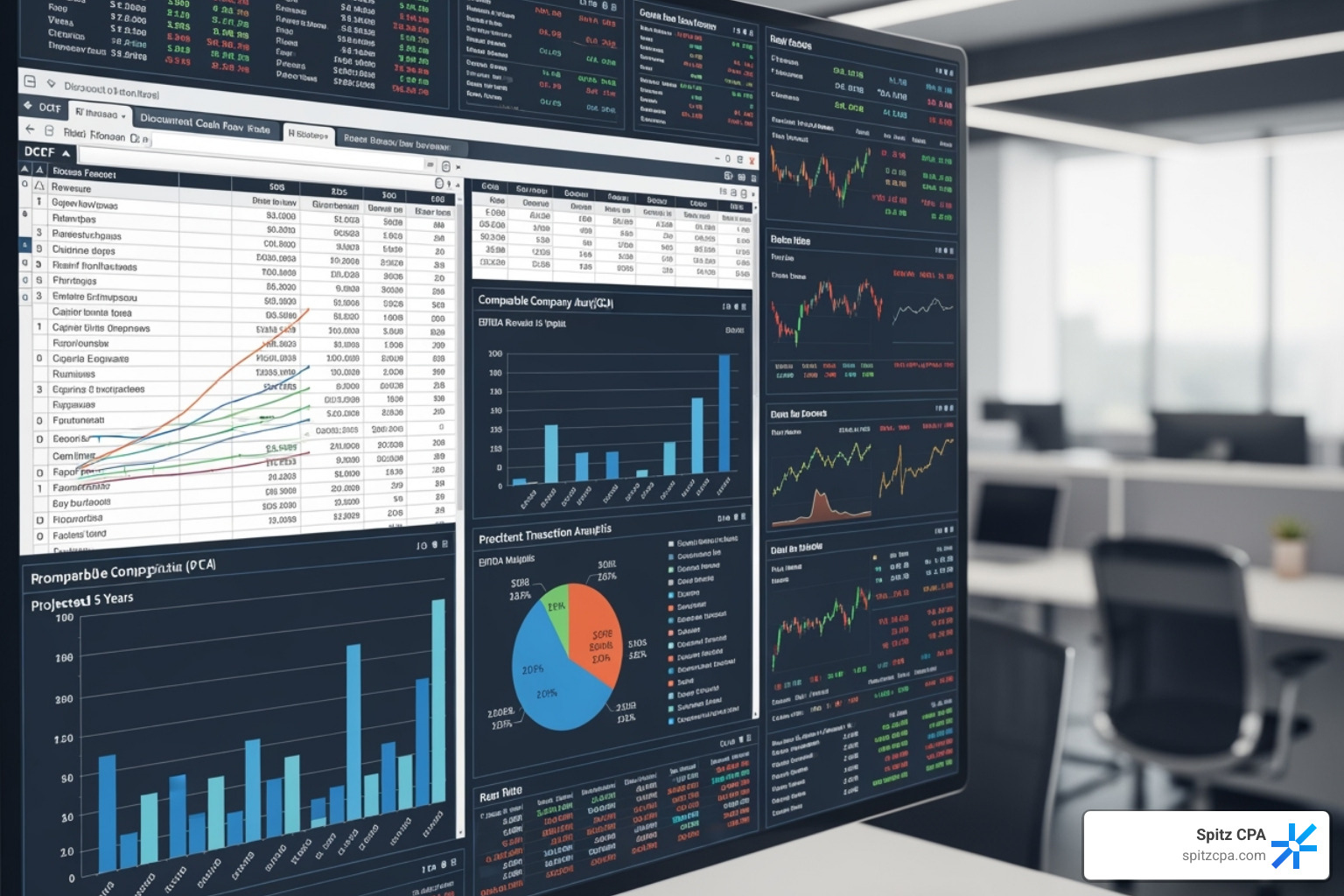
Technology has transformed business valuation services, making them faster, more accurate, and more affordable:
- Data analytics: Process massive amounts of information to spot trends and anomalies
- Proprietary databases: Access over 50,000 comparable business sales for better market-based valuations
- Financial modeling: Build complex models and run multiple scenarios quickly
- Automation: Handle routine tasks to reduce errors and speed turnaround (often 3-10 business days)
- Secure collaboration: Share documents and updates through protected platforms
These tools improve accuracy while keeping costs reasonable. For organizing your financial information, check out our Excel Accounting and Bookkeeping Template.
Conclusion: Empower Your Business with Financial Clarity
Understanding your business’s true worth isn’t just nice to know anymore – it’s absolutely essential for making smart decisions and planning for the future. Business valuation services give you much more than just a dollar amount on a piece of paper. They provide a complete financial roadmap that reveals where your business stands today and where it can go tomorrow.
Think of a professional valuation as your business’s financial GPS. It shows you the strengths you can build on, the weaknesses you need to address, the opportunities waiting to be seized, and the risks you should prepare for. This clarity becomes your strategic planning tool, helping you make decisions with confidence rather than guesswork.
Whether you’re dreaming of selling your business, need financing to grow, want to minimize tax headaches, or find yourself dealing with legal disputes, a professional valuation puts you in the driver’s seat. It takes the mystery out of your business’s worth and gives you the power to negotiate from a position of strength.
At Spitz CPA in Gilbert, Arizona, we’re passionate about helping business owners like you achieve remarkable growth – we’ve seen businesses increase their value by 10 times or more. We believe in combining smart financial analysis with genuine care for your dreams and goals. After all, we know there’s a real person with real hopes behind every set of numbers.
Our personalized approach means we don’t just hand you a report and walk away. We clean up your accounting, provide clear guidance, and make sure you understand exactly what your valuation means for your future. We’re here to help you turn your business vision into financial reality.
Don’t let your business’s value remain a mystery any longer. Take control of your financial future with the clarity you deserve. Get expert accounting and valuation guidance from Spitz CPA today, and find what your business is truly worth.


