


Why Cash Flow Calculation is Critical for Your Business Survival
Cash flow calculation is the process of tracking how money moves into and out of your business. Here’s a quick overview:
Quick Answer: How to Calculate Cash Flow
- Net Cash Flow = Total Cash Inflows – Total Cash Outflows
- Operating Cash Flow = Net Income + Non-Cash Expenses – Change in Working Capital
- Free Cash Flow = Operating Cash Flow – Capital Expenditures
These formulas are foundational to understanding your business’s financial health.
Cash flow is the pulse that keeps your business alive. While profit shows on paper, cash flow determines if you can make payroll, pay suppliers, or invest in growth. A profitable business can still fail if it runs out of cash.
The stakes are high: 60% of small businesses struggle with cash flow, and 30% of businesses fail simply because they run out of money. Many owners focus on revenue or profit, overlooking the actual cash movement that determines their ability to operate.
Understanding cash flow reveals your liquidity (your capacity to meet short-term needs) and financial flexibility (your ability to seize opportunities).
I’m Michael J. Spitz, and with 15+ years of corporate accounting experience, I’ve seen how mastering cash flow transforms businesses. Accurate calculation provides the clarity needed to move forward with confidence.
Understanding the Fundamentals of Cash Flow
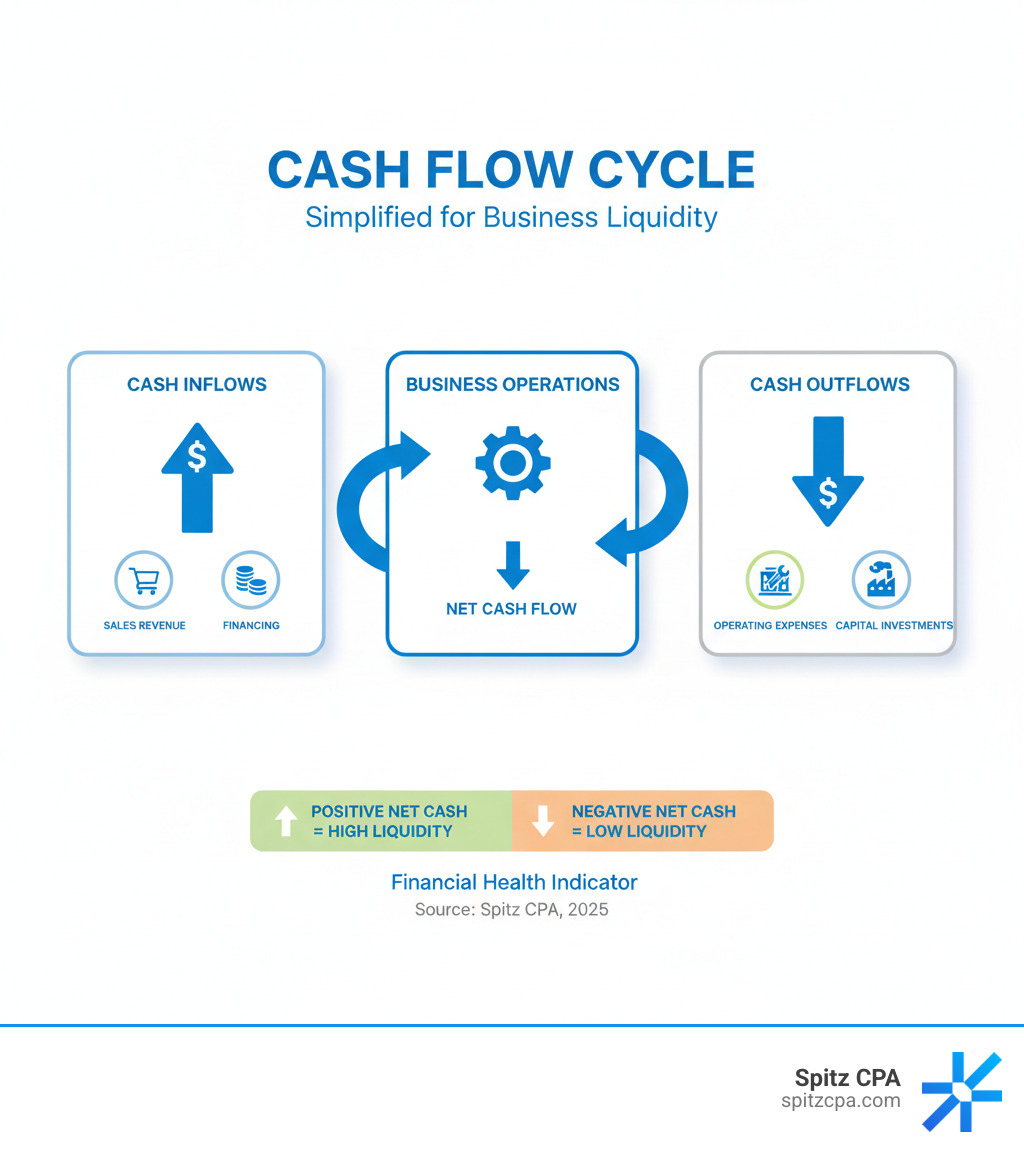
Think of cash as the oxygen for your business. Without actual cash to pay bills, even a profitable business can fail. This is why cash flow calculation is essential for survival. Strong cash flow provides liquidity (the ability to meet immediate bills) and financial flexibility (the power to seize opportunities).
The Financial Accounting Standards Board recognized this by requiring public companies to include cash flow statements in their reporting via Statement No. 95. Whether public or private, this understanding is vital. If you’re new to financial statements, the SEC’s Beginners’ Guide To Financial Statements is a great resource. To assess your current standing, we can help you Perform a Business Financial Health Check.
A common point of confusion is the difference between cash flow, profit, and revenue.
| Feature | Cash Flow | Profit (Net Income) | Revenue |
|---|---|---|---|
| Definition | The actual movement of money into and out of your business. | What’s left after all expenses are subtracted from revenue. | The total income generated from sales of goods or services. |
| Focus | Liquidity: ability to meet short-term obligations and pay bills. | Profitability: financial success after all costs. | Top-line growth: volume of sales before expenses. |
| Timing | Records cash when it’s received or paid (cash basis). | Records income and expenses when they are incurred, regardless of cash movement (accrual basis). | Records sales when they occur, even if cash isn’t received yet. |
| Non-cash items | Excludes non-cash expenses like depreciation and amortization (added back). | Includes non-cash expenses like depreciation and amortization. | Does not account for any expenses. |
| Key Insight | Do you have enough money to operate day-to-day? | Is your business financially successful overall? | How much are you selling? |
For example, a $50,000 sale in January is revenue, and the profit is recorded then. But if the customer pays in March, you don’t have that cash in January. This timing gap is where businesses get into trouble.
The Three Types of Cash Flow Activities
Your cash flow statement has three categories:
Cash Flow from Operating Activities (CFO) captures cash from core business operations. It includes cash from sales minus cash spent on daily expenses like salaries, rent, and inventory. A healthy business generates most of its cash here, proving its business model is sustainable.
Cash Flow from Investing Activities (CFI) tracks cash related to long-term assets. Purchasing equipment or property is a cash outflow, while selling them is an inflow. This section reflects investment in your business’s long-term infrastructure.
Cash Flow from Financing Activities (CFF) shows how you fund your business. Taking out a loan or issuing stock are cash inflows. Repaying debt or paying dividends are cash outflows. This section reveals how you raise capital and return it to investors and lenders.
Key Components in Cash Flow Calculations
To perform an accurate cash flow calculation, you need to understand these components:
Net Income is the starting point for the indirect method. Found on your income statement, it’s your profit after all expenses, including non-cash items.
Non-Cash Expenses are costs that reduce net income without using cash, like depreciation and amortization. Since no cash is spent, these expenses are added back when calculating operating cash flow.
Changes in Working Capital reflect the cash impact of changes in current assets and liabilities. An increase in Accounts Receivable (customers owe you more) or Inventory (you bought more than you sold) reduces cash flow. An increase in Accounts Payable (you owe suppliers more) increases cash flow because you’re holding onto cash longer.
Capital Expenditures (CapEx) are investments in long-term physical assets like property and equipment. CapEx is subtracted from operating cash flow to calculate Free Cash Flow, showing cash available after reinvesting in the business.
Understanding these components makes cash flow analysis a powerful tool for managing your business and making smarter decisions.
A Step-by-Step Guide to Cash Flow Calculation
Now, let’s walk through the actual cash flow calculation process. This isn’t just an accounting exercise; it’s a tool that reveals your business’s ability to sustain itself and grow. The importance of these calculations was formalized by the Financial Accounting Standards Board (FASB) in Statement No. 95, but they are vital for any business, large or small.

How to Calculate Net Cash Flow (NCF)
The simplest cash flow calculation is Net Cash Flow (NCF), a quick snapshot of your financial pulse. The formula is: Net Cash Flow = Total Cash Inflows – Total Cash Outflows.
For example, if your Gilbert-based business had $25,000 in total cash inflows and $15,000 in total cash outflows last month, your Net Cash Flow is $10,000. A positive Net Cash Flow means more cash came in than went out, boosting your liquid assets and financial health. Conversely, a negative Net Cash Flow means more cash left than arrived. While a one-time large purchase can cause this, consistent negative NCF is a warning sign.
How to Perform an Operating Cash Flow Calculation (OCF)
Operating Cash Flow (OCF) shows how much cash your core business activities generate, stripping away noise from investments and financing.
Indirect Method
The indirect method is most common because it’s easier to prepare. The formula is: Operating Cash Flow = Net Income + Non-Cash Expenses – Change in Working Capital.
Let’s use an example. Your Arizona business has $50,000 in net income. First, add back non-cash expenses like $10,000 in depreciation. Next, adjust for changes in working capital. If accounts receivable increased by $5,000 (cash not yet collected), you subtract it. If accounts payable increased by $2,000 (bills not yet paid), you add it back. If inventory decreased by $3,000 (cash freed up from sales), you add that back too.
The net change in working capital is -$5,000 + $2,000 + $3,000 = $0.
The calculation is: Operating Cash Flow = $50,000 (Net Income) + $10,000 (Depreciation) – $0 (Change in Working Capital) = $60,000. This shows your operations generated $10,000 more in cash than your reported profit.
Direct Method
The direct method is more straightforward: Operating Cash Flow = Cash from Customers – Cash Paid for Expenses. It tracks actual cash receipts and payments. While this provides a clearer picture, it requires more detailed record-keeping, so most companies use the indirect method for external reporting. However, it’s very useful for internal management.
Free Cash Flow (FCF) Calculation Explained
Free Cash Flow (FCF) answers a critical question: After covering operations and necessary investments, how much cash is left?
The formula is beautifully simple: Free Cash Flow = Operating Cash Flow – Capital Expenditures.
This “free” cash is vital. It’s the money available for expansion, debt repayment, and shareholder returns. Companies with strong FCF can grow without outside financing.
Using our previous example, with an OCF of $60,000, let’s say you spent $10,000 on a new computer system (a capital expenditure).
Your Free Cash Flow = $60,000 – $10,000 = $50,000.
This $50,000 is your financial flexibility. To plan its use, you might want to See an Example of Cash Flow Projection for 12 Months. Understanding these three levels of cash flow analysis gives you a complete picture of your business’s financial health.
From Calculation to Action: Analyzing Your Cash Flow
Once you’ve completed your cash flow calculation, the real work begins: turning data into decisions. At Spitz CPA, we help clients do just this, changing their cash flow statement into a roadmap for growth.
Interpreting the Numbers:
A positive Operating Cash Flow (CFO) means your core business is healthy and self-sustaining. Consistent negative CFO is a red flag.
A negative Investing Cash Flow (CFI) is often a good sign, showing investment in future growth. Positive CFI means you’re selling assets, which could be strategic or a sign of distress.
Financing Cash Flow (CFF) shows how you manage capital. Positive CFF means you’re taking on debt or equity. Negative CFF can be a good sign, indicating debt repayment or profit distribution, which demonstrates financial strength.
Using Cash Flow for Financial Modeling and Business Valuation:
Cash flow is the foundation for planning your future. We use it in financial modeling, like Discounted Cash Flow (DCF) models, to project future cash flows and determine a business’s intrinsic value for investors, lenders, or buyers. This approach grounds strategic planning in reality, helping you Improve Business Profitability.
Potential Pitfalls:
Be aware of potential distortions. Companies can alter the timing of payments—delaying vendor payments or accelerating customer collections—to temporarily boost a period’s numbers. Large one-time payments or upfront customer payments can also skew results. This is why analyzing trends over several periods is crucial. Also, inconsistent classification of capital expenditures between companies can make FCF comparisons difficult.
Important Cash Flow Ratios and Metrics
Beyond raw numbers, these ratios help assess cash flow quality:
The Operating Cash Flow Ratio (Operating Cash Flow / Sales Revenue) measures efficiency. A ratio over 1 is a strong sign.
The Price-to-Cash Flow (P/CF) Ratio is useful for valuing businesses, especially those with accounting losses but positive cash flow.
The Current Liability Coverage Ratio (Operating Cash Flow / Average Current Liabilities) measures your ability to cover short-term debts. A higher ratio indicates a stronger financial cushion.
These metrics offer a quick way to assess liquidity, efficiency, and financial strength, helping you spot problems and opportunities.
Frequently Asked Questions about Calculating Cash Flow
We hear these questions all the time from business owners in Gilbert and across Arizona who are working to understand their finances better. Let’s clear up some of the most common points of confusion around cash flow calculation.
How does cash flow differ from profit?
Cash flow is the actual money moving in and out of your bank account, determining your ability to pay bills. Profit, on the other hand, is an accounting calculation (Revenue – Expenses) that includes non-cash items like depreciation and recognizes revenue when earned, not when cash is received.
For example, you can record a $50,000 profitable sale, but if the client pays in 90 days, you have no cash from that sale to cover immediate expenses. This timing difference is why a business can be profitable but have negative cash flow. You can’t pay bills with profit; you need cash.
What is considered a healthy cash flow?
A healthy cash flow means you consistently generate more cash than you spend, especially from core operations. Positive operating cash flow is the key indicator, showing your business is self-sustaining. It provides the financial flexibility to cover expenses, service debt, invest in growth, and build a cash reserve.
A temporary negative cash flow from a large strategic investment can be acceptable. However, persistent negative operating cash flow is a major red flag, indicating you’re burning through cash and may not survive without external funding.
Which method is better for calculating operating cash flow: direct or indirect?
Both methods are valid, but they serve different purposes.
The indirect method is more common for financial reporting. It starts with net income and adjusts for non-cash items (like depreciation) and changes in working capital. It’s easier to prepare from existing statements and clearly links profit to cash flow, which investors appreciate.
The direct method is more intuitive for internal management. It lists actual cash receipts from customers and cash payments for expenses, offering a clear view of cash movements. However, it’s more labor-intensive due to detailed tracking requirements.
Most companies use the indirect method for official reports but apply the principles of the direct method for internal analysis. The goal is to understand your cash flow well enough to make informed decisions, regardless of the method.
Gain Financial Clarity with Expert Cash Flow Management
We’ve covered the essentials of cash flow calculation, from the core formulas to analysis. The key takeaway is that cash flow is the lifeblood of your business. It determines if you can pay bills, invest in growth, and survive unexpected challenges. A business can be profitable but still fail from a lack of cash.
That’s why regular cash flow calculation and analysis are crucial. They empower you to make decisions based on financial reality, spot trends, and seize opportunities.
Throughout my 15+ years in corporate accounting, I, Michael J. Spitz, have seen many business owners feel overwhelmed by their finances. It doesn’t have to be this way. Understanding and applying these fundamentals brings clarity and confidence.
At Spitz CPA, we help business owners in Gilbert, AZ, and across Arizona achieve this clarity. Whether you need help with your books, cash flow projections, or financial strategy, our expert guidance is here for you. Our financial services are designed to provide peace of mind and a clear path forward.
You don’t have to do it alone. If you’re ready to take control of your cash flow and build a more resilient business, let’s talk. We’ll help you turn numbers into actionable growth.


