


Why Every Startup Needs a Financial Strategist
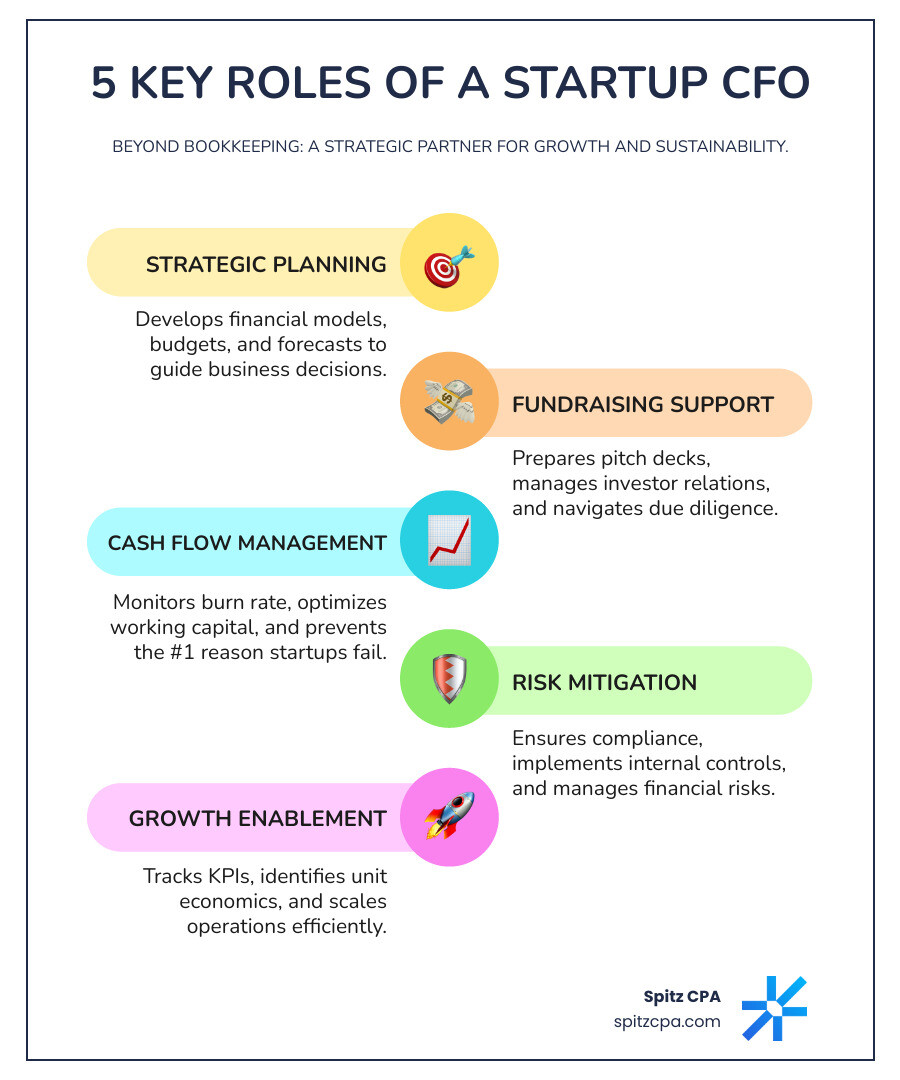
A CFO for startups is not just about managing numbers—it’s about unlocking growth, securing funding, and building a sustainable financial foundation. A Chief Financial Officer brings strategic vision and investor credibility that can mean the difference between thriving and merely surviving. Their role encompasses strategic planning, fundraising support, cash flow management, risk mitigation, and enabling efficient growth.
Many founders assume a CFO is only needed late-stage, but bringing in financial expertise early prevents costly mistakes. Poor cash flow management is the number one reason startups fail, according to CB Insights research. Unlike a controller who focuses on past transactions, a CFO is forward-thinking, translating data into actionable insights to build investor confidence. Whether full-time or fractional, the right financial leadership transforms your startup.
The challenge is knowing when to hire and what it costs. Compensation varies by stage, from a $50k-$120k salary plus 1%-5% equity at early stages to $160k-$490k with 0.1%-1% equity later on. Fractional CFOs offer expertise for a monthly fee or hourly rate, often between $250-$350.
I’m Michael J. Spitz, and with over 15 years of experience, I’ve seen how the right CFO can transform financial chaos into clarity and drive exponential growth.
Know your startup finance terms:
What a Startup CFO Really Does: From Scorekeeper to Strategist
A CFO for startups is a financial architect, not just a bookkeeper. While your accounting team records past events, a CFO builds the financial blueprint for your future. They translate your vision into a strategic roadmap with achievable milestones, helping you steer everything from daily cash flow to your next funding round.
The foundation of their work is financial planning and forecasting. They build comprehensive financial models to explore different scenarios, helping you make informed decisions. These aren’t just spreadsheets; they are tools for understanding your liquidity, like this Example of Cash Flow Projection for 12 Months.
Managing Cash Flow and Burn Rate
Poor cash flow management is the #1 reason startups fail, according to CB Insights. A CFO acts as the guardian of your cash, actively managing your burn rate and projecting your runway. This foresight gives you time to adjust spending, accelerate revenue, or plan a fundraising round before a crisis hits. They also optimize working capital to ensure you can meet immediate obligations and work to improve business profitability by refining your pricing and revenue models.

Steering Fundraising and Investor Relations
When pitching investors, your financials are under intense scrutiny. A CFO crafts pitch deck financials that tell a compelling story, helps defend your valuation, and manages the entire due diligence process. After funding, they handle investor reporting to maintain confidence and advise on your capital structure. They also ensure you’re prepared for a future exit by knowing what to prepare if you’re selling Your business. As Jeff Jordan from a16z notes, A great CFO is more than a bean counter; they articulate your vision to investors.
Mitigating Risks and Avoiding Mistakes
A startup CFO also acts as a financial shield. They mitigate risks like market volatility, ensure regulatory compliance, and implement internal controls to prevent fraud. This includes developing smart Business Tax Strategies to minimize your tax burden legally.
With an experienced CFO, you can avoid fatal financial mistakes. Besides managing cash flow, they prevent common pitfalls like mispricing products, failing to track critical KPIs (CAC, LTV, churn), and making costly tax errors. As CB Insights highlights, Running out of cash is the #1 reason startups fail, but many other financial missteps can be just as damaging. A CFO helps you avoid learning these lessons the hard way.
Timing is Everything: When to Hire a CFO for Your Startup
The right time to hire a CFO for your startup isn’t based on a magic revenue number. It’s about recognizing when financial complexity outgrows your current capabilities. Waiting until you’re overwhelmed means you’ve likely already made costly mistakes.
Key signals it’s time for CFO expertise include:
- Growth Complexity: You’re juggling multiple revenue streams or struggling to calculate core KPIs.
- Approaching Fundraising: Investors expect robust financial models and credible leadership. A CFO is essential for closing a round successfully.
- Founder Time Constraints: You’re spending too much time on spreadsheets instead of product, sales, and vision.
- Strategic Needs: You need a forward-thinking vision to spot risks and opportunities, especially when planning international expansion.
If your financial health is a mystery, a Business Financial Health Check can provide clarity. However, a fractional CFO can offer this guidance continuously, often becoming critical around Series A funding.
CFO vs. Controller: Understanding the Difference
Founders often confuse these roles. A Controller is tactical and backward-looking, ensuring your books are accurate and compliant. They manage day-to-day accounting and reporting.
A startup CFO is strategic and forward-looking. They use the Controller’s data to ask “where are we going?” They focus on fundraising, capital structure, and long-term growth. You typically need a Controller’s skills earlier, but a CFO’s strategic guidance becomes critical as you scale, especially for funding rounds or major strategic shifts. You need both perspectives for a complete financial leadership team.
Choosing the Right Model: Full-Time vs. Fractional CFO
You don’t have to hire a full-time executive immediately.
- A full-time CFO is a dedicated in-house executive, best for later-stage companies (e.g., $50M+ revenue) with complex needs and the budget for a significant salary and equity.
- A fractional CFO is a part-time expert, ideal for early to mid-stage startups needing high-level strategy without the full-time cost. They typically charge an hourly rate ($250-$350) or a monthly retainer.
- An outsourced CFO service, often from a firm like Spitz CPA, provides access to an entire finance team. These Outsourcing Services can manage everything from bookkeeping to strategic planning.
For most startups, a fractional or outsourced model provides the perfect balance of expertise and cost-efficiency. You can scale your financial leadership as your company grows, often starting with a fractional CFO and hiring a full-time one later.
Hiring Your Financial Co-Pilot: Qualities, Costs, and Compensation
Finding the right startup CFO is like choosing a co-pilot. Technical skills are important, but the chemistry and trust between a CEO and CFO are critical for this partnership. As a16z notes in their guide on Hiring a Chief Financial Officer, this relationship is the most important element of a successful hire. Your CFO will challenge assumptions and influence major decisions, so you need a partner you can trust implicitly.

Essential Qualities of a Top Startup CFO
An exceptional startup CFO blends financial acumen with leadership. Look for these key qualities:
- Strategic and Data-Driven: They don’t just report numbers; they translate data into actionable insights and anticipate future trends.
- Acts Like an Owner: They are curious, proactive problem-solvers who take initiative to fix issues across the business.
- Strong Communicator: They can explain complex financial concepts clearly to your team, board, and investors, building confidence.
- Startup and Industry Experience: They understand the chaos of rapid growth, know how to operate in lean environments, and have relevant industry knowledge.
- Leadership and Relationships: They can build a finance team and maintain strong connections with banks, investors, and audit partners.
Startup CFO Compensation and Equity
A startup CFO’s compensation package typically includes a salary, equity, and performance bonuses, all varying by stage.
- Early-Stage (Pre-Seed/Seed): Salaries range from $50k to $120k with 1% to 5% equity to compensate for higher risk.
- Mid-Stage (Series A/B): Salaries increase to $80k to $185k with equity dropping to 0.5% to 3%.
- Late-Stage (Series C+): Salaries are competitive, from $160k to $490k, with equity between 0.1% and 1%.
A standard four-year vesting schedule with a one-year cliff is common. Performance bonuses (30%-60% of base salary) are often tied to milestones like fundraising. When making an offer, consider the total package and be transparent about how future funding rounds will cause dilution.
Financial Needs by Startup Stage and How a CFO Addresses Them
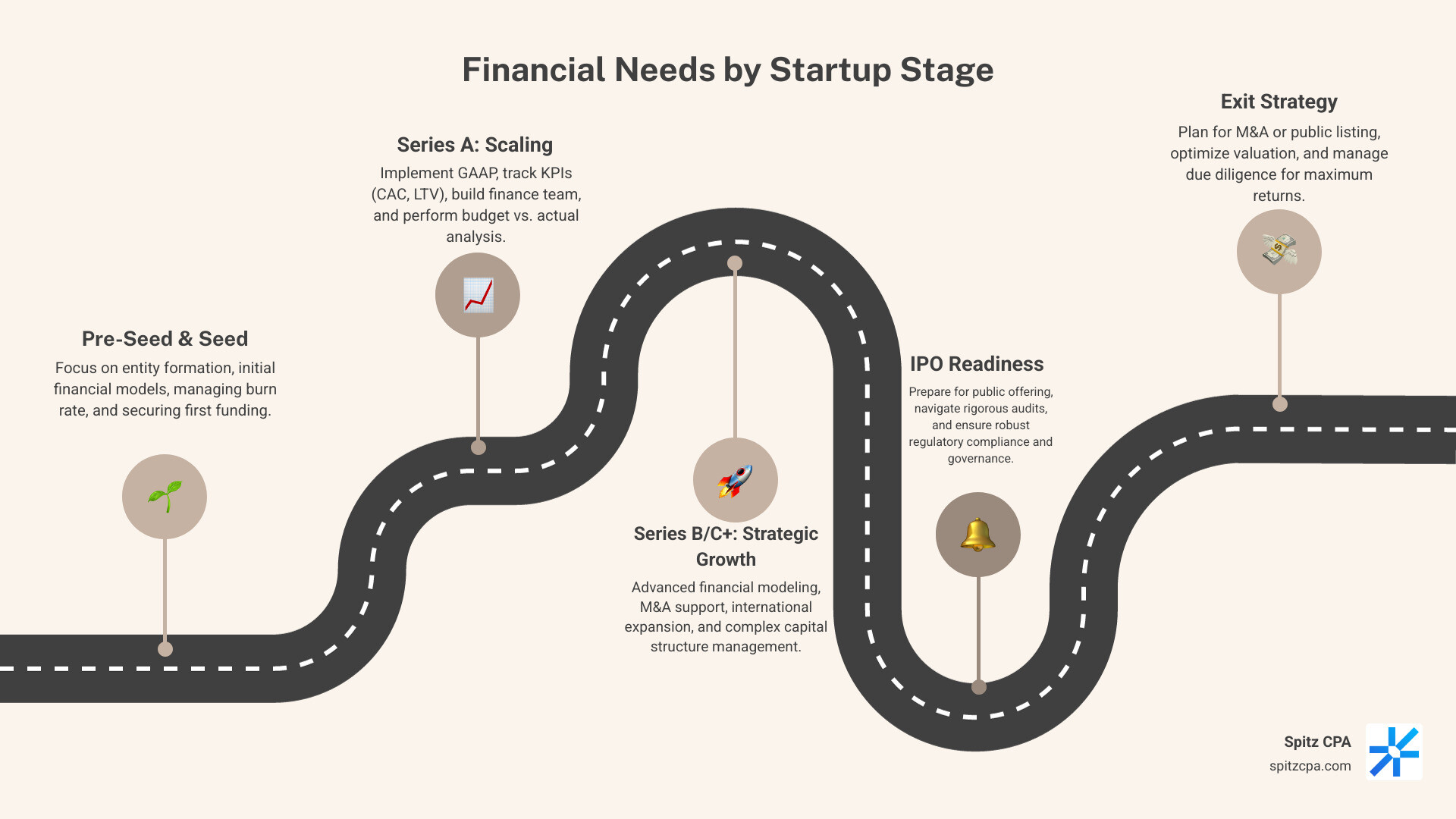
A startup’s financial needs evolve dramatically with growth, and a skilled startup CFO adapts their strategy for each stage. They know what financial infrastructure, reporting, and strategy your company needs at every inflection point, from building a foundation at pre-seed to preparing for an exit.
Pre-Seed & Seed Stage
At this foundational stage, a CFO (often fractional) focuses on getting the basics right. Key activities include:
- Ensuring correct Business Entity Formation for tax efficiency and investor appeal.
- Building initial financial models to project runway and manage burn rate.
- Establishing basic bookkeeping systems.
- Preparing financial documentation for early-stage funding rounds.
Series A: Scaling and Professionalizing
As you prove your concept can scale, financial operations must mature. A CFO’s focus shifts to:
- Establishing GAAP-compliant books, often requiring Accounting Clean-Up Services.
- Implementing rigorous KPI tracking (CAC, LTV, churn) to guide growth strategy.
- Building out the finance team (e.g., hiring a Controller).
- Leading the financial aspects of the Series A fundraise with detailed models and investor presentations.
Series B, C, and Beyond: Strategic Growth and Exit
In the big leagues, financial complexity requires a seasoned CFO. Their responsibilities expand to:
- Advanced financial modeling for M&A, international expansion, and paths to profitability.
- Managing complex capital structures and overseeing mandatory annual audits.
- Steering international expansion through different tax and regulatory environments.
- Preparing the financial foundation for an exit (IPO or acquisition) to maximize shareholder value.
At every stage, a great CFO anticipates what’s next, preparing your startup for future challenges and opportunities.
Frequently Asked Questions about Startup CFOs
What are the primary responsibilities of a CFO in a startup?
A startup’s CFO is a strategic partner to the CEO. Their primary responsibilities go beyond bookkeeping and include:
- Strategic Financial Planning: Building financial models, forecasts, and budgets to guide decisions.
- Fundraising: Crafting the financial narrative for investors, managing relations, and steering due diligence.
- Cash Flow and Burn Rate Management: Monitoring cash, projecting runway, and preventing cash shortages—the #1 reason startups fail.
- Risk and Compliance: Ensuring compliance with tax laws, implementing internal controls, and mitigating financial risks.
- Data-Driven Insights: Translating financial data into actionable strategy for growth.
What is the difference between a fractional CFO and an outsourced CFO?
While similar, there’s a key distinction. A fractional CFO is typically an individual expert who works part-time for a few companies, offering senior-level strategic guidance. An outsourced CFO service, like the Outsourcing Services from a firm like Spitz CPA, provides access to a full team of financial professionals, from bookkeepers to strategic advisors. The choice depends on whether you need a single strategic partner or a comprehensive finance department.
How much equity should a startup CFO get?
Equity for a startup CFO depends on the company’s stage and the CFO’s risk.
- Early-Stage (Pre-Seed/Seed): Typically 1% to 5% equity, paired with a lower cash salary ($50k-$120k).
- Mid- to Late-Stage (Series A+): Equity decreases to 0.1% to 3% as cash salaries increase significantly ($80k-$490k) and risk is lower.
Equity is almost always granted on a standard four-year vesting schedule with a one-year cliff to ensure long-term commitment.
Conclusion: Your Unfair Financial Advantage
Brilliant ideas and hustle aren’t enough to guarantee startup success. Without strategic financial leadership, promising ventures often stumble. A startup CFO provides this leadership, turning financial chaos into clarity, managing burn rate to ensure survival, and building the investor confidence needed for growth.
The right financial partner helps you win the game by translating data into insights, spotting risks before they become crises, and identifying opportunities. Whether you need help with business entity formation, accounting clean-up services, or advanced financial modeling, strategic leadership is the key differentiator.
Michael J. Spitz has over 15 years of experience helping businesses steer these challenges. At Spitz CPA, we provide the personalized financial guidance that drives growth for startups in Gilbert, AZ, and beyond. While your competitors make preventable financial mistakes, you can gain an unfair advantage.
Don’t let financial complexity hold you back. Take the first step towards financial mastery by exploring our expert Accounting Services and let us be the strategic partner that helps you build something remarkable.


