


Why Construction Profitability Analysis Is Harder Than It Looks
Construction profitability analysis is the process of identifying, measuring, and managing the financial drivers that determine whether a construction project and the firm running it actually make money. It looks at gross and net profit margins by project type, contract structure, and region. It also examines how labor costs, material pricing, overhead allocation, project delays, cash flow timing, supply chain volatility, economic cycles, and bid accuracy all work together to shape the final result.
The construction industry runs on surprisingly thin margins. General contractors typically net between 3% and 8% after overhead. One miscalculated bid or unresolved change order can erase an entire quarter of profit. The data reveals something even more striking. Profit margins across construction projects are not just thin. They are wildly inconsistent, ranging from losses of nearly 94% to gains of 100%, with a standard deviation of over 26 percentage points. That kind of variability makes it hard to rely on gut instinct or flat-rate estimation methods to protect your bottom line. The issue is not a lack of ambition. It is that most cost-benefit frameworks were not built for the complexity that real projects bring.
I’m Michael J. Spitz, a CPA with over 15 years of corporate accounting experience spanning cost accounting, financial modeling, variance analysis, and cash flow management. These disciplines sit at the heart of construction profitability analysis. In the sections ahead, I will walk you through the key drivers, common pitfalls, and practical strategies that can help your construction business build margins that hold up under pressure.
The Core Drivers of Construction Profitability Analysis

To build a business that consistently makes money, we first need to understand the true drivers behind a reliable construction profitability analysis. Many business owners rely on standard templates or basic estimators, but construction accounting is more complex than that. While the median profit margin for construction projects sits at 19.46% and the average reaches 21.48%, those figures hide a wide spread of outcomes. Projects can suffer losses of over 93% or reach extremely high levels of profitability, creating a standard deviation of 26.58%. This volatility shows that profitability is not a fixed target. It is a moving variable shaped by project attributes, cost structures, and operational execution.
Project Attribute Variability and the Uniform-Rate Trap
Relying on uniform-rate estimation methods is one of the most dangerous traps in the construction industry. When we apply a flat overhead percentage or a standard historical rate across all bids, we ignore how specific project attributes change cost structures. For example, our data shows that greenfield projects average a healthy profit margin of 22.4%, while brownfield developments drop to 13.11% because of hidden site complexities and remediation challenges. Project duration also plays a critical role in margin erosion. Projects lasting up to three years produce the highest average profit margin at 27.62%, while projects lasting seven years or more fall to just 6.02% as risk and inflation compound over time.
The type of contract and sector can also make or break a project before work begins. Alliance Agreement contracts yield the highest average profit margin at 43.67% by aligning incentives, while Term Maintenance contracts average a negative 1.41% margin and can drain resources if they are not managed carefully. Sector dynamics show a similar divide. Power & Energy projects make up 84.66% of analyzed projects and average a solid 22.75% margin, while Transport sector projects average only 5.25%. The type of work matters as well. Maintenance work leads with an average profit margin of 29.01%, compared to 17.56% for new builds. Regional variation is just as clear, with Region 2 averaging a highly profitable 30.09% while international projects struggle at 10.91%. This variability shows why using a simple Construction Profit Margin Calculator is only the first step. True costing must be tailored to the specific attributes of every bid.
Interacting Cost Drivers: Labor, Materials, and Delays
Profitability is determined by how labor, materials, overhead, and schedule delays interact in real time. A minor wage increase or a slight drop in productivity can quickly erode the thin net margins that general contractors operate within. When labor efficiency slips, it does more than increase direct payroll costs. It can push out the project schedule, create direct cost overruns, trigger contractual penalties, and lead to lost opportunity costs. To combat these compounding issues, local contractors in Gilbert, AZ should look for ways to Improve Business Profitability by connecting daily field progress directly to financial forecasting.
Managing material pricing volatility is another major challenge that requires a strong procurement strategy. Fluctuations in raw materials like steel, concrete, and lumber can wipe out a project’s paper profit if the contract does not include protective escalation clauses. When a project is delayed, the extended duration increases the indirect overhead absorbed by that job. It also reduces the firm’s capacity to take on new, profitable work. By understanding how these cost drivers are connected, we can move away from reactive accounting and put proactive controls in place to protect margins from the unpredictable nature of the field.
Overcoming the Overhead Trap and Cash Flow Bottlenecks

Many construction business owners believe their projects are highly profitable, only to wonder why their bank accounts do not reflect those paper gains. The answer often lies in the overhead trap and serious cash flow bottlenecks. While 86% of projects appear profitable on a direct-cost basis, only 76% remain profitable after subtracting the average company overhead of 8%. That means nearly a quarter of projects move into actual losses. Applying a flat, unvalidated overhead rate across all bids distorts the true cost of complex, resource-heavy projects. It can lead estimators to underbid difficult jobs while overpricing simpler, more profitable ones.
Cash Flow Optimization: Overdrafts, Overbilling, and Credit
Managing cash flow in a multi-project environment requires a careful balance of timing, credit, and negotiation. Construction firms often face an average payment delay gap of 60 to 90 days, which can create a liquidity crisis if they do not have the working capital to cover payroll and materials in the meantime. To optimize cash flow, we help our clients implement strategic Cash Flow Management practices, including balancing overdraft requirements against material credit terms. For example, negotiating extended payment terms with suppliers can reduce high-interest bank overdraft costs and keep more cash in the business.
Strategic overbilling, when handled ethically and accurately through progress billings, can also help maintain positive cash flow. By billing slightly ahead of the actual work completed, contractors can fund the early stages of a project with the client’s capital instead of relying entirely on expensive lines of credit. This requires precise coordination with your accounting team. Overbilled amounts should not be mistaken for pure profit. They need to be managed as liabilities that will cover future project costs. To master these dynamics, we recommend reviewing our comprehensive Cash Flow Improvement Guide 2026 to establish a resilient financial foundation.
Strategic Cost Management and Technology Adoption
Maximizing profit margins in today’s competitive landscape requires a shift toward modern technology and lean operational practices. Traditional paper-based tracking and manual spreadsheets cannot keep up with the pace of modern construction. By adopting cloud-based financial software, integrated ERP systems, and automated data analytics, firms can gain real-time visibility into direct expenses and overhead allocation. This technological shift supports the strategies outlined in The Lean Machine: Unlocking Your Business’s Cost-Cutting Potential, which focuses on eliminating waste and optimizing resource use across active jobs.
Technology also plays a vital role in improving labor efficiency and procurement. When field teams use mobile tracking apps, project managers can compare actual labor hours against estimates every day instead of waiting until the end of the week. This immediate feedback loop allows for quick course corrections before a minor productivity dip turns into an expensive schedule overrun. Historical cost-code data also helps estimators build more accurate bids, so the firm can pursue projects that match its target margins and operational capacity.
Dynamic Systems and Risk Mitigation in Volatile Markets
Operating a successful construction firm in Arizona means navigating a volatile market shaped by economic cycles, interest rate changes, and localized labor shortages. To protect your business from these external pressures, it is not enough to look at individual project budgets in isolation. We need to view the entire business as a dynamic system where external shocks and internal decisions interact constantly. A regular Business Financial Health Check can help identify balance sheet vulnerabilities, evaluate debt-to-equity ratios, and confirm that your firm has the resilience to weather an economic downturn.
Leveraging Big Data for Construction Profitability Analysis
Modern project analytics and big data architectures are transforming how progressive construction firms approach profitability. Instead of relying on post-mortem financial reports that reveal losses only after a project has closed, contractors can use real-time data from the field. By capturing large volumes of project data, from daily equipment utilization rates to material delivery logs, firms can build predictive models that forecast final margins with much greater accuracy. A real-time job profitability tracking system allows business owners to see where margins are slipping while there is still time to make meaningful operational adjustments.
Machine Learning and Predictive Construction Profitability Analysis
Machine learning is becoming an important tool for predicting construction profit margins and capital structures. By analyzing years of historical project data, advanced algorithms can identify subtle, non-linear patterns that human estimators might miss. This predictive capability is especially valuable when evaluating how supply-chain volatility affects a firm’s financial stability. For a deeper academic look at how these technologies are being applied to modern corporate finance, you can read An Explainable AI-Based Framework for Predicting Construction Firm Profitability and Capital Structure Considering Supply-Chain Volatility , which demonstrates how integrating external market indices can reduce forecasting errors by over fifty percent.
Mitigating Macroeconomic Shocks and Supply-Chain Volatility
To safeguard your margins against sudden macroeconomic shifts, your financial forecasting should include external supply-chain indicators. Relying only on internal historical costs can leave your business vulnerable when global supply chains experience disruption. We work with our clients to develop financial projections using tools like the Construction Financial Projections Generator – PlanArmory – PlanArmory to simulate market scenarios such as material price spikes or interest rate hikes. This kind of proactive planning allows firms to form hedging plans, negotiate bulk purchasing agreements, and adjust bidding strategies before market volatility affects the bottom line.
System Dynamics: Profit Quality, Potentiality, and Sustainability
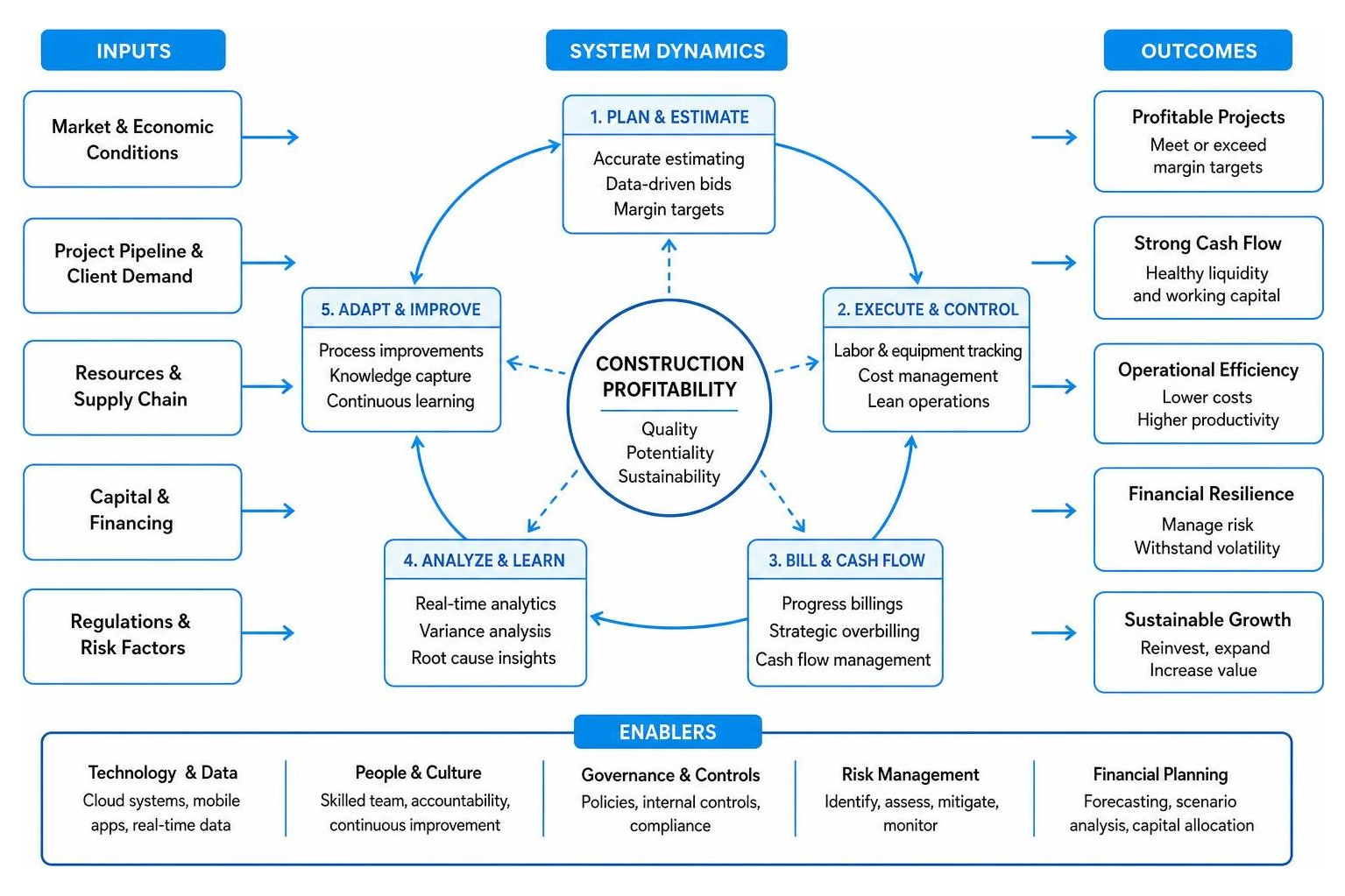
To achieve long-term Strategic Business Growth, we need to evaluate profitability through three dimensions: quality, potentiality, and sustainability. Profit quality looks at how much of reported earnings are backed by actual cash flow rather than paper adjustments. Profit potentiality examines the firm’s capacity to secure high-margin work in the future. Sustainability focuses on the ability to maintain those margins over time. By using system dynamics modeling, we can analyze how path dependency and organizational learning compound over multiple projects. This approach shows how a small operational improvement made today can ripple through the organization and increase overall business value.
Frequently Asked Questions about Construction Profitability
When analyzing financial benchmarks, general contractors and specialty subcontractors operate under different expectations. General contractors typically target gross margins of 15% to 25%, which often translates to an average net profit margin of 3% to 8% after accounting for a target overhead rate of 25% to 32%. Specialty subcontractors generally target higher gross margins of 25% to 40% and net profit margins of 5% to 12%, supported by a target overhead rate of 28% to 35%. Both groups maintain a healthy backlog-to-revenue ratio of 1.0x to 1.5x. Top-quartile revenue per employee reaches over $300,000 for general contractors and exceeds $400,000 for specialty subcontractors.
Why do traditional uniform-rate estimation methods fail in construction?
Traditional uniform-rate estimation methods fail because they treat every project as if it operates under identical conditions. They ignore the margin variability caused by unique project attributes. A flat overhead or labor rate cannot account for the hidden complexities of a brownfield redevelopment, the extended risks of a multi-year contract, or the regulatory hurdles of different regions. When estimators use simplified averages, they often underbid complex, resource-heavy projects while overpricing simpler jobs. This can create a portfolio of work that is volatile and prone to unexpected losses. For a more detailed breakdown of how to move away from these flat-rate traps, explore advanced cost analysis methodologies that focus on activity-based costing and project-specific risk factors.
How does supply-chain volatility impact construction profit margins?
Supply-chain volatility directly impacts construction profit margins by creating unpredictable raw material price changes and costly project delays. When the cost of steel, concrete, lumber, or other essentials rises mid-project, contractors operating under fixed-price contracts may have to absorb the added expense. That quickly erodes planned profit margins. Shipping delays and material shortages can also disrupt project schedules, reduce labor efficiency as crews wait for deliveries, and allow fixed overhead costs to keep accumulating. To protect your business from these risks, implement dynamic procurement strategies, monitor global producer price indices, and include strong material escalation clauses in client contracts.
What is a healthy backlog-to-revenue ratio for a construction firm?
A healthy backlog-to-revenue ratio for a construction firm typically ranges from 1.0x to 1.5x, which represents about 12 to 18 months of contracted work in the pipeline. Maintaining a ratio within this range provides stronger revenue predictability and financial stability. If the ratio drops below 0.8x, it can serve as an early warning sign of a potential cash flow crisis within the next six to nine months, which means the firm needs to secure new work quickly. A ratio well above 2.0x indicates strong demand, but it can also create execution risks if the firm lacks the labor capacity and working capital to manage that volume safely.
Conclusion
Mastering construction profitability analysis is not just about keeping clean books. It is about building a strategic framework that protects your hard-earned margins from the unpredictable realities of the field. From avoiding the uniform-rate trap to optimizing cash flow and using modern predictive technology, every financial decision you make affects the long-term value of your business.
At Spitz CPA, we help construction firms in Gilbert, AZ, and throughout Arizona gain financial clarity, clean up historical accounting errors, and implement strong cash flow controls. Michael J. Spitz and our dedicated team of financial professionals are here to provide the personalized guidance and strategic advisory services you need to scale with confidence. Discover how our Profitability Services in Gilbert AZ That Pay for Theirmselves can help you build a more secure, profitable, and resilient future for your construction company.


