


Fueling Growth with Tax Incentives
A development tax rebate can return significant cash to your bottom line, changing your approach to innovation and growth. These government incentives reward companies for investing in qualifying activities that drive economic progress.
Key Development Tax Rebate Programs:
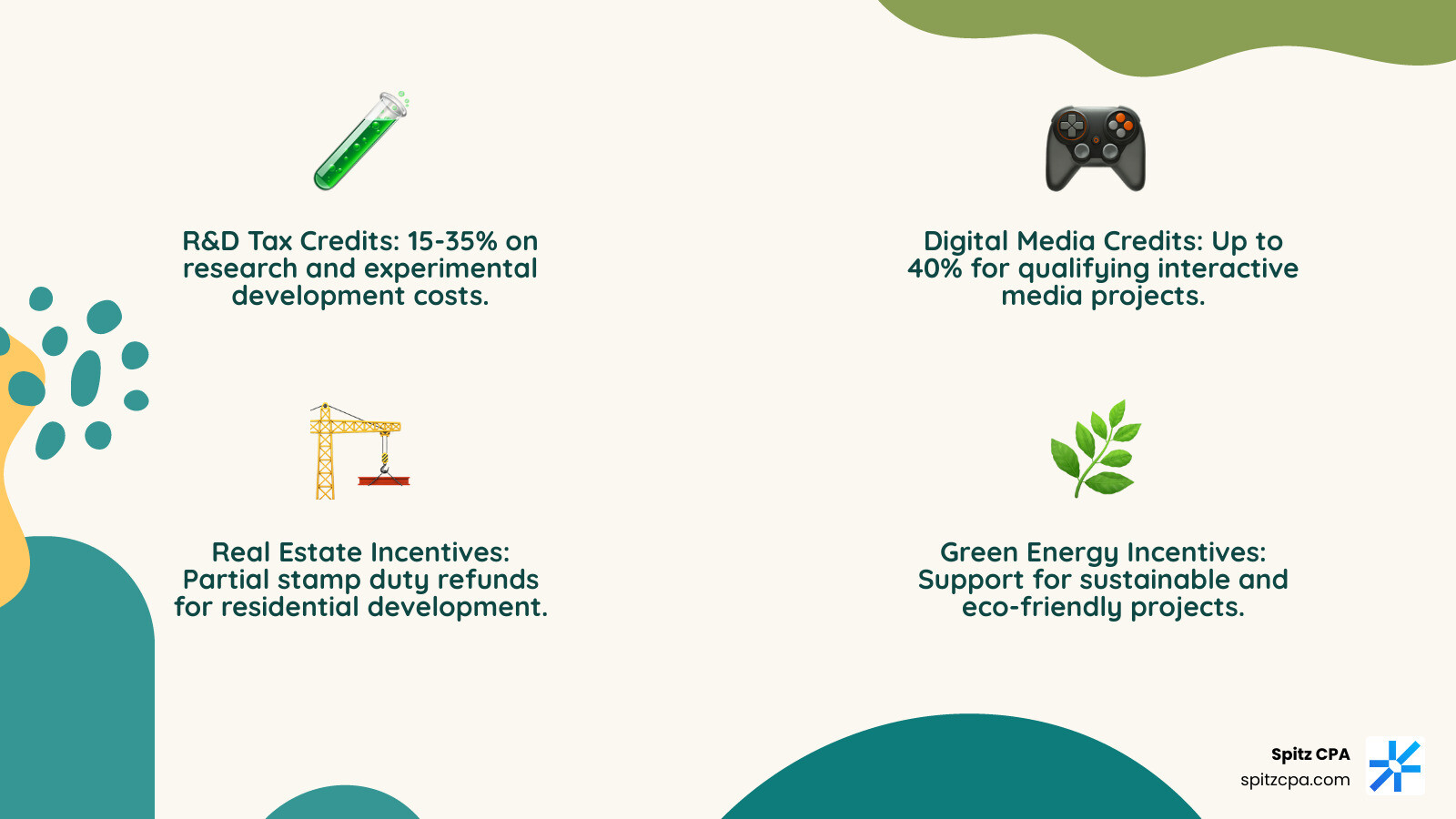
- R&D Tax Credits: 15-35% rebate on research and experimental development costs
- Digital Media Credits: Up to 40% rebate on qualifying interactive media projects
- Real Estate Incentives: Partial stamp duty refunds for residential development
- Industry-Specific Programs: Targeted rebates for gaming, film, and technology sectors
For example, Canada’s SR&ED program offers a 35% refundable credit on the first $3 million of qualified expenditures for eligible corporations. Australia’s Digital Games Tax Offset provides a 30% rebate capped at $20 million annually, and New Zealand’s Game Development Sector Rebate delivers 20% cash back on eligible development costs.
These programs reduce financial risk, improve cash flow, encourage technological advancement, and support job creation. The application process typically requires detailed documentation of expenditures, technical reports, and compliance with eligibility criteria, such as demonstrating systematic investigation or technological uncertainty.
I’m Michael J. Spitz. With over 15 years in corporate accounting, I’ve helped businesses steer complex development tax rebate programs to boost cash flow and growth. My expertise in financial modeling, compliance, and strategic tax planning can guide your company through these valuable incentives.
Understanding Your Development Tax Rebate: R&D and Innovation Incentives
When your team is tackling a tough technological puzzle with mounting costs and an uncertain outcome, a development tax rebate can be a financial lifeline.

R&D tax incentives are the government’s way of supporting your innovation. Whether you’re developing software in Gilbert, Arizona, or conducting lab research, these programs can put money back in your pocket. The most well-known is Canada’s Scientific Research and Experimental Development (SR&ED) tax incentives, but the US R&D Tax Credit offers similar benefits. Recent changes to Section 174 have made software development even more relevant for these credits.
What is a development tax rebate and its purpose?
A development tax rebate is a government investment in your company’s future, designed to reduce the financial risk of R&D projects. The purpose is broader than helping one business; it’s about creating jobs, developing new industries, and boosting economic growth. These programs reward the attempt to solve technological uncertainties, not just success. You can qualify even if a project fails, as long as you followed a systematic research approach.
Who is Eligible and What Expenditures Qualify?
Most businesses, including corporations, individuals, and trusts, can participate in development tax rebate programs if their work meets specific criteria. For SR&ED eligibility, your project needs: technological advancement (pushing boundaries), technological uncertainty (the outcome or method is unknown), and systematic investigation (using hypotheses and documented experiments).
The US R&D Tax Credit’s four-part test requires a permitted purpose under Section 174, being technological in nature, aiming to eliminate uncertainty, and involving a process of experimentation.
Qualified expenditures include: salaries and wages for R&D staff, materials consumed, contractor costs for R&D services, and applicable overhead.
Note a recent change: since 2022, R&D costs (including software development) must be capitalized and amortized over five years (domestic) or fifteen (international). This affects cash flow but can strengthen R&D Tax Credit claims. Organizing your books early is crucial; our Small Business Accounting 101: A Guide for New Entrepreneurs guide can help.
The Application Process and Required Documentation
Applying for a development tax rebate requires attention to detail, but the payoff is worth it. In Canada, you submit your SR&ED claim with your annual tax return using Form T661 and your T2 Corporation Income Tax Return. You’ll also need comprehensive technical reports explaining your technological uncertainties, hypotheses, and systematic investigation.
Meticulous record keeping is vital. Document hypotheses, results, and progress, linking every expense to R&D activities with payroll records, invoices, and overhead calculations. You can file your claim through the Canada Revenue Agency’s My Business Account portal.
The process typically takes two to six weeks. If you haven’t claimed R&D credits before, especially for software, consider reviewing current and past tax years for potential amendments. Professional help with technical reports and cost identification is key to a successful claim. Strategic Tax Planning for Entrepreneurs is invaluable for maximizing your rebate and ensuring compliance.
A Global Look: Comparing Development Incentives
Countries support innovation with unique development tax rebate programs. While the goal of encouraging R&D is the same, the methods vary. Let’s compare the incentives in Canada, Australia, and New Zealand.
These programs reflect national priorities. Canada offers broad R&D support, while Australia and New Zealand focus on the gaming industry.
Canada’s SR&ED and Provincial Credits
Canada’s development tax rebate system involves multiple levels of government. The federal SR&ED program is the foundation, and provincial credits add significant value. Federally, most businesses get a 15% non-refundable tax credit. However, Canadian-controlled private corporations (CCPCs) can claim a 35% refundable credit on the first $3 million of qualified expenditures. This cash-back incentive is a game-changer for growing businesses.
Provincial credits, ranging from 4.5% to 30%, add another layer. In Ontario, for example, two main options work with the federal program. The Ontario Innovation Tax Credit (OITC) is an 8% refundable credit with a $3 million expenditure limit. The Ontario Research and Development Tax Credit (ORDTC) is a 3.5% non-refundable credit with unused portions that can be carried back three years or forward 20.
Canada’s system allows credits to stack together. Claiming the 35% federal credit plus provincial credits creates a powerful financial boost. Our Accounting team helps businesses steer these layered programs to maximize returns.
Australia’s Digital Games Tax Offset (DGTO)
Australia’s Digital Games Tax Offset (DGTO) is a targeted incentive to boost its global standing in the gaming industry. The program offers a 30% refundable tax offset on Qualifying Australian Development Expenditure (QADE), providing significant cash back that can fund future projects. The program has a generous $20 million annual cap per company. Requirements include obtaining certificates from the Minister for the Arts and meeting a minimum QADE of $500,000. You can learn more at the Digital games tax offset page.
New Zealand’s Game Development Sector Rebate (GDSR)
New Zealand’s Game Development Sector Rebate (GDSR) is a straightforward gaming incentive. It provides a 20% rebate on eligible development costs incurred since April 1, 2023. Its broad scope covers the entire development lifecycle, from R&D and design to marketing and post-launch updates. Claims are made annually with specific deadlines. Though the process is complex, the 20% rebate is significant. Success requires excellent record-keeping, where professional Bookkeeping is invaluable.
Here’s how these three programs stack up:
| Feature | Canada (SR&ED – CCPC) | Australia (DGTO) | New Zealand (GDSR) |
|---|---|---|---|
| Rebate Rate | 35% (federal) + provincial | 30% | 20% |
| Type | Refundable (federal) + Provincial | Refundable Tax Offset | Rebate |
| Key Industries | All R&D-performing industries | Digital Games | Digital Games |
| Cap/Limit | $3M (federal expenditure limit) | $20M (per company/group per year) | No explicit cap mentioned |
| Administered By | CRA (federal), Provincial bodies | ATO (tax), Minister for the Arts (cert.) | NZ On Air |
Each program reflects its country’s unique approach to fostering innovation. Canada’s comprehensive system supports R&D across all industries, while Australia and New Zealand have made strategic bets on the gaming sector.
Industry-Specific Rebates: From Digital Media to Real Estate
Beyond broad R&D incentives, many jurisdictions offer specialized development tax rebate programs for specific industries. These targeted programs nurture sectors considered vital for economic growth, job creation, or cultural development.

Industries that commonly benefit from these rebates include:
- Interactive digital media and gaming
- Film and television production
- Real estate and construction (especially residential, affordable, or historic)
- Green energy and clean technology
- Manufacturing (for process improvements or new products)
- Agriculture (for new farming techniques)
Interactive Digital Media and Gaming Credits
Interactive digital media and gaming are prime examples of sectors with targeted development tax rebate programs. Ontario’s Interactive Digital Media Tax Credit (OIDMTC) is a generous, refundable tax credit for corporations creating eligible digital media products.
The credit is 40% for eligible Ontario labour and marketing on “non-specified products” (for sale/licensing). For “specified products” (fee-for-service) and digital games, the rate is 35% on eligible labour. Eligible expenditures include salaries and wages for Ontario residents. For non-specified products, marketing and distribution costs also qualify (capped at $100,000).
Eligibility criteria require a Canadian corporation developing products at a permanent Ontario establishment. The product must be interactive digital media for entertainment or education (for children under 12), using at least two formats (text, sound, images). An “80/25 rule” dictates labour cost proportions, but qualifying digital game corporations have some relief from this.
The administration process is two steps: first, get a certificate of eligibility from Ontario Creates, then file it with the CRA. For the latest updates, check out What’s new – Film and media tax credits.
Real Estate and Construction Incentives
Development tax rebates also exist for real estate and construction, sectors that impact housing and community development. These programs often align with public policy goals like increasing housing supply.
Ireland’s Residential Development Stamp Duty Refund Scheme provides partial refunds of stamp duty for residential units built on non-residential land, offsetting high land acquisition costs. The refund calculation is generous, allowing developers to recoup up to two-thirds of the stamp duty paid, provided construction deadlines are met.
In the United States, the 45L Tax Credit offers up to $5,000 per dwelling unit for developers of energy-efficient buildings. Even traditional construction can qualify for R&D tax credits. Developing efficient methods, testing new materials, or solving complex engineering problems that meet the IRS’s four-part test can make a construction company eligible.
State-level programs like those in Texas offer further opportunities for affordable housing, media production facilities, and other qualifying developments. Navigating these programs requires careful planning and documentation, similar to the diligence needed when you What to Prepare If You’re Selling Your Business. Attention to detail and professional guidance are key.
Frequently Asked Questions about Development Tax Rebates
Navigating development tax rebates can be complex. Here are answers to some common questions.
What are the key differences between federal and provincial tax incentives?
Federal and provincial tax incentives work together but differ in key areas: jurisdiction, administration, refundability, credit rates, and stacking rules.
- Jurisdiction and administration: Federal incentives (like Canada’s SR&ED) are run by national bodies (CRA), while provinces run their own. Sometimes the federal body administers provincial programs.
- Refundability: Refundable credits provide a cash payment if the credit exceeds taxes owed. Non-refundable credits only reduce taxes to zero, with the excess carried over.
- Credit rates: Federal programs offer a baseline rate, while provincial programs add their own percentage on top.
- Stacking rules: These define how programs interact. Most jurisdictions let you claim both federal and provincial credits for the same costs. However, other government assistance can reduce eligible expenditures, requiring careful calculation.
How do these incentives encourage innovation and R&D?
These incentives act as a financial safety net, encouraging innovation through several mechanisms:
- Reducing financial risk: Tax rebates offset the high costs and uncertainty of R&D, making companies more willing to invest in innovative projects.
- Increasing cash flow: Refundable credits provide a direct cash injection that can be reinvested into hiring, equipment, or scaling. This is crucial for growth.
- Funding future projects: Recovering past R&D costs frees up capital for new initiatives, creating a cycle of continuous innovation.
- Fostering experimentation: Knowing that even unsuccessful R&D costs can be partially recovered encourages companies to take experimental approaches that can lead to breakthroughs.
- Enhancing competitiveness: These programs provide a cost advantage, allowing companies to invest more in innovation, leading to better products and a stronger market position.
Calculating your potential development tax rebate: How do rates and caps work?
Calculating your potential development tax rebate involves understanding credit rates, expenditure limits, and caps. For example, the 15% federal SR&ED rate becomes a 35% refundable rate for CCPCs on the first $3 million of expenditures. Anything above that threshold falls under the lower rate.
Caps can be on expenditures (like SR&ED’s $3 million threshold) or on the total rebate (like Australia’s DGTO cap of $20 million per year). If a tax year straddles a rate change, calculations must be prorated.
For example, a CCPC in Ontario with $1 million in eligible SR&ED expenditures could calculate a $350,000 federal refundable credit (35%) plus an $80,000 Ontario Innovation Tax Credit (8%), for a total potential refund of $430,000. The complexity arises from program interactions and eligibility rules, where professional guidance is invaluable for maximizing rebates and ensuring compliance.
Conclusion: Building Your Future with Smart Tax Strategy
You’ve seen the exciting potential of development tax rebates. These aren’t just paperwork; they are powerful financial tools that can transform your approach to innovation and growth.
Whether you’re developing software in Gilbert, creating a mobile game, or building housing projects, governments are willing to help fund your ambitious ideas. The improved cash flow from these credits can be the difference between an idea and a reality. The reduced cost of innovation allows for calculated risks that lead to breakthroughs. The resulting increased profitability and strategic growth opportunities allow you to hire, invest, and expand.
Knowing these programs exist is half the battle. The real advantage comes from having an expert who understands both tax law and your business. That’s where we come in.
At Spitz CPA, we’ve seen how the right tax strategy can change a business trajectory. We don’t just fill out forms; we help you see the bigger picture. Our personalized guidance and accounting clean-up expertise have helped businesses achieve remarkable growth, sometimes even a 10x value increase, by ensuring they capture every available opportunity.
These programs are designed with you in mind. The key is having a partner who can help you steer the complexity and turn these opportunities into real cash. Your future self will thank you for taking action today. Smart tax strategy is about building the foundation for sustained growth. Ready to explore what these powerful programs can do for your business? Our Tax Services team is here to help you open up your full potential.


