


Are You Missing Out on Valuable Tax Savings?
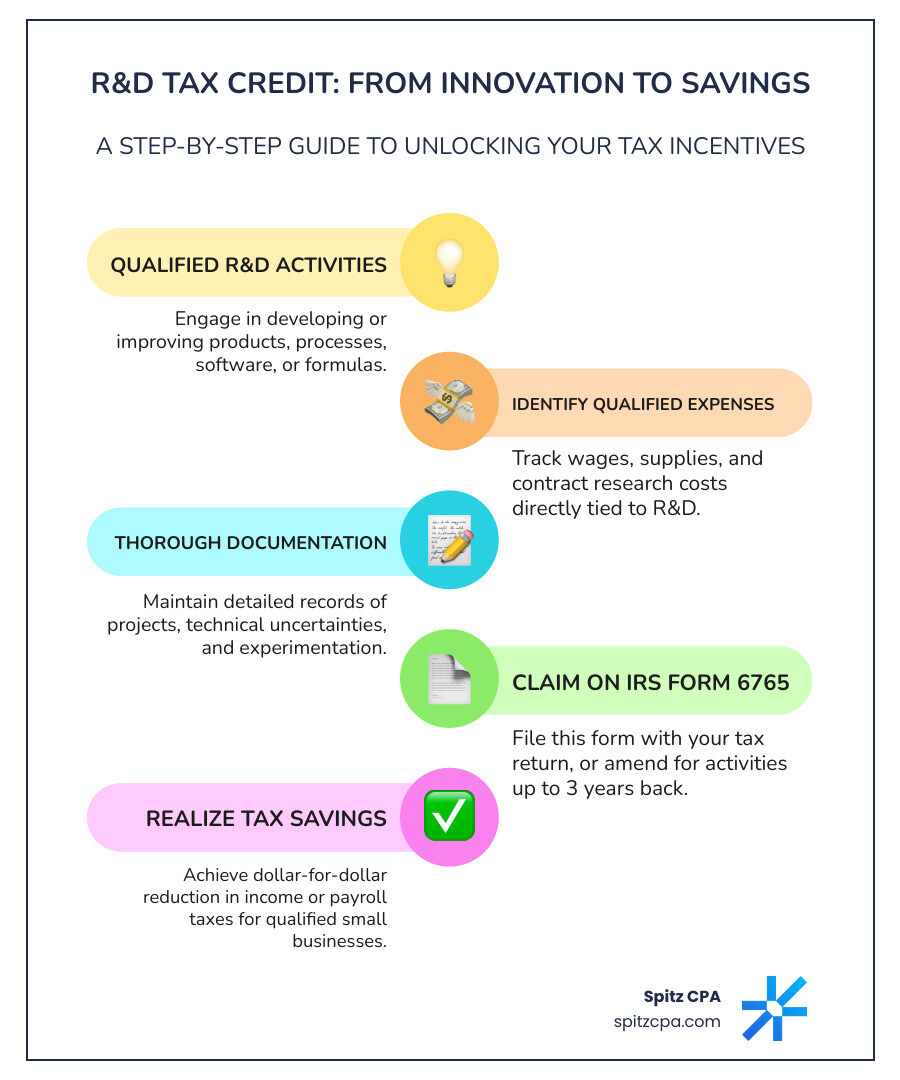
Do I qualify for R&D tax credit? You may be eligible if your business develops, improves, or innovates products, processes, software, or technology through a systematic process that involves technical uncertainty. Here’s a quick qualification check:
Quick Qualification Checklist:
- Business Structure: Corporations, partnerships, sole proprietorships, or individuals conducting business in the U.S.
- Qualifying Activities: Developing or improving products, processes, software, formulas, or techniques
- Technical Nature: Work relies on hard sciences like engineering, computer science, physics, chemistry, or biology
- Uncertainty: You faced technical challenges about capability, method, or design
- Experimentation: You used systematic testing, prototyping, modeling, or trial-and-error approaches
- Eligible Expenses: Wages for R&D staff, supplies consumed during research, and contract research costs
If you’re investing time and money into research and development, you might be missing out on a powerful tax incentive that could significantly reduce your tax liability. The R&D tax credit offers a dollar-for-dollar reduction in federal income or payroll taxes for companies conducting qualified research in the United States. Yet many businesses—from startups to established mid-market companies—either don’t realize they qualify or struggle to steer the complex claiming process.
The good news? The Protecting Americans from Tax Hikes (PATH) Act of 2015 expanded access to this credit, making it easier for small businesses and startups to benefit. In fact, 91% of claims were accepted by the IRS in the 2023-2024 fiscal year, and businesses can claim credits for activities as far back as three years through amended returns.
This guide will walk you through the qualification criteria, explain the IRS’s four-part test, identify eligible expenses, and show you how to claim the credit effectively. Whether you’re developing software, improving manufacturing processes, or conducting experiments to overcome technical challenges, understanding if you qualify for the R&D tax credit could open up substantial tax savings for your business.
I’m Michael J. Spitz, and with over 15 years of corporate accounting experience including strategic financial decisions and tax preparation, I’ve helped numerous businesses steer complex tax incentives and optimize their financial performance, including determining R&D tax credit eligibility. Throughout this guide, I’ll break down the qualification process into clear, actionable steps so you can confidently assess your eligibility and maximize your claim.
Related R&D Tax Credit Guides:
Understanding the R&D Tax Credit: A Powerful Incentive for Innovation
Imagine getting a dollar back for every dollar you invest in innovation. That’s essentially the magic of the R&D tax credit. This federal incentive, formalized under Section 41 of the Internal Revenue Code (IRC), is designed to encourage businesses across the U.S., including those right here in Arizona, to keep pushing boundaries, innovating, and developing new or improved products, processes, software, and techniques. It’s a general business tax credit that directly reduces your tax liability, rather than just being a deduction.
Before 2015, many small and medium-sized businesses found it challenging to fully use the R&D credit due to limitations. However, the Protecting Americans from Tax Hikes (PATH) Act of 2015 was a game-changer. It made the R&D credit permanent and, crucially, allowed eligible small businesses to offset their Alternative Minimum Tax (AMT) and even claim a portion of the credit against their payroll taxes. This means that even if your startup isn’t yet profitable enough to owe income tax, you could still receive cash back through reduced payroll taxes!
This powerful incentive can significantly boost your company’s cash flow, fund further innovation, and support overall profitability. It’s an opportunity we help many Arizona businesses explore through our R&D Tax Services.
Who is eligible to claim the R&D tax credit?
One of the most common questions we hear is, “Who exactly can claim this credit?” The beauty of the R&D tax credit is its broad applicability. It’s not just for tech giants or pharmaceutical companies. Any U.S. business, regardless of its size or industry, that incurs expenses related to developing or improving products, processes, software, or technology may qualify. This includes:
- Corporations: Both C-corporations and S-corporations are eligible. C-corps typically use the credit to reduce their income tax liability, while S-corps pass the credit through to their shareholders.
- Individuals: Sole proprietorships can claim the credit on their personal tax returns.
- Partnerships: Partnerships also pass the credit through to their partners, who then claim it on their individual returns.
This broad definition means that whether you’re a startup, a small or medium-sized business (SMB), or a mid-market company operating in Arizona, you might be eligible.
- Startups: If you’re a new company with limited taxable income, the payroll tax offset provision (up to $250,000 per year) can be incredibly valuable, effectively providing a cash infusion to fuel your growth.
- SMBs: For established small and medium-sized businesses, the R&D credit can significantly reduce your federal income tax burden, freeing up capital for reinvestment, expansion, or hiring.
- Mid-market companies: Larger, more established businesses can leverage the credit to optimize their tax strategy, fund significant innovation projects, and maintain a competitive edge.
The key is that the R&D activities must be performed in the United States. So, if your operations are based in Gilbert, Arizona, you’re already off to a great start! To dive deeper into what constitutes eligible R&D activities, check out our guide on What is R&D in Business?.
Do I Qualify for R&D Tax Credit? The IRS Four-Part Test
To determine if your activities truly qualify for the R&D tax credit, the IRS uses a “four-part test.” Think of this as a rigorous scientific method for your tax claim. All four parts must be met for an activity to be considered “qualified research.” This test helps distinguish routine engineering or commercialization efforts from genuine, credit-worthy innovation.

Understanding these criteria is crucial, as they form the bedrock of your eligibility. We’ve seen many businesses overlook potential credits simply because they didn’t realize their everyday innovations fit these definitions. Our R&D Tax Credit Rules Complete Guide offers an even more in-depth look, but here’s the breakdown:
1. The Permitted Purpose Test
This first test asks: “What were you trying to achieve?” For an activity to qualify, its purpose must be to develop a new or improved business component. A business component can be a product, process, software, technique, formula, or invention. The goal of your research must be to improve its:
- Functionality: Making it do more things or perform new tasks.
- Performance: Making it faster, more efficient, or more powerful.
- Reliability: Making it less prone to failure or more consistent.
- Quality: Making it better in some measurable way.
For example, if an Arizona-based software company is developing a new algorithm to make its application run faster or handle more data, that would likely meet the permitted purpose test. The intent is key here—you’re not just making cosmetic changes; you’re genuinely trying to advance the capabilities of something.
2. The Technological in Nature Test
This test focuses on how you’re trying to achieve your goal. The research must be “technological in nature,” meaning it relies on the principles of the “hard sciences.” This includes:
- Engineering: Designing, building, and maintaining structures, machines, and systems.
- Computer Science: Developing new software, algorithms, or data structures.
- Physics: Applying the laws of matter and energy.
- Chemistry: Understanding and manipulating chemical compounds.
- Biology: Research into living organisms and biological processes.
If your team in Gilbert is experimenting with new materials to create a lighter, stronger aerospace component, you’re definitely working within the field of hard science. This test ensures that the work isn’t just business analysis or market research, but rather a systematic investigation rooted in scientific principles.
3. The Elimination of Uncertainty Test
This is where the “R&D” truly comes into play. You must be trying to eliminate “technological uncertainty.” This means you faced a challenge or unknown that you couldn’t easily solve with readily available information or standard practices. You were uncertain about:
- The capability of achieving your desired result.
- The method to achieve that result.
- The appropriate design to achieve that result.
Let’s say a local manufacturing company wants to automate a complex assembly line. They know what they want to achieve, but they’re uncertain if existing robotics can handle the intricate movements required or how to integrate them seamlessly. The work they do to overcome this uncertainty—through experimentation, testing, and design modifications—is exactly what this test looks for. You don’t need to succeed, by the way; the act of trying to overcome the uncertainty is what counts!
4. The Process of Experimentation Test
Finally, the IRS wants to see that you approached this technical uncertainty in a “systematic” way. This isn’t just fiddling around; it’s a deliberate, iterative process of experimentation. This can involve:
- Formulating a hypothesis: “If we do X, then Y will happen.”
- Testing: Running experiments, building prototypes, or conducting simulations.
- Evaluating alternatives: Trying different approaches when one doesn’t work.
- Modeling and Simulation: Using software to predict outcomes.
- Prototyping: Building early versions to test theories.
- Trial and Error: A structured approach to learning from failures and refining your methods.
If your team is repeatedly testing different software configurations to optimize performance, documenting the results, and adjusting their approach based on what they learn, that’s a process of experimentation. It’s about systematically investigating and analyzing to resolve the technical uncertainties you identified.
By carefully documenting how your projects meet each of these four tests, you build a strong case for your R&D tax credit claim.
What Expenses Can You Claim? A Breakdown of QREs
Once you’ve determined that your activities pass the IRS’s four-part test, the next step is to identify and quantify your Qualified Research Expenditures (QREs). These are the costs directly related to your eligible R&D activities that you can claim for the credit. Understanding these categories is essential for maximizing your benefit, as every dollar of QREs contributes to your credit calculation. For a deeper dive into the numbers, our R&D Tax Credit Calculation Complete Guide can help.
Wages and Salaries
This is often the largest component of an R&D tax credit claim. You can include wages paid to employees who are directly involved in performing qualified research activities. This isn’t just the scientists or engineers; it extends to anyone whose work directly supports the R&D. The IRS categorizes these employees into three groups:
- Directly Engaged Employees: These are the individuals actually performing the hands-on research, experimentation, or development. Think of the software developers coding, the chemists running experiments, or the engineers designing prototypes.
- Direct Supervision: This includes individuals who directly supervise the people performing the qualified research. Their role is to oversee and guide the R&D activities.
- Direct Support: These are employees who provide direct support to the R&D activities. This could be a lab technician maintaining equipment, a data analyst compiling research results, or a CAD designer creating models for prototypes. However, general administrative staff (like payroll personnel or HR) whose work isn’t directly tied to the R&D project itself typically don’t qualify.
While we don’t have specific U.S. statistics on R&D wage spending from the provided research, it’s clear that a significant portion of R&D investment goes into human capital. Many businesses in Arizona, from innovative startups to established manufacturers, invest heavily in their R&D teams, and these wages are a prime source of credit.
Supplies and Materials
Any tangible property (excluding land and depreciable property) used and consumed in the R&D process can be included as a QRE. This often includes:
- Prototypes: Materials used to build experimental models or initial versions of a new product.
- Testing: Chemicals, components, or other items consumed during the testing phase of your research.
- Experimental Production: Materials used in the initial, experimental production runs where you’re still working out the kinks of a new process.
The key here is that these supplies and materials must be consumed during the R&D activities and not for commercial sale or incorporated into a final product that is sold. For example, if you’re developing a new type of semiconductor, the silicon wafers you test and destroy during the experimentation phase would qualify. The materials used in the final, commercially viable chip would not.
Contract Research and Cloud Computing
Sometimes, your R&D might involve external help. You can claim 65% of amounts paid or incurred to third parties for qualified research performed on your behalf. This is known as “contract research.” The IRS generally requires that the contractor performs the research at your risk and under your direction.
For businesses in Arizona developing software or leveraging advanced analytics, cloud computing costs are also becoming increasingly relevant. While the IRS instructions mention “computer rentals” as a qualified expense, it’s crucial that these costs are directly tied to your R&D activities. If you’re using cloud servers to run simulations for a new AI model, host experimental software, or perform data analysis for your R&D, those costs can be included. Only the portion directly linked to R&D activities is eligible, so detailed tracking is essential.
To see how these expenses come together in a real-world scenario, take a look at our R&D Tax Credits Example.
The Claiming Process: From Documentation to Filing
So, you’ve identified your qualifying activities and expenses. Now comes the crucial step: claiming the credit. The process involves meticulous documentation, accurate calculation, and timely filing. It might sound a bit daunting, but with the right approach, it’s entirely manageable.

How to Claim and How Far Back Can You Go?
To officially claim the R&D tax credit, your business will need to file IRS Form 6765, Credit for Increasing Research Activities (you can find more details at IRS Form 6765, Credit for Increasing Research Activities). This form is submitted along with your annual federal income tax return. On this form, you’ll detail your qualified research expenses and calculate the credit amount.
What if you just realized you qualified for activities you did a few years ago? Good news! You can generally claim the R&D credit retroactively by filing amended returns. The standard “look-back” period is three years from the date you filed your original return. So, if you filed your 2022 tax return on April 15, 2023, you generally have until April 15, 2026, to amend it and claim the R&D credit. This can be a fantastic opportunity to recover past R&D expenses and boost your cash flow.
Best Practices for Maximizing Your Claim
Maximizing your R&D tax credit isn’t just about identifying eligible expenses; it’s about proving them to the IRS. Here are some best practices we advocate for Arizona businesses:
- Contemporaneous Documentation: This is perhaps the most critical element. The IRS wants to see documentation created at the time the R&D activities occurred, not retroactively. This includes project plans, meeting minutes, lab notebooks, design specifications, test results, emails, and any other records that show the systematic process of experimentation and the technical uncertainties you faced.
- Project Accounting: Track your R&D expenses by project. This makes it much easier to connect specific costs to specific qualifying activities.
- Time Tracking: Implement a robust system for employees to track their time spent on R&D activities. This provides clear evidence of who worked on what, and for how long, allowing you to accurately claim eligible wages.
- Regular vs. Alternative Simplified Credit (ASC): The IRS offers two methods to calculate the credit: the Regular Credit and the Alternative Simplified Credit (ASC). The ASC is often simpler to calculate, especially if you don’t have extensive historical data, but may yield a lower credit. We often calculate both to determine which method provides the greatest benefit for our clients.
- Expert Guidance: Navigating the nuances of R&D tax credits can be complex. Working with experienced R&D Tax Experts can ensure accuracy, compliance, and help you uncover every eligible dollar.
Common Mistakes to Avoid When Determining R&D Tax Credit Eligibility
Even with the best intentions, businesses can make mistakes that jeopardize their R&D tax credit claims. Here are some of the most common pitfalls we help our clients avoid:
- Poor Documentation: As mentioned, this is the biggest culprit. Without clear, contemporaneous records, the IRS may disallow your claim. Don’t rely solely on oral testimony; back it up with paper (or digital) trails.
- Misclassifying Activities: Claiming activities that don’t meet the four-part test is a red flag. Forgetting to apply the “technological in nature” or “elimination of uncertainty” tests can lead to problems.
- Overlooking Support Costs: Many businesses focus only on direct research wages and forget about direct supervision and direct support personnel, leaving money on the table.
- Missing Deadlines: The three-year look-back period for amended returns is strict. Miss that window, and you lose the opportunity to claim past credits.
- Ignoring Section 174 Changes: Recent legislative changes, particularly around Section 174 regarding the capitalization of R&E expenditures, can significantly impact your tax strategy. Understanding these new rules is crucial, and our New R&D Rules guide can provide more context.
Frequently Asked Questions About the R&D Tax Credit
We often get asked similar questions by businesses curious about the R&D tax credit. Let’s tackle some of the most common ones.
How does the R&D tax credit benefit startups?
For startups, especially those not yet showing a profit, the R&D tax credit can be a lifeline. The most significant benefit is the payroll tax offset. Eligible qualified small businesses (those with gross receipts under $5 million for the tax year and no gross receipts for any tax year before the 5-tax-year period ending with the tax year) can elect to use up to $250,000 of their R&D credit annually against their employer’s portion of Social Security taxes.
This means you can monetize the credit even without an income tax liability, effectively providing a cash refund that can be reinvested directly into your operations, hiring, or further R&D. It’s a fantastic way to turn your innovation into immediate cash flow. This is essentially a R&D Cash Credit for growing businesses.
Is the R&D tax credit considered taxable income?
No, the R&D tax credit is not considered taxable income. This is a common misconception! It’s a direct credit, meaning it reduces your tax liability dollar-for-dollar. Unlike a deduction, which lowers your taxable income, a credit directly reduces the amount of tax you owe.
However, there is a nuance with Section 280C of the Internal Revenue Code. If you claim the R&D credit, you generally can’t also deduct the portion of your research expenses that generated the credit. You have two options: either reduce your R&D expense deduction by the amount of the credit or elect a reduced R&D credit (which is 65% of the full credit) and keep your full deduction. We always help our clients determine the most advantageous approach.
Do R&D tax credits expire if I can’t use them?
No, R&D tax credits don’t just disappear if you can’t use them in the current tax year. The IRS allows for generous carryforward and carryback provisions. Unused R&D credits can generally be carried back one year to offset past tax liabilities, and they can be carried forward for up to 20 years to offset future tax liabilities. This means that even if your business doesn’t have enough tax liability in the current year to fully use the credit, it remains a valuable asset for years to come. This flexibility makes the R&D tax credit a powerful long-term incentive for continuous innovation.
Conclusion: Secure Your R&D Tax Incentives
As we’ve explored, the R&D tax credit is a powerful, yet often underused, financial incentive for businesses that innovate, develop, or improve products, processes, software, or techniques. Whether you’re a startup in Phoenix, a manufacturer in Tucson, or a software developer in Gilbert, understanding if you qualify for the R&D tax credit can open up significant tax savings and boost your company’s growth.
The key to successfully leveraging this credit lies in carefully understanding the IRS’s four-part test, diligently tracking eligible expenses, maintaining robust documentation, and navigating the filing process with precision. It’s an opportunity to turn your investment in innovation into tangible financial benefits, but it requires careful attention to detail and a strategic approach.
Don’t leave money on the table. Michael J. Spitz and the team at Spitz CPA are experts in helping businesses like yours assess their eligibility, calculate their claims, and confidently secure the R&D tax credits they deserve. We’re here to provide the personalized guidance and accounting expertise you need to improve cash flow, gain financial clarity, and achieve significant growth.
Ready to find out if your innovative work qualifies for this valuable tax incentive?


