


Stop Overpaying: What Business Owners Can Actually Deduct
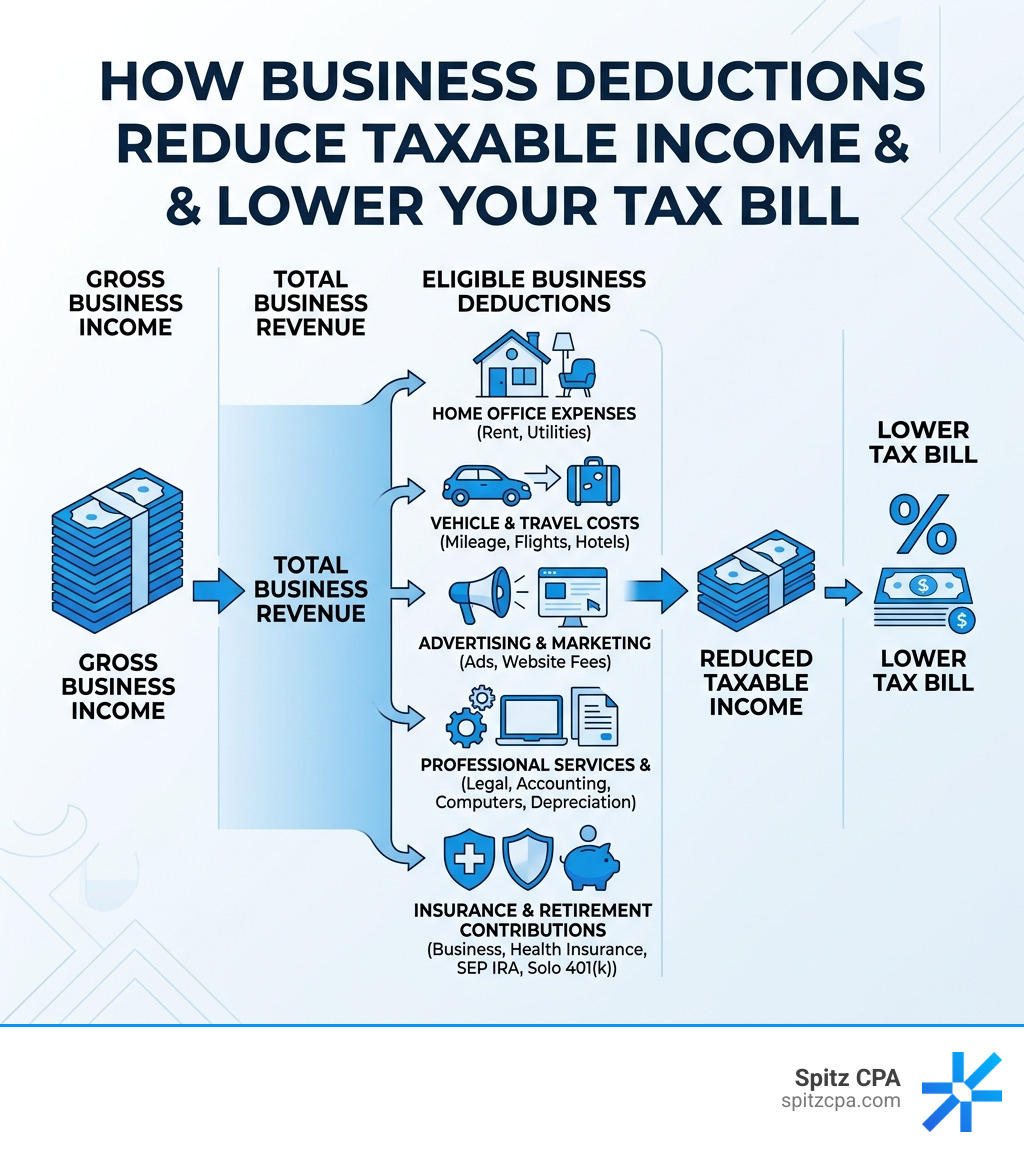
Deductions for business owners are eligible business expenses that reduce your taxable income — meaning you pay tax on less of what you earn.
Here are the most common ones at a glance:
| Deduction Category | Examples |
|---|---|
| Home office | Rent, utilities, internet |
| Vehicle & travel | Mileage, flights, hotels |
| Advertising | Ads, website, marketing |
| Professional services | Legal, accounting fees |
| Insurance | Business, health, liability |
| Retirement contributions | SEP IRA, Solo 401(k) |
| Equipment & depreciation | Computers, machinery |
| Contract labor | Freelancers, 1099 workers |
| Office supplies | Software, materials |
| Taxes & licenses | Self-employment tax, permits |
The IRS allows deductions for expenses that are ordinary (common in your industry) and necessary (helpful for your business). Most small business owners miss dozens of these — and that means leaving real money on the table every year.
I’m Michael J. Spitz, a CPA with 15+ years of corporate accounting experience helping business owners across Phoenix and the country identify every eligible deduction they’re entitled to. Let’s walk through the ones that matter most.
Quick look at deductions for business owners:
- Insurance Premiums Tax Deduction
- Small Business Tax Credit for Health Insurance
- Small Business Tax Deductions
Who Qualifies for Deductions for Business Owners?
If you are operating a business in Gilbert, AZ, or anywhere else in the country, you likely qualify for various tax write-offs. However, the IRS has specific rules about who can claim these expenses. Generally, if you are a sole proprietor, a freelancer, a 1099 independent contractor, or the owner of an LLC, you are eligible to claim Small Business Tax Deductions.
The primary requirement is that you must have a “profit motive.” This means you are engaging in your activity with the intent to make money. The IRS distinguishes between a business and a hobby; if you’re just doing something for fun and happen to make a few dollars, your deduction options are much more limited. To stay on the safe side, we recommend reviewing the Guide to business expense resources | Internal Revenue Service to ensure your activities meet their criteria.
At Spitz CPA, we see many entrepreneurs in Arizona who aren’t sure if they “count” as a business owner. Whether you’re running a full-scale operation in Gilbert or consulting from your kitchen table, if you’re working for yourself, you’re a business owner in the eyes of the tax man.
Top 20 Essential Deductions for Business Owners
Navigating the tax code can feel like trying to read a map in a blizzard. To help clear the air, we’ve compiled a list of the most essential deductions for business owners. These are the “bread and butter” expenses that keep your doors open and your website running.

- Advertising and Marketing: Everything from Facebook ads to the business cards you hand out at local Gilbert networking events.
- Bank Fees: Monthly maintenance fees for your business checking account or transaction fees from payment processors.
- Contract Labor: Payments made to freelancers or independent contractors. If you’re wondering What Can I Write Off On My Taxes As A Freelance Boss, this is a big one.
- Professional Services: Fees paid to lawyers or for accounting and tax preparation (like the services we provide at Spitz CPA).
- Office Supplies: Pens, paper, ink, and even the software subscriptions you use daily.
- Repairs and Maintenance: Fixing the equipment you use for work.
- Utilities: Electricity, water, and internet for your dedicated business space.
- Business Insurance: Protection for your assets and professional liability.
- Insurance Premiums: Specifically, Insurance Premiums Tax Deduction A Healthy Way To Save can apply to various health and business policies.
- Interest Expense: Interest paid on business loans or business credit cards.
- Taxes and Licenses: Business licenses, permits, and your share of payroll taxes.
- Rent: If you lease an office or storefront.
- Employee Benefits: Contributions to health plans or life insurance for your staff.
- Education: Workshops, seminars, and books that improve your skills in your current trade.
- Meals: Generally 50% deductible when traveling or meeting clients.
- Travel: Flights, hotels, and transportation for business trips.
- Software: CRM tools, accounting software, and specialized industry programs.
- Dues and Memberships: Professional organizations or local Chambers of Commerce.
- Shipping and Postage: The cost of sending products or documents to clients.
- Depreciation: Spreading the cost of large purchases over several years.
| Expense Type | Deductibility Status | Key Requirement |
|---|---|---|
| Advertising | 100% | Must be directly related to business |
| Legal/Accounting | 100% | Must be for business purposes |
| Business Meals | 50% | Must include a business discussion |
| Home Office | Varies | Must be exclusive and regular use |
| Office Supplies | 100% | Used within the tax year |
Maximizing Your Home Office Deduction
The home office deduction is often misunderstood, leading many business owners to either skip it out of fear of an audit or claim it incorrectly. To qualify, your home office must be used regularly and exclusively for business. This means the “office” can’t double as a guest bedroom or the kids’ playroom. It must also be your principal place of business.
There are two ways to calculate this deduction:
- The Simplified Method: You claim $5 per square foot of your home used for business, up to a maximum of 300 square feet ($1,500 max deduction). This saves a lot of paperwork.
- The Actual Expenses Method: You calculate the percentage of your home used for business and apply that percentage to your mortgage interest, rent, utilities, and insurance. This requires filing Form 8829.
For more technical details, the IRS provides a breakdown through their Credits and deductions for businesses | Internal Revenue Service portal.
Vehicle and Travel Deductions for Business Owners
Whether you’re driving across Gilbert to meet a client or flying to a conference, travel expenses add up. For vehicles, you have a choice:
- Standard Mileage Rate: For 2024, the rate is 67 cents per mile (set to increase to approximately 70 cents per mile in 2025). This is usually the easiest way to track expenses.
- Actual Expense Method: You track gas, oil changes, tires, insurance, and repairs, then multiply by the percentage of business use.
The key to surviving an IRS check is keeping “contemporaneous logs.” This is just a fancy way of saying you should record your mileage at the time of the trip, not six months later. When it comes to business travel, you can deduct 100% of transportation and lodging, but remember the 50% limit on meals. To ensure you’re getting every penny back, check out our guide on how to Maximize Tax Deductions.
Advanced Strategies: QBI, Depreciation, and Retirement
Once you’ve mastered the basic deductions, it’s time to look at advanced strategies that can save you thousands.
One of the most powerful tools is the Qualified Business Income (QBI) deduction. This allows eligible self-employed individuals and small business owners to deduct up to 20% of their qualified business income from their taxes. It’s essentially “free money” from the IRS, but the rules are complex depending on your total income and type of business. You can read more about it on the Qualified business income deduction | Internal Revenue Service page.
Another heavy hitter is Section 179 expensing. This allows you to deduct the full purchase price of qualifying equipment (like computers or machinery) in the year you buy it, rather than depreciating it over several years. Combined with bonus depreciation, this can drastically lower your tax bill in a high-income year. We often use these as part of our Tax Planning Strategies to help our clients achieve 10x value increase in their business clarity.
Don’t forget retirement! Contributions to a SEP IRA or a Solo 401(k) are not only great for your future but are also powerful deductions for business owners today.
Navigating OBBBA and 2025 Deductions for Business Owners
Tax laws are constantly shifting. You may have heard talk of the “One Big Beautiful Bill Act” (OBBBA) or similar legislative updates affecting future filings. One major area of focus is the phase-out of bonus depreciation. While it was 100% in previous years, it is scheduled to decrease unless Congress acts.
However, Section 179 remains a robust option with a deduction limit of over $1 million and a total equipment purchase cap of around $2.5 million. At Spitz CPA, we specialize in Tax Planning For Entrepreneurs, staying ahead of these changes so you don’t have to spend your weekends reading tax code.
Frequently Asked Questions about Business Write-Offs
We get a lot of questions at our Gilbert, Arizona office. Here are the most common ones regarding deductions for business owners.
Can I deduct my health insurance premiums?
Yes! If you are self-employed and have a net profit for the year, you may be able to claim the self-employed health insurance deduction. This is an “above-the-line” deduction, meaning it reduces your adjusted gross income (AGI) regardless of whether you itemize. It can cover premiums for you, your spouse, and your dependents. Plus, you might even qualify to Get Paid To Insure Your Team With This Small Business Tax Credit.
How much of my self-employment tax is deductible?
When you work for yourself, you pay both the employer and employee portions of Social Security and Medicare taxes (totaling 15.3%). The good news is that you can deduct 50% of this self-employment tax from your gross income. This helps level the playing field between business owners and traditional employees. For more itemized ideas, see our Itemized Deduction Examples.
What startup costs can I claim in my first year?
The IRS allows you to deduct up to $5,000 in business start-up costs and $5,000 in organizational costs in your first year of operation. However, this benefit starts to phase out if your total startup costs exceed $50,000. Any costs that aren’t deducted immediately must be amortized over a 15-year period. Proper Business Tax Strategies are essential during your first year to ensure you don’t lose these valuable deductions.
Conclusion
Maximizing deductions for business owners isn’t about “cheating” the system; it’s about using the rules the government created to encourage business growth. By maintaining proper bookkeeping and gaining financial clarity, you protect yourself from audits and keep more of your hard-earned money to reinvest in your company.
At Spitz CPA, we help businesses in Gilbert, AZ, and beyond clean up their accounting and implement growth-focused tax strategies. If you’re ready to stop guessing and start growing, reach out to us for professional Tax Services. We’ll help you make sure Uncle Sam only gets his fair share—and not a penny more.


