


Why Employee Outsourcing Companies Are Changing Modern Business
Employee outsourcing companies are third-party providers that handle HR functions like payroll, benefits, and compliance for businesses of all sizes. They help companies reduce costs, save time, and focus on their core operations while ensuring regulatory compliance.
The numbers tell the story: 66% of U.S. companies outsource at least some business functions, and small to medium businesses that partner with outsourcing providers grow 7-9% faster and have 10-14% lower employee turnover.
As Melissa Kinnoch, CFO of Kit and Ace, shared about their outsourcing partnership: “We have the necessary information to eliminate potential errors, leading to labor savings and business improvement.”
Whether you’re drowning in payroll tasks or struggling with compliance, employee outsourcing companies can transform your business operations from a time drain into a competitive advantage.
I’m Michael J. Spitz, and with over 15 years of corporate accounting experience, I’ve helped businesses steer the financial complexities of employee outsourcing companies and optimize their workforce management strategies. My expertise in payroll systems, compliance, and cost accounting gives me unique insight into how outsourcing can drive both operational efficiency and bottom-line results.
Key Services Offered by Employee Outsourcing Companies
Partnering with employee outsourcing companies means engaging a strategic ally to handle a broad spectrum of human resources functions. Key services include:
- Payroll Processing: Accurate salary calculations, tax withholding, and direct deposits. This ensures timely and precise employee payments. For more on this, see our guide on How to Do Payroll and Avoid Mistakes.
- Benefits Administration: Managing health insurance, retirement plans (401(k)s, group RSPs), and other employee perks. Providers often offer access to more comprehensive and affordable benefit packages.
- HR Compliance Management: Ensuring your business adheres to all relevant federal, state, and local employment laws (e.g., FMLA, ADA, FLSA), minimizing legal risks.
- Talent Acquisition and Onboarding: Support with recruitment, screening, and creating a smooth onboarding process for new hires.
- Performance Management: Providing tools and guidance for performance reviews, goal setting, and navigating employee relations issues.
- Year-End Reporting: Preparing and filing all necessary year-end documents, such as W-2s or T4s, accurately and on time.
Why Businesses Outsource
Businesses turn to employee outsourcing companies for several compelling reasons:
- Cost Efficiency: Avoid the high costs of an in-house HR team, including salaries, benefits, and training, and reduce the risk of expensive compliance penalties.
- Time Savings: Free up internal teams from time-consuming administrative tasks to focus on core business activities and strategic growth.
- Access to Expertise: Gain immediate access to seasoned HR specialists who are up-to-date on compliance, best practices, and industry trends.
- Risk Mitigation: Shift the burden of complex employment laws and regulations to a provider who is responsible for ensuring adherence and minimizing legal exposure.
- Improved Employee Experience: Provide reliable payroll, professional benefits administration, and consistent HR support, which contributes to higher employee satisfaction and lower turnover.
The Core Benefits: Opening up Efficiency and Growth
Partnering with employee outsourcing companies opens up new levels of operational efficiency and paves the way for sustainable growth. It provides a specialized, invisible partner to handle the intricate details of workforce management.

Gaining Cost and Time Efficiency
Cost and time savings are two of the most significant benefits of outsourcing:
- Labor Savings: Reduce overall labor costs by offloading tasks like payroll and benefits administration, avoiding the direct and indirect expenses of an in-house HR team.
- Reduced Infrastructure Costs: Eliminate the need for investment in expensive HR software, systems, and office space. Providers use their own robust, secure platforms.
- Avoiding In-House HR Staff Costs: Access a full suite of HR expertise for a fraction of the cost of hiring, training, and retaining a comparable internal team.
- Automating Manual Tasks: Leverage advanced software and automation to streamline repetitive HR functions, increasing accuracy and freeing your team from manual data entry and correction.
At Spitz CPA, our Outsourcing Services are designed to help businesses achieve maximum efficiency and cost savings.
Ensuring Compliance and Reducing Risk
The legal landscape surrounding employment is a significant risk area for any business. Outsourcing helps mitigate these risks effectively.
- Navigating Labor Laws: Specialists stay current on frequently updated labor laws, ensuring your policies and practices are fully compliant and reducing your risk of lawsuits or penalties.
- Tax Regulations: Outsourcing partners handle complex payroll tax withholding, reporting, and remittance, ensuring accuracy and timeliness to avoid severe fines. Our Tax Services can further support your strategy in this area.
- Workers’ Compensation: Simplify the management of workers’ compensation insurance and claims. PEOs, in particular, can often provide better rates by pooling clients.
- Data Security: Reputable providers use secure, encrypted systems and follow stringent data privacy protocols to protect sensitive employee information.
- Expert HR Support: Gain access to expert advice on tricky employee situations, new regulations, and HR best practices, helping prevent compliance issues before they arise.
Comparing the Models: PEO vs. HRO and Beyond
When exploring employee outsourcing companies, you’ll find several distinct models. Understanding the differences between a Professional Employer Organization (PEO), HR Outsourcing (HRO), and an Employer of Record (EOR) is crucial for selecting the right fit for your business.

Understanding the Professional Employer Organization (PEO)
A PEO operates on a co-employment relationship, where it shares certain employer responsibilities with your business. The PEO becomes the employer of record for tax and compliance purposes, while you maintain full control over your daily operations and employees.
This shared liability for compliance, payroll taxes, and workers’ compensation provides a significant safety net. One of the biggest advantages of a PEO is access to large-group benefits. By pooling employees from all client companies, PEOs can offer Fortune 500-level health insurance and retirement plans to small businesses.
A PEO delivers a comprehensive HR solution, making it ideal for small to mid-sized businesses that need full HR support without the overhead of an internal department. According to The National Association of Professional Employment Organizations, SMBs that partner with PEOs grow 7-9% faster, see 10-14% lower employee turnover, and are 50% less likely to fail.
The Flexibility of HR Outsourcing (HRO)
If a PEO is a full-service solution, HR Outsourcing (also known as an Administrative Services Organization or ASO) is an à la carte menu. HRO allows for selective task delegation, meaning you choose which HR functions to outsource while handling the rest in-house.
With HRO, you retain full employer status and all associated legal responsibilities; the provider acts as a vendor. This model’s strength is its customizable service packages, which can scale with your business. You can start with just payroll and add other services as you grow.
This flexibility makes HRO attractive for businesses with some internal HR capabilities that need targeted support. Many HRO providers specialize in Human Capital Management & Payroll services, offering tools to optimize your workforce strategy.
Comparing PEO, HRO, and EOR
Here’s a straightforward comparison of the three main models:
| Feature | Professional Employer Organization (PEO) | HR Outsourcing (HRO) / ASO | Employer of Record (EOR) |
|---|---|---|---|
| Service Scope | Comprehensive HR suite including payroll, benefits, compliance, and workers’ compensation | Selective HR functions based on your specific needs and preferences | Global employment services including payroll, taxes, benefits, and legal compliance in foreign countries |
| Employment Relationship | Co-employment model with shared legal responsibilities | You remain the sole legal employer with a vendor relationship | EOR becomes the legal employer in the target country while you direct the work |
| Best For | Small to mid-sized businesses wanting complete HR support and enterprise-level benefits | Companies with existing HR capabilities needing targeted support in specific areas | Businesses hiring employees in countries where they don’t have a legal entity established |
| Cost Structure | Typically per-employee-per-month fees that often include comprehensive benefits packages | Flexible pricing including per-service fees, monthly rates, or project-based arrangements | Per-employee-per-month fees, usually higher due to the legal employer responsibilities and international complexity |
As Michael J. Spitz often tells clients, the right outsourcing choice should align with both your current operational needs and your long-term financial strategy.
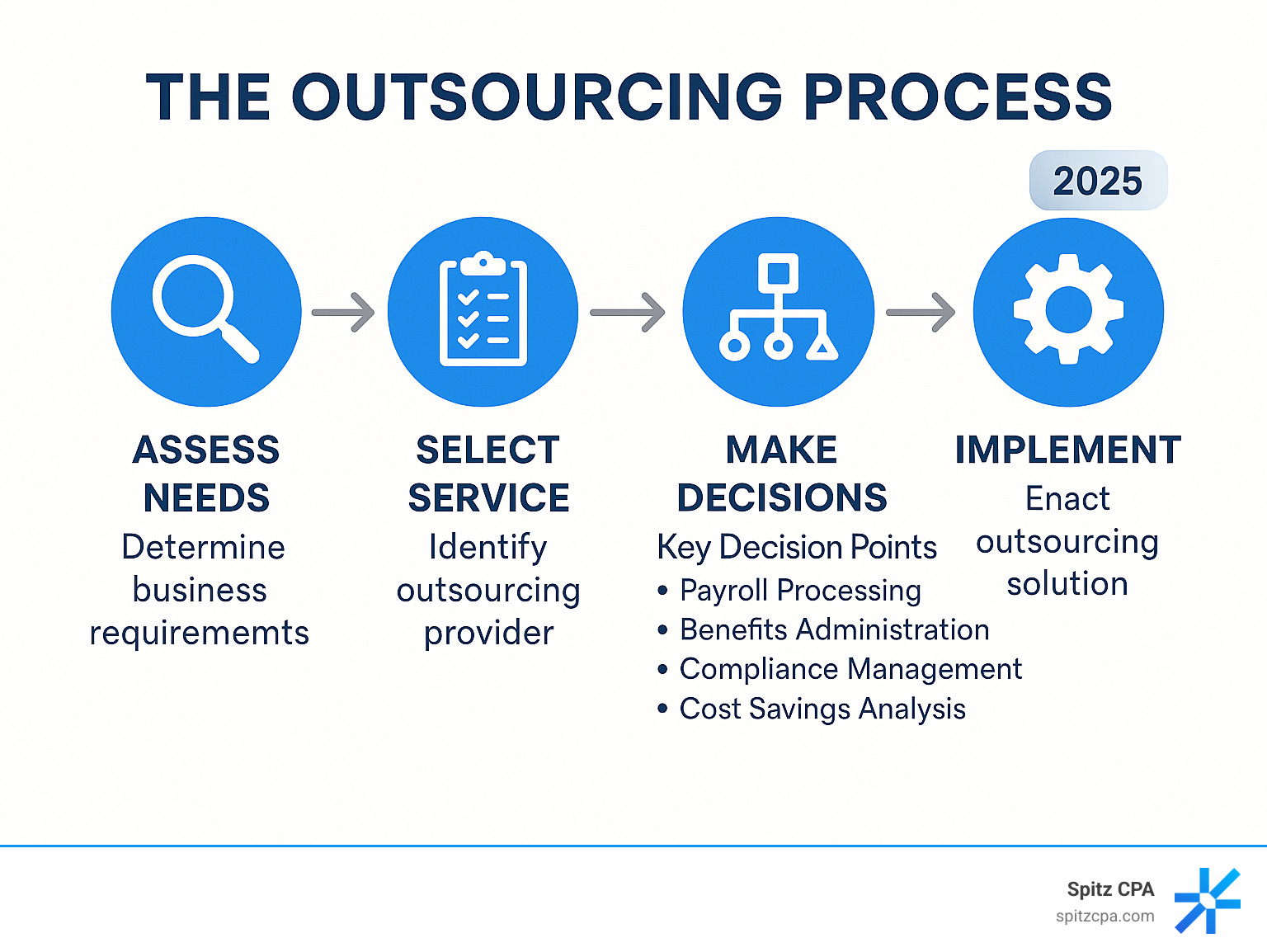
Your 5-Step Guide to Choosing Among Employee Outsourcing Companies
Selecting the right partner from the many employee outsourcing companies is a critical strategic decision. Breaking the process into five manageable steps can help you find a provider that aligns with your business goals and values.

Step 1: Assess Your Business Needs and Goals
Before you begin your search, conduct an internal assessment of your HR requirements and business objectives.
- Company Size and Growth: Your current size and future growth plans will influence the type of provider you need. A small startup may benefit from a comprehensive PEO, while a mid-sized company might prefer a flexible HRO.
- Industry Needs: Consider any industry-specific compliance or HR challenges you face. Some providers specialize in certain sectors, offering valuable, targeted expertise.
- Budget: View outsourcing as an investment. Determine a realistic budget that balances cost with the value of services needed. Our guide on Small Business Accounting 101: A Guide for New Entrepreneurs can help you with these financial considerations.
Step 2: Evaluating Potential Employee Outsourcing Companies
Once you know what you need, carefully vet potential partners.
- Expertise and Reputation: Look for providers with a long, stable history and positive industry recognition. Experience indicates they can steer regulatory changes and economic shifts.
- Client Testimonials and References: Go beyond marketing materials. Read reviews and ask for references from businesses similar to yours to gauge client satisfaction.
- Scalability: Ensure the provider can support your business not only today but also as you grow. You want a partner for the long term, not one you will quickly outgrow.
Step 3: Analyze Technology and Integration
The provider’s technology platform is a critical component of their service.
- Platform and Interface: An all-in-one platform with a user-friendly interface is ideal. It streamlines processes and ensures a positive experience for your employees when they access pay stubs or benefits information.
- Data Security: The provider must have robust security measures, including encryption and clear data protection policies, to safeguard sensitive employee and financial data.
- Integration: Check if their platform can integrate with your existing systems, such as accounting software. Smooth integration prevents data silos and reduces manual work.
Step 4: Understand Pricing Models
Clarify the provider’s pricing structure to avoid unexpected costs.
- Common Models: Pricing is often per-employee-per-month (PEPM), which is predictable and scales with your workforce. Other options include flat fees or project-based pricing for specific one-time services.
- Hidden Costs: Ask for a complete breakdown of all potential fees. Be aware of hidden costs like setup charges, cancellation penalties, or fees for additional reports.
The cheapest option is not always the best. Focus on the overall value, ensuring the provider’s services and quality align with your investment.
Frequently Asked Questions about Employee Outsourcing
Here are answers to the most common questions business owners have when considering outsourcing.
How much do employee outsourcing services cost?
Costs vary significantly based on your needs. Basic payroll processing can start around $50 per employee per month. Comprehensive PEO solutions that include benefits, compliance, and strategic HR support typically cost $150 or more per employee per month.
The final price depends on your company size, the complexity of your needs, and the specific services you select. Always request a customized quote to understand the full investment.
Can I outsource HR if I only have a few employees?
Yes. Outsourcing is highly beneficial for small businesses, even those with just a few employees. It provides access to professional-grade expertise and systems without the high cost of hiring a full-time HR person.
By outsourcing, you can ensure compliance with complex regulations and free up your time to focus on core business activities and growth, rather than on administrative tasks.
What is the difference between a PEO and an EOR?
While both are models of employee outsourcing companies, they serve different purposes.
A Professional Employer Organization (PEO) enters into a co-employment relationship with your business. It shares employer responsibilities, handling HR administration like payroll and benefits, while you maintain control over your employees and daily operations. PEOs are ideal for businesses operating within their home country.
An Employer of Record (EOR) becomes the legal employer for your staff in a specific country where you don’t have a legal entity. The EOR manages all local legal, tax, and compliance requirements, while you direct the employee’s work. EORs are designed for businesses expanding globally.
In short, a PEO helps you manage your domestic workforce, while an EOR enables you to hire legally in foreign countries.
Conclusion: Integrating Outsourcing into Your Financial Strategy
Partnering with employee outsourcing companies is a strategic financial decision that can transform your business. It’s a powerful tool that frees up capital and time, allowing you to focus on innovation and growth.
Every hour spent on administrative tasks is an hour not spent on core business priorities. Outsourcing gives you that time back, along with the peace of mind that experts are handling complex HR and compliance matters.
The financial benefits are clear. Small businesses that work with PEOs grow 7-9% faster—a game-changing improvement. Whether you choose a comprehensive PEO or a targeted HRO, the right partnership can be the difference between surviving and thriving.
However, making the right choice requires understanding how it fits into your overall financial strategy. The tax implications, cash flow impacts, and long-term costs must align with your business goals.
This is where expert guidance is invaluable. Michael J. Spitz at Spitz CPA brings over 15 years of corporate accounting experience to help you steer these complex decisions. We understand how outsourcing affects your bottom line, tax situation, and growth potential.
Our team can help you evaluate the financial implications of different models, ensuring your choice supports sustainable growth. We’ll help you see the full picture—not just the monthly fees, but the long-term financial impact on your business.
Ready to explore how outsourcing can fit into your financial strategy? Check out our comprehensive Payroll Services to see how we can support your journey and help your business achieve the clarity and growth it deserves.


