


Why Choosing the Right Investment Advisor Matters More Than You Think
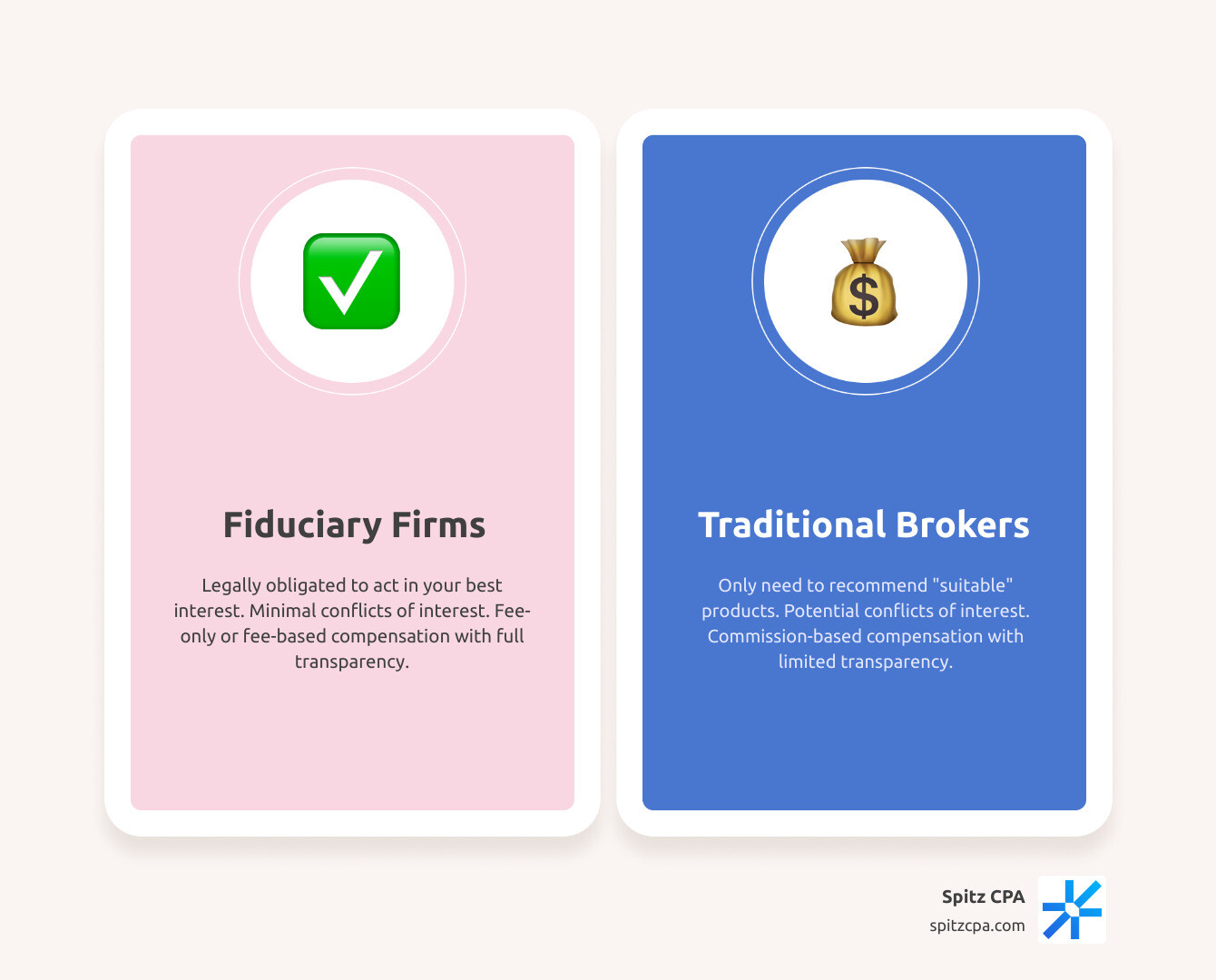
Fiduciary investment firms are financial advisory companies legally required to put your interests first when managing your money. Unlike traditional brokers who must only recommend “suitable” products, fiduciary firms eliminate many conflicts of interest and work exclusively for your benefit.
Key Types of Fiduciary Investment Firms:
- Registered Investment Advisors (RIAs) – SEC-registered firms bound by fiduciary duty under the Investment Advisers Act of 1940
- Independent Fiduciary Firms – Stand-alone advisors not affiliated with product providers or broker-dealers
- Fee-Only Advisors – Compensated solely by client fees, not commissions or product sales
How They Differ from Traditional Brokers:
| Feature | Fiduciary Firms | Traditional Brokers |
|---|---|---|
| Legal Obligation | Client’s best interest | Suitability standard |
| Fee Structure | Fee-only or fee-based | Commission-based |
| Conflicts of Interest | Minimal | Potential conflicts |
| Transparency | Full disclosure required | Limited disclosure |
The financial advisory landscape is crowded. Some advisors are legally bound to prioritize your interests, while others only need to sell you “suitable” products—even if better options exist.
This distinction matters enormously when you’re building wealth or managing the financial complexity of a successful business. The wrong advisor relationship can cost you dearly over time through higher fees, suboptimal investments, and missed tax-planning opportunities.
The numbers tell the story. The industry manages trillions in client assets, and independent firms often boast high client retention rates, with many new clients coming from referrals. These metrics reflect the trust that fiduciary relationships can build—but only when you understand what you’re actually getting.
I’m Michael J. Spitz, and through 15+ years of corporate accounting and strategic financial experience, I’ve seen how the right relationship with a fiduciary firm can transform business outcomes and personal wealth trajectories. My work integrating financial planning, tax strategy, and business growth has taught me that the advisor you choose is just as important as the investments you make.
Must-know fiduciary terms:
What is a Fiduciary? The Gold Standard of Financial Advice
Imagine hiring someone to manage your most precious asset: your hard-earned money. Wouldn’t you want them to act solely in your best interest, without any hidden agendas? That’s the promise of a fiduciary. A fiduciary investment firm or advisor is legally and ethically bound to put your financial interests above their own. This isn’t just a nice idea; it’s a stringent legal obligation that forms the bedrock of trust in financial advice.
At its core, fiduciary duty has two main principles:
- Duty of Care: This requires advisors to act with the skill and diligence a prudent person would use when managing their own affairs. For investors in Gilbert, AZ, this means advice is custom to your specific goals and risk tolerance.
- Duty of Loyalty: This obligates them to avoid conflicts of interest and always act in your best interest. They cannot recommend an investment simply because it pays them a higher commission; your financial well-being is the primary concern.
The historical context for this standard is rooted in the Investment Advisers Act of 1940. This landmark legislation established the framework for regulating investment advisors, setting them apart from brokers and mandating the fiduciary standard for those registered with the Securities and Exchange Commission (SEC). This act was a crucial step in formalizing the ethical obligations that protect investors.
Understanding these core principles is vital because they define the ethical compass of any fiduciary investment firm. They are legally enforceable responsibilities designed to safeguard your wealth. This commitment to putting clients first resonates deeply with our philosophy at Spitz CPA, where we strive to provide comprehensive financial insights that genuinely improve our clients’ profitability and financial health.

Fiduciary Standard vs. Suitability Standard
The distinction between the fiduciary standard and the suitability standard is perhaps the most critical concept for investors to grasp. It’s the difference between a doctor prescribing the best medicine for you versus one who prescribes a suitable medicine that also happens to pay them a bonus.
Let’s break down the key differences:
| Feature | Fiduciary Standard | Suitability Standard |
|---|---|---|
| Legal Obligation | Client’s Best Interest: Must act solely in the client’s best financial interest. | Suitable Products: Must recommend products that are “suitable” for the client’s profile. |
| Conflicts of Interest | Minimal/Avoided: Proactively identifies and mitigates conflicts; full disclosure. | Permitted (with disclosure): Conflicts can exist as long as they are disclosed. |
| Fee Structures | Fee-Only or Fee-Based: Often compensated by client fees (AUM, hourly, flat). | Commission-Based: Often compensated by commissions from product sales. |
| Investment Recommendations | Optimal for Client: Recommends the most appropriate and cost-effective investments. | Acceptable for Client: Recommends investments that fit general profile, but not necessarily the best. |
| Legal Accountability | Higher: Greater legal liability for breach of duty. | Lower: Regulatory action if recommendations are clearly unsuitable. |
| Transparency | High: Full disclosure of fees, conflicts, and investment rationale. | Limited: Disclosure primarily focuses on product features and costs. |
A traditional broker operating under the suitability standard doesn’t have to find you the best or most cost-effective option. They might recommend a mutual fund that pays them a higher commission, even if a similar, lower-cost fund would serve your needs better.
In contrast, a fiduciary investment firm must actively seek out the best available options for you. This often leads to lower fees, more transparent investment choices, and a clearer alignment of interests. This commitment to your financial well-being is why we at Spitz CPA believe in transparent, client-focused advice, working to improve business profitability and personal wealth through clear strategies.
The Anatomy of Fiduciary Investment Firms: RIAs and Independents
When we talk about fiduciary investment firms, we’re often referring to Registered Investment Advisors (RIAs). These firms are regulated by either the SEC (for larger firms) or state securities authorities, which legally binds them to the fiduciary standard.
An RIA’s transparency is centered on its Form ADV, a public document detailing the firm’s services, fees, and any conflicts of interest. Part 2A, the “brochure,” offers a plain-language summary of their operations. Think of it as their professional autobiography.
Many RIAs operate as independent firms, meaning they are not tied to a larger bank or brokerage that might push proprietary products. This independence is crucial because it allows them to select from a vast universe of investment products, choosing only those that genuinely serve your best interests. This freedom is a hallmark of truly client-centric advice.
The compensation structure of these firms also tends to be different. Many operate on a fee-only compensation model, where their only revenue comes directly from the client (e.g., a percentage of assets under management (AUM), a flat fee, or an hourly rate). This eliminates the conflict of interest inherent in commission-based models. Some firms use a fee-based compensation model, earning both fees and commissions, but they must be diligent in disclosing and managing these potential conflicts. We always advocate for transparency, allowing our clients to make informed decisions.
For those looking to understand more about finding the right financial partner, our guide on Registered Investment Advisor Search can provide valuable insights. These firms also typically emphasize robust risk management and diversification, understanding that a well-constructed portfolio is essential for long-term wealth preservation.
How to Identify and Verify Fiduciary Investment Firms
So, you’re convinced that a fiduciary is the way to go. But how do you find one and verify their status? It’s easier than you might think.
- Check the SEC’s IAPD Website: The Investor Adviser Public Disclosure (IAPD) website, maintained by the SEC, is your best resource. This free database allows you to search for any registered investment advisor or broker by name. It will pull up their registration details, a crucial verification step for anyone in Gilbert, AZ, or anywhere in the U.S.
- Review Their Form ADV Part 2A: On the IAPD website, look for the firm’s Form ADV. Part 2A (the “brochure”) will clearly state if they are an RIA, their fee structure, services, conflicts of interest, and disciplinary history. A true fiduciary will explicitly state their commitment to this standard.
- Look for Professional Credentials: While not a guarantee, designations like Certified Financial Planner (CFP®) or Personal Financial Specialist (PFS) indicate a higher level of education and ethical commitment, as these professionals are often bound to act as fiduciaries.
Ask Direct Questions: When interviewing potential advisors, don’t be shy. Ask them:
- “Are you a fiduciary 100% of the time when advising me?”
- “Will you put that in writing?”
- “How are you compensated, and can you provide a detailed breakdown of all fees?”
- “Do you receive compensation from third parties for recommending certain products?”
- “How do you handle conflicts of interest?”
A true fiduciary firm will answer these questions clearly. Evasive answers are a red flag. For businesses seeking high-level financial guidance, our CFO Consulting Services can help you identify partners who align with your strategic goals.
How Fiduciary Firms Approach Fees and Investments
One of the defining characteristics of fiduciary investment firms is their approach to fees and investment selection. Their fee structures are designed to minimize conflicts, and their investment choices are driven purely by what’s best for your financial plan.

Fee-Only Models: The most transparent structure is “fee-only,” where the advisor is compensated only by fees paid directly by the client. These can be:
- Assets Under Management (AUM) Fees: A percentage of the assets the firm manages for you (e.g., 0.5% to 1.5% annually).
- Flat Fees: A fixed fee for specific services, like a comprehensive financial plan.
- Hourly Rates: Charging for time spent on your behalf. This direct compensation model significantly reduces conflicts, as the advisor has no incentive to push specific products.
Reduced Conflicts, Clearer Choices: With fees clearly defined, a fiduciary advisor can focus on optimizing your portfolio. This means:
- Investment Selection: They recommend investments based on your goals, prioritizing low-cost, tax-efficient options like index funds and ETFs.
- Risk Management: Their approach is holistic, considering your entire financial picture, including insurance, debt, and emergency planning.
- Long-Term Wealth Management: Fiduciaries focus on building and preserving wealth over the long term, emphasizing a disciplined, diversified approach. This aligns with our work at Spitz CPA, where we help clients develop strategies that increase business value and ensure sustainable financial health.
By understanding these fee structures and investment philosophies, investors in Arizona can make more informed decisions about who they trust with their financial future.
The Pros and Cons of Partnering with a Fiduciary
Choosing a financial advisor is a significant decision. While the fiduciary standard offers substantial advantages, it’s wise to consider both the benefits and potential limitations to ensure it’s the right fit for you.
Key Benefits for the Investor
Working with a fiduciary investment firm brings a level of assurance and alignment that is unparalleled. For individuals and business owners in Gilbert, AZ, these benefits can translate into tangible financial gains and peace of mind.
- Client-First Priority: This is the cornerstone. Every recommendation is made with your best interest at heart, eliminating doubts about an advisor’s motives. This commitment provides peace of mind, knowing your financial future is in trusted hands.
- Holistic Financial View: Fiduciary firms often provide comprehensive financial planning that extends beyond just investments. They look at your entire financial ecosystem—income, expenses, savings, debts, insurance, and long-term goals—to ensure all parts work in harmony.
- Integrated Tax Planning: A crucial benefit, especially for those with significant wealth or business profits. Fiduciary advisors often collaborate with tax experts to ensure your investment strategy is as tax-efficient as possible, using strategies like tax-loss harvesting and optimizing retirement contributions. At Spitz CPA, we understand the profound impact of tax planning strategies on overall wealth.
- Estate Planning Coordination: For many, building wealth is about creating a lasting legacy. Fiduciary firms can coordinate with estate attorneys to align your financial plan with your wishes for wealth transfer and charitable giving, helping you steer trusts, wills, and beneficiary designations.
- Transparency and Clarity: Fiduciaries are obligated to be fully transparent about their fees, potential conflicts, and the rationale behind their recommendations. You’ll receive clear explanations, empowering you to understand and participate in your financial decisions.
These benefits combine to create a powerful partnership, allowing you to focus on what matters most, knowing your financial strategy is sound and ethically guided.
Potential Drawbacks to Consider
While the advantages of working with a fiduciary are compelling, it’s also important to be aware of potential limitations.
- Minimum Asset Requirements: Many fiduciary investment firms, particularly those with an AUM fee model, have minimum asset requirements (e.g., $250,000 or more). This can be a hurdle for those just starting their wealth-building journey, as the firm’s comprehensive service model requires a certain scale to be viable.
- Perceived Higher Fees: On the surface, a fiduciary’s fees might seem higher than broker commissions. However, this can be misleading. Commissions are often embedded in product costs and can incentivize sales of higher-cost products. A fiduciary’s transparent fee often covers a broader range of services and can lead to lower overall costs due to a focus on low-expense investments and tax efficiency. It’s crucial to compare the total cost and value received.
- Limited Product Shelf (No Proprietary Products): Fiduciary firms typically don’t offer proprietary investment products. They are free to choose from the entire market, which is a major advantage. However, if you are looking for highly specialized or proprietary products that only a large brokerage might offer, you may not find them with an independent fiduciary.
- Finding the Right Fit: The sheer number of financial advisors can be overwhelming. Even within the fiduciary space, firms have different specialties and philosophies. Finding one that truly understands your specific needs—whether you’re a young professional, a family, or a business owner in Gilbert, AZ, navigating growth and business valuation services—requires careful due diligence.
Choosing the Right Firm for Your Long-Term Goals
Selecting a fiduciary investment firm is a decision that can impact your financial trajectory for decades. It’s about choosing a partner for your long-term wealth management, estate planning, and overall financial well-being. This is especially true for individuals and business owners in Gilbert, AZ, focused on building and preserving wealth.
At Spitz CPA, we emphasize that financial success is a marathon, not a sprint. The same philosophy applies to your choice of an investment advisor. You need a firm that understands your journey, whether it’s planning for retirement, structuring your business for growth, or ensuring your legacy through thoughtful succession planning services.
A good fiduciary will integrate your investment strategy with your broader financial life. For a business owner, personal investments should complement the business’s financial health and tax strategy. They should help you steer critical decisions like tax planning for entrepreneurs. Leading firms with a focus on private client services understand this intricate connection, offering solutions for complex financial, tax, and investment decisions that shape legacies and ensure comprehensive wealth management.
Key Questions for Potential Fiduciary Investment Firms
To ensure you find the best fit, we recommend preparing a list of questions to ask any potential fiduciary investment firm. Think of this as your interview process for a crucial financial partner:
- What is your firm’s investment philosophy? Do they believe in passive investing (index funds, ETFs) or active management? Does their approach align with your comfort level and goals?
- What is your communication style and frequency? How often will you meet? What methods do they use (in-person, video calls, email)? Ensuring a good communication fit is paramount.
- What are the credentials and experience of the advisors you’d be working with? Look for CFPs, CPAs, or other relevant certifications. Do they have experience with clients in situations similar to yours?
- Do you specialize in certain types of clients or financial situations? Some firms excel with pre-retirees, others with entrepreneurs. Understanding their niche helps determine if they understand your unique needs.
- What technology and tools do you use to help manage my finances? Do they offer client portals for easy access to reports? Do they use financial planning software for scenario analysis?
- How do you handle risk management and rebalancing? What is their process for assessing your risk tolerance and adjusting your portfolio to maintain that level?
- Can you provide client references? While firms may have privacy restrictions, they might share anonymized case studies or testimonials that speak to their client successes.
By asking these questions, you’ll gain a deeper understanding of how a firm operates and whether their approach aligns with your vision for strategic business growth and personal financial security. Choosing wisely today can set the stage for a financially robust tomorrow.
Conclusion: Securing Your Financial Future with a Trusted Partner
Navigating the complexities of the financial world can feel like a daunting task, but it doesn’t have to be. By understanding the profound difference that a fiduciary investment firm brings to the table, you empower yourself to make informed decisions that prioritize your financial well-being above all else. The fiduciary commitment—rooted in duties of care and loyalty, and backed by regulations like the Investment Advisers Act of 1940—is truly the gold standard in financial advice.
We’ve explored how these firms operate with transparent fee structures, how they approach investment selection with your best interests in mind, and the critical benefits they offer, from holistic financial planning to integrated tax and estate coordination. While considerations like minimum asset requirements exist, the peace of mind and long-term value derived from a fiduciary relationship are invaluable.
As Michael J. Spitz and the team at Spitz CPA, we firmly believe that aligning your financial advice with a strategic tax approach is paramount. Whether you’re a business owner in Gilbert, AZ, striving to maximize profitability, or an individual aiming for robust long-term wealth management, the advisor you choose can be your most powerful ally. We encourage you to conduct your due diligence, ask the tough questions, and verify the credentials of any firm you consider. Your financial future deserves nothing less than a partner who is legally and ethically bound to put you first.
For expert guidance that integrates financial planning, tax strategy, and business advisory, we invite you to explore how we can help you achieve your financial goals. Get expert financial guidance


