


Why Financial Planning for Growth Is the Bridge Between Vision and Execution
Financial planning for growth is the strategic process of aligning your financial resources, capital allocation decisions, and operational capabilities to support sustainable business expansion. Here’s what you need to know:
Core Elements of Financial Planning for Growth:
- Strategic Alignment – Connect financial decisions to business goals and mission
- Capital Allocation – Deploy resources based on proven ROI and unit economics
- Risk Management – Build scenario plans and emergency reserves for resilience
- Performance Tracking – Monitor KPIs like burn multiple, CAC/LTV, and Rule of 40
- Dynamic Forecasting – Use rolling forecasts that adapt to actual performance
Companies with structured capital allocation processes achieve 30% higher returns than those making ad-hoc investment decisions. Yet most growing businesses struggle to move beyond reactive financial management.
The challenge isn’t just about having enough capital. It’s about deploying it strategically. Research shows that businesses exceeding the Rule of 40 demonstrate efficient capital allocation, balancing market capture with sustainable unit economics. SaaS companies typically target burn multiples below 2x for capital-efficient growth.
But here’s what often gets missed: financial planning for growth isn’t a one-time exercise. It requires rolling forecasts, sensitivity analysis, and continuous monitoring. The most successful scale-ups treat capital deployment with discipline, using frameworks like 50/30/20 allocation (50% core growth, 30% innovation, 20% contingency) to balance risk and opportunity.
I’m Michael J. Spitz, and over 15+ years of corporate accounting experience, I’ve guided businesses through seed rounds, financial modeling, budgeting, and cash management—helping them transform their approach to financial planning for growth. My work focuses on creating strategic financial roadmaps that turn ambitious goals into achievable milestones.
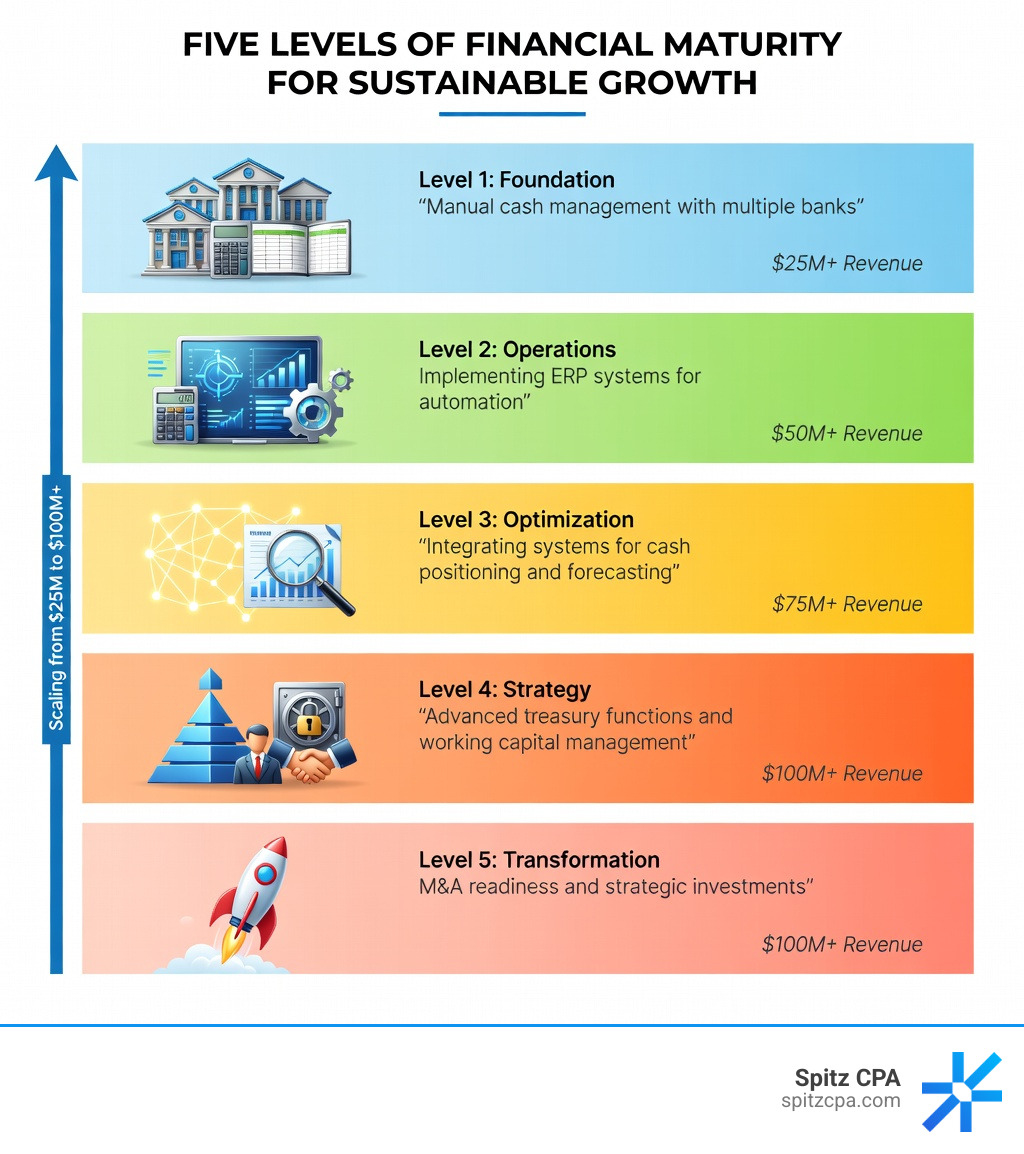
Financial planning for growth terms to remember:
The Essentials of Financial Planning for Growth
Scaling a business in Gilbert, AZ, or anywhere in the competitive Arizona landscape, requires more than just a great product. It requires a financial engine that can handle the increased load. At its heart, financial planning for growth is about ensuring your infrastructure doesn’t crumble as your revenue climbs.
Aligning Financial Planning for Growth with Business Goals
We often see founders who are incredibly passionate about their vision but haven’t translated that vision into a spreadsheet. Strategic alignment means every dollar spent is a vote for your company’s future. Your mission statement should guide your Strategic Annual Planning for Sustainable Growth.
Are you aiming for market dominance or high-margin niche stability? Your financial plan will look vastly different depending on the answer. By focusing on strategic business growth, we help you ensure that operational excellence isn’t just a buzzword, but a measurable outcome of your spending choices.
The Role of Strategic Capital Allocation
Capital allocation is your most powerful strategic weapon. It’s the process of deciding where to put your money to generate the highest possible value. Instead of “spray and pray” spending, high-performing companies use portfolio thinking. This means treating different departments or initiatives like an investment portfolio—some are safe bets (core growth), while others are high-risk, high-reward (innovation).
Assessing Financial Health and Readiness for Expansion
Before you hit the gas, you need to check the engine. Expansion acts as a magnifying glass; it makes your successes bigger, but it also makes your financial leaks much worse.

Identifying Growth Opportunities and Challenges
We start by calculating your net worth—subtracting your liabilities from your assets—to understand your baseline. But the real story is in the 12-month cash flow statement. In Arizona’s dynamic market, understanding when cash enters and leaves your business is critical.
Growth often creates a “cash gap.” You might need to hire staff or buy inventory today to fulfill orders that won’t be paid for until 60 days from now. Without proper small business accounting, this “success” can actually lead to bankruptcy.
Establishing Baseline Metrics for Scaling
To scale effectively, you need financial clarity. This involves looking at:
- Unit Economics: Is every new customer actually profitable after considering acquisition costs?
- Working Capital: Do you have enough liquidity to cover day-to-day operations during the expansion?
- Liquidity Ratios: Can you meet your short-term obligations without stress?
Strategic Capital Allocation and Financing Options
How you fund your growth is just as important as the growth itself. Each vehicle comes with its own set of trade-offs regarding control and speed.
| Funding Option | Pros | Cons | Best For |
|---|---|---|---|
| Self-Funding | Full control, no debt | Slower growth speed | Low-cap businesses |
| Debt Financing | Retain equity, tax-deductible interest | Monthly repayment stress | Proven revenue models |
| Equity Investors | Massive capital, expert networks | Dilution of ownership | High-growth startups |
Key Metrics: The Rule of 40 and Burn Multiples
In SaaS and high-growth tech, we use specific benchmarks to see if financial planning for growth is actually working. The Rule of 40 suggests that your growth rate plus your profit margin should exceed 40%. If you are growing at 50% but losing 5% in margin, you’re at 45%—a healthy sign of efficient scaling.
We also look at the burn multiple. This measures how much you are spending to generate each dollar of new revenue. A burn multiple below 2x is generally considered efficient. If it’s higher, it might mean your marketing is inefficient or you’re scaling before you’ve truly found product-market fit.
Choosing the Right Funding Vehicle
Choosing between bootstrapping and seeking venture capital isn’t just a financial decision; it’s a lifestyle and strategy decision. For many Arizona entrepreneurs, commercial loans or alternative funding sources provide a middle ground that allows for expansion without giving up the captain’s chair.
Risk Management and Resilient Forecasting Techniques
Growth is inherently risky. You are stepping into the unknown, often with higher stakes. This is why we advocate for a “shield” of risk mitigation.
Creating Rolling Forecasts for Agility
Static budgets are dead on arrival. In a fast-moving economy, you need financial modeling consulting to create dynamic, rolling forecasts. We recommend a 13-week cash flow forecast updated weekly. This allows you to see “around the corner” and adjust your spending before a minor dip becomes a crisis.
Sensitivity analysis is another crucial tool. We ask “what if” questions:
- What if revenue is 20% lower than projected?
- What if our main supplier raises prices by 15%?
- What if a key tax planning for entrepreneurs strategy saves us $50k this year?
Monitoring Your Financial Planning for Growth Post-Expansion
The work doesn’t end when the expansion begins. You must track your performance against your projections using real-time dashboards. Variance analysis—comparing what you thought would happen to what actually happened—is the only way to refine your strategy for the next phase of growth.
Frequently Asked Questions about Scaling Finances
What are the most common pitfalls in growth-stage capital allocation?
The most dangerous mistake is premature scaling—spending big on marketing or hiring before you have a proven, repeatable sales process. Other pitfalls include:
- Over-hiring: Adding headcount without a corresponding increase in productivity.
- Delayed Cost Discipline: Letting small expenses spiral because “we’re growing.”
- Spray-and-Pray Marketing: Spending on every channel instead of doubling down on what works.
How does the 50/30/20 allocation framework apply to business growth?
This framework helps maintain a balanced portfolio:
- 50% Core Growth: Invested in proven revenue drivers (e.g., your best-selling product).
- 30% Innovation Bets: Funding new ideas or market entries that could be the “next big thing.”
- 20% Contingency Reserves: An emergency fund to protect against market volatility or unexpected setbacks.
Why is zero-based budgeting effective for new initiatives?
Zero-based budgeting requires you to justify every single expense from scratch every period, rather than just adjusting last year’s numbers. This eliminates “legacy waste” and ensures that resources are always prioritized toward the highest-impact areas.
Conclusion
At the end of the day, financial planning for growth is about more than just numbers on a page; it’s about building a legacy. Whether you are a startup in the “seed” stage or a mature company looking to 10x your value, the principles of disciplined capital allocation and rigorous forecasting remain the same.
At Spitz CPA, we specialize in helping businesses in Gilbert and throughout Arizona achieve financial clarity. From deep-dive accounting clean-up to high-level strategic advisory, our goal is to turn your financial data into a roadmap for success.
Ready to transform your finances from a source of stress into a competitive advantage? Start your growth journey with professional accounting services and let’s build something great together.
Michael J. Spitz Founder, Spitz CPA


