


Why Fund Finance Advisory Has Become Essential for Modern Asset Managers
Fund finance advisory has transformed from a niche service into a critical resource for fund managers navigating an increasingly complex financial landscape. If you’re looking to optimize your fund’s financing solutions, here’s what you need to know:
What Fund Finance Advisory Delivers:
- Independent, conflict-free advice on all available fund-level financing options
- Access to a broader lender universe, including traditional banks and alternative capital providers
- Negotiation expertise to secure optimal terms, pricing, and structure
- Strategic guidance from initial planning through execution and post-closing optimization
- Support for all fund types, from emerging managers to established sponsors managing $100B+ AUM
The private fund finance market has evolved dramatically. What started as straightforward subscription credit lines has grown into a sophisticated ecosystem encompassing NAV facilities, hybrid structures, management company lines, and specialized solutions across every asset class. With the supply of capital call facilities struggling to meet demand and lenders becoming more selective due to balance sheet constraints, the opacity of this private market creates challenges for fund managers seeking the best possible terms.
Recent years have seen significant shifts in market dynamics. The challenging macroeconomic environment has made orderly asset disposals more difficult, driving increased demand for NAV-based financing solutions. Fund managers now face higher interest rates, tighter liquidity, and fundraising pressures—all while navigating an evolving regulatory landscape. As one industry expert noted, advisors are moving “from sidekick to superhero” as fund finance advisory becomes essential for managers of all sizes.
I’m Michael J. Spitz, and with over 15 years of corporate accounting and financial strategy experience—including extensive work with VC/PE seed rounds, fundraising due diligence, financial modeling, and complex capital structures—I understand the critical role that fund finance advisory plays in optimizing liquidity and returns for alternative investment managers. Whether you’re structuring your first fund or managing a mature portfolio, expert advisory guidance helps you steer the complexities and secure financing solutions custom to your specific needs.
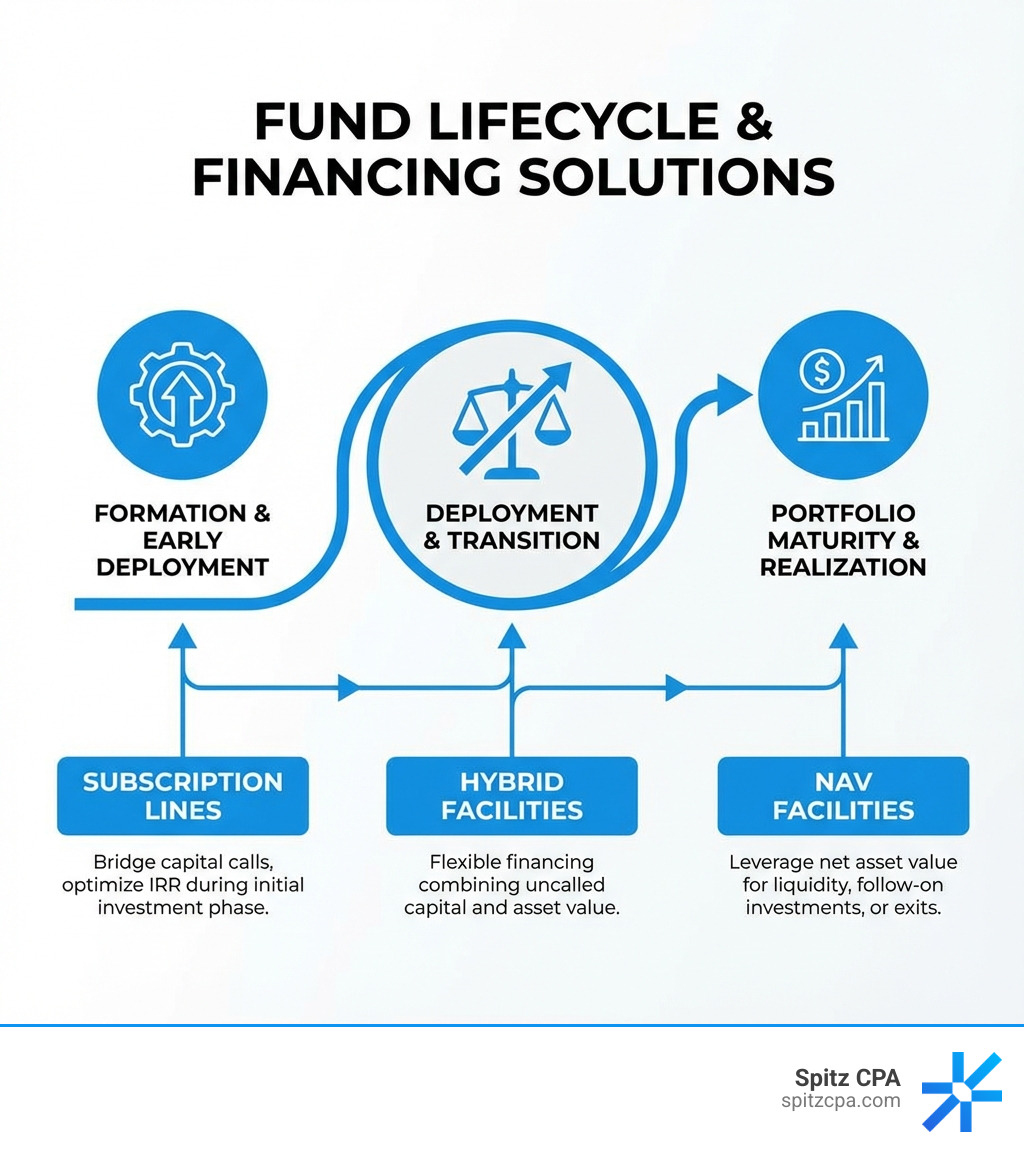
Fund finance advisory terms you need:
Opening up the Fund Finance Toolkit: Key Solutions for Every Stage
Fund finance has evolved into a comprehensive “toolkit” of financial solutions, each designed to address specific liquidity and capital management needs throughout a fund’s lifecycle. These solutions are not one-size-fits-all; their application varies significantly across different asset classes, including private equity, real estate, infrastructure, and credit funds. Understanding these tools and how they can be leveraged is critical for fund managers to optimize their operations and improve investor returns.

Subscription Credit Facilities (Capital Call Lines)
Subscription credit facilities, often called capital call lines, are perhaps the most well-known and widely used form of fund finance advisory. They provide funds with immediate liquidity, bridging the timing gap between when a fund needs to deploy capital for an investment and when it calls capital from its limited partners (LPs).
- Definition: These are short-term revolving credit lines extended to investment funds.
- Security: The primary collateral for a subscription line is the fund’s uncalled capital commitments from its investors. Lenders assess the creditworthiness of the fund’s investor base, as these commitments are the ultimate source of repayment.
- Use Case: Fund managers use these facilities to:
- Bridge capital calls: Deploy capital quickly for investment opportunities without waiting for LPs to fund their commitments.
- Accelerate investments: Speed up the investment process, allowing funds to capitalize on time-sensitive deals.
- Treasury utility: Manage cash flow efficiently, cover operational expenses, and provide letters of credit.
- Lender creditworthiness assessment: Lenders primarily underwrite these facilities based on the credit quality of the fund’s investors, their commitment sizes, and the fund’s governing documents.
For a deeper dive into how cash flow management, a core benefit of subscription lines, can improve your fund’s financial health, explore our insights on Cash Flow Calculation.
Net Asset Value (NAV) Facilities
As a fund matures and deploys most of its capital, the focus often shifts from uncalled commitments to the value of its underlying investments. This is where Net Asset Value (NAV) facilities come into play, gaining significant traction in recent years.
- Definition: NAV facilities are loans secured by the fund’s investment portfolio itself, rather than by uncalled capital commitments.
- Security: The collateral typically includes the equity interests in underlying portfolio companies, rights to investment proceeds, and pledges of distribution or custody accounts.
- Use Case: NAV facilities are particularly useful for:
- Later-stage liquidity: Providing liquidity to a fund once its subscription line is exhausted or nearing maturity.
- Follow-on investments: Funding additional investments in existing portfolio companies.
- LP distributions: Enabling distributions to LPs, especially when the market for asset disposals is challenging or when a fund seeks to optimize returns through earlier distributions.
- Avoiding forced asset sales: Allowing managers to hold onto assets for optimal sale timing rather than being forced to sell in an unfavorable market.
- Growing popularity: The challenging macroeconomic environment and difficulty in achieving orderly asset disposals have significantly increased the demand for NAV facilities, making them a “hot topic” in the fund finance advisory space.
To understand how these private liquidity solutions fit into the broader landscape of fund finance, we encourage you to read A review of private liquidity solutions.
Hybrid and Specialized Facilities
Beyond the core subscription and NAV facilities, the fund finance advisory toolkit includes a range of hybrid and specialized solutions designed for unique situations and complex fund structures.
- Hybrid Facilities: These innovative facilities combine elements of both subscription lines and NAV financing. They are particularly beneficial during transitional periods when a fund still has some uncalled capital but has also deployed a significant portion of its portfolio into valuable assets. Hybrid facilities provide flexible borrowing capacity across the fund’s lifecycle, adapting as the collateral base shifts.
- Management Company Lines: These credit facilities are extended directly to the fund’s management company, rather than the fund itself. They are typically secured by the management company’s rights to receive management fees and, in some cases, performance fees (carry). These lines provide crucial liquidity for operating expenses, strategic initiatives, or to cover shortfalls during fundraising troughs.
- GP Co-investment Loans: Limited Partners often require General Partners (GPs) to invest their own capital alongside investors, aligning interests. GP co-investment financing allows fund executives to obtain third-party finance for these personal commitments. These bespoke facilities can be vital for succession planning or to manage increasing GP commitment obligations as fund sizes grow.
- Continuation Vehicles: These structures allow a fund to retain attractive assets beyond its typical lifecycle, providing liquidity to existing LPs while allowing new investors to come in. Debt solutions within continuation vehicles often deploy variants of subscription financing or NAV financing-like solutions, custom to the specific structure.
- Back Leverage: This refers to additional debt incurred by a holding vehicle within the fund structure to finance one or more of its acquired assets. It allows for timely capital deployment to support investments, potentially improving return potential and capital efficiency.
Navigating the Evolving Market: Trends, Challenges, and Future Outlook
The fund finance advisory market is dynamic, constantly evolving in response to global economic shifts, regulatory changes, and the increasing sophistication of alternative investment strategies.

In recent years, we’ve witnessed significant shifts. The macroeconomic environment, characterized by higher interest rates and the potential for recession, has created a challenging landscape for fund managers. Lender appetite has become more selective due to balance sheet constraints, leading to a supply-demand imbalance, particularly for traditional capital call facilities. This complexity underscores the growing importance of expert advisory to help managers steer these turbulent waters.
The Rise of NAV Lending and Non-Bank Lenders
One of the most prominent trends in modern fund finance is the dramatic rise of NAV lending. This isn’t just a fleeting trend; it’s a fundamental shift driven by several critical factors:
- Why NAV is a hot topic: The supply of capital call facilities has struggled to keep pace with demand. Simultaneously, the challenging macroeconomic environment has made it tougher for fund managers to arrange orderly asset disposals. This has created a significant need for alternative liquidity solutions.
- Challenging exit environment: With fewer opportunities for profitable exits, funds need ways to provide liquidity to their LPs without being forced to sell assets at unfavorable valuations.
- LP distribution needs: Investors are increasingly seeking liquidity from their commitments. NAV facilities enable funds to make distributions to LPs even when exit markets are slow, optimizing investor returns. NAV facilities can serve dual purposes: downstream for follow-on investments and upstream for distributions to LPs.
- Influx of new capital providers: The growing demand for NAV facilities has attracted a diverse array of new lenders, including non-banks and dedicated debt funds. This influx increases the supply of capital, making it easier for funds to access liquidity later in their lifecycles. These new providers often offer innovative and flexible solutions, further expanding the fund finance toolkit.
Future Outlook and Key Challenges
Looking ahead, the fund finance market is ready for continued innovation and growth, but also faces several key challenges:
- Continued innovation: We expect ongoing development of new and more bespoke financing solutions, custom to specific fund strategies and market conditions. The market will continue to adapt to the evolving needs of fund managers and investors.
- Regulatory changes: New regulations, such as the SEC’s Private Funds Rulemaking, will continue to shape the market, requiring funds to adapt their structures and operations. Expert advisory becomes crucial for ensuring compliance and optimizing strategies within new regulatory frameworks.
- Fundraising pressures: Managers will likely face continued pressure in fundraising, especially in a higher interest rate environment where investors may be more cautious.
- Higher cost of capital: The increased cost of borrowing will remain a significant consideration for fund managers, emphasizing the need for efficient and optimized financing structures.
Navigating these complexities requires a robust strategy and a clear understanding of your financial position. Our insights on Strategic Business Growth can provide valuable guidance on how to align your financing strategy with your long-term growth objectives.
The Superhero’s Cape: The Expanding Role of Fund Finance Advisory
In today’s intricate financial landscape, fund finance advisory has truly moved from a supporting role to that of a superhero, providing critical guidance and execution expertise. The opacity of the private fund finance market, coupled with evolving lender appetites and macroeconomic uncertainties, means fund managers need more than just legal or administrative support—they need strategic partners.
Expert advisors help fund managers:
- Steer complexity: They explain the array of financing products and structures, translating complex financial jargon into clear, actionable strategies.
- Secure liquidity: Advisors possess deep market knowledge, connecting borrowers with the right lenders from across the entire universe of capital providers, ensuring access to diverse pools of capital.
- Optimize capital structure: They help tailor financing solutions that align with a fund’s specific investment strategy, lifecycle stage, and investor base, ultimately driving higher returns for LPs.
Why Partner with an Independent Fund Finance Advisory Firm?
Partnering with an independent fund finance advisory firm like Spitz CPA offers distinct advantages that can significantly impact a fund’s success:
- Conflict-free advice: Unlike lenders or other conflicted parties, independent advisors prioritize your fund’s best interests. This ensures objective recommendations and optimal outcomes without hidden agendas.
- Broader market access: Independent advisors have established relationships with a wide range of traditional banks, non-bank lenders, and alternative capital providers. This extensive network allows them to screen the entire lender universe and identify the most suitable partners for your specific needs, even in a market with increased lender selectivity.
- Improved negotiation power: With deep market knowledge and experience in structuring over a thousand unique fund financing transactions, advisors can effectively evaluate proposals, negotiate optimal terms, and secure the best pricing for all types of fund financing solutions.
- Deep expertise: Our team understands the nuances of fund structures, tax implications, and regulatory considerations across various asset classes. This comprehensive expertise ensures that financing solutions are not only effective but also compliant and strategically sound.
- Time and resource savings: The process of procuring financing can be resource-intensive. Advisors streamline facility execution, reducing diligence, negotiation time, and costs, allowing your team to focus on core investment strategies.
For funds in Gilbert, AZ, and across Arizona, leveraging our CFO Consulting Services provides the strategic financial leadership needed to make informed decisions about fund finance.
Supporting Emerging Managers and Diverse Strategies
The fund finance advisory industry plays an increasingly vital role in supporting emerging managers and those pursuing diverse fund strategies. Lenders often gravitate towards established relationships with larger sponsors, making it challenging for first-time funds or smaller managers to secure financing.
- Navigating lender bias: Advisors help emerging managers overcome this hurdle by presenting their unique value proposition effectively and connecting them with lenders willing to support new relationships.
- Structuring first-time funds: Advisors provide crucial guidance on structuring initial funds to be attractive to lenders, helping avoid common pitfalls and ensuring all necessary documentation is in place.
- Accessing capital: By leveraging their market knowledge, advisors can help these managers access pools of capital that might otherwise be inaccessible, ensuring they have the liquidity needed to grow.
- Avoiding common pitfalls: Advisors guide new managers through the complexities of loan agreements, covenants, and reporting requirements, preventing costly mistakes.
Our expertise in CFO for Startups extends to helping emerging fund managers build robust financial foundations and steer the initial financing challenges.
The Impact of Technology in Modern Fund Finance Advisory
Technology is rapidly changing the fund finance advisory landscape, enhancing efficiency, accuracy, and strategic insights.
- Data analytics for lender selection: Advanced data analytics allow advisors to thoroughly screen the lender universe, identifying those with the right appetite, terms, and experience for a specific fund’s needs. This data-driven approach ensures optimal matching between borrowers and lenders.
- Streamlined due diligence: Technology-based solutions and dedicated analyst teams accelerate and improve the efficiency of the due diligence process, reducing the time and resources required for facility execution.
- Portfolio monitoring tools: Sophisticated software helps advisors and fund managers monitor portfolio performance, manage covenants, and track compliance more effectively, particularly crucial for NAV and hybrid facilities.
- Advanced financial modeling: Complex financial models are essential for structuring intricate fund finance deals, evaluating various scenarios, and optimizing capital structures. Technology empowers advisors to perform these analyses with greater precision and speed.
The Engagement Playbook: Process, Considerations, and FAQs
Engaging in fund finance advisory is a structured process designed to maximize efficiency and achieve the best possible financing outcomes for your fund.
The Typical Advisory Process from Strategy to Execution
Our approach, refined over years of experience, ensures a seamless journey from initial concept to post-closing optimization:
- Strategy Formulation & Needs Analysis: We begin by deeply understanding your fund’s investment strategy, objectives, and specific liquidity needs. This involves formulating a custom fund finance strategy that considers the fund’s lifecycle, asset classes, and investor base.
- Market Sounding & Collateral Preparation: Once the strategy is clear, we prepare compelling marketing collateral and craft a message designed to attract the most suitable lenders. We then conduct a thorough market sounding, exploring new banking relationships and expanding potential syndicates.
- Proposal Evaluation & Term Sheet Negotiation: We carefully evaluate proposals from various banks and lenders, comparing term sheets, sensitizing fund models, and presenting comprehensive qualitative and quantitative comparison checklists. Our expertise ensures optimal terms are negotiated on your behalf.
- Documentation & Execution: We work to streamline the entire execution process, from legal documentation to closing. This reduces diligence, negotiation costs, and overall duration, getting your facility in place efficiently.
- Post-Closing Optimization & Compliance: Our support doesn’t end at closing. We help optimize the utilization of your facilities by providing abstracts and supplementary materials for simplified compliance, ensuring ongoing adherence to terms and conditions.
Key Considerations for Lenders and Borrowers
Successful fund finance deals require careful consideration from both sides of the table:
- Borrower considerations: Fund managers must assess the cost (interest rates, fees), flexibility (drawdown/repayment terms), covenants (restrictions on fund activities, leverage limits), and reporting requirements of any facility. It’s crucial to choose a facility that aligns with the fund’s operational needs and long-term strategy.
- Lender considerations: Lenders, whether traditional banks or non-bank providers, scrutinize various factors. For subscription lines, they assess the credit risk of the investor base. For NAV facilities, they focus on valuation mechanics, asset quality, and portfolio concentration. Across all facilities, they evaluate the fund’s structure, governing documents, and the quality of documentation.
To ensure your fund is always in a strong position, we recommend a regular Business Financial Health Check.
Frequently Asked Questions
What is the difference between a subscription line and a NAV facility?
A subscription line (capital call facility) is secured by the fund’s uncalled capital commitments from its investors and is typically used earlier in a fund’s life to bridge capital calls. A NAV facility, on the other hand, is secured by the fund’s underlying investment portfolio (its Net Asset Value) and is generally used later in a fund’s life for liquidity, follow-on investments, or LP distributions.
How long does it take to secure a fund finance facility?
The timeframe can vary significantly depending on the complexity of the fund structure, the type of facility, and market conditions. However, engaging an experienced fund finance advisory firm can significantly streamline the process. Advisors efficiently steer lender selection, negotiation, and documentation, potentially reducing the overall timeline.
Can smaller or first-time funds access fund finance?
Yes, but it can be more challenging. Lenders often prefer to work with larger, established sponsors. This is where fund finance advisory becomes particularly valuable for emerging managers. Advisors can help structure the fund to be more attractive to lenders, connect them with appropriate capital providers, and guide them through the process to avoid common pitfalls.
Conclusion: Securing Your Fund’s Financial Future
The journey of fund finance advisory from a simple “sidekick” to an indispensable “superhero” reflects the increasing complexity and strategic importance of financing solutions for alternative investment funds. What began as basic subscription lines has blossomed into a sophisticated ecosystem of NAV facilities, hybrid structures, and specialized lending, all designed to optimize liquidity and improve investor returns.
In this dynamic environment, expert advisory is no longer a luxury but a strategic necessity. It provides the independent guidance, market access, and negotiation power needed to steer intricate financial markets, secure optimal terms, and support funds across their entire lifecycle, from emerging managers to established players.
At Spitz CPA, I, Michael J. Spitz, leverage over 15 years of corporate accounting and financial strategy expertise to provide the strategic financial guidance that fund managers in Gilbert, AZ, and across Arizona need to thrive. We understand that optimizing your fund’s financial future is about more than just numbers; it’s about strategic partnerships and informed decisions.
Ready to optimize your fund’s financial strategy? Explore our Financial Services to see how we can help.
