


The Small Business Tax Credit for Health Insurance Could Put Thousands Back in Your Pocket
The small business tax credit for health insurance is one of the most underused tax breaks available to small employers today — and it can be worth up to 50% of what you pay in employee health insurance premiums.
Here’s a quick snapshot of how it works:
| Key Factor | Requirement |
|---|---|
| Maximum credit (for-profit) | 50% of employer-paid premiums |
| Maximum credit (non-profit) | 35% of employer-paid premiums |
| FTE employee limit | Fewer than 25 full-time equivalents |
| Average wage limit | $65,000 or less per FTE |
| Where to purchase coverage | SHOP Marketplace (required in most cases) |
| Minimum employer contribution | At least 50% of employee-only premiums |
| How long you can claim it | Two consecutive tax years |
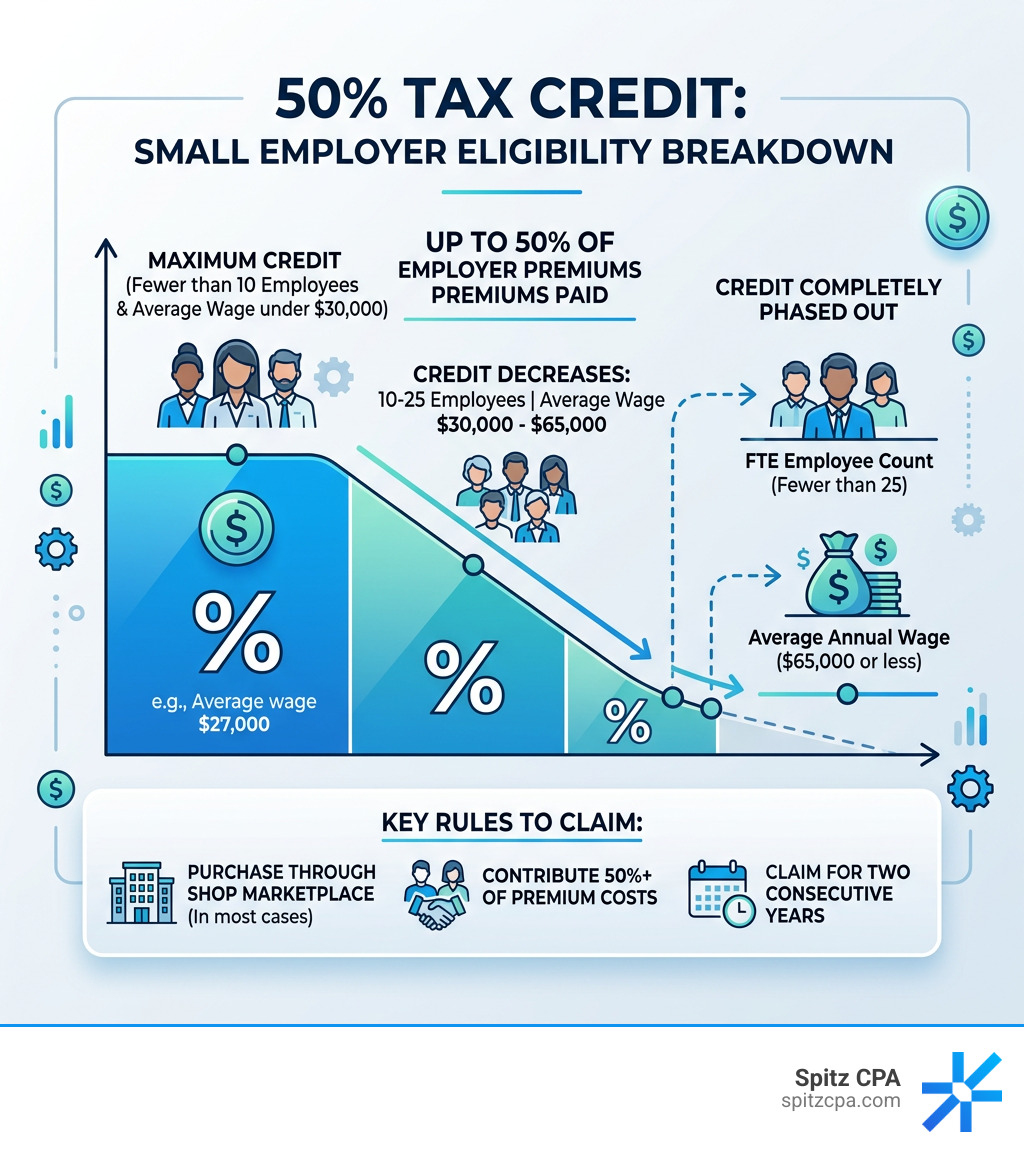
The credit is highest if you have fewer than 10 employees earning an average of $27,000 or less per year. For example, a business with 10 employees, an average salary of $25,000, and $70,000 in employer premium contributions could qualify for a $35,000 tax credit — real money that goes straight back into your business.
With average annual health insurance premiums running nearly $9,000 for single coverage and over $25,000 for family coverage in 2024, this credit can make offering health benefits far more affordable than many small business owners realize.
I’m Michael J. Spitz, a CPA with over 15 years of corporate accounting experience helping businesses across industries — including health services and technology — navigate complex tax obligations like this specific health care credit. If you’re unsure whether your business qualifies or how to maximize what you claim, you’re in the right place.
Understanding the Small Business Health Care Tax Credit

When we talk about the small business tax credit for health insurance, we are referring to a specific provision under Section 45R of the Internal Revenue Code, established by the Affordable Care Act (ACA). This isn’t just a simple deduction that lowers your taxable income; it is a “dollar-for-dollar” credit that directly reduces the actual tax you owe.
For many of our clients in Gilbert, AZ, this credit is a game-changer. If your business qualifies, the federal government essentially picks up a significant portion of your bill for providing health coverage. For-profit businesses can receive a credit worth up to 50% of their premium contribution. If you run a tax-exempt non-profit, you aren’t left out—you can qualify for a credit of up to 35%.
However, there is a catch: the credit is designed to help small businesses get on their feet with benefits. Therefore, you can only claim it for two consecutive tax years. This “two-year limit” begins the first year you claim the credit for tax years after 2013. You can find more detailed information on Small Business Health Care Tax Credit and the SHOP Marketplace to see how the IRS views these timelines.
Maximum Credit Thresholds
The IRS uses a “sliding scale” to determine how much you get. Generally, the smaller the business and the lower the average wages, the higher the credit.
To get the full 50% (or 35% for non-profits), your business must generally have:
- Fewer than 10 full-time equivalent (FTE) employees.
- Average annual wages of $33,000 or less (this amount is inflation-adjusted; for 2024/2025, the threshold for the maximum credit sits around $30,000 to $33,000).
As your employee count grows toward 25 or your average wages climb toward the $65,000 cap, the credit phases out. This is why tax-planning-for-entrepreneurs is so vital. We help you look at your hiring and compensation structure to ensure you aren’t accidentally “earning” your way out of a massive tax break.
Who Qualifies for the Credit?
Eligibility isn’t just about being “small.” The IRS has three specific hurdles you must clear to be considered an “eligible small employer.”
First, you must have a “qualifying arrangement.” This means you pay a uniform percentage (at least 50%) of the premium cost for each enrolled employee. You can’t just offer it to the managers; it has to be a fair shake for the whole team. To see if your current setup matches the requirements, you can Verify your eligibility for SHOP.
Eligibility Requirements
To qualify for this tax break, we look for these three markers:
- Fewer than 25 FTEs: This doesn’t mean you have fewer than 25 people on payroll. It means the total hours worked by your team, when combined, equal fewer than 25 full-time positions.
- Average Wages: Your average annual wages must be less than $65,000 per FTE (for tax year 2024/2025).
- SHOP Enrollment: In almost all cases, you must purchase your group policy through the Small Business Health Options Program (SHOP) Marketplace.
Many owners find the HR side of this daunting. At Spitz CPA, we often integrate this with our hr-for-small-businesses services to ensure that the plans you choose actually meet the legal definitions required for the credit.
Excluded Employees and Special Rules
One of the most common mistakes we see is including the wrong people in the employee count. The IRS is very specific about who does not count toward the 25-FTE limit and whose premiums do not qualify for the credit:
- Owners: Sole proprietors, partners, and shareholders owning more than 2% of an S-corp are excluded.
- Family Members: Spouses, children, parents, and even in-laws of the owners are excluded from the FTE count.
- Seasonal Workers: Generally, if someone works 120 days or fewer during the tax year, they are not counted in the FTE or average wage calculation. However, if you pay premiums for them, those premiums might still be used to calculate the credit. You can Learn more about seasonal workers from the IRS to see how their hours impact your total.
How to Calculate Your FTE and Average Annual Wages
Calculating your Full-Time Equivalents (FTEs) is different than just counting heads. For the purposes of this credit, one FTE is based on a 2,080-hour work year.
To find your FTE count:
- Total the hours worked by all employees (but don’t count more than 2,080 hours for any one person).
- Divide that total by 2,080.
- Round down to the nearest whole number (unless the result is less than one, then it’s one).
For example, if you have 10 employees who each work 1,040 hours (half-time), you have 5 FTEs. This aggregation of part-time hours is a huge benefit for businesses like restaurants or retail shops in Arizona that rely on a large part-time staff.
Once you have your FTE number, you calculate average wages by taking the total wages paid (excluding owners and their families) and dividing it by your FTE count. If the result is over the phase-out threshold (currently $65,000), the credit hits zero. Accurate small-business-accounting is the only way to ensure these numbers are right before you file.
Using the Tax Credit Estimator
Before you dive into the paperwork, it’s a good idea to run the numbers through a tax credit estimator. This tool gives you a “ballpark” figure of what you might expect.
We often use these estimates when helping clients with hr-payroll-benefits planning. If the estimator shows a $15,000 credit, that might be the nudge you need to finally offer that health plan you’ve been considering.
How to Claim Your Credit via the SHOP Marketplace
To get the credit, you generally must buy your insurance through the SHOP Marketplace. This is a portal designed specifically for small employers to compare plans.
You don’t have to do this alone. You can How to work with an agent or broker to find a local Arizona professional who can help you pick the right “Qualified Health Plan.” Once you have the plan, you must ensure you are paying at least 50% of the employee-only premium.
Filing Form 8941
When tax season rolls around, the magic happens on Form 8941. This is where you calculate the actual credit.
- For-profit businesses: You take the amount from Form 8941 and carry it to Form 3800 (General Business Credit).
- Tax-exempt non-profits: You claim the credit on Form 990-T.
One of the best features of this credit is the “carryback” and “carryforward” rule. If you don’t owe taxes this year, you can carry the credit back one year (to get a refund on taxes already paid) or forward up to 20 years. For local businesses, our tax-services-gilbert-az team handles the heavy lifting of these complex forms to ensure you get every penny you deserve.
Additional Tax Deductions for Business Owners
While the small business tax credit for health insurance is fantastic for employers with teams, what if you’re a solopreneur or a partner?
The Self-Employed Health Insurance Deduction is your primary tool. This is an “above-the-line” deduction, meaning it reduces your Adjusted Gross Income (AGI) regardless of whether you itemize. You’ll use Form 7206 to determine this deduction. It’s limited to the net profit of your business—so if your business had a loss this year, you generally can’t take the deduction. We keep a close eye on these small-business-tax-deductions to ensure no money is left on the table.
Related Business Incentives
Beyond health insurance, there are several other credits that can lower your tax bill:
- Work Opportunity Tax Credit (WOTC): A credit for hiring individuals from certain groups who have consistently faced barriers to employment.
- Retirement Plan Startup Credit: You can get up to $5,000 for three years to help cover the costs of starting a 401(k) or SEP IRA.
- Accessibility Improvements: If you’ve made accessibility improvements to your business location (like adding a ramp or accessible restrooms), there is a specific credit for that too.
Managing all these moving parts is part of our employee-benefits-administration strategy, ensuring your business is as tax-efficient as possible.
Frequently Asked Questions
Can I claim the credit if I don’t use the SHOP Marketplace?
Generally, no. The law requires you to use the SHOP Marketplace to qualify for the credit. However, the IRS has provided relief in very specific cases. Per IRS Notice 2014-06, if you are located in a county where no SHOP plans are available, you may still be able to claim the credit with a private plan. We can help you verify if your specific Arizona county qualifies for this exception.
How many years can I claim this tax credit?
The credit is available for only two consecutive tax years. This clock starts the first year you claim it. This is why we recommend waiting to claim it until you have a year where you actually have a significant tax liability to offset, or when your premium costs are at their peak.
Does the credit cover dental and vision insurance?
Yes! As long as the stand-alone dental and vision plans are purchased through the SHOP Marketplace and meet the contribution requirements, they can be included in your premium totals for the credit calculation.
Conclusion
Navigating the small business tax credit for health insurance doesn’t have to be a headache. At Spitz CPA, our goal is to provide the financial clarity you need to grow your business with confidence. Whether you’re trying to figure out your FTE count or looking for a full accounting clean-up, Michael J. Spitz and our team are here to help you achieve that 10x value increase.
Ready to see how much you could save? More info about tax services is just a click away. Let’s get your business the credit it deserves.


