


How Hard Is It for HR to Handle Payroll Services — and Why It Matters More Than You Think
How hard is it for HR to handle payroll services? In short, it is significantly harder than most business owners and HR professionals expect, and the consequences of underestimating that difficulty are measurable, immediate, and sometimes severe. Tax compliance risk is real and costly, as the IRS assessed over $8.5 billion in fines for employment tax problems in fiscal year 2023 alone, with penalties beginning to accumulate after just one day of being late. Time demands are also substantial, with forty-one percent of small business owners spending between three and ten hours every month managing payroll taxes internally, which pulls valuable time directly away from running and growing the business. Furthermore, errors erode employee trust fast, as research shows it only takes two payroll mistakes to send nearly half of employees looking for a new job. System fragmentation makes things worse because only thirteen percent of organizations operate on a fully unified HR and finance platform, meaning most HR teams are reconciling data across disconnected systems every single pay cycle. Finally, complexity scales with growth, and the moment a business hires across state lines or crosses fifty employees, reporting requirements and compliance obligations expand significantly.
Payroll is often described as the kind of thing you do not think about until something goes wrong, and then it is suddenly all you can think about. That is because payroll sits at the center of the employer-employee relationship. When it works, it is invisible. When it does not, the damage shows up in penalty notices, employee turnover, and leadership credibility all at once.
The challenge for HR teams is that payroll is not simply a matter of cutting checks on time. It requires staying current on federal and state tax law, correctly classifying employees and contractors, managing deductions for benefits and garnishments, maintaining years of accurate records, and processing everything on a fixed schedule with zero tolerance for error. That is a significant technical and compliance burden to stack on top of the core HR responsibilities of hiring, onboarding, performance management, and employee relations.
I am Michael J. Spitz, a CPA with over 15 years of corporate accounting experience across industries including technology, health services, property management, and recruitment, and I have seen how hard it is for HR to handle payroll services without the right structure, tools, or outside expertise in place. In this guide, I will walk you through the real complexity behind in-house payroll management and help you evaluate whether your current approach is serving your business or quietly creating risk.
To better understand how hard is it for hr to handle payroll services, you can explore our guides on employee benefits administration, our comprehensive HR & Payroll services, and our detailed breakdown of the hr and payroll administrator role.
Why In-House Payroll is a Single Point of Failure for HR Teams
Many businesses in Gilbert and across Arizona operate their payroll systems under a dangerous assumption of permanent stability. When a single internal team member holds all the specialized knowledge required to run payroll, the entire organization is exposed to severe operational risk. This setup is known as key-person dependency, and it turns an essential back-office task into a single point of failure. If your primary payroll processor takes unexpected medical leave, experiences a family emergency, or suddenly resigns, your business faces an immediate operational crisis.
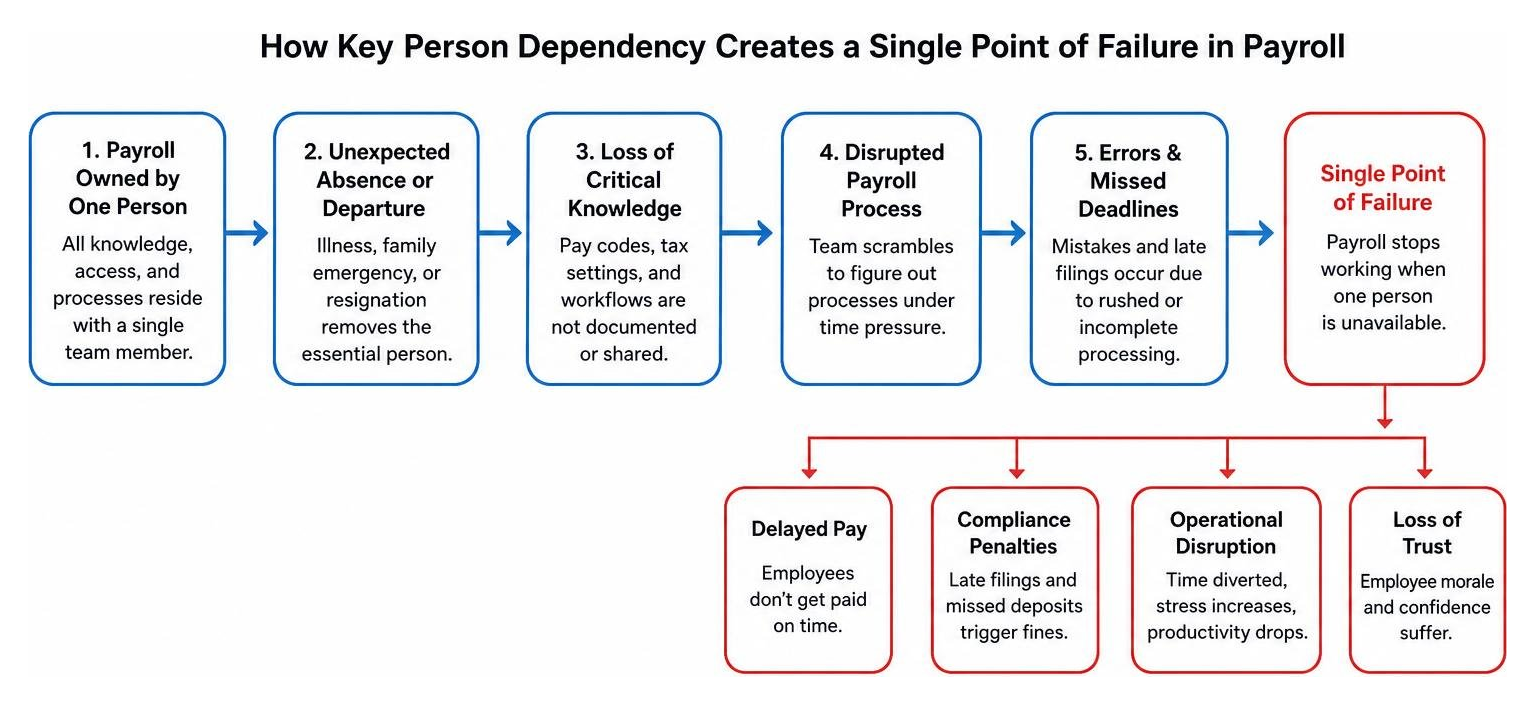
This operational risk is magnified because payroll operates on strict, unyielding deadlines. State and federal agencies do not pause tax filing deadlines because an employee is absent, nor do staff members tolerate delayed paychecks when they have mortgages to pay and families to support. When the person who knows the intricacies of your specific pay codes, local tax withholdings, and benefits deductions is no longer available, the rest of the team must scramble to reconstruct complex workflows from scratch. This lack of bench depth often leads to rushed processing, which inevitably causes significant calculation errors and missed compliance deadlines.
To mitigate this vulnerability, organizations must focus on building true payroll continuity. This means moving away from isolated spreadsheet tracking and documenting every step of the payroll lifecycle so that multiple people can step in if needed. The challenge is that most human resources professionals are already stretched thin managing recruitment, conflict resolution, and cultural initiatives. They rarely have the spare time to master the technical mechanics of payroll processing or to study The Complete Guide to the HR and Payroll Administrator Role to build robust internal redundancies.
How Hard Is It for HR to Handle Payroll Services Internally?
Managing payroll internally requires an extraordinary level of precision that goes far beyond simple data entry. It is a highly technical discipline that demands a deep understanding of tax regulations, financial accounting, and shifting labor laws. Many human resources professionals are trained to focus on people, culture, and organizational development, which means they must spend valuable time learning complex accounting rules that fall outside their core expertise. When you task an HR team with running payroll without specialized financial support, you are asking them to act as tax advisors and compliance officers, which increases the likelihood of costly administrative oversights.

The stakes of making a mistake are incredibly high for both the business and its workforce. When payroll is mismanaged, employees suffer immediate financial stress, especially since a vast majority of workers live paycheck to paycheck. A single underpayment or delayed deposit can disrupt an employee’s personal finances, leading to overdraft fees, missed rent payments, and eroded trust in leadership. For the business, the consequences of payroll errors include steep government penalties, potential labor audits, and a tarnished reputation in the local job market. To protect the organization and maintain a stable workforce, leadership must prioritize accuracy and learn how to Fix Payroll Errors Fast and Stay Compliant.
The Administrative Burden of Tax Filings and Multi-State Compliance
The tax compliance landscape is a minefield for internal HR teams, particularly when managing a workforce that spans multiple jurisdictions. Employers must accurately calculate and withhold federal income tax, Social Security, Medicare, and Federal Unemployment Tax Act contributions, alongside state and local taxes. In Arizona, businesses must navigate specific state withholding rules and register with the appropriate agencies, such as tracking requirements outlined by the Arizona Department of Revenue. If your business employs remote workers who live in neighboring states, your HR team must suddenly master the tax codes, local withholding requirements, and labor laws of multiple states simultaneously, which exponentially increases the administrative burden.
Failing to submit these tax filings and payments on time results in immediate financial penalties from the IRS and state authorities. If you are late in paying your employer taxes by a single day, the IRS imposes a two percent penalty, which jumps to five percent after six days, and climbs to ten percent after sixteen days. The IRS assessed over sixty-five billion dollars in civil penalties in the 2023 fiscal year alone, with more than eight and a half billion dollars in fines specifically targeting employers for employment tax errors. Staying compliant requires a continuous investment of time to study updated tax tables and filing requirements, which is why many growing companies seek out specialized CPA Payroll Services Complete Guide resources to protect their bottom line.
The Hidden Costs of Managing Payroll Systems Without Expert Help
Processing payroll internally involves a massive amount of hidden costs that rarely show up on a standard balance sheet. The most obvious cost is the sheer volume of staff time dedicated to repetitive manual tasks, including tracking hours, entering data, calculating deductions, and preparing tax returns. Additionally, companies must pay for specialized payroll software licenses, ongoing system updates, and mandatory training to keep internal staff certified on changing regulations. When you calculate the loaded salaries of the employees involved in this process alongside software fees, the true cost of running payroll in-house is often significantly higher than outsourcing the entire function to a professional provider.
Beyond the direct expenses, businesses must also account for the cost of payroll leakage, which refers to money lost through time-tracking errors, overpayments, and uncaptured benefit deductions. There is also a major opportunity cost to consider when highly skilled HR professionals spend their week resolving payroll disputes and manually entering timesheet data. Instead of focusing on strategic business growth, talent acquisition, and employee retention, your leadership team is bogged down in administrative tasks. Furthermore, employers must dedicate physical or digital storage to comply with federal record-keeping mandates, which require keeping accurate payroll records for three years and tax records for four years, creating a long-term administrative tail that consumes corporate resources. To understand how to streamline these operational demands, business owners should review The Ultimate Guide to Payroll Processing Solutions.
The Operational Trade-Offs of Standalone Software vs. Managed Solutions
When deciding how to manage payroll, businesses generally choose between two primary operational paths: purchasing standalone software to keep the process in-house or partnering with a full-service managed provider. Standalone software platforms provide the basic digital tools to calculate wages and generate tax forms, but they still require an internal employee to manage data entry, verify hours, and assume ultimate liability for any processing mistakes. A full-service managed solution, such as a specialized CPA firm, takes over the entire process from start to finish, handling calculations, tax filings, and compliance monitoring while providing expert oversight.
Evaluating these options requires looking past the monthly software subscription price and analyzing the total cost of risk, labor, and compliance. Standalone software may appear cheaper on paper, but it leaves the burden of accuracy and legal liability entirely on your shoulders. If a software update fails to capture a new local tax rate, or if an internal user misclassifies an employee, your business is still responsible for the resulting back taxes and penalties. A managed partner acts as an active extension of your team, providing professional guidance to prevent errors before they happen and stepping in to handle audits if issues arise.
Evaluating How Hard Is It for HR to Handle Payroll Services with Standalone Software
Many organizations purchase standalone DIY software believing it will completely solve their payroll challenges, only to find that technology alone is not enough. While modern platforms automate basic calculations, they still function on a garbage-in, garbage-out model, meaning they rely entirely on the accuracy of the data entered by your HR staff. Your team must still manually input new hire details, update benefit deductions, track overtime hours, and verify employee classifications. This manual data entry creates a constant risk of human error, which can lead to missed pay cycles and incorrect tax withholdings that require hours of stressful manual correction.
Furthermore, standalone Payroll Processing Software cannot interpret complex regulatory changes or provide strategic advice when unusual situations arise. For example, if you need to calculate tipped wages, manage multi-state remote workers, or handle complex court-ordered wage garnishments, standard software platforms often fall short. Without an experienced payroll professional to guide the system, your HR team is left to research complex tax rules on search engines, which increases the likelihood of compliance gaps. This lack of professional guidance is why many companies find that DIY software simply shifts the administrative burden rather than reducing it.
When to Outsource to Simplify How Hard Is It for HR to Handle Payroll Services
Recognizing the exact moment to transition from internal payroll management to an outsourced partner is critical for sustaining business growth. A key trigger for outsourcing is when your business begins hiring employees in multiple states, as managing different state tax IDs and local withholding rules quickly becomes too complex for an in-house generalist. Another clear sign is when your workforce approaches fifty employees, which is the threshold where federal mandates like the Affordable Care Act and advanced reporting requirements take effect. If your HR team is spending more time answering payroll questions and fixing processing errors than focusing on employee engagement, it is time to seek professional help.
By transitioning to specialized HR Payroll Companies, businesses can immediately reduce their operational risk and free up internal resources for high-impact activities. Outsourcing provides access to dedicated professionals who monitor legislative updates, manage tax filings, and guarantee accuracy, which protects your business from costly IRS penalties. This shift allows your HR team to step out of the stressful cycle of bi-weekly payroll processing and focus on strategic initiatives like building a strong corporate culture, improving employee onboarding, and developing competitive compensation packages that attract top talent.
Integrating Payroll with HRIS and Benefits Administration
One of the most effective ways to reduce payroll errors and improve administrative efficiency is to integrate your payroll processing with your Human Resources Information System and benefits platform. In a fragmented environment where these systems do not communicate, your HR team must manually update employee data in multiple places whenever a change occurs. For instance, when an employee receives a promotion, changes their health insurance plan, or updates their tax exemptions, that information must be manually copied from the HR database into the payroll system. This double data entry is highly time-consuming and serves as a primary source of calculation errors.

Connecting these platforms creates a single source of truth where data updates flow automatically across your entire operational ecosystem. When an employee updates their benefits elections through an integrated portal, the system automatically adjusts their payroll deductions for the next pay cycle without requiring manual intervention from your HR team. This seamless connection drastically reduces the time spent on manual reconciliations, prevents payroll leakage from uncaptured benefits changes, and ensures that tax withholdings remain accurate. Investing in integrated HR Payroll Benefits administration is a strategic move that simplifies compliance while delivering a modern, self-service digital experience for your entire workforce.
Frequently Asked Questions about HR Payroll Management
Navigating the complexities of payroll administration often brings up critical questions about compliance, certifications, and operational scalability. Understanding these core areas helps business leaders make informed decisions about structuring their internal teams and choosing the right external partners.
What are the most common payroll errors made by HR teams?
The most frequent payroll mistakes made by internal HR teams include misclassifying employees as independent contractors, failing to calculate overtime wages correctly, and missing tax filing deadlines. Misclassification is a major focus for regulatory audits, and getting it wrong can result in substantial back taxes, interest, and penalties. Additionally, manual data entry often leads to simple keystroke errors that result in incorrect pay rates or missed benefit deductions, which require significant administrative time to resolve. To minimize these risks, organizations must establish strict review protocols and learn how to Fix Payroll Errors Fast and Stay Compliant.
What certifications do HR professionals need to manage payroll?
While there is no legal requirement for HR professionals to hold specific payroll certifications, obtaining credentials like the Certified Payroll Professional or Fundamental Payroll Certification from the PayrollOrg can significantly improve processing accuracy. These programs require rigorous study of federal tax codes, labor standards, and benefits administration, which helps build the technical expertise needed to manage complex payroll environments. However, preparing for these exams requires a substantial investment of time and money, and maintaining the certifications demands ongoing continuing education to stay current on shifting regulations.
How does payroll complexity scale with business size?
As a business grows, its payroll complexity does not scale in a simple linear fashion; instead, it expands exponentially at specific employee thresholds. For small businesses with under ten employees, payroll is primarily about tracking basic hours and processing local withholdings. Once a company crosses fifty employees, it must comply with complex Affordable Care Act reporting requirements, manage family leave laws, and navigate advanced non-discrimination testing for benefits programs. Managing these expanded compliance mandates requires a level of specialized knowledge and system capability that quickly outgrows standard DIY software, making it essential to implement Human Capital Payroll Best Practices to maintain operational control.
Conclusion: Achieving Financial Clarity with Michael J. Spitz
Managing payroll internally is a highly complex, risk-prone endeavor that often pulls your HR team away from their core mission of supporting your workforce and building a thriving company culture. From navigating the strict withholding rules of the Arizona Department of Revenue to managing multi-state tax filings and avoiding costly IRS penalties, the administrative burden of in-house processing is a constant challenge for growing businesses. Trying to handle these technical financial tasks without dedicated expert support can lead to costly compliance gaps, operational bottlenecks, and eroded employee trust.
At Spitz CPA, led by Michael J. Spitz, we help businesses in Gilbert, Phoenix, and throughout Arizona achieve complete financial clarity and operational peace of mind. We provide comprehensive accounting clean-up, proactive tax planning, and strategic financial advisory services designed to improve your cash flow and protect your business from compliance risks. By partnering with us, you can offload the stress of payroll management, eliminate administrative errors, and refocus your internal HR team on driving organizational growth and employee success. Contact us today to explore our specialized HR Payroll Services and discover how we can help your business thrive.


