


Why Human Capital Payroll Transforms Business Strategy
Human capital payroll represents a strategic evolution beyond traditional payroll processing, treating employees as valuable assets rather than just operational costs. This integrated approach combines payroll functions with broader human capital management to drive business growth and employee engagement.
Key Human Capital Payroll Solutions:
- Integrated Systems: Unified payroll, HR, and analytics platforms
- Strategic Analytics: Workforce data insights for decision-making
- Employee Experience: Self-service portals and transparent compensation
- Compliance Automation: Automated tax filings and regulatory updates
- ROI Measurement: Human Capital ROI (HCROI) calculations and workforce value tracking
The shift from viewing employees as “staff and personnel” to “human capital” reflects a fundamental change in how businesses approach workforce management. As one industry analysis notes, “Human capital management is the set of practices for measuring, managing, supporting, and guiding people within your organization.” This approach recognizes that your workforce represents your most significant investment – often accounting for the largest portion of operational expenses.
Modern human capital payroll systems integrate time tracking, benefits administration, and performance management into a single platform. This integration eliminates data silos and provides the comprehensive workforce insights needed for strategic decision-making. Companies using these systems report better access to information and reduced administrative costs as the primary benefits.
I’m Michael J. Spitz, a CPA with over 15 years of corporate accounting experience, including extensive work in payroll management and financial strategy across multiple industries. My expertise in human capital payroll helps businesses optimize their workforce investments while ensuring compliance and accuracy.
Beyond Paychecks: How Human Capital Payroll Redefines HR
Remember when payroll meant simply cutting checks and hoping you didn’t mess up the tax calculations? Those days are behind us. Today’s human capital payroll transforms what used to be a back-office headache into a powerful business strategy tool.
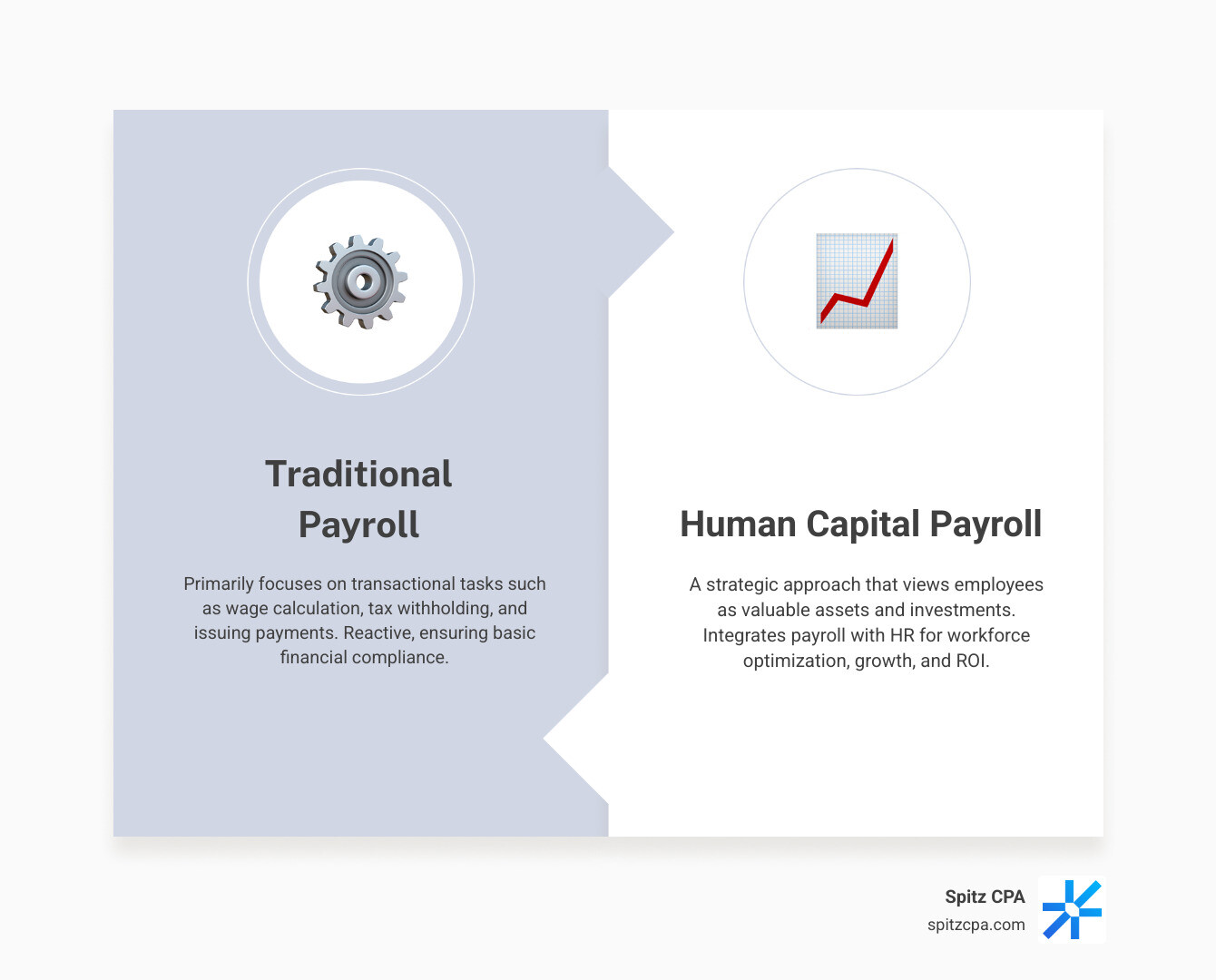
The shift is profound. Traditional payroll treats employees as expenses to manage – calculate their hours, subtract the taxes, cut the check, and move on. It’s reactive work that keeps you busy but doesn’t move the needle on business growth. And when things go wrong? Well, that’s when you really feel the pain, as we outline in our guide on how to do payroll and avoid mistakes.
Human capital payroll flips this entire approach. Instead of seeing employees as costs, it recognizes them as strategic investments – your most valuable assets whose skills, knowledge, and dedication directly fuel your company’s success. This isn’t just feel-good corporate speak; it’s smart business.
Think about it this way: your people often represent your largest expense. Shouldn’t you be getting strategic value from that investment beyond just having bodies in seats?
| Feature | Traditional Payroll | Human Capital Payroll |
|---|---|---|
| Focus | Transactional; Cost-centric | Strategic; Value-centric |
| Data Integration | Limited; Often siloed | Highly integrated; Single source of truth |
| Goal | Accurate, timely payments; Basic compliance | Optimize workforce value; Improve productivity & ROI |
| Employee View | Cost to be managed | Asset to be invested in; Source of competitive advantage |
| Primary Driver | Administrative efficiency | Business growth & employee engagement |
The magic happens through integration. Rather than keeping payroll data locked away in its own system, human capital payroll connects with your broader business strategy. It tracks not just what you pay people, but how that investment translates into skill development, value creation, and ultimately, business growth.
This approach treats the entire employee journey as interconnected – from the day someone joins your team until they retire. Every piece of data becomes valuable intelligence for making better decisions about your workforce.
The results speak for themselves. Companies using this strategic approach report that Human Capital ROI becomes “the ultimate productivity measurement” – showing exactly how your investment in people translates to financial returns. When you can measure and optimize the value your team creates, you’re no longer just running payroll. You’re building competitive advantage.
Core Components and Strategic Integration
Think of human capital payroll as the nervous system of your business – connecting every part of your workforce management into one intelligent network. Instead of juggling separate systems that don’t talk to each other, you get a unified approach that actually makes sense.
The Core Components of a Human Capital Payroll System
A true human capital payroll system goes far beyond just cutting checks. It’s like having a Swiss Army knife for workforce management – multiple tools working together seamlessly.
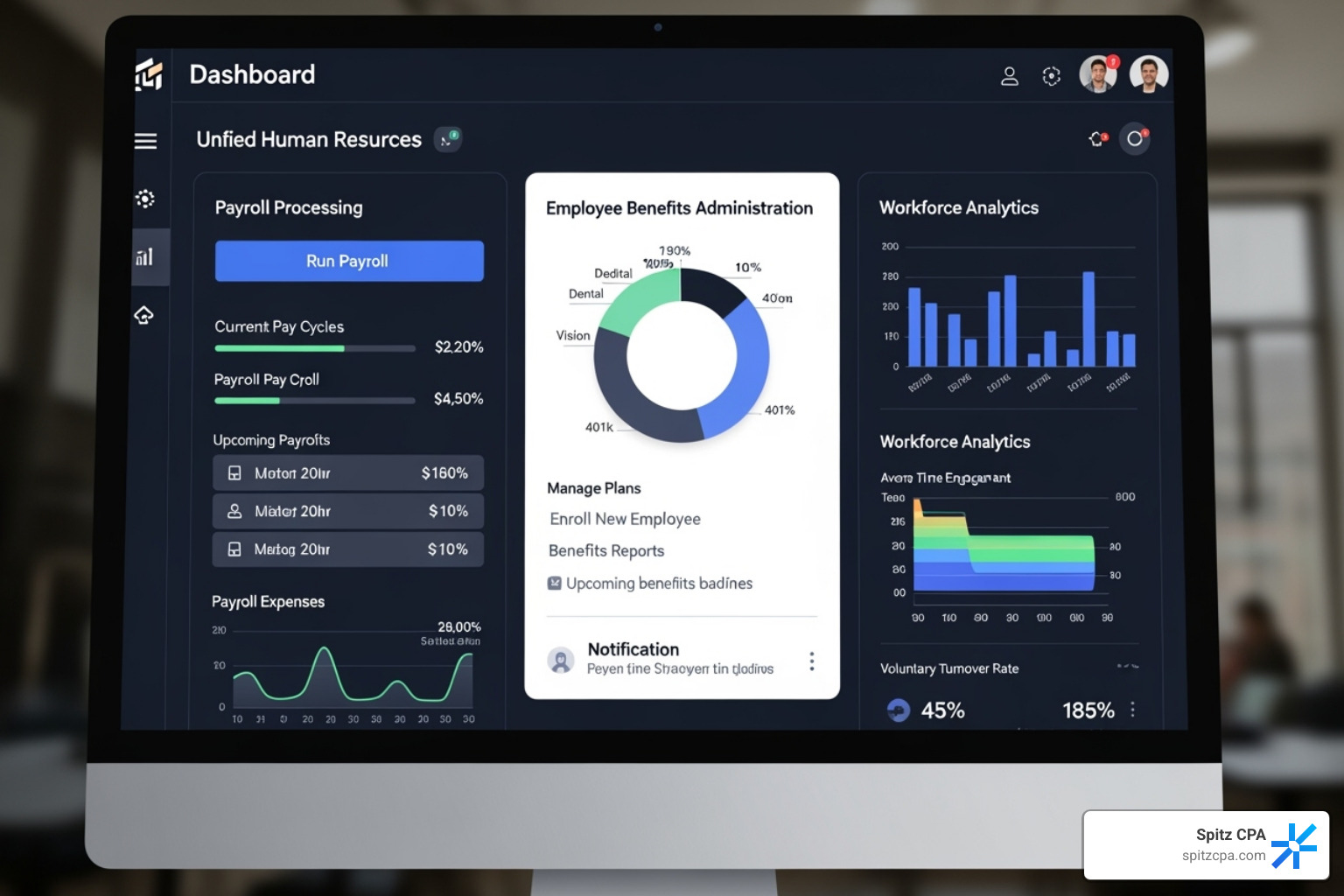
The foundation starts with payroll processing, but it’s smarter than your grandfather’s payroll system. Instead of manually entering hours and hoping for the best, it automatically pulls data from other parts of the system. No more “oops, forgot to include overtime” moments.
Time and attendance management feeds directly into payroll, which means your employees get paid accurately without you having to play detective with timesheets. When someone clocks in late or works extra hours, the system knows about it instantly.
Benefits administration becomes less of a headache too. Health insurance, retirement contributions, vacation time – it all connects. When an employee updates their 401(k) contribution, it flows right through to their next paycheck without anyone having to remember to make the change.
Here’s where it gets really interesting: workforce analytics and reporting. This isn’t just number-crunching for the sake of it. You can actually see patterns in your workforce – who’s performing well, where you might have retention issues, or which departments are your biggest investment. It’s like having X-ray vision for your business.
Employee self-service portals put the power in your team’s hands. They can check their pay stubs, update their address, or request time off without bothering HR. Everyone wins – your employees feel more in control, and your HR team can focus on bigger picture stuff.
Integrating Payroll with Broader Human Capital Strategy
The magic happens when all these pieces work together as unified data in a single system. Remember the old days of updating the same employee information in three different spreadsheets? Those days are gone.
With integrated human capital payroll, you create what we call a single source of truth. When Sarah in accounting updates her emergency contact information, it automatically updates everywhere else too. No more calling around to make sure everyone has the latest version.
This approach is brilliant for eliminating redundancies. Instead of your HR team spending hours reconciling different systems and fixing mismatched data, they can focus on actually helping your people grow and succeed.
The seamless data flow means better decisions with less hassle. Performance reviews can inform salary adjustments, training completions can trigger certification bonuses, and attendance patterns can help you spot potential issues before they become problems.
Your reduced administrative costs come naturally when you’re not paying people to do the same data entry work multiple times. Plus, fewer manual steps mean fewer opportunities for expensive mistakes.
The result? Better access to information that actually helps you run your business. You can see the complete picture of your workforce investment and make smarter decisions about where to focus your resources. It’s the difference between flying blind and having a clear flight plan for your team’s success.
The Financial Impact: Boosting ROI and Employee Engagement
When we talk about human capital payroll, we’re looking at something much bigger than just cutting paychecks. We’re talking about turning your biggest business expense—your people—into your most profitable investment. And honestly, once you see the numbers, it’s pretty exciting.
Calculating the Return on Your People Investment
Here’s where things get interesting. You can actually measure how much money your employees make for your company. It’s called Human Capital ROI, or HCROI for short, and it’s like having a financial thermometer for your workforce.
The beauty of HCROI is its simplicity. You take your revenue, subtract what you spend on your people, then divide that by what you spent. So if your company brings in $250,000 after all non-people costs, and you spent $95,000 on salaries, benefits, training, and HR software, your HCROI looks like this:
HCROI = ($250,000 – $95,000) / $95,000 = 163%
That means every dollar you invest in your team returns $1.63. Not bad, right?
But here’s what makes this really powerful: human capital payroll systems give you the data to calculate this accurately. They track everything from training costs to productivity metrics, so you’re not guessing anymore. You can see which departments are crushing it, which training programs actually work, and where your hiring budget gives you the biggest bang for your buck.
This kind of measuring workforce value isn’t just about patting yourself on the back. It helps you make smarter decisions about raises, training programs, and new hires. When you can show that investing in your people contributes directly to your financial health, those budget conversations get a lot easier.
At Spitz CPA, we help businesses get this kind of financial clarity. When you really understand your numbers—including what your people cost and what they generate—you can make decisions that actually move the needle. Check out our accounting services at Spitz CPA to see how we can help you get a clearer picture of your workforce investment.
Enhancing the Employee Experience with Human Capital Payroll
Now, let’s talk about the human side of human capital payroll. Because when your people feel valued and supported, amazing things happen to your bottom line.
Think about it: nothing kills trust faster than a messed-up paycheck. When employees worry about whether they’ll get paid correctly, they’re not thinking about your customers or that big project. They’re stressed, distracted, and probably updating their resume.
Human capital payroll systems fix this by creating pay transparency that actually works. Employees can log in anytime to see their pay stubs, understand their deductions, and track their benefits. No more awkward conversations with HR about missing overtime or confusion about health insurance costs.
But it goes deeper than just accurate paychecks. These systems help you create personalized career paths that make sense. When payroll data connects with performance reviews and skills tracking, you can spot patterns. Maybe Sarah in accounting is ready for more responsibility, or maybe Tom in sales would thrive in a training role. This kind of role alignment happens naturally when you have all the data in one place.
Here’s what we see with businesses that get this right: increased engagement leads to better work, which leads to better results, which leads to resources for even more investment in people. It’s a cycle that builds on itself.
The retention piece is huge too. When employees see clear growth opportunities and feel financially secure, they stick around. And keeping good people saves you serious money—recruiting and training new employees can cost months of salary, not to mention the productivity hit while they get up to speed.
The best part? Improved retention happens almost automatically when people feel like their contributions matter and their financial well-being is supported. We’ve seen businesses transform their culture just by implementing systems that treat employees as valuable assets rather than necessary expenses.
Want to explore how this might work for your team? Feel free to contact us for insights into enhancing your employee experience while boosting your financial performance.
The Engine of Modern Systems: Technology and Compliance
In today’s business world, technology isn’t just helpful—it’s absolutely essential for managing human capital payroll effectively. The days of manually calculating wages on spreadsheets and hoping we caught every tax change are long gone. Modern systems powered by automation and artificial intelligence have transformed payroll from a monthly headache into a smooth, reliable process that actually helps our business grow.

The Role of Automation in Human Capital Payroll
Think about the last time you had to manually calculate payroll for even a handful of employees. The hours worked, overtime calculations, various deductions, tax withholdings—it’s enough to make anyone’s head spin. Now imagine doing that for hundreds of employees across multiple states. That’s where automation becomes our best friend.
Process automation in human capital payroll handles all those mind-numbing calculations with lightning speed and precision. When an employee clocks in and out, the system automatically captures those hours. When they update their tax withholdings, it instantly applies to their next paycheck. No more wondering if you remembered to update Sarah’s new address or if you calculated overtime correctly for the night shift.
The error reduction alone makes automation worthwhile. We’ve all heard horror stories about payroll mistakes—employees getting paid twice, or worse, not getting paid at all. These systems eliminate the human errors that come with manual data entry. Time tracking feeds directly into payroll calculations, benefits deductions happen automatically, and tax withholdings adjust based on the latest rates. It’s like having a super-accurate assistant who never gets tired or distracted.
But here’s where it gets really exciting: data-driven insights. Modern systems don’t just process payroll—they learn from it. They can spot patterns like seasonal overtime trends, identify departments with high turnover costs, or flag unusual payroll spikes that might indicate timesheet fraud. This information helps us make smarter business decisions about staffing, budgeting, and workforce planning.
Looking ahead, future trends in payroll automation include AI-powered predictive analytics that can forecast payroll costs, smart scheduling that optimizes labor expenses, and even more sophisticated integration with other business systems. The technology keeps getting better at helping us understand not just what we’re spending on our workforce, but how to maximize the return on that investment.
Ensuring Tax and Labor Law Compliance
Let’s be honest—keeping up with tax and labor law changes is like trying to hit a moving target while blindfolded. Federal tax rates change, states update their minimum wage laws, and local jurisdictions add new requirements seemingly every month. Miss one update, and you could face penalties that make your accountant weep.
This is where human capital payroll systems really shine. Automated tax filings mean the system calculates federal, state, and local taxes automatically, applies the correct withholdings, and often handles the electronic filing of required forms like W-2s and quarterly reports. No more late nights scrambling to meet filing deadlines or wondering if you used the right tax tables.
Regulatory updates happen seamlessly in the background. When the Department of Labor updates overtime rules or your state raises the minimum wage, the system automatically incorporates these changes. You don’t have to track every legislative session or subscribe to multiple compliance newsletters—the technology handles it for you.
For businesses with employees in multiple locations, compliance with federal, state, and local laws becomes exponentially more complex. Different states have different unemployment insurance rates, various local jurisdictions have their own tax requirements, and don’t get me started on the complexity of paid sick leave laws. Modern payroll systems manage all these nuances automatically, ensuring compliance wherever your employees work.
The risk mitigation aspect cannot be overstated. These systems maintain detailed, audit-ready records and perform automatic compliance checks with every payroll run. They help ensure the correct tax treatment is applied to all aspects of employee compensation, from regular wages to bonuses to stock options.
At Spitz CPA, we understand that technology is only as good as the expertise behind it. Our comprehensive tax services at Spitz CPA complement your human capital payroll system, providing the strategic guidance and expert oversight that keeps your business compliant and thriving. Because while technology can handle the calculations, you still need human expertise to steer the bigger picture of tax strategy and business planning.
Frequently Asked Questions about Human Capital Payroll
We get a lot of questions from business owners who are curious about human capital payroll and how it might transform their operations. Let’s explore the most common ones we hear, because understanding these distinctions can make all the difference in how you approach your workforce strategy.
What is the main difference between human capital and human resources?
This question comes up constantly, and for good reason. People use these terms like they mean the same thing, but they’re actually quite different – and understanding that difference is key to open uping real value from your team.
Human capital is about viewing your employees as valuable assets with skills, knowledge, and experience that drive your business forward. Think of it as the economic value each person brings to your company. When we talk about human capital, we’re focusing on investment and growth potential. It’s recognizing that Sarah in accounting isn’t just a cost center – she’s someone whose expertise in financial analysis could help you identify new profit opportunities.
Human resources, on the other hand, is the function that manages people – the department and the processes involved in hiring, benefits, policies, and yes, payroll. HR is about the how of managing people, while human capital is about the what – the actual value those people represent.
Here’s a simple way to think about it: human capital is what makes your employees valuable, and human resources is how you nurture and manage that value. You need both working together to build a thriving business.
How does an integrated system improve payroll accuracy?
Nothing frustrates employees more than payroll mistakes, and nothing wastes more time than fixing those errors after the fact. An integrated human capital payroll system solves this problem by creating one unified source of information instead of juggling multiple spreadsheets and systems.
When your time tracking automatically feeds into payroll, there’s no chance for someone to mistype hours or forget to include overtime. When benefit deductions are calculated automatically based on the employee’s current enrollment, you eliminate those awkward conversations about why someone’s health insurance wasn’t deducted properly.
The real magic happens with real-time updates. If an employee gets a raise or changes their tax withholding, that information flows through the entire system immediately. No more finding three months later that someone’s been paid incorrectly because the HR system wasn’t talking to the payroll system.
These systems also have built-in safety checks. If something looks unusual – like an employee suddenly working 80 hours without overtime approval – the system flags it before you process payroll. It’s like having a really smart assistant who catches mistakes before they become problems.
Can small businesses benefit from these systems?
Absolutely! In fact, small businesses often see the biggest change from human capital payroll systems, and here’s why: when you’re running a small business, every hour counts, and every mistake is magnified.
Small business owners often wear multiple hats – you might be the CEO in the morning, the HR manager at lunch, and the bookkeeper in the evening. Automating complex tasks like payroll processing, tax filings, and benefits administration gives you back precious time to focus on growing your business instead of drowning in paperwork.
Compliance becomes manageable when you don’t have to track every change in federal, state, and local tax laws yourself. The system handles those updates automatically, so you’re not lying awake at night wondering if you calculated unemployment taxes correctly.
Perhaps most importantly, these systems help small businesses compete for top talent. When you can offer professional payroll processing, employee self-service portals, and transparent benefits administration, you’re providing an experience that rivals much larger companies. That matters when you’re trying to attract the best people in a competitive market.
The data insights alone can be game-changing for small businesses. Understanding your labor costs, tracking productivity trends, and identifying which employees drive the most value helps you make smarter decisions about hiring, raises, and resource allocation. For more guidance on managing your growing business finances effectively, check out our small business accounting guide.
The bottom line? Human capital payroll systems don’t just make small businesses more efficient – they make them more strategic, more compliant, and more attractive to the talent that drives growth.
Conclusion
The change from traditional payroll processing to human capital payroll represents more than just a technological upgrade – it’s a fundamental shift in how we view our most valuable business asset: our people. Throughout this journey, we’ve explored how this strategic approach moves us far beyond simply cutting checks to creating a comprehensive system that nurtures, measures, and maximizes our workforce investment.
The benefits speak for themselves. We gain crystal-clear financial insights through metrics like Human Capital ROI, allowing us to see exactly what return we’re getting on every dollar invested in our team. Our employees experience a more engaging, transparent workplace where their growth and well-being are prioritized. Meanwhile, automation and AI handle the heavy lifting of administrative tasks, freeing us to focus on what truly matters – building our business and supporting our people.
Perhaps most importantly, human capital payroll systems keep us compliant with the ever-changing maze of tax regulations and labor laws. This isn’t just about avoiding penalties; it’s about building a solid foundation that lets us sleep soundly at night.
The workplace is evolving rapidly. Employees expect more transparency, better experiences, and genuine investment in their professional development. The businesses that thrive will be those that accept these changes, using human capital payroll as their strategic advantage rather than treating payroll as a necessary chore.
At Spitz CPA, we’ve seen how the right approach to workforce management can transform a company’s financial health. Our expertise goes beyond just processing payroll – we help you understand what your numbers are telling you about your business. When you can clearly see the return on your people investment, you can make smarter decisions about hiring, training, and retention that directly impact your bottom line.
We believe every business deserves financial clarity and the tools to achieve significant growth. Your employees are your greatest investment, and with the right human capital payroll strategy, that investment can yield remarkable returns.
Ready to turn your payroll process into a competitive advantage? Contact us for expert Payroll Services and let’s discuss how we can help your business – and your people – reach their full potential.


