


Open uping Your Business’s Profit Potential
Many business owners want to improve business profitability, but often feel overwhelmed about where to start. Simply put, boosting your bottom line comes down to a few core actions:
- Increase revenue through smart pricing and more sales.
- Reduce costs by finding efficiencies and better deals.
- Optimize operations for smoother, leaner processes.
- Understand your financial data to make informed choices.
Profit isn’t just a number; it’s the lifeblood of any growing business. It allows you to invest, innovate, and secure your future. Without healthy profits, even a busy business can struggle to survive. This guide will walk you through the key strategies to strengthen your company’s financial health.
My name is Michael J. Spitz, and with over 15 years in corporate accounting, I’ve guided businesses through strategic financial decisions, from fundraising to cost management. My expertise in financial modeling and cash management helps clients tangibly improve business profitability.
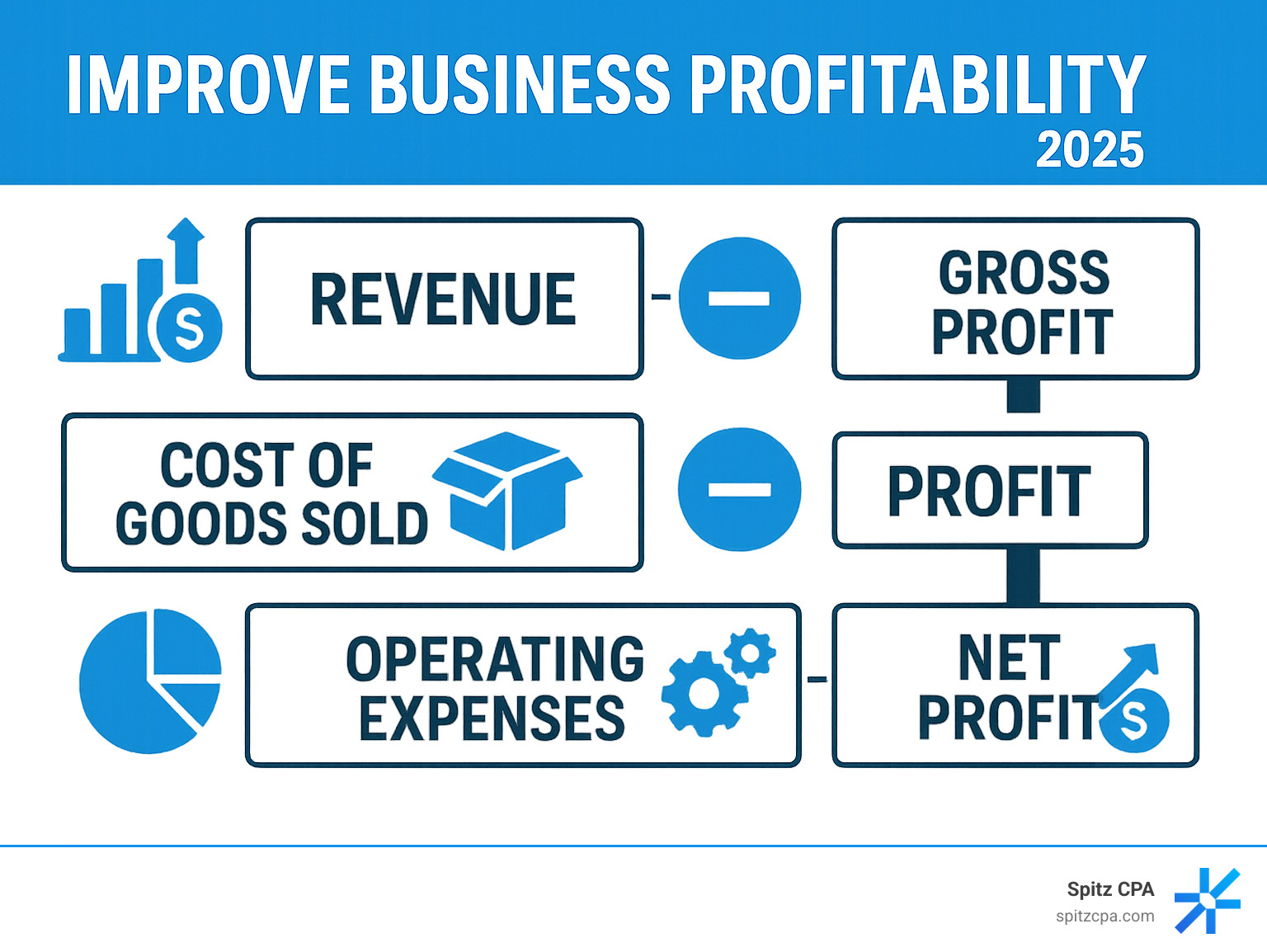
Understanding the Profit Equation: Gross vs. Net
Profit can feel like a black box. One month you have great sales, the next you’re wondering where the money went. To truly improve business profitability, you must understand what’s happening under the hood.
Think of profit like an onion; each layer reveals something important about your business’s health.
The profit game comes down to four key players:
Price is what you charge, Volume is how much you sell, Variable costs are expenses that fluctuate with sales (like materials), and Fixed costs are steady bills like rent and insurance.
These four factors are interconnected. Raising prices too much can reduce sales volume, while aggressive cost-cutting can hurt quality. The secret is finding the right balance.
The Two Tiers of Profit
Accountants discuss two types of profit, each telling a different story about your finances.
Gross profit is what you keep after paying for the direct costs of what you sell. The formula is simple: Revenue – Cost of Goods Sold (COGS).
COGS includes all direct costs to make your product or deliver your service, like a baker’s flour and eggs. Gross profit measures the efficiency of your core operations.
Net profit is your gross profit minus all other operating expenses like rent, salaries, and marketing. It’s what you actually keep at the end of the day.
Here’s how they stack up:
| Feature | Gross Profit | Net Profit |
|---|---|---|
| Focus | Production efficiency, direct cost management | Overall business health, total expense management |
| Calculation | Revenue – Cost of Goods Sold (COGS) | Gross Profit – Operating Expenses (OpEx), Interest, Taxes |
| What it tells you | How much money you make from each sale before overhead | How much money your business truly keeps after all bills are paid |
| Key driver for improving | Optimizing COGS, smart pricing | Managing all costs, revenue growth, tax efficiency |
What is a Good Profit Margin?
What’s a good profit margin? It depends heavily on your industry.
For example, a grocery store might thrive on a 3% net margin, while a software company with the same margin would not.
According to NYU’s Stern School of Business, the average net profit margin across U.S. industries is around 7.59%, but it varies widely. Water utilities can see 19% margins, while retail businesses often have much thinner ones.
As a rough guide, 5% is considered low, 10% is pretty good, and 20% or higher is excellent. However, the most important comparison is with businesses similar to yours.
The key is to understand your current standing and work to improve business profitability sustainably. A stable 8% margin is often better than a shaky 15%.
For deeper insights into profit margins, check out this helpful resource on What Is a Good Profit Margin?. You can also explore detailed Margins by Sector (US) data to see exactly how your industry typically performs.
These benchmarks are just starting points. Your goal should be steady improvement, not perfection overnight.
Strategic Revenue Improvement
Increasing revenue is an exciting way to boost your bottom line, but it’s not just about selling more. The magic is in selling smarter by understanding your value and connecting with the right customers at the right price.
Revenue improvement has three pillars: pricing strategies to maximize value, sales volume tactics to grow your customer base, and product optimization to focus on what’s most profitable.
Pricing Strategies to Improve Business Profitability
Many business owners fear raising prices, but even a modest 3% price bump can significantly boost your profit per sale without extra work.
Value-based pricing focuses on the value you deliver, not just your costs. If your service saves a client $10,000 annually, you can price accordingly. The key is communicating that value clearly so customers understand what they’re paying for.
Tiered pricing works well across industries. Offering basic, standard, and premium packages creates natural upsell paths. Most customers choose the profitable middle tier, avoiding the cheapest and most expensive options.
Bundling products or services increases the average sale value while offering customer convenience. Research on mixed bundling shows this approach—where items are available both individually and bundled—often generates higher revenue than pure bundling strategies.
Use competitive analysis as a benchmark, but don’t just copy prices. Differentiate based on your unique strengths. The goal is to be the obvious choice, not the cheapest.
Boosting Sales Volume and Customer Value
Once your pricing is dialed in, focus on bringing in more customers and getting more value from existing ones.
Lead generation is the fuel for sales. You need a steady stream of prospects, whether from networking, partnerships, or online ads. We offer specialized lead generation services because a solid lead pipeline is transformative for our clients.
Customer retention is often more profitable than acquisition, as it costs more to win a new customer than to keep one. Loyal customers also provide word-of-mouth marketing. Focus on exceptional service and address concerns promptly.
Upselling and cross-selling are natural extensions of good customer service. When you understand customer needs, suggesting additional products or services feels helpful, not pushy. Train your team to spot these opportunities.
Market expansion doesn’t have to be intimidating. It can be as simple as understanding your current market better through research and adapting your offerings, or exploring adjacent markets where your expertise applies.
Eliminating Unprofitable Products and Services
Sometimes, the best way to improve business profitability is to sell less. The 80/20 rule often applies: 80% of your profits may come from 20% of your offerings.
Product profitability analysis is often eye-opening. Some popular products may actually lose money due to hidden costs, while an overlooked service could be a major profit driver.
Strategic discontinuation of unprofitable offerings takes courage but is often necessary. It’s not giving up; it’s focusing your resources on what works.
The goal isn’t to have the biggest catalog, but the right mix that serves customers well while keeping your business profitable.
Mastering Cost Control and Operational Efficiency

While boosting revenue gets attention, smart cost control offers the quickest wins to improve business profitability. The goal is to spend smarter, not just less.
Every dollar saved from cost control goes straight to your bottom line, delivering pure profit improvement.
Reducing Variable Costs Without Sacrificing Quality
Variable costs fluctuate with your sales volume. The secret is cutting these costs without hurting the quality your customers expect.
Start with supplier negotiation. Don’t just accept the first quote. Regularly review terms with suppliers and ask about volume discounts or better pricing. Simply asking can yield surprising results.
Bulk purchasing can slash per-unit costs but be careful not to tie up cash in excess inventory. Balance bulk savings with healthy cash flow.
With process optimization, analyze your workflows for waste, unnecessary steps, or chances to combine tasks. Small improvements add up to significant savings.
Don’t overlook responsible waste management. Reducing waste, whether it’s food in a restaurant or paper in an office, lowers material costs and disposal fees.
Managing Fixed Costs and Overhead
Fixed costs are consistent regardless of sales volume, but they still offer savings opportunities.
Budgeting and expense audits are profit goldmines. Review every recurring expense, like forgotten subscriptions or old insurance policies. These costs add up.
Consider outsourcing non-core functions like IT or payroll. Specialists can often do it faster and cheaper than an in-house team. We help businesses identify these opportunities through our outsourcing services.
Rent negotiation and contract optimization can yield surprising savings. Landlords and service providers are often flexible to keep a good client. It never hurts to ask.
Boosting Efficiency Through Automation and Inventory Control
Lean management principles help you spot waste and inefficiency everywhere, from order processing to material handling.
Automation is no longer just for big corporations. Small businesses can automate repetitive tasks, freeing up their team for higher-value work.
Just-in-time inventory management frees up cash and reduces storage costs by ordering materials as needed rather than stockpiling them. It requires solid forecasting, but the payoff is substantial. For detailed strategies on cutting inventory costs, check out these ways to reduce costs on inventory.
Here are key operational areas where automation can significantly improve business profitability:
- Payroll: Automated calculations, deductions, and direct deposits save hours each pay period
- Bookkeeping: Streamlined transaction recording and report generation reduce errors and time
- Invoicing: Automated invoice creation and payment reminders improve cash flow
- Customer Relationship Management: Automated lead tracking and follow-ups ensure nothing falls through the cracks
- Inventory Management: Automated reorder points prevent stockouts and overstock situations
- Marketing Campaigns: Automated email sequences and social media posting maintain customer engagement without constant manual effort
The goal is to automate the right things so your team can focus on what humans do best: building relationships, solving complex problems, and growing the business.
How to Systematically Improve Business Profitability for Long-Term Success

Lasting profitability isn’t about one big change. It requires consistent care and a systematic approach. Businesses that truly improve business profitability for the long haul apply this to every part of their operation.
This is your roadmap to sustainable growth, outlining the elements that separate thriving businesses from those that merely look busy.
Mastering Your Financials
You can’t steer your business without understanding your financials. While statements can seem intimidating, you don’t need an accounting degree to grasp the basics that will transform your decision-making.
Your income statement (or P&L) tells your business’s story over time, showing revenue, costs, and profitability. It reveals trends that guide your strategy.
The balance sheet is a snapshot of your financial health, showing assets, liabilities, and equity. It reveals your financial strength to weather storms or seize opportunities.
The cash flow statement is critical. A business can be profitable on paper but fail due to poor cash flow. This statement tracks actual cash movement. Understanding that profit isn’t the same as cash in the bank is vital for survival.
Tracking Key Performance Indicators (KPIs) like gross profit margin and customer acquisition cost provides a dashboard for your business. Reviewing these KPIs regularly with an accounting partner helps you make informed decisions.
For business owners just starting their financial journey, our Small Business Accounting 101: A Guide for New Entrepreneurs breaks down everything you need to know. And don’t overlook the power of smart Tax Planning for Entrepreneurs – it’s not just about staying compliant, but about keeping more of what you earn.
Leveraging Your Team to Improve Business Profitability
Your employees are your secret weapon for profitability. When your team is engaged, everything gets easier.
Employee engagement is a profit driver. Research by Gallup on engagement shows engaged employees are more productive, innovative, and loyal, creating better customer experiences.
Engagement starts with making your team feel valued. When employees see how their work contributes to success, they become invested. Regular feedback, transparency, and recognition are smart business strategies.
Training your team is a crucial investment. Poor training is expensive; studies show 40 percent of employees who receive poor training leave within a year. The cost of turnover makes proper initial training a financially sound decision.
Well-trained employees are more productive, make fewer mistakes, and can take on more responsibility, freeing you to focus on growth. Productivity incentives aligned with profitability goals can turn your team into partners in success.
Avoiding Common Pitfalls
Even smart owners fall into traps that hurt profitability. Awareness is the first step to avoiding them.
Chasing revenue over profit is a common trap. High sales are exciting, but if they aren’t profitable, you’re just working harder for less. A “busy but broke” business is still broke. Always analyze if a new sale truly improves the bottom line.
Ignoring cash flow is a fatal mistake. You can be profitable on paper and still go bankrupt. Monitor cash flow diligently and maintain adequate cash reserves.
Failing to adapt is a silent profit killer. Markets change fast, and businesses that resist new technology or shifting customer preferences get left behind. Stay curious and be willing to evolve.
Ineffective cost-cutting can backfire. Slashing costs without a strategy can hurt quality, service, and morale. Smart cost reduction focuses on efficiency and eliminating waste, not just cutting corners.
Neglecting customer feedback is like ignoring free business advice. Customers offer an outside perspective that can reveal problems and opportunities you might miss. All feedback is valuable intelligence.
The goal isn’t perfection – it’s progress. Every small improvement in financial understanding, team engagement, and operational efficiency compounds over time. That’s how you build a business that doesn’t just survive, but thrives for years to come.
Frequently Asked Questions about Business Profitability
When I work with business owners, I hear the same questions over and over again. These are the fundamentals that every entrepreneur should understand to improve business profitability. Let me break down the most common ones for you.
What are the four fundamental factors that determine profit?
Think of profit like a simple equation with four moving parts. The price you charge for your products or services is your first lever. Even a small price increase can dramatically boost your bottom line.
The quantity or volume of what you sell is your second factor. More sales usually mean more profit, but it’s not always that straightforward (more on that below).
Your third factor is the costs you incur directly in producing or buying your products or services. These are your variable costs – they go up and down with your sales volume. Think raw materials, shipping, or commission payments.
Finally, you have the costs that happen whether you make any sales or not – your fixed costs like rent, insurance, and base salaries.
The beauty of understanding these four factors is that profitability strategies become much clearer. You can adjust one or more of these levers to achieve the results you want. It’s like having four dials on your profit dashboard.
How does increasing sales volume impact profit margins?
This is where many business owners get confused, and I don’t blame them! Increasing sales volume can boost your total profit, but it might actually decrease your profit margin percentage.
Here’s why: if you lower prices to drive more volume, or if you spend heavily on marketing to achieve those higher sales, your profit margin percentage might shrink. You’re making less profit per dollar of sales, even though your total profit dollars increase.
But here’s the flip side – and this is where it gets exciting. Increasing volume can actually improve business profitability through economies of scale. When you produce more, your per-unit variable costs often decrease. Your supplier might give you better pricing for larger orders, or your production becomes more efficient.
The key is analyzing the trade-offs carefully. Sometimes it’s better to sell fewer units at higher margins. Other times, volume is your friend. The answer depends on your specific business and market conditions.
What is the difference between gross profit margin and net profit margin?
I like to think of these two margins as telling different stories about your business health. Gross profit margin focuses on how efficiently you produce and sell your core products or services. It’s calculated as (Revenue – COGS) / Revenue.
This margin tells you how much profit you make from each sale before you pay for overhead like rent, marketing, or administrative costs. If your gross profit margin is strong, you know your core business model is sound.
Net profit margin gives you the complete picture. It’s calculated as (Revenue – All Expenses) / Revenue. This includes everything – your cost of goods sold, operating expenses, interest payments, and taxes.
Net profit margin shows your overall business health and your ability to turn revenue into actual profit that stays in your bank account. It’s the ultimate test of whether your business is truly profitable or just busy.
Both margins are important, but they serve different purposes. Gross profit helps you understand your production efficiency, while net profit reveals your overall financial performance after all the bills are paid.
Conclusion
Improving business profitability isn’t a destination – it’s an ongoing journey that requires patience, strategy, and the right guidance. Throughout this guide, we’ve explored how improving business profitability comes down to mastering four key areas: strategic revenue growth, smart cost control, operational efficiency, and financial clarity.
The most successful businesses don’t try to tackle everything at once. Instead, they take a systematic approach, making data-driven decisions based on solid financial understanding. Whether you’re adjusting your pricing strategy, streamlining operations, or empowering your team to be more productive, every small improvement compounds over time.
What sets thriving businesses apart is their commitment to continuous improvement. They regularly review their financial statements, track key performance indicators, and aren’t afraid to make tough decisions about unprofitable products or services. They understand that balancing revenue growth with diligent cost control isn’t just good business practice – it’s essential for long-term survival.
At Spitz CPA, we’ve seen how financial clarity transforms businesses. When you truly understand your numbers, you can make confident decisions that drive real growth. Our clients often find profit opportunities they never knew existed, simply by having clear, accurate financial data at their fingertips.
The path to improved profitability doesn’t have to be overwhelming. With the right support and guidance, you can steer the complexities of financial management while focusing on what you do best – serving your customers and growing your business.
Ready to take the next step? Take control of your financial performance with expert Accounting services. Let us help you uncover the profit potential in your business, so you can build the thriving, sustainable company you’ve always envisioned.


