


Why Profitability Is the Foundation of Business Success
The ultimate goal for every business owner is to increase business profitability—it’s the difference between survival and thriving. Here are the primary ways to achieve it:
Five Core Strategies to Boost Profitability:
- Optimize Pricing – Shift from cost-based to value-based pricing and implement tiered options
- Reduce Operating Costs – Negotiate with suppliers, eliminate waste, and automate repetitive tasks
- Improve Operational Efficiency – Streamline processes and leverage technology to do more with less
- Increase Revenue Streams – Focus on upselling, cross-selling, and customer retention
- Track Financial KPIs – Monitor gross profit margin, net profit margin, and cash flow regularly
The reality facing many businesses today is stark. Recent data shows that 41.8% of business owners expected a drop in profitability in the short term, while only 8.3% anticipated an increase. Many industries saw revenue plummet—with 86.4% of accommodation and food services businesses reporting significant drops.
But there’s good news. Profitability isn’t just about working harder or making one big change. It’s about making lots of little things better across your entire operation. Research shows that just a 10% improvement across five key business areas can lead to a 61% increase in overall profit. That’s the power of compound improvements.
The path from red to green requires strategic action across three main pillars: driving revenue growth, mastering cost control, and boosting operational efficiency. Each pillar offers multiple levers you can pull to move your business toward sustainable profitability.
I’m Michael J. Spitz, and with over 15 years of corporate accounting experience including extensive FP&A work with modeling, budgeting, and cash management, I’ve helped businesses develop and implement strategies to increase business profitability across multiple industries. My approach combines rigorous financial analysis with practical, actionable solutions that deliver measurable results.
The Three Pillars of Profitability: A High-Level Overview
Imagine your business resting on three sturdy pillars. If one is weak, the entire structure is unstable. To truly increase business profitability, we must strengthen all three: revenue growth, cost control, and operational efficiency. These aren’t isolated concepts; they’re interconnected forces that, when balanced, lead to robust business health and long-term financial stability.
Many business owners primarily focus on increasing sales or cutting costs. While these are vital, they often overlook the synergistic effect of tackling all three areas simultaneously. For instance, an online retailer successfully cut operational costs by 28% while simultaneously improving customer satisfaction through strategic automation. This holistic approach boosted their profit margins from 34% to 48%, proving that integrated strategies yield superior results.
At Spitz CPA, we emphasize that restoring and maintaining profitability isn’t a one-time fix but an ongoing commitment to strategic planning and continuous improvement. It requires a clear vision, proactive decision-making, and the discipline to execute. We help businesses in Gilbert, AZ, and across Arizona develop a roadmap for their strategic business growth, ensuring all pillars are fortified for sustainable success. For more detailed guidance on setting your long-term vision, explore our resources on Strategic Business Growth.
Driving Revenue: Pricing, Sales, and Customer Loyalty
Increasing revenue isn’t just about selling more; it’s about selling smarter. This pillar focuses on optimizing how you price your offerings, enhancing your sales and marketing efforts, and building unshakeable customer loyalty. When customers are happy and willing to pay for the value you provide, your business thrives.

Optimizing Your Pricing Strategy for Maximum Margins
Your pricing strategy is a powerful lever for profitability. Simply raising prices isn’t always the answer, but understanding the true value you offer can open up significant margin improvements. A service company, for example, transformed its approach from price-based competition to value-based pricing, nearly tripling its profit margins in under a year. This demonstrates that customers are often willing to pay more when they clearly understand the additional value they receive.
Here are some strategies we help our clients implement:
- Value-Based Pricing: Instead of just calculating your costs and adding a markup, price your products or services based on the perceived value to the customer. What problem do you solve? How much is that solution worth to them?
- Tiered Pricing: Offer different versions of your product or service with varying features and price points. This allows you to capture different customer segments, from budget-conscious to premium buyers.
- Dynamic Pricing: Adjust prices based on real-time demand, seasonality, or market conditions. Think about how airlines or ride-share services price their offerings.
- Bundling Products: Combine complementary products or services into a package deal. This can increase the average transaction value and make your offer more attractive than individual items. Harvard Business School research suggests that offering bundled options alongside individual products (mixed bundling) can lead to higher revenue increases than pure bundling alone.
- Premium Versions: Introduce improved or luxury versions of your existing products. This allows you to reposition your product to a segment that values quality over price, commanding higher margins. If you’re looking to redefine your market perception, consider how you can Reposition your product.
- Limiting Discounts: While discounts can drive sales, overuse can erode your profit margins and devalue your brand. Use them strategically, perhaps for clearing old inventory or attracting new customers for a limited time.
Key Marketing and Sales Strategies to Increase Business Profitability
Effective marketing and sales are the engines of revenue growth. Beyond simply attracting new customers, the goal is to attract the right customers—those who value your offerings and contribute positively to your profit margins.
- Upselling and Cross-selling: Train your sales team to recommend higher-value products (upselling) or complementary items (cross-selling) to existing customers. It’s often easier and more cost-effective to sell more to current clients than to acquire new ones.
- Content Marketing: Establish your authority and expertise by creating valuable content. This could include service pages, industry insights, case studies, videos, or a business blog. A well-maintained business blog can attract organic traffic and position you as a thought leader in your field.
- Targeting High-Margin Products: Focus your marketing efforts on promoting products or services that yield the highest profit margins. A fabrication company, for instance, doubled their profit margins by strategically declining low-margin work and specializing in high-value projects. Less can indeed be more profitable.
- Referral Programs: Encourage satisfied customers to refer new business. Word-of-mouth is a powerful and cost-effective marketing tool.
- Improving Online Presence: A strong online presence is non-negotiable. This includes optimizing your website, engaging on social media, and leveraging digital marketing channels. As of early 2021, 16.7% of businesses had an online sales platform or planned to implement one, highlighting the shift towards digital commerce.
- CRM Systems: Implement a Customer Relationship Management (CRM) system to track customer interactions, manage leads, and personalize communications. This helps in nurturing relationships and identifying sales opportunities.
Turning Customer Service into a Profit Center
Excellent customer service isn’t just a nice-to-have; it’s a critical component in your strategy to increase business profitability. Exceptional service fosters loyalty, reduces churn, and can even justify premium pricing. A management consulting firm, for example, increased profit margins by 45% through personalized client experiences and subscription-based advisory services, while simultaneously reducing client acquisition costs.
Here’s how customer service fuels profitability:
- Customer Lifetime Value (CLV): By providing outstanding service, you increase the chances of repeat business and customer retention, significantly boosting their CLV. Loyal customers buy more, more often, and are less sensitive to price.
- Personalized Experiences: Tailoring interactions to individual customer needs makes them feel valued and understood, strengthening their bond with your brand.
- Subscription Models: For many businesses, offering subscription-based services can create a predictable, recurring revenue stream, improving cash flow and customer stickiness.
- Reducing Customer Acquisition Cost (CAC): Happy customers become advocates, referring new clients at little to no cost to you. This reduces the need for expensive marketing campaigns to acquire new business.
- Loyalty Programs: Reward your most loyal customers with exclusive benefits. This encourages continued engagement and makes them feel appreciated.
- After-Sales Support: Providing excellent support even after the sale reinforces trust and satisfaction, ensuring customers return for future purchases.
If you’re looking to optimize your customer experience and integrate it into your overall business strategy, our Business Consulting in Gilbert services can help you identify opportunities to turn customer interactions into a profit driver.
Mastering Cost Control and Financial Management
While growing revenue is exciting, effectively managing your costs is equally crucial to increase business profitability. It’s not about cutting corners, but about optimizing every dollar spent to maximize its impact. This pillar combines diligent expense reduction with robust financial management practices to ensure every aspect of your business contributes to a healthy bottom line.

Effective Cost Reduction Methods
Cost reduction can feel daunting, but it’s often about making smart, strategic adjustments rather than drastic cuts. The goal is to eliminate waste and inefficiency without compromising quality or customer satisfaction.
- Negotiating with Suppliers: Don’t be afraid to periodically compare suppliers and negotiate for better prices or terms. Even small reductions in your Cost of Goods Sold (COGS) can significantly impact your profit margins. Consider bulk discounts or exploring alternative, closer sources for raw materials to reduce transportation costs.
- Reducing Operational Waste: Waste isn’t just physical trash; it includes wasted time, resources, and effort. Responsible waste management, from food to paper to excess raw materials, not only cuts down on disposal bills but can also improve your brand image. Less wastage equals less money needed to haul that waste to a recycling or landfill site.
- Optimizing Inventory: Inventory is cash tied up on shelves. Reduce carrying costs and avoid overstock situations that tie up capital. Eliminating obsolete stock and adapting to changing consumer needs are key inventory reduction strategies for a more profitable business.
- Outsourcing Non-Core Tasks: Delegate tasks like accounting, payroll, or customer support to specialized external providers. This can reduce labor costs, increase efficiency, and allow your team to focus on core competencies. For businesses in Arizona, outsourcing your Accounting can be a game-changer for cost efficiency and financial clarity.
- Reviewing Fixed Costs: Regularly scrutinize your fixed expenses—rent, utilities, insurance, subscriptions, and bank charges. Shop around for better rates or consider if certain services are still essential. A construction company, for example, improved profit margins from 9% to 27% through rigorous financial management and cash flow optimization, illustrating the power of careful cost scrutiny.
Essential Financial Management Practices
Strong financial management is the backbone of sustainable profitability. It provides the insights needed to make informed decisions and steer your business effectively. For a deeper dive into managing your finances, we recommend exploring A Manager’s Guide to Finance & Accounting.
- Cash Flow Management: Profitability doesn’t always equal cash in the bank. Effective Cash Flow Management ensures you have enough liquid assets to meet your obligations. This involves tracking receivables and payables, forecasting future cash needs, and optimizing your cash conversion cycle. A profitable company can still face liquidity crises if cash isn’t managed well.
- Budgeting: Create realistic budgets and stick to them. This involves not only projecting income and expenses but also tracking actual spending against those projections. Budgeting helps identify areas of overspending and ensures resources are allocated to profit-generating activities.
- Financial Statement Analysis: Learn to read and understand your balance sheet, income statement, and cash flow statement. These documents provide a clear picture of your company’s financial health, allowing you to identify trends, diagnose problems, and measure the impact of your profitability strategies. Regular Business Financial Health Checks are vital.
- Credit Control: Implement tight credit control policies to ensure timely payments from customers. Uncollected debts can severely impact cash flow and ultimately reduce your realized profits.
Inventory Management Philosophy: Consider your approach to inventory.
Feature Just-in-Time (JIT) Just-in-Case (JIC) Goal Minimize inventory holding costs and waste Maximize stock availability to prevent shortages Inventory Level Low High Risk Supply chain disruptions, stockouts High carrying costs, obsolescence Ideal For Stable demand, reliable suppliers, custom orders Volatile demand, unpredictable supply, critical items Profit Impact Reduces costs, frees up capital Ensures sales, but higher storage/obsolescence costs The optimal approach depends on your industry and market volatility.
Boosting Efficiency to Increase Business Profitability
Operational efficiency is about doing more with less—optimizing processes, empowering your team, and leveraging technology to maximize output and minimize waste. When your operations run smoothly, costs naturally decrease, and productivity soars, directly impacting your ability to increase business profitability.
Improving Operational Efficiency Through Process and People
Your people and processes are at the heart of efficiency. By investing in both, you create a powerful engine for profit.
- Streamlining Workflows: Regularly review your existing processes to identify bottlenecks, redundancies, and inefficiencies. Look for tasks that can be simplified, combined, or eliminated. Stepping back and questioning if there are more efficient ways to reach your goals is always a good idea.
- Eliminating Bottlenecks: Pinpoint areas where work slows down or piles up. Addressing these choke points can significantly speed up your overall operations.
- Kaizen Philosophy: Accept the concept of “continuous improvement.” This Japanese philosophy encourages small, incremental changes made regularly by everyone in the organization. Even tiny improvements, when consistently applied, lead to substantial gains over time.
- Employee Training: Invest in comprehensive training and development. Skilled employees are more productive, innovative, and deliver better customer service. Research indicates that 40% of employees who receive poor training leave their jobs within the first year, and replacing an employee can cost one-half to two times their salary. Effective training isn’t just an expense; it’s an investment that pays dividends in retention and performance.
- Employee Engagement: Engaged employees are more productive, committed, and less likely to leave. Foster engagement by soliciting feedback, communicating transparently, providing constructive feedback, recognizing their work, supporting their development, and delegating tasks. Research by Gallup shows that while US employee engagement rates are high, a significant portion of the workforce remains disengaged, representing a huge untapped potential for productivity and profitability. Consider implementing an employee rewards and recognition program to boost morale and productivity.
Leveraging Technology for a Competitive Edge
Technology is no longer a luxury; it’s a necessity for any business looking to optimize operations and increase business profitability.
- Automate Processes: Use software and digital tools to automate repetitive, manual tasks across departments. This reduces labor costs, minimizes human error, and frees up your team to focus on more strategic, value-added activities. From marketing automation to automated invoicing, the possibilities are vast.
- CRM Systems: Beyond sales, CRM systems can automate customer service workflows, track customer interactions, and provide insights that improve efficiency in various departments.
- Data Analytics: Leverage data analytics to gain deeper insights into customer behavior, operational performance, and market trends. Understanding your data allows for more informed, data-driven decisions that can optimize everything from inventory levels to marketing spend.
- E-commerce Platforms: If you sell products, an e-commerce platform can significantly expand your reach and streamline sales processes. It allows you to serve customers 24/7, reaching markets beyond Gilbert, AZ, and even across state lines.
- AI and Machine Learning: Implement AI and machine learning for advanced tasks like predictive analytics, personalized customer recommendations, fraud detection, and optimizing complex supply chain logistics. These technologies can identify efficiencies and opportunities that human analysis might miss.
- HR & Payroll Automation: Our HR & Payroll Services can help you leverage technology to streamline these essential functions, reducing administrative burden and ensuring compliance, freeing up valuable time and resources.
Strategic Analysis and Continuous Improvement
To not only increase business profitability but sustain it, we must constantly look forward. This final pillar involves strategic analysis to understand your market position, continuous innovation to stay ahead, and a commitment to ongoing improvement in every aspect of your business. This forward-thinking approach is key to increasing your business value in the long run.
Using SWOT Analysis and Benchmarking for a Winning Strategy
Understanding your internal strengths and weaknesses, alongside external opportunities and threats, is fundamental.
- SWOT Analysis: A SWOT analysis provides a structured framework for assessing your business.
- Strengths: What does your business do well? What unique resources do you have?
- Weaknesses: What could your business improve? What does it lack?
- Opportunities: What external factors could your business capitalize on?
- Threats: What external factors could harm your business?
Regularly reviewing your SWOT analysis with your team can help define your “North Star”—the guiding principle for what your business aims to achieve annually. This helps us respond to market trends and ensure we’re on course.
- Benchmarking: Compare your business’s performance against industry leaders or comparable businesses. Benchmarking helps identify areas where you can improve, find new ideas, and gain momentum. This could be as simple as comparing energy costs or as detailed as analyzing production and stockholding patterns. You can use benchmarking and other strategic analysis models to inform your profit strategy and help you respond to changes before your competitors do. For comprehensive guidance on preparing your business growth plan, resources from general business growth tutorials offer valuable insights into strategic development.
How to Measure and Track KPIs to Increase Business Profitability
“What gets measured gets managed.” Key Performance Indicators (KPIs) are vital for monitoring your progress and making data-driven decisions to increase business profitability.
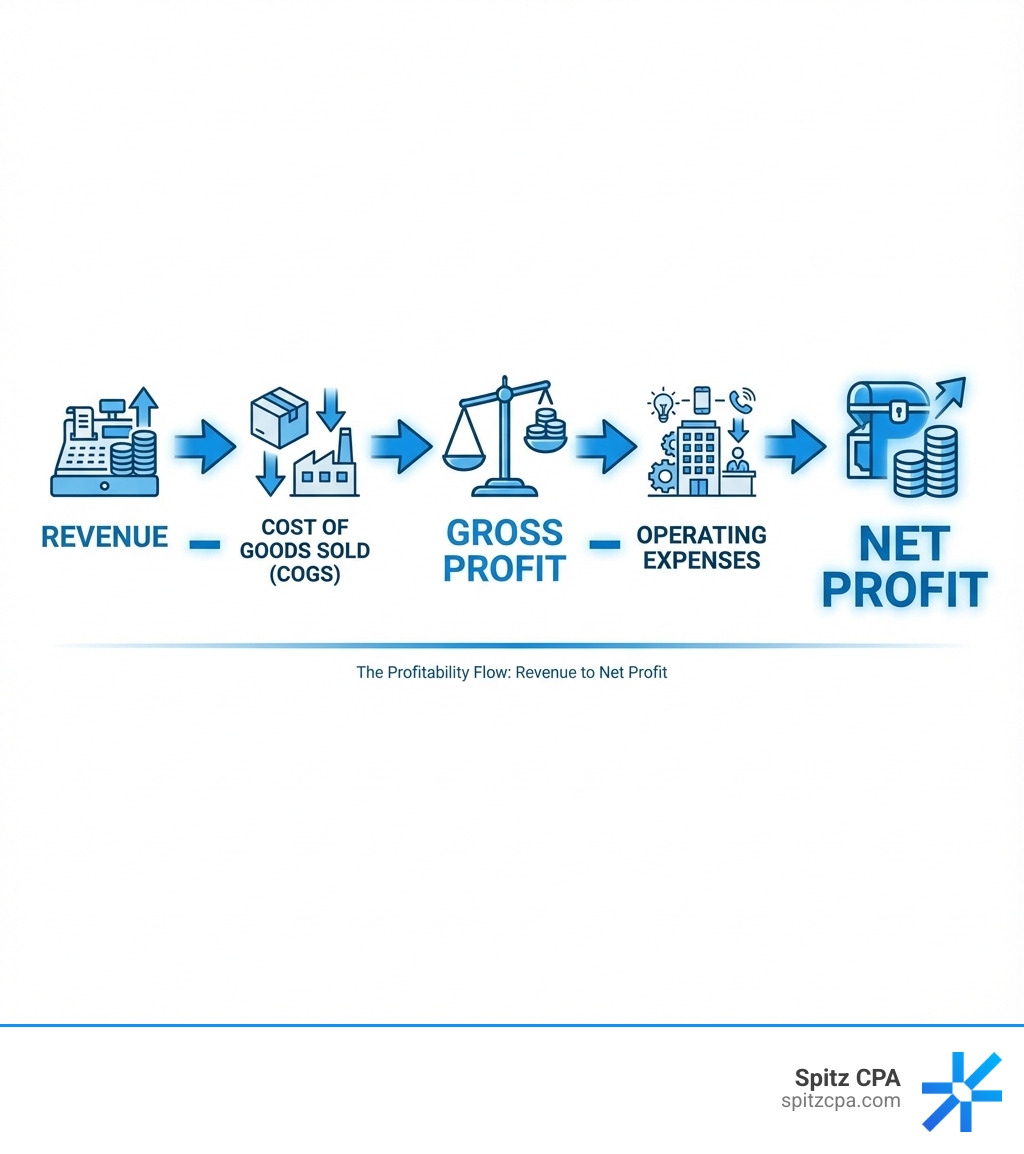
- Gross Profit Margin: This KPI shows the percentage of revenue left after deducting the Cost of Goods Sold (COGS). A higher gross profit margin indicates more efficient production or better pricing. You can calculate and track yours with a Gross Profit Margin Calculator.
- Net Profit Margin: This is the percentage of revenue remaining after all expenses, including COGS, operating expenses, interest, and taxes, have been deducted. It’s the ultimate indicator of your business’s overall profitability.
- Return on Investment (ROI): Measures the efficiency of an investment. It helps you understand which projects or expenditures are delivering the best financial returns.
- Customer Acquisition Cost (CAC): The total cost of sales and marketing efforts required to acquire a new customer. Keeping this low is crucial for profitable growth.
- Customer Lifetime Value (CLV): The predicted total revenue that a customer will generate throughout their relationship with your business. Comparing CLV to CAC helps ensure you’re acquiring profitable customers.
- Cash Flow KPIs: Monitor operating cash flow, free cash flow, and cash conversion cycle to ensure liquidity.
By consistently tracking these and other relevant KPIs, you gain a clear picture of your financial health and can quickly identify areas that need attention. We help our clients establish robust KPI dashboards, turning raw data into actionable insights for improved profitability.
The Power of Diversification, Innovation, and Continuous Improvement
To secure long-term profitability, businesses must be agile, innovative, and committed to constant evolution.
- Diversification: Expanding into new markets or product lines can reduce reliance on a single revenue stream and open up new profit opportunities. A local bakery, for example, diversified into catering and cooking classes, increasing profit margins from 12% to 31% while building customer loyalty. This approach leverages existing expertise to create new value.
- Innovation: Continuous innovation, whether in products, services, or processes, keeps you ahead of the competition. A medical device manufacturer dramatically increased profit margins from 22% to 48% by investing in R&D for specialized products, becoming a market leader in their niche. Understanding What is RD in Business? and how to leverage it can be a significant advantage.
- Sustainable Practices: Implementing eco-friendly processes and engaging in ethical sourcing can attract conscious consumers who are willing to pay a premium. An organic food distributor increased profit margins from 14% to 35% by implementing sustainable practices and premium eco-friendly positioning. This demonstrates that doing good can also be good for your bottom line.
- Quality Control and Brand Positioning: Superior quality and a strong brand image allow you to command higher prices. A specialty coffee roaster transformed from commodity pricing to premium positioning, increasing profit margins from 18% to 42% through rigorous quality control and brand building. Investing in quality and building a reputable brand fosters customer trust and loyalty.
- Continuous Improvement: This isn’t a one-time project; it’s a mindset. Regularly seeking ways to improve every aspect of your business, from product development to customer service, ensures you remain competitive and profitable.
Frequently Asked Questions about Increasing Business Profitability
What are the first steps I should take to improve my business’s profitability?
Start by analyzing your financial statements to understand your current situation. Focus on the three pillars: increasing revenue, reducing costs, and improving efficiency. A great first step is to calculate the profitability of each product or service to identify quick wins. This allows you to prioritize efforts on areas with the most significant potential impact.
How can a business be profitable but still have cash flow problems?
Profitability is an accounting measure (Revenue – Expenses), while cash flow is the actual cash moving in and out of your business. A profitable company can have cash flow issues if clients pay slowly (poor accounts receivable), if you have too much cash tied up in inventory, or if you make large upfront investments. For instance, a construction company might have large project profits but experience cash flow strain if payments are delayed. Effective Cash Flow Management is crucial to bridge this gap.
Should I focus more on increasing sales or cutting costs?
Both are important, but the right focus depends on your business’s current state. If your profit margins are already very thin, cost-cutting and efficiency improvements may have a bigger, more immediate impact. If your operations are lean but you have untapped market potential, focusing on sales growth and market expansion is key. A balanced approach that considers both is usually best for long-term health, as they often reinforce each other. For example, a modest price increase combined with a slight reduction in expenses can have a compounding effect on profitability.
Conclusion
The journey to increase business profitability is a continuous and dynamic one, built upon the solid foundation of three interconnected pillars: driving revenue growth, mastering cost control, and boosting operational efficiency. It’s about strategic action, continuous effort, and a commitment to financial clarity.
At Spitz CPA, we understand the unique challenges faced by businesses in Gilbert, AZ, and across Arizona. We help businesses steer the complexities of financial management to build a stronger, more profitable future. By implementing custom strategies, from Tax Planning Strategies to Outsourced CFO Services, we provide the expert guidance needed to turn your financial goals into reality. Michael J. Spitz and our team are dedicated to helping you open up your business’s full potential, ensuring every decision contributes to a robust and sustainable bottom line. Ready to transform your bottom line? Explore our expert Tax Services today.


