


Why Increasing Business Value Matters for Every Owner
Increase business value isn’t just a pre-sale task; it’s a strategic imperative that strengthens your company and builds lasting wealth. To do this effectively, focus on four core areas:
- Financial Health – Optimize EBITDA, cash flow, and profit margins.
- Strategic Growth – Diversify revenue and build brand equity.
- Operational Excellence – Create repeatable processes and reduce owner dependency.
- Risk Mitigation – Diversify customers and protect intellectual property.
Many owners focus on running their business, not on making it valuable to someone else. Buyers assess if your company will thrive without you, grow predictably, and deliver strong returns with minimal risk. The good news is you can systematically increase your company’s value. Industry data shows a significant number of entrepreneurs expect to sell within five years, and those who plan proactively can increase their business value by 25% or more. Companies with formal value creation plans often project significant EBITDA improvements, and buyers pay a premium for this potential.
This blueprint will guide you through the proven strategies to make your business more attractive. I’m Michael J. Spitz, and with over 15 years in corporate accounting and financial strategy, I’ve helped owners implement the controls needed to increase their company’s value dramatically. My expertise in valuations, exits, and financial modeling can transform your company into a highly attractive acquisition target.
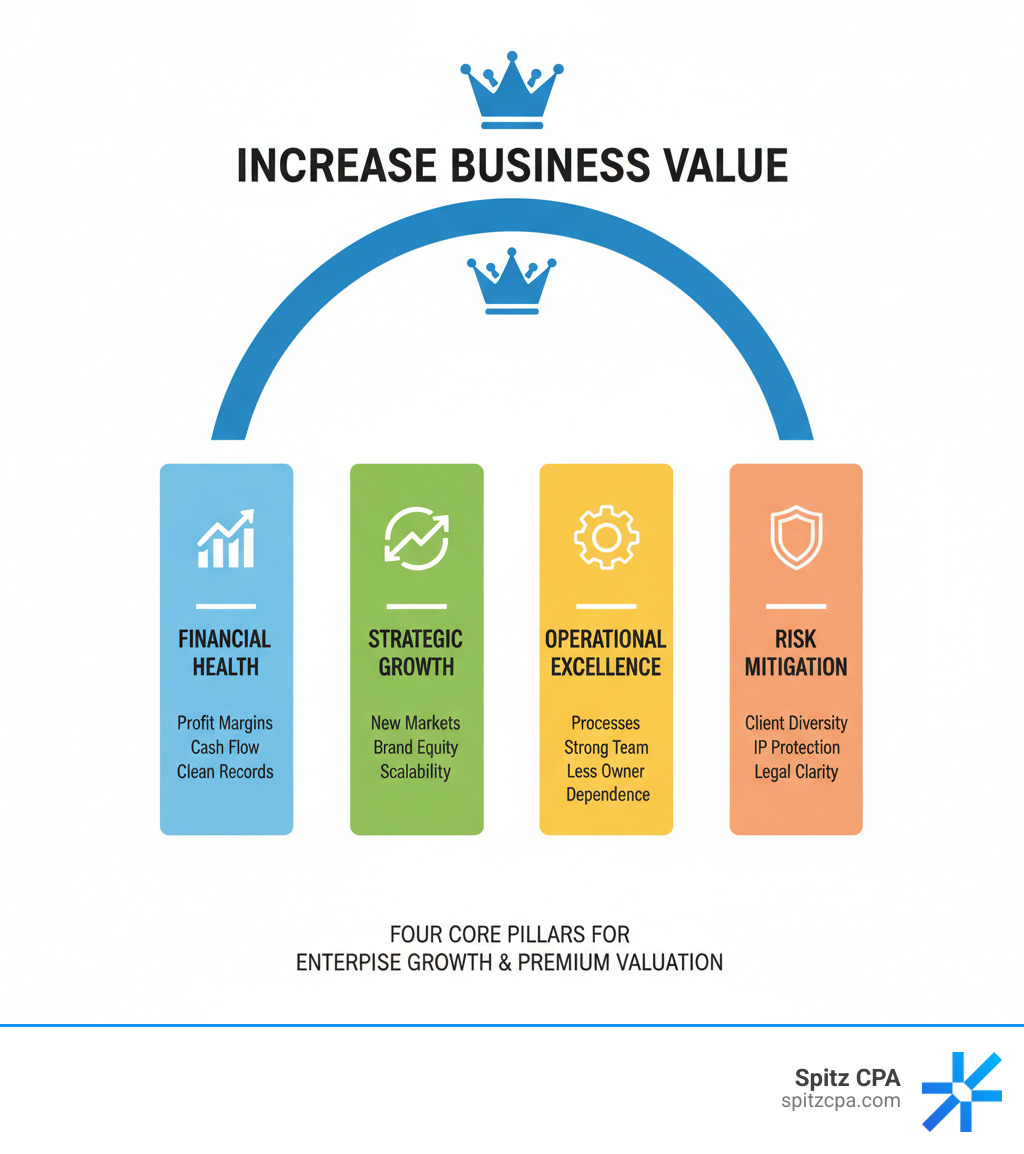
The Four Pillars of Business Value: Financial Health (EBITDA, cash flow, clean records), Strategic Growth (revenue diversification, brand strength, market position), Operational Strength (documented processes, strong team, low owner dependency), and Risk Profile (customer diversification, IP protection, legal compliance). Master these areas to command premium valuations.
Fortifying Your Financial Foundation

Your financials are the first thing buyers scrutinize. A weak financial foundation can kill a deal, no matter how great the rest of the business is. To increase business value, your financials must be pristine, demonstrating consistent profitability and clean records. Our Business Financial Health Check can provide a clear picture of where you stand.
Understanding the Metrics Buyers Prioritize
Buyers dig deep into the numbers that reveal your company’s true earning power.
- EBITDA (Earnings Before Interest, Taxes, Depreciation, and Amortization) is the key metric. It shows your operational profitability. Buyers apply a market multiple to your EBITDA, which can be adjusted for one-time expenses, to determine a valuation.
- Seller’s Discretionary Earnings (SDE) is often used for smaller businesses. It’s EBITDA plus the owner’s salary and benefits, showing a new owner’s potential take-home earnings.
- Revenue trends over three to five years must show consistent, sustainable growth.
- Profit margins (gross, operating, or net) reveal your efficiency. Stable, high margins signal strong operations.
- Cash flow is critical, as buyers are purchasing future cash flows. They will scrutinize free cash flow to ensure the business can fund itself.
- Key Performance Indicators (KPIs) like customer acquisition cost and lifetime value tell the story behind the numbers. Our Accounting Clean Up Services can help organize your books to highlight these metrics.
How to Proactively Improve Profitability
You can boost profitability long before a sale by growing revenue or, more immediately, reducing costs.
Start with operational efficiency. Look for redundant processes, outdated vendor contracts, or bloated overhead. As Michael J. Spitz often reminds clients, “A clean and lean company brings the highest price.” Re-evaluate your pricing strategy; modest increases can directly boost profits. Eliminate waste in materials, time, and inventory. Finally, conduct an internal pay audit to ensure executive compensation is aligned with market rates. Want help identifying these improvement areas? Learn how we can help you Improve Business Profitability.
The Importance of Clean and Transparent Financials
Messy books create suspicion and lead to lower offers.
Accurate bookkeeping on an accrual basis (per GAAP) is the foundation of buyer trust. Having your statements audited or reviewed by an independent accountant adds tremendous credibility. Buyers require three to five years of financial records to analyze trends. These records are also essential for creating the credible financial projections that justify your valuation. Proactively identifying positive adjustments to EBITDA can significantly increase your company’s value. As Michael J. Spitz puts it, “You want to present a business that’s been carefully cared for, not one with ‘duct-taped bumpers.'” Our Small Business Accounting services can keep your financials in top shape year-round.
Engineering Strategic Growth and Market Dominance
Buyers don’t just purchase your past performance; they invest in your future. A business with solid financials but no clear growth path has limited appeal. Demonstrating a clear runway for expansion is how you fundamentally increase business value. For additional perspectives on this topic, you might find insights on How can you increase your business valuation? helpful.
Strategies to Increase Sales and Revenue Streams
A business standing on a single revenue stream is unstable. Build multiple streams to reduce risk and show growth potential.
- Diversify your offerings by launching subscription services, digital products, or online platforms.
- Accept recurring revenue models. Predictable income from subscriptions or service contracts is highly valued by buyers.
- Expand into new markets, whether geographic or with complementary products, to show your business model is adaptable.
- Form strategic alliances to access new customers and scale efficiently.
- Leverage existing customers through cross-selling, upselling, and loyalty programs to increase customer lifetime value.
For more insights on building value through strategic positioning, our article on How to increase the market value of your business offers practical guidance.
Building a Powerful Brand and Unshakable Reputation
Two businesses with identical financials can have vastly different valuations. The difference is brand equity—the value derived from customer perception. Buyers pay a premium for a brand that customers trust and seek out.
- Your Unique Selling Proposition (USP) must clearly state why customers choose you. Proprietary processes or exclusive agreements are value multipliers.
- A well-executed marketing strategy builds awareness and drives sales, giving buyers confidence in future success.
- Customer loyalty and testimonials provide social proof of your value, signaling lower acquisition costs and predictable revenue.
- Your reputation is a critical asset. Protect it with consistent quality and ethical practices.
Demonstrating Future Growth Potential to Increase Business Value
Buyers invest in tomorrow. Your historical performance gets you in the door; your growth potential determines the price.
- A formal strategic plan with measurable goals shows you are proactively creating opportunities.
- Highlight unused production capacity to show how easily you can scale revenue without major investment.
- A scalable business model, with documented systems and processes, proves the business can grow without proportional cost increases.
- A culture of innovation signals that your business will remain relevant and competitive.
- Demonstrate how you use company data to gain a competitive advantage.
- A clear plan for environmental sustainability can make your company more attractive to a broader pool of modern buyers.
How to Increase Business Value Through Operational Excellence and Risk Reduction

Buyers don’t just purchase your products; they invest in peace of mind. A business that runs like a well-oiled machine—without constant owner oversight—commands a significantly higher price. Operational excellence and proactive risk management are fundamental to maximizing what buyers will pay and how you can increase your company’s value.
Mitigating Key Business Risks
Every business has risks. The key is to identify and address them before a buyer does.
- Customer concentration is a deal killer. If a few clients generate most of your revenue, diversify your client base immediately to reduce this risk.
- Supplier dependency is another major concern. Build resilience through supplier diversification and contingency plans.
- Owner dependency, a critical issue we’ll cover next, suggests the business is not a standalone asset.
- Legal and regulatory issues are massive red flags. As Michael J. Spitz often says, “Clean up your legal house before you invite buyers to inspect it.” Proactively resolve disputes, update licenses, and organize all corporate records.
Building a Business That Runs Without You
This is perhaps the most powerful way to increase business value. Buyers want an asset, not a job.
- A strong management team that can run operations without you is essential. Delegate key responsibilities to capable leaders.
- Empower employees across the organization to make informed decisions. Companies without a competent succession team can see their value drop by as much as 35%.
- High employee retention signals stability. Invest in professional development and a positive work environment to keep your best people.
- The secret weapon is documented processes. Standard Operating Procedures (SOPs) make your business knowledge transferable, repeatable, and scalable. This proves the business can thrive without you.
Protecting and Leveraging Your Assets to Increase Business Value
Your tangible and intangible assets are critical to your valuation.
- Intellectual property (IP)—patents, trademarks, and trade secrets—creates a competitive moat. As Michael J. Spitz emphasizes, “Your intellectual property can be your most valuable asset. Own it, protect it, and make sure it’s clearly defined.”
- Your customer database is proof of future revenue potential and a significant intangible asset.
- The collective expertise of your team is valuable. Use employment contracts to protect this asset and retain key staff.
- Maintain your tangible assets like equipment and property. Continued investment ensures they remain productive and valuable.
The Pre-Sale Playbook: Maximizing Your Exit

Preparing for a business sale is like training for the Olympics—it requires careful planning and a professional team. This pre-sale playbook will guide you through the steps to command the highest valuation. Our Business Valuation Services can provide the expert guidance you need.
Assembling Your Professional “A-Team”
Selling your business is not a DIY project. An expert team is non-negotiable for a successful exit.
- Business Valuator (CBV): Provides an independent, objective assessment of your company’s worth, strengthening your negotiating position.
- Accountant: As Michael J. Spitz does for his clients, a specialized accountant prepares your financials for due diligence, handles tax planning, and tells your financial story in the most favorable light. Explore our comprehensive Services to see how we support businesses through this critical phase.
- M&A Lawyer: Manages legal complexities, from deal structuring to contract drafting, to protect your interests.
- M&A Advisor/Business Broker: Brings market knowledge to position your business, find serious buyers, and guide the sale process.
Developing a Formal Value Creation Plan
A value creation plan is a roadmap showing how you will systematically increase business value. It shifts the negotiation from past performance to future potential. Industry research shows that well-crafted plans can project EBITDA improvements of 10% to 60% over three to five years. Even documenting planned initiatives helps buyers pay for that future growth. Your plan should detail concrete revenue growth and cost optimization strategies. As Michael J. Spitz advises, focus on four key value-creation levers: increasing revenue, improving margins, enhancing capital efficiency, and creating the right expectations.
Navigating the Sale Process for a Higher Valuation
The sale process itself is fraught with risk. In 90% of cases, revenues decline during the sale because owners get distracted.
- Timing matters. Selling in a buoyant market can attract more buyers and higher valuations.
- The most effective way to increase business value during a sale is anticipatory sell-side due diligence. Proactively identify and address potential issues before buyers find them. This builds trust and prevents last-minute surprises.
- Preparing for IPO readiness, even if you don’t plan to go public, forces you to build robust governance and scalable operations—qualities all sophisticated buyers value.
Throughout the process, delegate daily operations to your management team to maintain performance while you manage the sale.
Frequently Asked Questions about Increasing Business Value
What is the single most important factor for business valuation?
The most critical factor is consistent, predictable profitability (measured by EBITDA or SDE) combined with clear potential for future growth. Buyers are paying for reliable future cash flows. A business with stable earnings and a clear expansion roadmap is far more valuable than one with volatile profits, as predictability reduces risk.
How long before a sale should I start trying to increase my business’s value?
Start now. Ideally, you should begin your value-building efforts 3-5 years before a sale to establish a strong track record of performance. Buyers value consistent patterns. However, significant improvements made even 6-12 months prior can still have a major positive impact. As Michael J. Spitz often tells clients, “It’s never too late to start, but earlier is always better.”
Can I increase my business value without spending a lot of money?
Absolutely. Many of the highest-impact strategies for increasing business value require strategic focus, not large capital outlays. Improving operational processes, documenting systems with SOPs, and strengthening customer relationships cost little but yield enormous returns. Performing an Accounting Clean Up is a modest investment that dramatically improves buyer perception. These initiatives primarily demand your time and strategic thinking, not your bank account.
Conclusion: Your Blueprint for a More Valuable Enterprise
Building a valuable business is a continuous journey of strengthening your financials, strategy, and operations. The key takeaway is this: a business that is well-run, strategically positioned, and prepared for sale is inherently more valuable, whether you plan to exit next year or never. The work you do today to increase business value creates a more profitable and resilient company right now.
By focusing on the four pillars—financial health, strategic growth, operational excellence, and risk mitigation—you are building a substantial, lasting enterprise. Don’t wait until you’re ready to sell to get your house in order.
The team at Spitz CPA, led by Michael J. Spitz, has spent over 15 years helping business owners steer these challenges. We provide personalized guidance and accounting expertise to help you gain financial clarity, improve cash flow, and build the kind of enterprise value that attracts premium buyers.
Ready to take the first step? To get a clear picture of your business’s current value and a roadmap for growth, explore how our R&D Tax Services can open up hidden capital for reinvestment, fueling your next stage of value creation without taking on debt or giving up equity.
Your business represents years of hard work, sacrifice, and vision. Let’s make sure it’s worth every bit of that effort when the time comes.


