


What Is the Insurance Premiums Tax Deduction — and Does It Apply to You?
Understanding the insurance premiums tax deduction rules can save you real money — but only if you know which premiums qualify, who can claim them, and how to do it correctly.
Here is a quick answer:
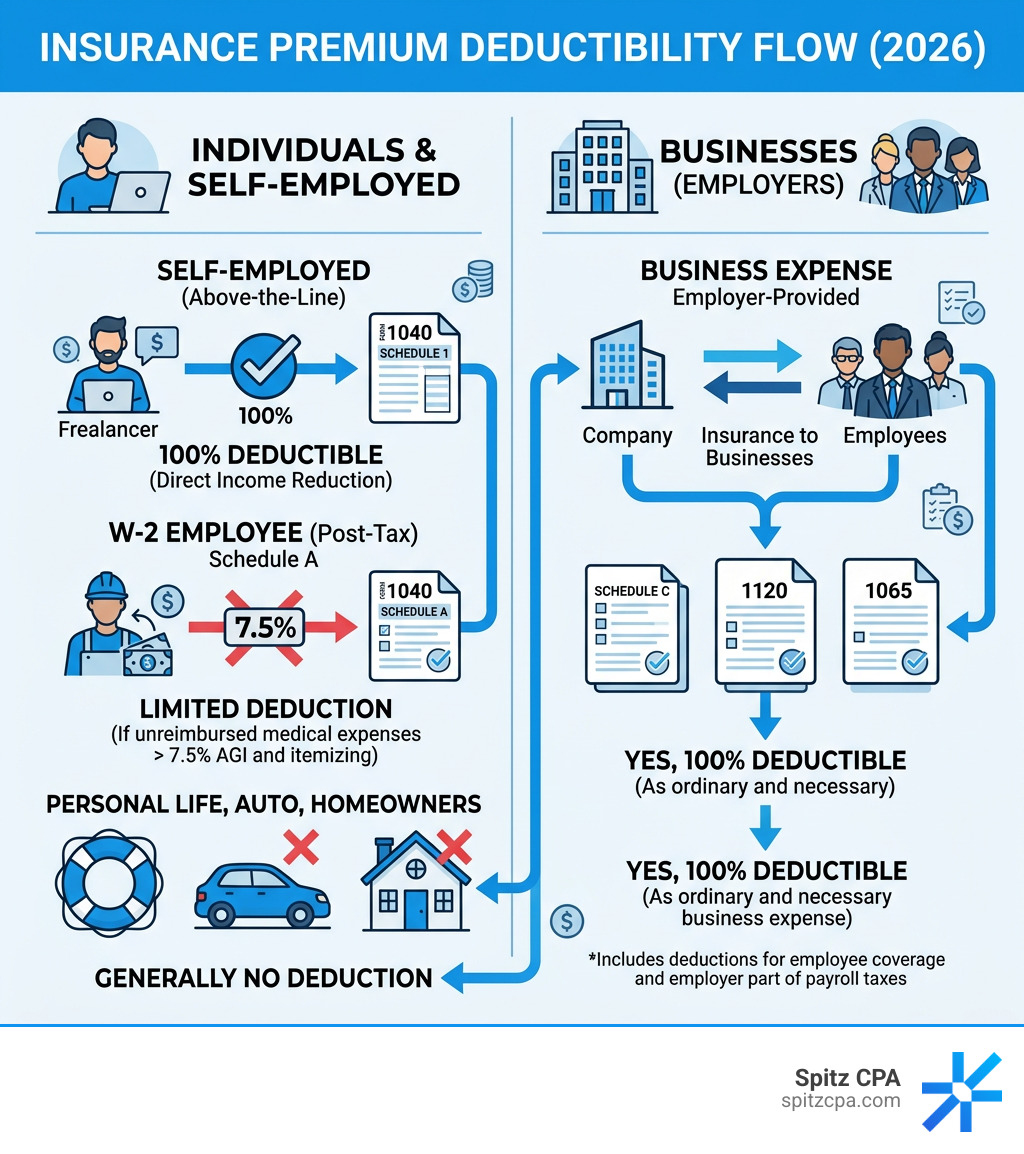
| Situation | Can You Deduct? | How |
|---|---|---|
| Self-employed (not eligible for employer plan) | Yes — 100% of premiums | Above-the-line deduction, Schedule 1 / Form 7206 |
| W-2 employee paying after-tax premiums | Sometimes — if medical expenses exceed 7.5% of AGI | Itemized deduction, Schedule A |
| W-2 employee paying pre-tax premiums | No — already excluded from taxable income | N/A |
| Small business (deducting employee coverage) | Yes — as a business expense | Schedule C, Form 1065, or Form 1120 |
| Long-term care insurance | Partially — age-based annual limits apply | Schedule A or Form 7206 |
| Personal life, auto, or homeowners insurance | Generally no | N/A |
The rules differ depending on whether you are an individual, a self-employed person, or a business owner — and the wrong approach can cost you deductions or trigger IRS scrutiny.
This guide breaks it all down clearly so you can make informed decisions before tax time.
I’m Michael J. Spitz, CPA, with over 15 years of corporate accounting experience helping businesses and individuals across the Phoenix area and beyond navigate complex tax obligations — including these often-misunderstood deductions. Whether you run a sole proprietorship, an S-corp, or manage payroll and benefits for a growing team, understanding what you can and cannot deduct is one of the fastest ways to reduce your tax bill legally.
Understanding the Insurance Premiums Tax Deduction for Health Coverage
When most people think about a tax break for their health insurance, they are looking at IRS Topic 502: Medical and Dental Expenses. For the average W-2 employee in Gilbert or anywhere else in Arizona, the path to a deduction is a bit of a steep climb.
To deduct health insurance premiums as a personal medical expense, you must first itemize your deductions on Schedule A of your Form 1040. This means you aren’t taking the standard deduction. Furthermore, you can only deduct the portion of your total unreimbursed medical expenses—including premiums—that exceeds 7.5% of your Adjusted Gross Income (AGI).
For example, if your AGI is $100,000, the first $7,500 of medical expenses “don’t count.” If you spent $10,000 on premiums and dental work, you could only deduct $2,500. This is why we often work with clients to maximize tax deductions by grouping elective procedures or vision care into a single tax year to clear that 7.5% hurdle.
Deducting Health Insurance Premiums for Employees
If you work for a company and receive a W-2, your premiums are likely handled in one of two ways. Most modern employers use “cafeteria plans” or Section 125 plans. In these cases, your health insurance premiums are taken out of your check pre-tax.
When this happens, you are already receiving the maximum tax benefit! Those dollars never even show up in Box 1 of your W-2 as taxable wages. Because you didn’t pay taxes on that money in the first place, the IRS (rightfully) says you cannot “double-dip” and deduct those same premiums again on your tax return.
Eligibility and Limitations for Health Coverage
There are a few “gotchas” when it comes to these health insurance deductions. First is the earned income rule: if you are trying to claim a deduction through your business, the deduction cannot exceed the net income your business earned. If your business had a bad year and showed a loss, you generally can’t use the insurance deduction to create an even bigger loss.
We also have to look at month-by-month eligibility. If you were eligible to join a spouse’s employer-subsidized health plan but chose to buy your own private plan instead, you might lose the ability to deduct those private premiums for the months you were eligible for the employer plan. This is a common area where tax planning for entrepreneurs becomes vital—knowing when to switch plans can save you thousands in lost deductions.
The Self-Employed Health Insurance Deduction
For our freelance and contractor friends in Arizona, there is a much better deal available: the self-employed health insurance deduction. This is what we call an “above-the-line” adjustment to income.
Unlike the itemized deduction mentioned earlier, you do not need to clear a 7.5% AGI floor to benefit from this. It directly reduces your AGI on Schedule 1 of your Form 1040. This is a powerful tool because a lower AGI can help you qualify for other tax credits that phase out at higher income levels.
To claim this, we typically use Form 7206. It allows you to deduct 100% of the premiums paid for medical, dental, and vision insurance for yourself, your spouse, and your dependents. It even covers premiums for children under age 27, even if they aren’t your legal dependents!
As part of mastering your money: smart tax planning for businesses, we remind self-employed clients that this includes Medicare premiums (Parts B and D) and supplemental “Medigap” policies if you are over 65 and still running your business.
Business Structures: Sole Proprietors, LLCs, and S-Corps
How you claim these deductions depends heavily on your business structure:
- Sole Proprietors: You’ll generally calculate the deduction on Form 7206 and report it on Schedule 1.
- Partnerships and LLCs: If you are a partner, the partnership must either pay the premiums or reimburse you. These amounts are then reported as “guaranteed payments” on your Schedule K-1, which you then deduct on your personal return.
- S-Corporations: This is the most complex area. For a more-than-2% shareholder to get the deduction, the S-corp must pay the premiums. Those premiums must then be reported as taxable wages in Box 1 of your W-2. Don’t worry—you then take the deduction on your personal 1040, which effectively makes it tax-free for income tax purposes. Using the best S-corporation tax planning strategies ensures you meet these strict W-2 reporting requirements so the IRS doesn’t disallow the break.
Long-Term Care Insurance Premiums Tax Deduction Limits
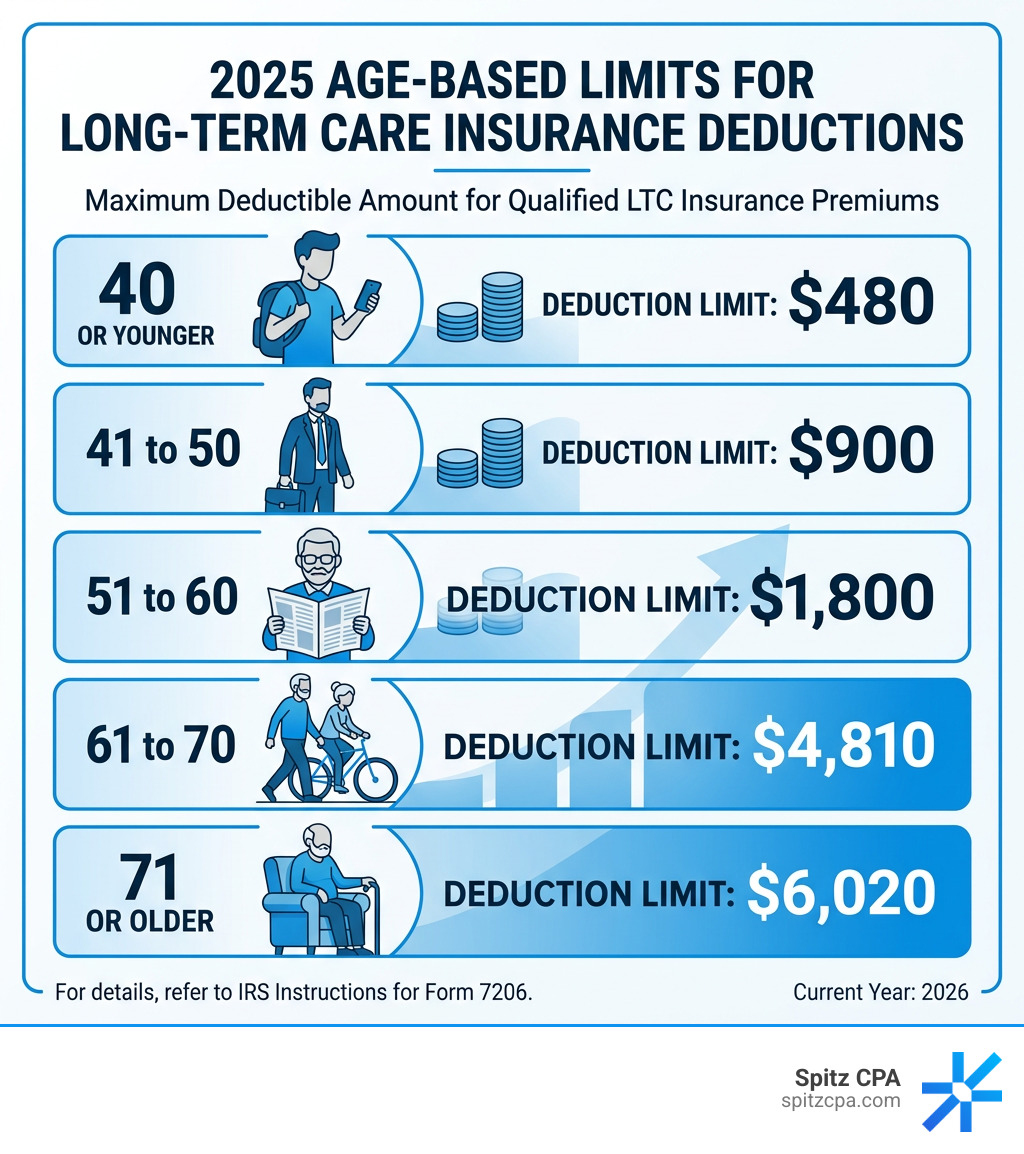
Long-term care (LTC) insurance is also deductible, but the IRS puts a cap on how much you can write off based on your age. As you get older, the amount you can deduct increases. This is handled either on Schedule A (if itemizing) or through Form 7206 (if self-employed).
According to the Instructions for Form 7206, the limits for 2024 and 2025 are as follows:
| Age at end of year | 2024 Limit | 2025 Limit |
|---|---|---|
| 40 or younger | $470 | $480 |
| 41 to 50 | $880 | $900 |
| 51 to 60 | $1,760 | $1,800 |
| 61 to 70 | $4,710 | $4,810 |
| 71 or older | $5,880 | $6,020 |
To qualify, the policy must be a “qualified” LTC contract, meaning it only provides coverage for long-term care services for someone who is “chronically ill.”
Deducting Business Insurance for Small Companies
If you own a business in Gilbert or Mesa, most of the insurance you pay to keep the doors open is fully deductible. The IRS allows you to deduct premiums that are “ordinary and necessary” for your trade or business.
According to the IRS Business Expense Guide, these are considered cost-of-doing-business items. We help our clients identify these small business tax deductions to ensure they aren’t leaving money on the table.
Common Deductible Business Premiums
Most “standard” business policies are 100% deductible as business expenses. These include:
- General Liability Insurance: Protects you if someone is injured on your property.
- Workers’ Compensation: Required in Arizona for businesses with employees; these premiums are fully deductible.
- Malpractice Insurance: Professional liability coverage for doctors, lawyers, and even us CPAs!
- Commercial Property Insurance: Coverage for your building, equipment, and inventory.
- Business Interruption Insurance: Covers lost profits if your business is forced to close due to a covered peril (like a fire).
| Deductible Business Insurance | Non-Deductible Business Insurance |
|---|---|
| Workers’ Compensation | Life insurance where the business is the beneficiary |
| General Liability | Disability insurance covering your own lost earnings |
| Commercial Auto (Actual Expense) | Self-insurance reserve funds |
| Group Health for Employees | Premiums to secure a business loan |
Commercial Auto and Home Office Insurance
If you use your personal vehicle for business—maybe you’re a real estate agent driving clients around Gilbert—you have a choice. You can use the standard mileage rate (67 cents per mile in 2024), which includes the cost of insurance. Alternatively, you can use the actual expense method. If you choose actual expenses, you can deduct the business percentage of your auto insurance premiums.
Similarly, if you qualify for a home office deduction, you can deduct a portion of your homeowners insurance. If your office takes up 10% of your home’s square footage, 10% of your insurance bill becomes a business deduction. This is a staple of many business tax strategies we implement for remote workers and consultants.
What Insurance Premiums Are Not Tax Deductible?
It would be great if every check we wrote to an insurance company was a tax break, but the IRS has clear boundaries. Generally, personal insurance is considered a “living expense” and is not deductible.
Common non-deductible premiums include:
- Personal Life Insurance: You cannot deduct premiums for a policy on your own life.
- Standard Homeowners Insurance: Unless you have a qualified home office or rental property, this is a personal expense.
- Personal Auto Insurance: If you only use your car for commuting and grocery runs, no deduction is allowed.
- Disability Income Insurance: While it seems like a “medical” cost, premiums for policies that replace your income if you get sick are generally not deductible. (The silver lining? If you pay the premiums with after-tax dollars, the benefits you receive later are usually tax-free).
- Private Mortgage Insurance (PMI): While there have been temporary laws in the past allowing this, PMI is currently not deductible for federal tax purposes.
We always recommend reviewing your tax planning strategies annually, as these rules—especially regarding things like PMI—can change with new legislation.
Frequently Asked Questions about Insurance Deductions
Can I deduct premiums if I take the standard deduction?
If you are a W-2 employee, the answer is usually no. Personal medical expenses (including premiums) require you to itemize on Schedule A. However, if you are self-employed, you can take the self-employed health insurance deduction on Schedule 1 even if you take the standard deduction. This is one of the biggest “wins” for small business owners.
How do I claim the self-employed health insurance deduction?
You will use Form 7206 to calculate the eligible amount. You’ll need to know your total premiums paid for the year and your net profit from the business. The final number flows to Schedule 1, Line 17 of your Form 1040.
Are life insurance premiums ever deductible for a business?
Yes, but only in specific cases. If a business pays life insurance premiums for its employees as a fringe benefit, those premiums are deductible for the business. However, if the business itself is the beneficiary of the policy (like a “Key Person” policy), the premiums are generally not deductible.
Conclusion
Navigating these tax rules doesn’t have to be a headache. Whether you are itemizing medical costs on Schedule A or utilizing the powerful self-employed deduction on Form 7206, the key is consistency and documentation.
At Spitz CPA, we believe in providing more than just a tax return; we provide financial clarity. By keeping meticulous records of your invoices and proof of payments, you protect yourself in the event of an audit and ensure you’re capturing every dollar you’re entitled to.
If you’re feeling overwhelmed by the nuances of S-corp health insurance or wondering if your home office insurance proration is correct, we’re here to help. Michael J. Spitz and our team can help you clean up your accounting and implement strategies that drive real growth.
Ready to maximize your savings? Contact Spitz CPA Tax Services today for personalized guidance tailored to your unique situation.


