


Why Finding the Right Financial Guide Matters for Your Success
An investment advisor consultant is a financial professional who provides personalized investment advice and portfolio management services, typically charging fees rather than commissions, and who may be legally required to act in your best interest as a fiduciary. These professionals help individuals, businesses, and institutions manage their investments, plan for major financial goals, and steer complex financial decisions.
Quick Overview: Investment Advisor Consultant Services
- For Individuals: Retirement planning, education savings, wealth preservation, and estate planning
- For Businesses: Managing corporate retirement plans, fiduciary oversight, and strategic asset allocation
- Compensation: Typically fee-based (percentage of assets, hourly, or retainer) rather than commission-based
- Regulation: Registered with SEC (for $100M+ in assets) or state securities regulators
- Fiduciary Duty: Many investment advisors are legally required to act in your best interest
- Key Document: Form ADV discloses credentials, fees, and potential conflicts of interest
When you’re running a business, managing complex financial decisions often feels like navigating unfamiliar waters. You might be handling cash flow challenges, planning for growth, or wondering how to turn your company into a more valuable asset. At some point, many entrepreneurs realize they need professional guidance—not just for their business finances, but for the personal wealth they’re building along the way.
The difference between working with a true fiduciary advisor and a commission-driven broker can significantly impact your financial outcomes. Investment advisors have a legal duty to put your interests first, while brokers are only required to recommend “suitable” investments. Understanding this distinction, along with how advisors charge for their services and what credentials to look for, helps you make informed decisions about who manages your financial future.
As Michael J. Spitz, with over 15 years of corporate accounting and strategic financial experience, I’ve worked with business owners who need clarity not just in their accounting, but in how their business finances connect to their personal wealth goals, making the role of a professional advisor critical for holistic financial success. This guide will help you understand what these professionals do, how to evaluate them, and how to find the right partner for your specific financial journey.
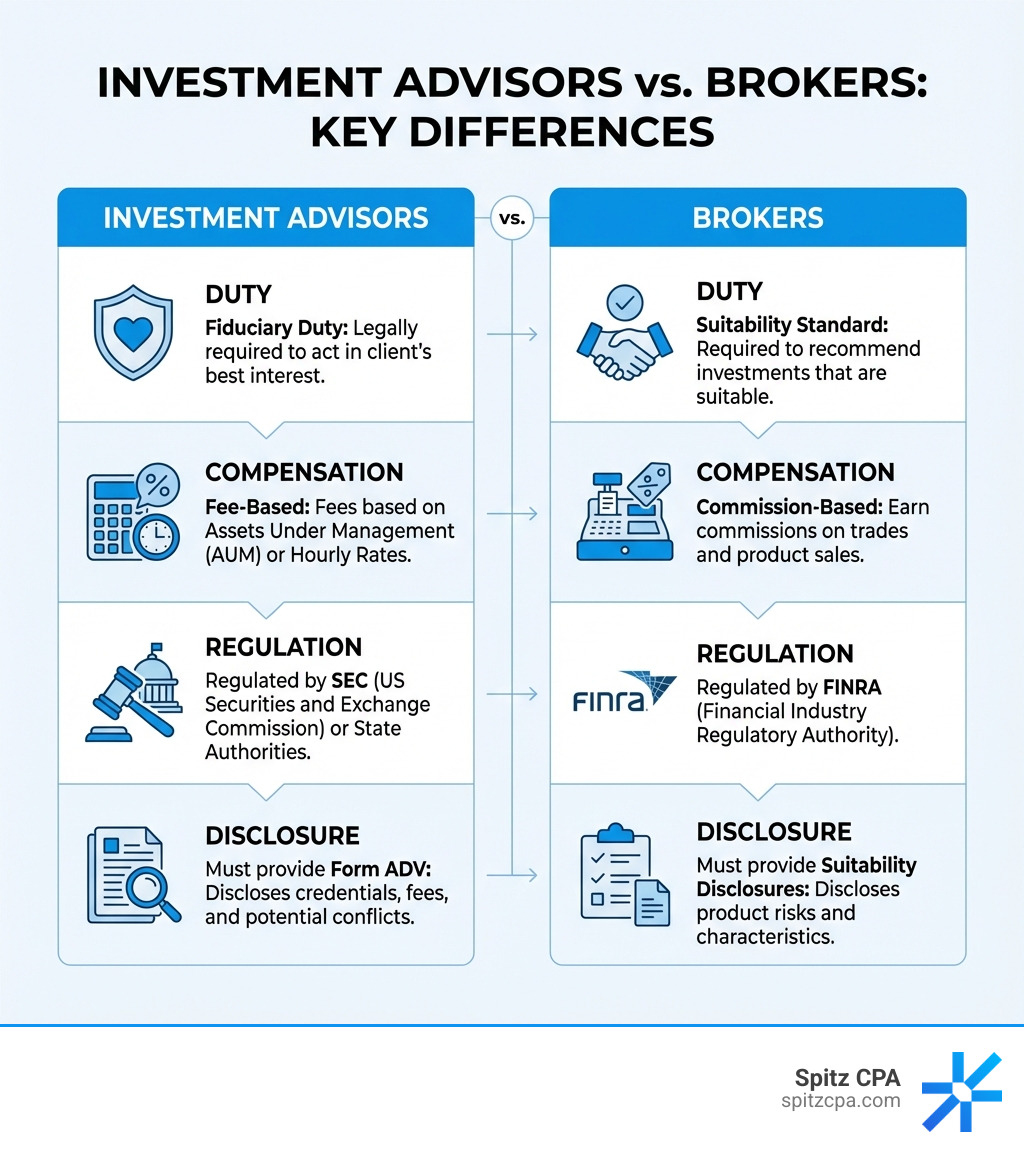
Investment advisor consultant terms at a glance:
What is an Investment Advisor Consultant?
An investment advisor consultant is a professional who provides expert guidance on investment strategies and financial planning. Think of them as your financial navigator, helping you chart a course through the often-choppy waters of the financial markets. They engage in the business of providing investment advice about securities—such as stocks, bonds, mutual funds, and ETFs—for compensation. This advice can range from broad market trends to specific asset allocation strategies, all custom to your unique situation.
The core services offered by these professionals typically include:
- Portfolio Management: Creating, managing, and rebalancing investment portfolios to align with your financial goals and risk tolerance.
- Financial Planning: Developing comprehensive plans that cover various aspects of your financial life, including retirement, education, and estate planning.
- Asset Allocation: Determining the optimal mix of asset classes (e.g., stocks, bonds, real estate) to achieve your objectives.
- Market Analysis: Providing insights into market trends and economic conditions to inform investment decisions.
These services are not one-size-fits-all. An advisor works with a diverse clientele, from individuals seeking personal wealth management to large institutions managing complex asset pools. Our team at Spitz CPA, for example, understands that each client, whether an individual or a business, requires personalized guidance to achieve their Strategic Business Growth and financial clarity.
The Advisor’s Role for Individuals
For individuals, an advisor acts as a personal financial coach, helping to translate life goals into actionable financial strategies. We know that life’s big milestones often come with significant financial implications. Our role is to simplify this complexity and provide clear pathways.
Common areas where we assist individuals include:
- Retirement Savings: Crafting strategies to build a robust retirement nest egg, ensuring you can enjoy your golden years comfortably.
- Education Funding: Planning for the rising costs of higher education, exploring options like 529 plans or other investment vehicles.
- Home Purchase: Advising on saving for a down payment and integrating real estate goals into your broader financial picture.
- Wealth Preservation: Implementing strategies to protect your accumulated wealth from inflation, market volatility, and taxes.
- Estate Planning: Working with legal professionals to ensure your assets are distributed according to your wishes, minimizing tax burdens and maximizing your legacy.
We also offer expertise in Tax Planning Strategies to ensure your investment decisions are tax-efficient, especially important in a state like Arizona where managing your financial footprint matters.
The Consultant’s Role for Institutions
For institutions, an advisor provides sophisticated expertise to manage large, complex investment portfolios with specific objectives and regulatory requirements. This includes working with:
- Corporate Retirement Plans: Assisting with the oversight and management of defined benefit and defined contribution plans, ensuring compliance and optimal performance for employees.
- Non-profit Endowments: Helping endowments and foundations manage their assets to support their mission for generations, often involving stress testing, funding analysis, and spending needs analysis.
- Public/Governmental Plans: Collaborating with these entities to ensure robust governance and effective asset diversification.
Our institutional consulting services help organizations implement investment programs, effectively manage and diversify assets, and ensure robust governance. This often involves blending investment and asset modeling experience to build tailor-made investment programs. We can even provide CFO Consulting Services to integrate investment strategy with overall financial management for businesses.
The Fiduciary Standard: An Advisor’s Legal Duty to You

One of the most critical distinctions in the financial industry, and one we emphasize at Spitz CPA, is the concept of fiduciary duty. An investment advisor consultant who operates under a fiduciary standard has a legal and ethical obligation to act in your best interest, placing your financial well-being above their own or their firm’s. This isn’t just a nice idea; it’s a legal requirement. It means they must disclose any conflicts of interest and strive to avoid them whenever possible.
This fiduciary duty contrasts sharply with the “suitability standard” that typically applies to brokers. While brokers are required to recommend investments that are suitable for you based on your financial situation, needs, and other holdings, they are not legally obligated to recommend the best option available or to inform you of conflicts of interest. We believe this distinction is paramount for clients seeking truly objective advice.
Investment Advisor vs. Broker: Key Differences
Understanding the fundamental differences between an investment advisor and a broker is crucial when choosing a financial professional. Here’s a quick comparison:
| Feature | Investment Advisor (Consultant) | Broker (Registered Representative) |
|---|---|---|
| Legal Standard | Fiduciary Duty: Legally required to act in your best interest, putting your needs first. This means avoiding conflicts of interest or disclosing them transparently. | Suitability Standard: Required to recommend investments that are “suitable” for your financial situation, goals, and risk tolerance. Not legally obligated to find the best option or disclose all conflicts of interest. |
| Compensation | Typically fee-based: Charged as a percentage of assets under management (AUM), an hourly rate, a flat fee, or a retainer for a package of services. Our fee structure is always transparent. | Primarily commission-based: Earns money from transactions they execute on your behalf (e.g., buying or selling stocks, mutual funds, or annuities). This can create an incentive for frequent trading or recommending higher-commission products. |
| Regulation | Registered Investment Advisers (RIAs) are regulated by the SEC if they manage $100 million or more in client assets (AUM), or by state securities regulators in Arizona if they manage less. | Regulated by FINRA (Financial Industry Regulatory Authority), which oversees brokerage firms and their individual brokers (also called registered representatives or stockbrokers). They are also regulated by the SEC. |
| Disclosure | Must provide Form ADV (Part 2 is the primary disclosure document), detailing credentials, experience, services, compensation, and any conflicts of interest. Also provides a Form CRS (Customer Relationship Summary). | Provides suitability disclosures and a Form CRS. However, they are not legally responsible to inform you of all potential conflicts of interest beyond basic suitability. |
| Primary Role | Provides ongoing investment advice, portfolio management, and comprehensive financial planning to help you achieve your long-term financial goals. They are your trusted advisor. | Facilitates buying and selling securities for you. While they might offer investment suggestions, their primary role is transactional. |
Managing Conflicts of Interest
Even with a fiduciary duty, potential conflicts of interest can arise, especially concerning how an advisor is compensated. For instance, an advisor might be “fee-based,” meaning they earn both fees (e.g., AUM) and commissions, or they might be “fee-only,” meaning their sole compensation comes directly from client fees. We believe in transparency and clearly outlining our compensation structure upfront.
To manage these conflicts, investment advisors are required to disclose them fully. Key documents like Form ADV and Form CRS are designed to provide clients with this crucial information. Form ADV, particularly Part 2, serves as the primary disclosure document, outlining the advisor’s business, services, fees, and any potential conflicts. The Form CRS, or Customer Relationship Summary, is a newer, simpler document designed to help you compare services, fees, and conduct standards across different financial professionals. We encourage all our clients to Learn more about Form CRS to make informed decisions.
How to Vet and Hire the Right Investment Advisor Consultant

Choosing an investment advisor consultant is a significant decision, akin to selecting a trusted partner for your financial future. It requires careful due diligence, not just a quick search. We always advise our clients to do their homework, just as they would when making any other important business or personal decision. This involves thoroughly researching their background, understanding their compensation, and asking probing questions during an interview process.
Researching an Advisor’s Background and History
Before engaging an advisor, you should always verify their credentials, experience, and disciplinary history. Fortunately, there are robust public resources available for this.
- Form ADV: This is a two-part document that investment advisors must file with the SEC or state securities regulators. Part 2 of Form ADV is particularly important as it provides detailed information about the advisor’s business, services, fees, disciplinary history, and conflicts of interest. Always ask for a copy and review it carefully.
- Form CRS: As mentioned earlier, this summary document provides a snapshot of the advisor’s services, fees, conflicts, and disciplinary history, making it easier to compare professionals.
- Regulatory Databases:
- For SEC-registered and state-registered investment advisors, you can use the Investment Adviser Public Disclosure database. This powerful tool allows you to search for firms and individuals, view their Form ADV filings, and check for any disciplinary actions.
- If you are researching a broker, rather than an investment advisor, you should start with FINRA’s BrokerCheck. This database provides licensing and registration information for registered representatives and brokerage firms, including employment history and any disciplinary actions or civil judgments.
Registered Investment Advisers (RIAs) managing $100 million or more in client assets (AUM) are generally regulated by the SEC. Those managing less than $100 million in AUM are typically regulated by state securities regulators, which in our case, means the Arizona Corporation Commission.
Understanding Compensation and Fee Structures
How an advisor charges for their services is a critical piece of the puzzle. Understanding this will help you assess potential conflicts of interest and ensure you’re getting value for your money.
Common fee structures include:
- Assets Under Management (AUM): A percentage of the total assets the advisor manages for you (e.g., 1% of your portfolio value annually). This is a common model for ongoing portfolio management.
- Hourly Fees: Charged for the time spent on your financial planning or advice, often suitable for specific projects or limited engagements.
- Flat Fees: A fixed fee for a particular service, like developing a comprehensive financial plan.
- Retainer Fees: A periodic fee for a package of ongoing services.
It’s vital to remember that even small ongoing fees can significantly impact your investment returns over time. We encourage clients to read the Updated Investor Bulletin: How Fees and Expenses Affect Your Investment Portfolio to fully grasp this concept. Always ask for a clear breakdown of all fees—both direct and indirect—and ensure there are no hidden costs.
Key Questions to Ask Your Potential Investment Advisor Consultant
Before you make a commitment, we recommend asking these questions to any potential advisor:
- What are your qualifications and experience? Ask about their education, certifications (like CFA or CFP), and how long they’ve been working with clients similar to your situation.
- Are you a fiduciary? This is perhaps the most important question. A clear “yes” means they are legally bound to act in your best interest.
- How are you compensated? Get a detailed explanation of their fee structure. Are they fee-only or fee-based?
- What are your fees? Request a clear estimate of all costs you will incur, including advisory fees, transaction fees, and any other charges.
- What types of clients do you work with? Do they specialize in individuals, small businesses, institutions, or a mix? Do they have experience with clients in Arizona?
- What is your investment philosophy? Understand their approach to risk, diversification, and market fluctuations. Does it align with your comfort level and goals?
- Do you have any disciplinary history? While you can research this online, it’s good to hear their explanation directly.
- How often will we meet or communicate? Establish expectations for ongoing communication and account reviews.
- What services are included in your fees? Clarify exactly what you’re paying for—is it just investment management, or does it include financial planning, tax advice, or other services?
The Benefits of Professional Financial Guidance
Engaging an investment advisor consultant offers a multitude of benefits that extend beyond simply picking stocks. We’ve seen how professional guidance can transform financial futures, helping individuals and businesses in Gilbert, AZ, and throughout Arizona achieve their most ambitious goals.
The benefits include:
- Goal Achievement: A clear roadmap and consistent strategy to reach specific financial milestones.
- Expert Knowledge: Access to specialized expertise in investment markets, tax laws, and financial planning strategies that you might not have yourself.
- Emotional Discipline: Helping you avoid impulsive decisions driven by market volatility, ensuring you stick to your long-term plan.
- Time Savings: Freeing you from the burden of managing your investments, allowing you to focus on your career, business, or personal life.
- Holistic Financial View: Integrating all aspects of your financial life—investments, taxes, insurance, estate planning—into a cohesive strategy.
Achieving Personal Financial Goals
For individuals, an advisor is instrumental in turning aspirations into reality. We help you create personalized financial plans that account for your unique circumstances and dreams.
This includes:
- Retirement Readiness: Developing comprehensive strategies to ensure you have sufficient funds for a comfortable retirement, considering factors like inflation and healthcare costs.
- College Savings Strategies: Guiding you through the complexities of saving for your children’s education, exploring the most tax-efficient and effective options.
- Wealth Accumulation: Implementing disciplined investment approaches designed to grow your assets over time, aligning with your risk tolerance.
- Cash Flow Management: Providing insights and strategies to optimize your income and expenses, which is foundational to effective saving and investing.
We also assist in assessing your risk tolerance, ensuring your portfolio is structured to help you sleep soundly at night while still pursuing your growth objectives.
Why Businesses Hire an Investment Advisor Consultant
For businesses, the role of an advisor is equally vital, contributing to stability, growth, and long-term value creation. We understand that business finances are often intertwined with personal wealth, and our integrated approach addresses both.
Key reasons businesses partner with us include:
- Managing Corporate Assets: Strategic allocation and management of company assets, including operating reserves and specialized funds.
- Fiduciary Oversight for Retirement Plans: Ensuring that corporate retirement plans comply with regulations and are managed in the best interest of employees.
- Improving a Business Financial Health Check: Our expertise extends beyond investments to help businesses optimize their financial operations, leading to greater efficiency and profitability.
- Strategic Asset Allocation: Developing investment strategies that align with the company’s financial objectives, whether it’s growth, capital preservation, or liquidity.
- Helping to Increase Business Value: By optimizing financial structures and investment strategies, we contribute to the overall valuation of the business, a crucial factor for future growth or succession planning.
Conclusion
Navigating the complexities of personal and business finance requires more than just good intentions; it demands expert guidance. An investment advisor consultant serves as your essential financial navigator, providing the expertise, discipline, and personalized strategies needed to achieve your specific goals. We’ve seen how crucial it is to work with a professional who operates under a fiduciary standard, always putting your best interests first.
Remember the importance of due diligence: research an advisor’s background using tools like the Investment Adviser Public Disclosure database, understand their compensation model, and ask probing questions about their experience and philosophy. By doing so, you empower yourself to make informed decisions and choose a trusted partner for your financial journey.
At Spitz CPA, we believe in an integrated approach to financial success. Michael J. Spitz and our team combine deep expertise in accounting and tax with strategic financial advisory services, providing a holistic view that connects your business’s financial health to your personal wealth goals. We help businesses in Gilbert, AZ, and across Arizona improve cash flow, gain financial clarity, and achieve significant growth, while also guiding individuals toward their personal financial milestones.
Don’t leave your financial future to chance. Take control, find the right investment advisor consultant, and build the financial success you deserve.


