


Why Finding the Right Local Accountant Transforms Your Business

Local accountants connect you with qualified professionals who understand your area’s tax laws, offer face-to-face guidance, and build long-term relationships that support your business growth. Here’s how to find yours:
Quick Answer: Finding Your Local Accountant
- Search the IRS Directory – Verify credentials using the IRS federal tax return preparer database
- Check Professional Licenses – Use tools like CPA Verify to confirm state licensing and standing
- Ask for Referrals – Consult your network, bank, or financial advisor for trusted recommendations
- Review Credentials – Look for CPAs, Enrolled Agents (EAs), or properly credentialed tax preparers
- Schedule Consultations – Meet with 2-3 candidates to assess fit, fees, and expertise
- Verify Insurance – Ensure they carry professional liability insurance for your protection
If you’re a business owner drowning in receipts or confused by tax codes, you’re not alone. As one business owner shared, “I don’t even know where to start!” Working with a qualified local professional can mean thousands in tax savings, hours reclaimed, and the financial clarity needed for confident business decisions.
Finding a local accountant is about securing a trusted partner who understands your industry and Arizona’s specific tax regulations. The right accountant does more than file your taxes; they become an integral part of your team, offering strategic guidance to improve cash flow and plan for growth.
I’m Michael J. Spitz, and with over 15 years of corporate accounting experience across multiple industries—from software technology to property management—I’ve helped businesses transform their financial operations. Through my practice serving the greater Phoenix area, I understand what it takes to find exceptional local accountants who deliver real results.
Common related terms:
Understanding the Role: What Can a Local Accountant Do for You?
While many think of accountants as just tax preparers, that’s only one piece of the puzzle. Local accountants offer a comprehensive suite of services to keep your financial house in order, provide strategic insights, and pave the way for sustainable growth.
At our core, we are financial professionals who prepare, maintain, and examine financial statements. This includes preparing tax reports, performing audits, creating budgets, analyzing profits, processing payroll, and maintaining financial databases. Our goal is to help you gain the financial clarity needed for informed business decisions.
Here’s a closer look at the services local accountants provide:
- Core Accounting Services: We maintain accurate financial records and compile essential statements like balance sheets and income statements, giving you a snapshot of your financial health.
- Financial Statement Preparation: We prepare detailed financial statements that are powerful tools for understanding business performance, identifying trends, and making strategic decisions.
- Payroll Management: We handle payroll to ensure employees are paid accurately and on time, managing all necessary tax filings so you can focus on your business.
- CPA Services for Businesses: We offer a full range of cost-effective solutions, including QuickBooks support and establishing best accounting practices for new businesses.
- Financial Advisory: We help you plan for the future with budgeting, forecasting, and financial reporting, offering insights to improve cash flow, manage risk, and ensure long-term growth.
- Strategic Business Planning: We help you interpret your numbers to develop effective business strategies, identify growth opportunities, and optimize operational efficiency.
- Industry Specialization: Many local accountants specialize in specific industries. Finding an accountant familiar with your sector’s unique challenges in Arizona can be incredibly beneficial.
The Difference Between a Bookkeeper and an Accountant
It’s common to confuse these roles, but they serve different functions:
- Bookkeeping: This is the day-to-day recording of financial transactions. A bookkeeper manages ledgers, accounts payable/receivable, and reconciliations, creating the data foundation for your financial records. Accurate bookkeeping is crucial for tracking finances and creating an audit trail.
- Accounting: This involves interpreting, classifying, and summarizing the bookkeeper’s data. An accountant prepares financial statements, develops tax strategies, and offers financial advice to inform future decisions and minimize tax liabilities.
Many local firms, including ours, offer both bookkeeping and accounting services. This integrated approach provides both careful daily management and strategic financial insights. For more on how we support small businesses, visit our page on Small Business Accounting.
What is a CPA and Why Does it Matter?
When searching for local accountants near me, you’ll often see the “CPA” designation. A CPA is a Certified Public Accountant, a financial professional who has met rigorous state-mandated requirements:
- Education: A bachelor’s degree in accounting plus additional coursework, typically totaling 150 semester hours.
- Examination: Passing the comprehensive, multi-part Uniform CPA Examination.
- Experience: Gaining a required number of hours of supervised accounting experience.
- Continuing Education: Completing ongoing professional education to maintain their license.
The CPA license signifies deep knowledge of accounting, tax laws, and business practices. Crucially, CPAs have unlimited representation rights with the IRS, meaning they can represent taxpayers in any tax matter, including audits and appeals. Most other preparers cannot.
Furthermore, CPAs are bound by a strict code of ethics and professional conduct, often adhering to a fiduciary duty to act in their clients’ best interests. This provides an additional layer of trust and assurance when handling your finances.
For more information, review the IRS’s guidance on Understanding Tax Return Preparer Credentials and Qualifications.
The Local Advantage: Why “Near Me” Matters for Your Finances
While you can hire an accountant from anywhere, there are undeniable benefits to choosing a local accountant, especially in Gilbert, Arizona. The “near me” factor is about more than convenience; it’s about partnership, accessibility, and trust.

Here’s why a local accountant in Gilbert, AZ, makes a difference:
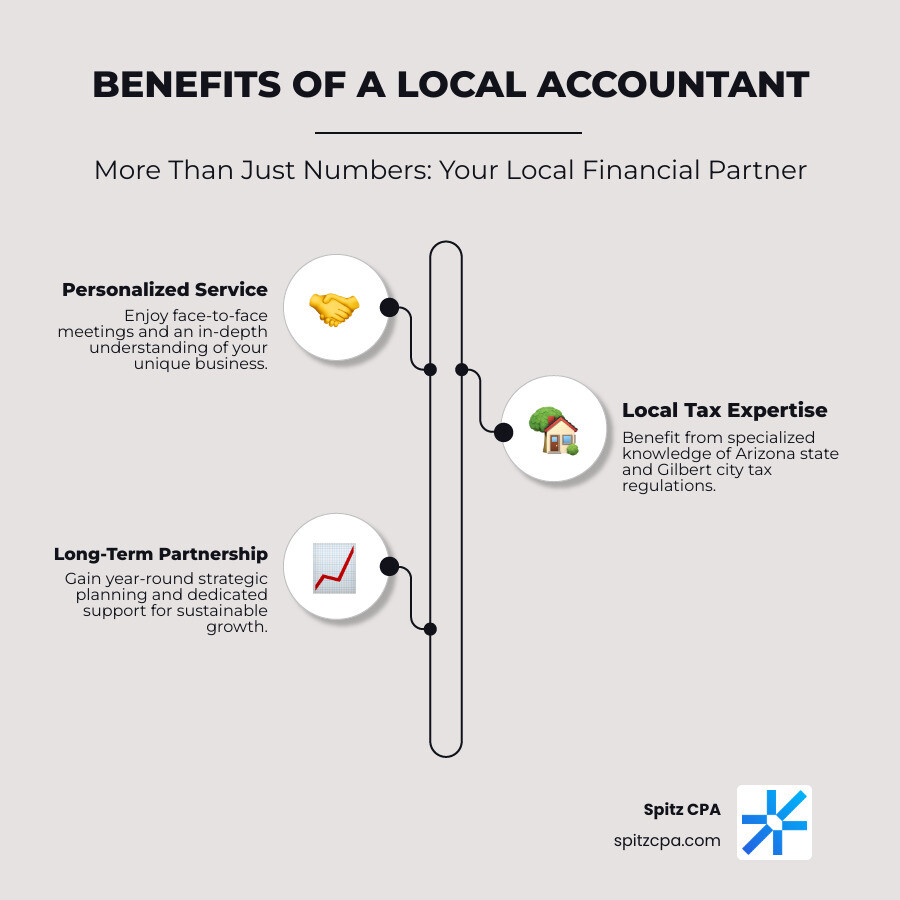
- In-Person Meetings and Personalized Service: Face-to-face meetings foster a deeper connection, allowing for nuanced discussions about your goals and challenges. This leads to truly personalized guidance.
- Understanding of Local and State Tax Laws: A local accountant is an expert in Arizona’s specific state and local tax laws, including sales and property taxes. This expertise helps you stay compliant and can minimize your tax burden.
- Community Involvement and Networking: Local accountants are embedded in the community, providing valuable networking opportunities and insights into the local economy.
- Supporting Local Businesses: Hiring a local accountant contributes to the economic vitality of your community, strengthening the local business ecosystem.
- Quick Response Time and Accessibility: A local presence means quicker access for urgent matters and simplifies document exchange and follow-up meetings.
- Building a Long-Term Relationship: A local accountant is more likely to become a long-term, trusted advisor who understands your business’s history and can offer consistent advice year after year.
- Specialized Services for Specific Industries: Local firms often specialize in prevalent local industries, such as real estate or construction in Arizona, providing more targeted and effective advice.
For small businesses, these local advantages are particularly pronounced. A good local accountant is proactive, communicative, and helps you improve cash flow and achieve growth. Explore how our specialized consulting services can help on our Business Consulting Gilbert page.
Your Step-by-Step Guide to Finding a Local Accountant
Finding the right financial partner requires a thoughtful vetting process to ensure they have the right expertise and are a good fit for your business. Here’s our step-by-step guide to finding the best local accountant.
How to find a qualified local accountant
The search begins with casting a wide net, then narrowing it down based on specific criteria.
- Start with Online Searches, but Go Deeper: Go beyond a simple search. Use specific terms like “CPA Gilbert AZ,” “small business accountant Arizona,” or “tax preparer Gilbert for Schedule C” to find specialists.
- Use Professional Directories: Use reputable directories like the IRS’s robust database of tax preparers, the QuickBooks ProAdvisor program, and state boards of accountancy to find qualified professionals.
- Ask for Referrals: Personal recommendations are invaluable. Ask for trusted referrals from colleagues, other business owners, your banker, or your financial advisor.
- Check Online Reviews and Testimonials: Platforms like Google Reviews and Yelp can provide insights into other clients’ experiences. Look for patterns in feedback regarding responsiveness, expertise, and customer service.
For entrepreneurs looking for comprehensive guidance, our Accounting for Entrepreneurs Complete Guide offers additional insights into building your financial team.
How to verify the credentials of a local accountant
Once you have a shortlist, it’s critical to verify their credentials to ensure you’re hiring a qualified professional.
- Confirm a Preparer Tax Identification Number (PTIN): Ensure any preparer you consider has a current PTIN, a basic IRS requirement for anyone who prepares federal tax returns for compensation.
- Verify CPA License and Standing: For a CPA, use your state’s Board of Accountancy website or the National Association of State Boards of Accountancy’s CPA Verify tool to confirm their license is active and in good standing in Arizona.
- Check for Enrolled Agent (EA) Status: Verify an Enrolled Agent’s status through the IRS directory. EAs are federally licensed and have unlimited representation rights before the IRS.
- Inquire About Professional Liability Insurance: Ask if they carry professional liability (Errors & Omissions) insurance. It protects you in case of an error and is a mark of professionalism.
- Look for Disciplinary Actions: Check the state board’s website for any history of disciplinary actions or complaints, which can be a red flag.
Explaining the Costs: What to Budget for Accounting Services
One of the first questions people ask when considering hiring a local accountant is, “How much does it cost?” Accounting fees vary based on the services you need, the complexity of your situation, the accountant’s experience, and your location.

Here’s a breakdown of typical costs based on industry research:
- Individual Tax Preparation: For individuals, expect to pay around $242 on average. A basic 1040 from a CPA might cost around $319, while a more complex itemized return could be $377. A return with business income (Schedule C) averages around $521.
- Hourly Rates: Hourly rates can range from $40 to over $300. For tax preparation, professionals typically charge between $150 and $450 per hour.
- Monthly Retainer Packages: Monthly retainers for ongoing services like bookkeeping can range from $75 to $500+, depending on business size and transaction volume.
- Bookkeeping Services: The cost for basic bookkeeping services often falls between $60-$200, but this varies by task and pricing model.
- Overall Range: Generally, hiring an accountant can range from $100 to $1,000, depending on the specific service you need.
Factors Affecting Cost:
- Complexity: A simple W-2 tax return will cost less than a return for a small business with multiple income streams and state filings.
- Experience & Credentials: A seasoned CPA with specialized knowledge will typically charge more but can often provide greater tax savings and more valuable insights.
- Transaction Volume: For ongoing services, the number of your financial transactions will impact the time required and the cost.
- Location: Costs can vary based on local market rates, even within the greater Phoenix area.
We recommend getting a clear understanding of an accountant’s pricing structure upfront. We believe in transparency and will discuss our fees during your initial consultation. To learn more about our specific services, visit our Tax Accountant Gilbert AZ page.
Preparing for Success: Your First Meeting and Beyond
Your first meeting with a potential accountant is a crucial opportunity to assess fit, discuss needs, and set expectations for a long-term partnership. You’re not just hiring a number cruncher; you’re seeking a trusted advisor.
At Spitz CPA, Michael J. Spitz and our team focus on building strong, proactive partnerships. We provide year-round guidance to improve cash flow, gain financial clarity, and help your business grow. This approach moves you beyond reactive accounting to strategic financial planning. For more on our tax preparation services, see our Gilbert AZ Tax Preparer page.
What to Expect During an Initial Consultation
An initial consultation is a two-way interview. Here’s what to expect and what to ask:
- Discussing Your Needs and Goals: Be prepared to articulate your business objectives, financial situation, and any challenges you’re facing.
- Understanding Their Process: Ask about their workflow, communication preferences (email, phone, meetings), and availability, especially outside of tax season.
- Fee Structure Explanation: Expect a clear explanation of their pricing model—whether it’s hourly, a flat fee, or a monthly retainer—and what’s included.
- Assessing Personality Fit: This is subjective but important. Do you feel comfortable and understood? A good accountant should be approachable and explain complex topics clearly.
- Asking Key Questions: Be sure to ask probing questions:
- “What’s your experience with businesses like mine in Arizona?”
- “How do you stay updated on the latest tax laws?”
- “Can you represent me before the IRS if I face an audit?”
- “Will you sign my tax return and provide your PTIN?”
- “Do you e-file returns?”
- “Do you carry professional liability insurance?”
- “How do you help clients plan for growth?”
How to Prepare Your Financial Documents
Arriving prepared for your consultation will make the meeting more productive. Gather the following documents to tell your financial story:
- Previous Tax Returns: Last 1-3 years of federal and state tax returns (e.g., Arizona Form 140).
- Identification: Photo ID and your Social Security card or Individual Taxpayer Identification Number (ITIN).
- Income Statements: All income documents: W-2s, all 1099 forms (NEC, INT, DIV, R, etc.), K-1s, and records of other income (rental, capital gains).
- Expense Records: Records of all potential deductions: business expenses, medical costs, charitable donations, mileage logs, home office expenses, student loan interest (1098-E), tuition statements (1098-T), and property tax statements.
- Bookkeeping Files (if applicable): Access to your QuickBooks or other accounting software files, or manual ledgers.
- Business Formation Documents: Articles of incorporation/organization and your EIN (Employer Identification Number).
- Payroll Records: Summaries of wages paid and taxes withheld.
- Investment & Loan Documents: Brokerage statements and information on mortgages or business loans.
Keeping your records organized throughout the year is key. The more organized you are, the more efficiently an accountant can help you.
Frequently Asked Questions about Local Accountants
We understand you have questions when searching for local accountants near me. Here are answers to some common queries:
What’s the main difference between a CPA and a regular accountant?
The main difference is licensing. A CPA (Certified Public Accountant) has passed the rigorous Uniform CPA Exam, met strict state education and experience requirements, and must complete ongoing education. This license grants them unlimited representation rights before the IRS—a privilege most non-CPA accountants don’t have. CPAs are also held to a higher ethical standard, often with a fiduciary duty to their clients.
Can a local accountant really save me money on taxes?
Yes. A skilled local accountant saves you money by:
- Finding all eligible deductions and credits based on deep knowledge of federal, state, and local tax laws.
- Providing strategic, year-round tax planning to minimize future liabilities.
- Ensuring accuracy and compliance to help you avoid costly mistakes, penalties, and audits.
- Navigating constant changes in tax law to your advantage.
By leveraging their expertise, an accountant can help ensure your return is error-free and that you’re not overpaying your taxes.
How do I know if I need a bookkeeper or an accountant?
It depends on your needs:
- Hire a bookkeeper for daily tasks: recording transactions, managing invoices, reconciling accounts, and basic payroll. They keep your financial data organized.
- Hire an accountant for high-level strategy: financial analysis, tax planning, business advisory, and ensuring regulatory compliance. They use the bookkeeper’s data to provide strategic insights.
Many local firms, including Spitz CPA, offer both services. This integrated approach can be the most efficient solution, ensuring seamless financial management from daily transactions to long-term strategy.
Conclusion
Finding the right local accountant is about securing a trusted partner for your business’s success. A local professional in Gilbert, Arizona offers personalized service and a deep understanding of state and local tax laws. We’ve provided a clear roadmap to help you find, vet, and hire a qualified professional who fits your needs.
Preparing for your initial consultation with organized documents and thoughtful questions will set the stage for a productive and valuable partnership.
At Spitz CPA, Michael J. Spitz and our dedicated team believe in building these strong, local partnerships. We are committed to providing personalized guidance and accounting clean-up expertise that helps businesses like yours improve cash flow, gain financial clarity, and achieve significant growth. We understand the specific needs of businesses in Gilbert, AZ, and are passionate about helping our community thrive.
Don’t let financial complexities hold you back. Take the next step in securing your financial future.
Contact us for expert tax services today, and let us help you transform your financial landscape.


