


Why Strategic Tax Planning Matters More Than You Think
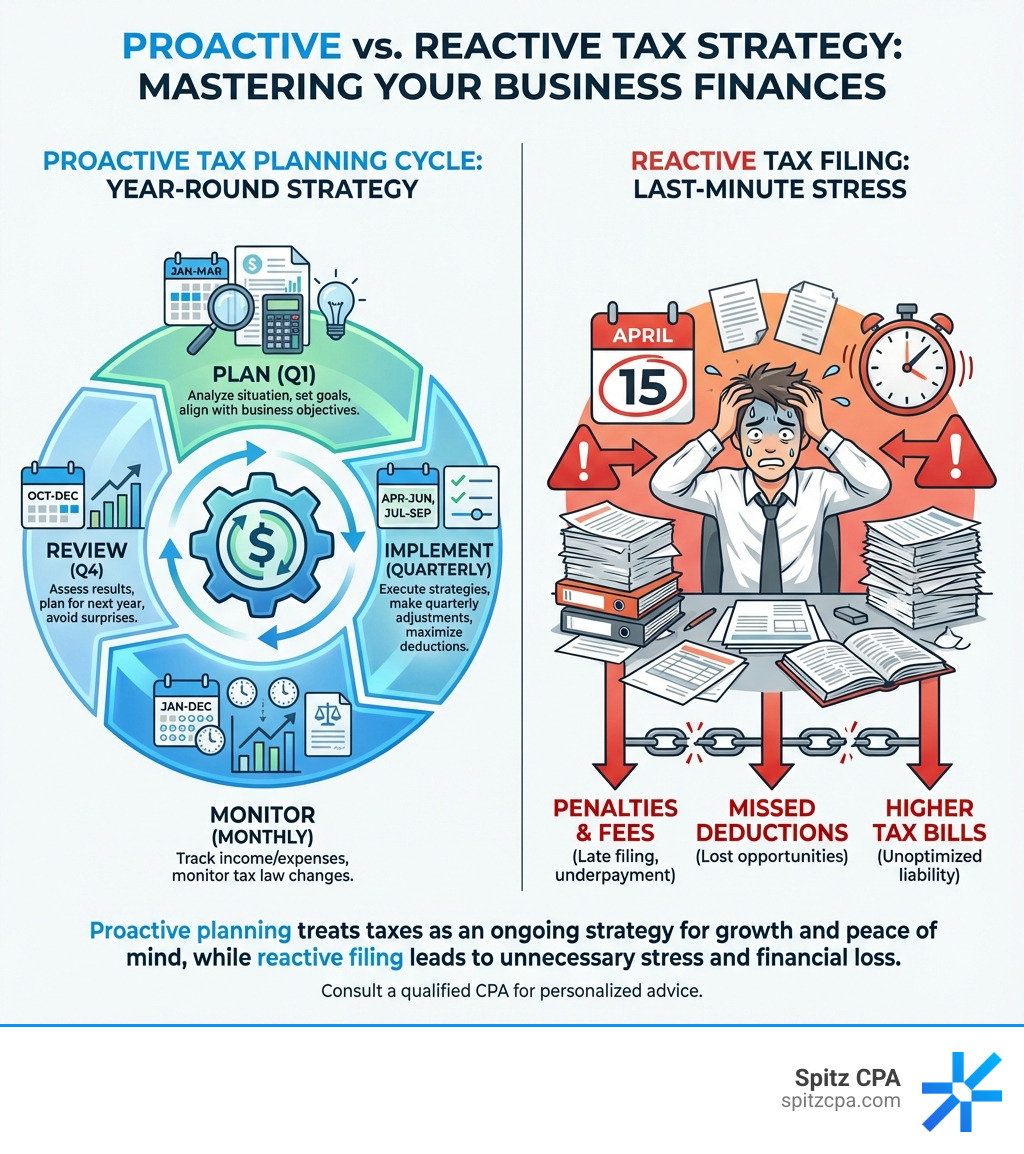
Proactive tax planning is a year-round strategy that transforms your business finances. Instead of reacting to tax deadlines, it involves making forward-thinking decisions to legally minimize your tax liability, maximize all available deductions and credits, and align your tax strategy with your long-term business goals. This approach helps you avoid unexpected tax bills and penalties, ensuring better cash flow and peace of mind.
Many business owners approach taxes reactively—scrambling in March and April. This often results in missed opportunities, higher tax bills, and unnecessary stress. Proactive planning, however, treats taxes as an ongoing part of your financial strategy. It’s the difference between playing defense and playing offense with your money.
I’m Michael J. Spitz, and with over 15 years of corporate accounting experience, I’ve helped businesses implement proactive tax planning strategies that improve profitability and support long-term growth. My approach combines strategic financial modeling, tax optimization, and practical business guidance to help you keep more of what you earn.
Learn more about related services:
The Pitfalls of Reactive Tax Planning
Waiting until tax season to address tax issues is a costly mistake. The drawbacks of this reactive approach are significant:
- Missed Opportunities: Without a year-round strategy, you can easily overlook valuable deductions, credits, or tax-advantaged investments that could have significantly reduced your tax burden.
- Higher Tax Liabilities: A reactive approach limits your options, often forcing you into less-than-optimal choices that result in unexpected tax bills and strained cash flow.
- Penalties and Interest: Lack of preparation can lead to overdue taxes, resulting in substantial penalties and interest charges.
- Unnecessary Stress: Scrambling to gather documents and deal with last-minute issues detracts from your focus on running your business. With reactive planning, you’re always playing catch-up.
The Strategic Advantage: Key Benefits of Proactive Tax Planning

Adopting a proactive tax planning strategy offers benefits that extend far beyond simply reducing your tax bill. It’s about building a robust financial foundation for your business and gaining peace of mind.
Maximize Savings and Improve Profitability
Proactive planning directly impacts your bottom line by legally minimizing your tax obligations, which increases net income.
This involves:
- Maximizing deductions and credits: We help you take full advantage of every legitimate tax break, turning tax dollars into operational capital. Tax credits are especially valuable, offering a dollar-for-dollar reduction in your tax bill.
- Lowering your effective tax rate: Strategic planning helps structure your income and expenses to keep more money in your business for reinvestment, expansion, or savings.
- Freeing up capital for investment: Every dollar saved in taxes can be put back into your business to fund new equipment, team expansion, or product launches. These investments can significantly improve business profitability and drive future growth.
Improve Financial Stability and Strategic Growth
Beyond immediate savings, this forward-thinking approach improves your business’s overall financial stability.
- Avoiding surprises: Anticipating tax liabilities eliminates unexpected tax bills and penalties, allowing for more accurate budgeting and a clearer financial picture.
- Better budgeting and forecasting: A predictable tax burden helps you allocate resources more effectively. This foresight is crucial for cash flow management and maintaining liquidity.
- Informed decision-making: Tax implications are considered before major business decisions, not after, allowing for more strategic choices about purchases, hiring, or structural changes.
- Managing tax law changes: Tax laws are constantly evolving. A proactive approach helps you adapt to new regulations and leverage new opportunities, ensuring your business maintains strategic business growth. This provides peace of mind, knowing your business is prepared for what’s next.
Foundational Tax Strategies for Individuals and Business Owners
Effective proactive tax planning starts with understanding basic tax principles. These concepts are the building blocks for more advanced strategies.
Understanding Tax Brackets, Deductions, and Credits
The U.S. has a progressive tax system where higher incomes face higher tax rates. However, your entire income isn’t taxed at your highest rate. Instead, different portions of your income fall into “brackets,” each taxed at a different marginal rate. Understanding this is key to planning.
To reduce your tax burden, you can use:
- Tax Deductions: These reduce your taxable income. A $1,000 deduction for someone in the 24% tax bracket saves $240 in taxes.
- Tax Credits: These provide a dollar-for-dollar reduction of your tax bill. A $1,000 tax credit saves you $1,000. This makes credits generally more valuable.
| Feature | Tax Deduction (e.g., $1,000) | Tax Credit (e.g., $1,000) |
|---|---|---|
| Impact on | Taxable Income | Final Tax Bill |
| Example Value | $1,000 deduction for someone in 24% bracket saves $240 in taxes | $1,000 credit saves $1,000 in taxes |
| Benefit | Reduces the income subject to tax | Directly reduces the amount of tax owed |
You must also choose between the standard deduction and itemized deductions.
- The Standard Deduction is a fixed amount set by the IRS (for 2024, it’s $14,600 for single filers and $29,200 for married couples filing jointly).
- Itemized Deductions are specific expenses like state and local taxes (capped at $10,000), mortgage interest, and charitable contributions. You should itemize if your total itemized deductions exceed your standard deduction amount.
Your Adjusted Gross Income (AGI)—gross income minus certain “above-the-line” deductions—is a critical figure, as it can limit your eligibility for other deductions and credits. A key goal of strategic tax planning is to strategically lower your AGI. We can help you maximize tax deductions to achieve this.
Key Tax-Advantaged Accounts
Using tax-advantaged accounts is a cornerstone of smart planning. These accounts offer significant tax benefits.
- 401(k) Plans: Employer-sponsored plans that allow pre-tax contributions, reducing your current taxable income. Money grows tax-deferred. For 2024, the contribution limit is $23,000 ($7,500 catch-up for age 50+).
- Traditional & Roth IRAs: A Traditional IRA may offer a tax-deductible contribution and tax-deferred growth. A Roth IRA uses after-tax dollars, but qualified withdrawals in retirement are tax-free. For 2024, the IRA contribution limit is $7,000 ($1,000 catch-up for age 50+).
- Health Savings Accounts (HSAs): For those with a high-deductible health plan, HSAs offer a triple tax advantage: contributions are deductible, funds grow tax-free, and withdrawals for qualified medical expenses are tax-free. For 2025, contribution limits are $4,300 for self-only and $8,550 for family coverage, plus a $1,000 catch-up for age 55+.
- 529 Plans: These are tax-advantaged education savings accounts. A 529 plan allows for tax-free growth and tax-free withdrawals for qualified educational expenses. Some states, like Arizona, also offer a state tax deduction for contributions.
Timing Income and Capital Gains
Strategic timing is a powerful tax planning tool.
- Deferring Income / Accelerating Deductions: If you expect to be in a lower tax bracket next year, you might defer income. If you expect a higher bracket, you might accelerate deductions into the current year. For example, a business might delay invoicing until January or prepay expenses before year-end. Be cautious, as this can impact working capital.
- Tax-Loss Harvesting: Sell investments at a loss to offset capital gains from profitable investments. If losses exceed gains, you can deduct up to $3,000 against ordinary income annually and carry forward the rest.
- Long-Term vs. Short-Term Capital Gains: Assets held over a year are taxed at lower long-term capital gains rates (0%, 15%, or 20%). Assets held for a year or less are taxed at higher ordinary income rates. Holding assets longer can significantly reduce your tax bill.
Advanced Proactive Tax Planning Strategies for Your Business

For business owners, proactive tax planning digs into your company’s operational and structural aspects. These advanced strategies are crucial for long-term financial health and growth.
Choosing the Right Business Entity
Your business’s legal structure has profound tax implications and is a critical planning choice. It impacts liability, deductions, and how you are taxed.
- Sole Proprietorship: The simplest structure. Business income and expenses are reported on your personal tax return (Schedule C), and profits are subject to self-employment taxes.
- Partnership: Similar to a sole proprietorship but for multiple owners. Income and expenses “pass through” to the partners’ individual tax returns.
- S-Corporation (S-Corp): A popular choice where profits pass through to owners’ personal income. Owners can take a “reasonable salary” (subject to payroll taxes), while remaining profits can be distributed without additional self-employment taxes.
- C-Corporation (C-Corp): Taxed separately from its owners, which can lead to “double taxation” (at the corporate level and again as dividends). However, C-Corps offer flexibility for reinvesting earnings and seeking outside investment.
The right entity affects your tax burden and eligibility for deductions like the Qualified Business Income (QBI) deduction. We can help you evaluate the options and ensure your business entity formation is optimized for tax efficiency.
Leveraging Business Deductions and Credits
Businesses have access to many deductions and credits designed to encourage investment. Here are some common small business tax deductions and credits:
- Qualified Business Income (QBI) Deduction: Owners of pass-through businesses may deduct up to 20% of their qualified business income. Understanding the nuances of the QBI deduction is crucial.
- Retirement Plan Startup Costs Credit: Small businesses can get a tax credit of up to $5,000 for the costs of starting a new retirement plan (e.g., SEP, SIMPLE IRA, 401(k)).
- Depreciation: Deduct the cost of business assets over time. Accelerated methods like Section 179 and bonus depreciation can allow for a large or full deduction in the year of purchase.
- Business Expenses: All “ordinary and necessary” expenses for running your business are deductible, including rent, utilities, advertising, and wages.
- Home Office Deduction: If you use part of your home exclusively for business, you may be able to deduct related expenses.
- Research & Development (R&D) Tax Credits: Many small and medium-sized businesses can qualify for these credits, which directly reduce tax liability.
Leveraging these business tax strategies requires careful planning. We can help you identify and claim every deduction and credit you’re entitled to.
Why Proactive Tax Planning is Crucial for Long-Term Growth
Proactive planning lays the groundwork for sustainable growth and maximizes future value.
- Succession Planning: Planning years in advance can significantly reduce capital gains or estate taxes when you sell or pass on your business.
- Business Valuation: Tax efficiency improves cash flow and makes your business more attractive to buyers or investors, helping to increase business value.
- Mergers and Acquisitions: A tax-efficient structure is critical when buying or selling businesses to preserve capital and maximize returns.
- Reinvesting Tax Savings: The capital saved can be reinvested into R&D, technology, or expansion, fueling a virtuous cycle of growth and profitability.
Putting Your Plan into Action: The Role of Professionals and Organization
The best proactive tax planning strategies are only as effective as their execution. This requires meticulous organization and partnering with knowledgeable tax professionals.
The Importance of Meticulous Record-Keeping
Effective planning relies on accurate, organized financial records. You can’t maximize deductions if you don’t know where your money is going.
- Organize Tax Records Year-Round: Create a system for organizing records as you receive them, not at year-end. Use accounting software (we can help with small business accounting) or labeled folders for receipts, bank statements, and other documents.
- Track Income and Expenses: Detailed records ensure you claim every legitimate deduction and accurately report income, avoiding potential IRS issues.
- Keep Supporting Documentation: You need documentation for every deduction or credit in case of an audit. Keep tax returns and supporting documents for at least three years, though some situations require longer.
Good record-keeping makes tax preparation easier and helps find overlooked savings, which is a key part of these year-round tax planning tips for taxpayers.
Partnering with Tax Professionals
Tax laws are complex and constantly changing. Navigating them alone is difficult. Partnering with a tax professional is indispensable for creating a tax-efficient strategy.
- Role of a CPA: A Certified Public Accountant (CPA) like Michael J. Spitz specializes in tax law, accounting, and financial planning. We go beyond tax preparation to develop a customized, forward-thinking tax strategy aligned with your goals. As your trusted Tax Accountant Gilbert AZ, we ensure your plan is effective.
- Coordination with a Financial Advisor: A financial advisor helps with broader investment strategies. The best approach involves coordination between your CPA and financial advisor to ensure your overall financial plan is cohesive and tax-efficient.
- Creating a Custom Plan: There is no one-size-fits-all solution. We work with you to understand your unique situation and create a custom strategy, helping you identify tax-saving opportunities you might otherwise miss.
Engaging in tax services year-round with a professional team keeps you ahead of the curve, allowing you to focus on running your business.
Frequently Asked Questions about Proactive Tax Planning
How often should I review my tax plan?
Proactive tax planning is an ongoing process. We recommend reviewing your tax plan at least quarterly and whenever significant changes occur in your life or business. This includes:
- A significant change in income
- Major asset purchases or sales
- Changes in business structure
- Hiring or laying off employees
- Major life events (marriage, divorce, birth)
- Changes in tax law
Regular reviews ensure your plan remains optimized and compliant, as your actions throughout the year affect your tax outcome.
Can proactive tax planning help with my personal finances too?
Absolutely. The principles of proactive tax planning apply equally to personal finances. Strategies like maximizing contributions to retirement accounts (401(k)s, IRAs), using HSAs, and leveraging 529 plans directly benefit your personal tax situation. For many business owners, personal and business finances are deeply intertwined, making a holistic approach essential.
What’s the difference between tax avoidance and tax evasion?
This is a crucial distinction. Tax avoidance is the legal use of tax laws to reduce your tax liability. This is the goal of strategic tax planning—using legitimate deductions, credits, and strategies to pay the lowest tax possible.
Tax evasion, on the other hand, is the illegal practice of not paying taxes by misrepresenting your finances, such as hiding income or falsifying deductions. Tax evasion carries severe penalties, including fines and imprisonment.
Our goal is always legal tax avoidance, helping you make smart, informed decisions within the law.
Conclusion: Partner with an Expert for Financial Mastery
Proactive tax planning is not an annual chore but a powerful, year-round strategy for your business’s financial success. By maximizing savings, improving stability, and making informed decisions, you can turn taxes from a source of stress into a strategic advantage.
At Spitz CPA, we specialize in helping businesses implement robust proactive tax planning strategies. With over 15 years of corporate accounting experience, Michael J. Spitz provides personalized guidance to help you improve cash flow, gain financial clarity, and achieve significant growth. Let us help you take control of your tax destiny.
Ready to transform your tax approach and open up your business’s full potential? Take the first step towards financial mastery.
Get a business financial health check today, and let’s build a brighter financial future for your business together.


