


Why Learning to Maximize Tax Deductions Changes Everything
Maximizing your tax deductions isn’t just about filling out forms correctly—it’s about keeping more of your hard-earned money. Here’s the quick answer:
To maximize tax deductions:
- Choose wisely between standard and itemized deductions based on your total eligible expenses
- Claim all above-the-line deductions (IRA contributions, HSA, student loan interest, self-employment tax)
- Use the “bunching” strategy to consolidate deductible expenses into high-income years
- Document everything with receipts, bank statements, and mileage logs
- Leverage business deductions if self-employed (QBI deduction, home office, health insurance)
- Stay current on tax law changes and available credits
A tax credit reduces your tax bill dollar-for-dollar (a $1,000 credit saves you $1,000), while a tax deduction lowers your taxable income, saving you an amount based on your tax bracket (a $1,000 deduction in the 24% bracket saves you $240).
For tax year 2024, the standard deduction is $14,600 for single filers and $29,200 for married couples filing jointly. If your itemized deductions (mortgage interest, charitable contributions, medical expenses, state and local taxes) exceed these amounts, itemizing is the smarter choice.
Tax planning can be overwhelming. Many business owners leave money on the table because they don’t know what’s available or how to claim it. In fact, tax literacy is a widespread issue; a Tax Foundation poll found that even 55% of people with postgraduate degrees had only beginner-level tax knowledge.
I’m Michael J. Spitz. With over 15 years of corporate accounting experience, I’ve helped countless clients maximize tax deductions through strategic planning. My expertise in financial modeling, budgeting, and tax preparation allows me to apply both technical rules and practical strategies to real-world situations, ensuring year-round financial clarity.
Deduction Fundamentals: Credits, Deductions, and Your Big Choice
Understanding how to maximize tax deductions starts with grasping two fundamental concepts: tax credits and tax deductions. Both can put money back in your pocket, but they work differently.
Tax Credits vs. Tax Deductions: What’s the Difference?
A tax credit is a powerful, dollar-for-dollar reduction of your tax bill. A $1,000 credit cuts your taxes by exactly $1,000. Credits come in two types: non-refundable credits can reduce your tax to zero, but no more. Refundable credits are more valuable; if the credit exceeds your tax liability, the IRS sends you the difference as a refund.
A tax deduction reduces your taxable income, the amount used to calculate your tax bill. The savings depend on your tax bracket. For example, a $1,000 deduction in the 24% bracket saves you $240. It’s valuable, but less direct than a credit.
Understanding this difference matters because when we’re planning your tax strategy at Spitz CPA, we prioritize credits first, then layer in deductions to maximize your overall savings.
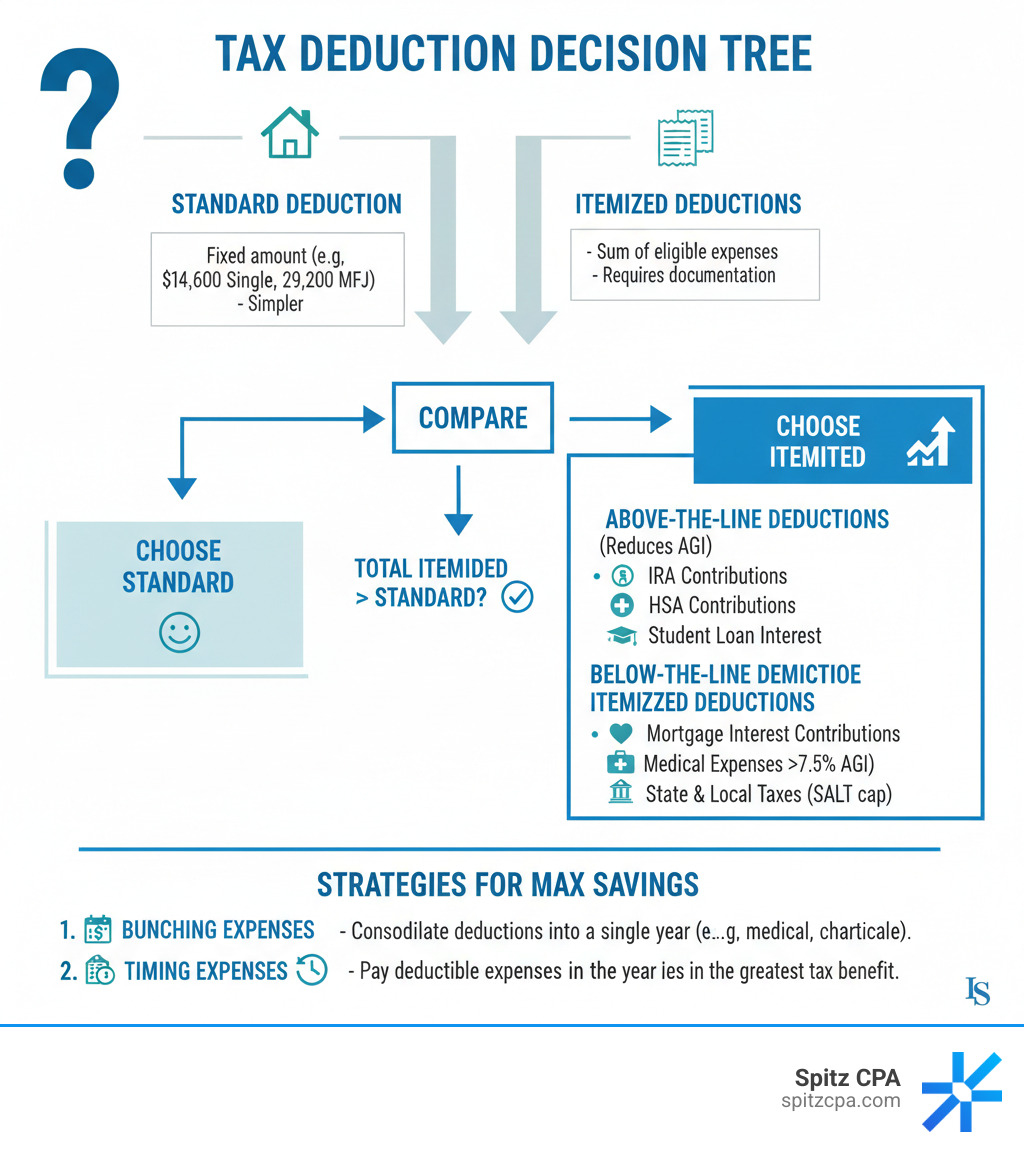
Standard vs. Itemized Deduction: Which Path Saves You More?
Every taxpayer must choose between the standard and itemized deduction, a choice that can save thousands.

The standard deduction is a fixed dollar amount anyone can claim without tracking expenses. For 2024, the amounts are: $14,600 for single filers, $29,200 for married couples filing jointly, and $21,900 for heads of household. It’s the simpler choice and often the better deal for most Americans.
Itemizing involves adding up all your eligible expenses—like medical bills, mortgage interest, charitable donations, and state/local taxes—on Schedule A. It requires detailed records, but the payoff can be substantial.
The rule is simple: itemize if your total deductible expenses exceed your standard deduction amount. For a single filer, $20,000 in expenses means you should itemize instead of taking the $14,600 standard deduction. If your expenses are only $10,000, take the standard deduction.
Since the Tax Cuts and Jobs Act nearly doubled standard deduction amounts, fewer people itemize. However, if you have a mortgage, significant medical expenses, or make large charitable donations, itemizing might still be your best path to savings.
At Spitz CPA, we run the numbers both ways for every client. We’re not guessing—we’re calculating which path puts more money back in your hands. For a comprehensive look at what’s available, the IRS guide to credits and deductions is a helpful resource.
A Comprehensive Guide to Common Tax Deductions
Let’s explore the specific deductions that can put real money back in your pocket. Deductions fall into two buckets: those that reduce your Adjusted Gross Income (AGI) and those that come after if you itemize.
“Above-the-Line” Deductions That Reduce Your AGI
These deductions are especially valuable because they reduce your income before your Adjusted Gross Income (AGI) is calculated. A lower AGI can help you qualify for other tax credits and deductions, maximizing your overall savings.
Traditional IRA contributions not only build your retirement nest egg but also provide a current tax break. For 2025, you can contribute up to $7,000 ($8,000 if 50 or older). Depending on your income and employer retirement plan access, these contributions may be fully deductible, reducing your taxable income.
Health Savings Accounts (HSAs) are a powerful tool if you have a high-deductible health plan. They offer a triple tax advantage: deductible contributions, tax-free growth, and tax-free withdrawals for medical expenses. For 2025, contribution limits are $4,300 for self-only coverage and $8,550 for family coverage, plus a $1,000 catch-up if you’re 55 or older.
The Student Loan Interest Deduction allows you to deduct up to $2,500 in interest paid on qualified student loans. It’s an above-the-line deduction, so you don’t need to itemize, though it does phase out at higher incomes.
The Educator Expenses deduction allows eligible K-12 educators to deduct up to $300 for unreimbursed classroom supplies in 2025. This doubles to $600 for two qualifying spouses filing jointly.
If you’re self-employed, you can deduct one-half of your self-employment tax. This accounts for the employer portion of Social Security and Medicare taxes you pay. The deduction is calculated on Schedule SE and directly reduces your AGI, making a meaningful difference.
For deeper strategies on managing your taxes throughout the year, check out our insights on Tax Planning.
“Below-the-Line” Deductions for Those Who Itemize
These deductions are only available if you itemize. Meticulous record-keeping is key to claiming them.
| Deduction Category | Key Requirements/Limitations | AGI Threshold/Cap |
|---|---|---|
| Medical & Dental Expenses | Unreimbursed expenses for medical care, prescriptions, etc. | Exceeds 7.5% AGI |
| State & Local Taxes (SALT) | Property, income, or sales taxes paid | $10,000 per household |
| Home Mortgage Interest | Interest on qualified home acquisition debt | Varies by loan amount and origination date |
| Charitable Contributions | Cash or property donated to qualified organizations | Up to 60% AGI (cash), 30% AGI (property) |
Medical and Dental Expenses are deductible only for the amount that exceeds 7.5% of your AGI. This high threshold means it applies mainly to those with substantial medical costs. Qualifying expenses include payments for diagnosis, treatment, prescriptions, medical equipment, and even mileage for medical travel. Gathering all receipts is crucial.
The State and Local Tax (SALT) deduction is capped at $10,000 per household. It covers property taxes plus either state income or sales taxes. This cap is challenging for those in high-tax states. You must choose to deduct either income or sales taxes; most people find income taxes provide a larger deduction.
Home Mortgage Interest is a valuable deduction for homeowners. You can deduct interest on acquisition debt for your primary and a second home. For mortgages taken out after Dec. 15, 2017, interest is deductible on up to $750,000 of debt ($1 million for older mortgages). Points paid to obtain the mortgage may also be deductible.
Charitable Contributions to qualified 501(c)(3) organizations are deductible. Cash donations are generally limited to 60% of your AGI, while appreciated property is limited to 30% of AGI. Always keep documentation, such as bank records or written acknowledgments from the charity for contributions of $250 or more.
At Spitz CPA, we help clients identify every deduction they’re entitled to claim. Sometimes the difference between a good tax return and a great one is simply knowing what to look for and having the records to back it up.
Pro-Level Strategies to Maximize Tax Deductions
Once you understand the fundamentals, strategic timing and planning can open up even greater savings. This is where proactive tax planning becomes proactive wealth-building.
The “Bunching” Strategy: How to Maximize Tax Deductions in a Single Year

Many taxpayers have itemized deductions that fall just short of their standard deduction, meaning they get no tax benefit from those expenses.
The “bunching” strategy helps you overcome this. The concept is simple: concentrate deductible expenses into a single tax year to exceed the standard deduction, rather than spreading them out. For example, instead of donating $6,000 to charity each year, you could donate $12,000 in one year. This might push your total itemized deductions for that year above the standard deduction, creating real tax savings. The next year, you simply take the standard deduction. Over two years, your total deductions are higher.
Medical payments are ideal for bunching. Scheduling elective procedures or buying prescription refills and eyeglasses in one year can help you exceed the 7.5% AGI threshold. These small timing decisions can add up.
Charitable donations are also flexible. Donor-Advised Funds (DAFs) make bunching especially powerful. You can contribute a large sum to a DAF in one year, claim the full deduction immediately, and then recommend grants from the fund to charities over several years. This provides a large, upfront tax benefit while you maintain a regular giving schedule.
This strategy requires looking ahead, but the payoff can be substantial. We help our clients map out these strategies years in advance.
How to Maximize Tax Deductions as a Self-Employed Individual
Running your own business open ups some of the most powerful tax deductions available, provided you know what qualifies and document everything.
The Qualified Business Income (QBI) Deduction is a major tax break for small businesses. If you operate as a sole proprietorship, S corp, or partnership, you may be able to deduct up to 20% of your qualified business income. While there are income limitations and complexities, this deduction is a game-changer for many entrepreneurs.
The home office deduction is often underused. You can deduct expenses for a part of your home used exclusively and regularly for business. This includes a portion of rent, mortgage interest, utilities, and repairs. The IRS offers a simplified method ($5 per square foot, up to 300 sq. ft.) or the actual expense method, which may yield greater savings.
Deducting business use of your car is valuable. You can use the standard mileage rate (67 cents per mile for 2024) or deduct actual expenses (gas, maintenance, insurance, etc.). While the standard rate is simpler, actual expenses can sometimes yield a larger deduction. In either case, detailed mileage logs are essential for audit-proofing.
Health insurance premiums for the self-employed are fully deductible as an above-the-line deduction. This includes medical, dental, and long-term care insurance for you, your spouse, and dependents. It directly reduces your AGI, potentially open uping other tax benefits.
Don’t overlook other business expenses: software, professional development, business meals (50% deductible), advertising, legal fees, office supplies, and travel. Every legitimate “ordinary and necessary” expense reduces your taxable income, so maintain excellent records.
We work with business owners year-round to ensure they’re capturing every available deduction. Explore our Business Tax Strategies to see how we help companies grow while minimizing their tax burden.
Staying Prepared: Documentation, Tax Law Changes, and Professional Guidance
Successfully maximizing your tax deductions isn’t just about finding them; it’s about proving them and staying informed.
Why Meticulous Record-Keeping is Non-Negotiable

A seasoned tax professional knows: documentation is your best friend. Many taxpayers miss deductions because they lack paperwork. The IRS requires records to support all reported income, deductions, and credits. Without proper documentation, a legitimate deduction can be disallowed in an audit. If you can’t prove it, you can’t deduct it.
An audit-proofing strategy requires organized records. Keep receipts for all business, charitable, and medical expenses. Bank statements corroborate these payments. For vehicle use, detailed mileage logs showing dates, destinations, purpose, and miles are essential. Also, keep investment statements, all W-2s, 1099s, K-1s, and acknowledgment letters for large charitable gifts. This supporting documentation is your audit insurance policy.
Organize records throughout the year using a digital or physical system. This makes tax season smoother and provides peace of mind. A shoebox of receipts in April is a recipe for stress and missed deductions.
Navigating New Tax Laws and Maximizing Credits
Tax laws are constantly evolving. A deduction from last year might be gone, while new opportunities emerge. Staying informed is crucial to maximize tax deductions and credits each year.
Major legislation has reshaped the tax landscape. The Tax Cuts and Jobs Act (TCJA) altered standard deductions and limited others, like the $10,000 SALT cap. The Inflation Reduction Act (IRA) introduced new credits for clean energy and electric vehicles.
For 2024, the Child Tax Credit is worth up to $2,200 per child, though it’s subject to phase-outs and limited refundability. The Earned Income Tax Credit is a powerful refundable credit for low-to-moderate-income workers. Higher education credits like the American Opportunity Tax Credit and Lifetime Learning Credit help offset tuition.
Energy Credits, bolstered by the IRA, are significant for homeowners making energy-efficient upgrades and for those buying clean vehicles. These tax benefits can make such investments more affordable.
Understanding the reasoning behind these tax provisions, as explored in academic works like Theories of Personal Deductions in the Income Tax, provides interesting context. But for practical application, you need current, expert advice.
When to Call an Expert: The Role of a CPA
Given the tax law complexity, navigating it alone is challenging. As the Tax Foundation poll showed, even highly educated people struggle. Getting expert help is a smart financial decision.
At Spitz CPA, we are more than just tax preparers; we’re strategic partners committed to helping you achieve financial clarity.
Michael J. Spitz and our team bring over 15 years of corporate accounting experience. We stay current on all tax legislation, including Arizona’s unique tax laws, ensuring you never miss an opportunity.
Our commitment is to personalized strategy. We take time to understand your unique financial situation—income, expenses, investments, and goals—to craft a custom plan to maximize tax deductions and credits. Your plan is built around your life, not a template.
We believe in year-round planning, not a last-minute scramble. We help you make smart financial decisions throughout the year, from timing contributions to structuring giving, to positively impact your tax liability.
Our expertise extends beyond tax returns to comprehensive accounting and financial advisory. We help businesses improve cash flow, gain financial clarity, and achieve significant growth—even a 10x increase in value through strategic guidance and accounting clean-up.
Don’t leave money on the table or risk unnecessary stress. We’re here to turn tax season from a headache into an opportunity. Contact us for expert tax services and let’s start building your personalized tax strategy together.
Conclusion: Take Control of Your Tax Future
This roadmap has shown you how to keep more of your money. By understanding credits vs. deductions, standard vs. itemized choices, and strategies like bunching and maximizing self-employment benefits, you can maximize tax deductions and improve your bottom line.
The key is proactive, year-round planning and organization. Tax season doesn’t have to be a frantic scramble. Viewing taxes as a year-round strategy instead of an annual chore changes everything.
Every dollar saved is money you can reinvest in your business, save for retirement, or use to enjoy life. Strategic tax planning can save you thousands of dollars compared to average planning.
The tax landscape is complex, with changing laws, AGI thresholds, and numerous deductions to track. That’s why documentation is your insurance policy, and a trusted advisor who understands your situation is a smart investment, not a luxury.
At Spitz CPA, we don’t just prepare tax returns. We partner with you to build a comprehensive tax strategy that aligns with your life and business goals. Michael J. Spitz and our team believe that with the right guidance, every business owner and individual can achieve financial clarity and significant growth.
If you’re ready to stop leaving money on the table and start taking full advantage of every tax-saving opportunity available to you, we’re here to help you make it happen.


