


The Strategic Power of Financial Modeling
Financial modeling consulting firms help businesses make better decisions by building robust, data-driven financial projections and analytical tools. These firms specialize in creating customized Excel models, conducting scenario analysis, supporting M&A transactions, securing funding, and providing strategic insights that transform complex financial data into actionable intelligence.
Top reasons businesses hire financial modeling consulting firms:
- Raising Capital: Build investor-ready financial projections and pitch deck models
- M&A Support: Create valuation models and support due diligence processes
- Strategic Planning: Develop three-statement forecasts and scenario analysis tools
- Transaction Support: Model complex deals including LBOs, restructurings, and capital raises
- Expertise Access: Leverage specialized skills without hiring full-time staff
- Model Audits: Review and validate existing models for accuracy and best practices
The global financial modeling market was valued at $1.5 billion in 2022 and is projected to reach $3.1 billion by 2030, growing at 9.5% annually. This growth reflects a fundamental shift in how successful businesses operate. As one industry source puts it: “When it comes to business decision-making, the contrast between intuition-driven strategies and data-driven precision could not be starker.”
Financial modeling isn’t just about spreadsheets. It’s about predicting the future viability of business initiatives, supporting current operations, and enabling stakeholders to make informed decisions through clear, adjustable projections. Whether you’re a startup seeking seed funding, a mid-market company evaluating an acquisition, or an established business planning strategic expansion, professional financial modeling provides the analytical clarity you need.
The stakes are too high to leave financial modeling to guesswork. Mid-market firms often struggle with the choice between hiring internally—covering salary costs, training time, and oversight—or engaging expensive Big Four consultancies that can charge hundreds of thousands to millions of dollars. This gap has created demand for specialized financial modeling consulting firms that offer high-quality, affordable solutions.
I’m Michael J. Spitz, and with over 15 years of corporate accounting experience including extensive FP&A work with seed rounds, modeling, budgeting, and complex financial presentations, I’ve seen how effective financial modeling transforms business outcomes. Through my work in financial modeling consulting and as the founder of Spitz CPA, I help businesses in Phoenix and nationwide build the financial clarity they need to grow.
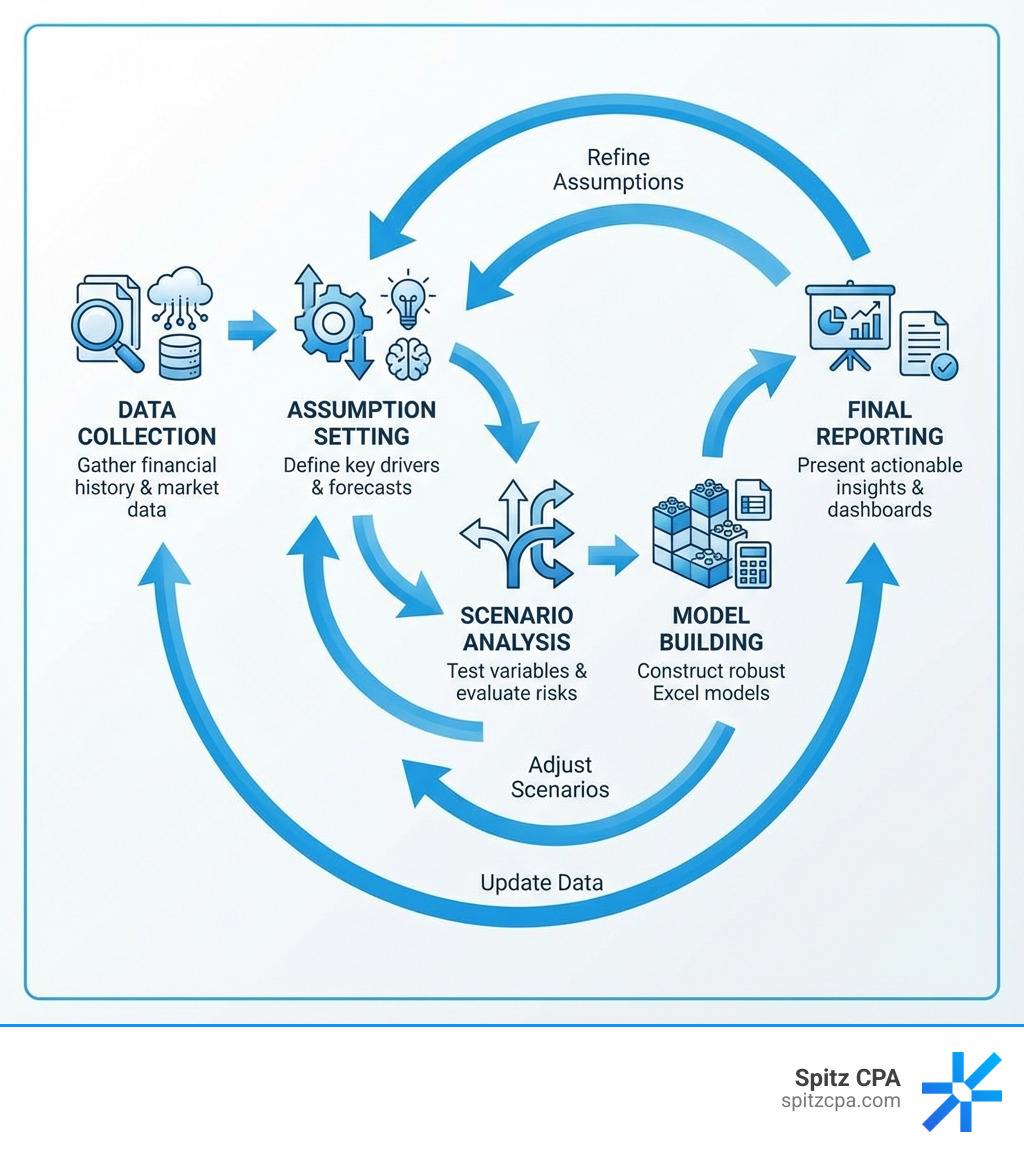
Similar topics to financial modeling consulting firms:
Core Services Provided by Spitz CPA in Financial Modeling
At Spitz CPA, we understand that robust financial models are the bedrock of sound business decisions. Our core services are designed to empower businesses in Gilbert, AZ, and across Arizona to optimize their financial performance, streamline strategic planning, and achieve significant growth. We leverage our expertise to ensure our clients have the clarity and foresight needed to steer complex financial landscapes.
Our approach to financial modeling goes beyond mere number crunching. We help businesses not only understand where they stand but also where they’re headed. By building and refining financial models, we provide the tools necessary for strategic planning, allowing our clients to forecast future performance, assess potential risks, and identify opportunities for expansion. This proactive approach is crucial for optimizing financial performance and making data-driven choices that align with long-term objectives.
One of the most critical aspects of our work involves assisting businesses in securing investments and facilitating transactions. Whether you’re a startup pitching to venture capitalists or an established company considering an acquisition, a well-constructed financial model is indispensable. It serves as a credible, data-backed narrative of your business’s potential, helping to attract investors and ensure favorable transaction terms. Our services include thorough Business Valuation Services and comprehensive due diligence support, ensuring all financial aspects are carefully analyzed and presented. From capital raising strategies to detailed transaction support, we build models that instill confidence in stakeholders and drive successful outcomes.
Types of Financial Models Built by Spitz CPA
The world of financial modeling is vast, with different models serving distinct purposes. At Spitz CPA, we specialize in building a variety of financial models custom to our clients’ unique needs, from early-stage startups to growing enterprises. Here are some of the key types of financial models we develop:
- Valuation Models: These models are crucial for determining the fair value of a company, asset, or project. They are essential for mergers and acquisitions, capital raising, investment analysis, and strategic planning. We use various methodologies, such as Discounted Cash Flow (DCF), comparable company analysis, and precedent transactions, to provide accurate and defensible valuations.
- Mergers & Acquisitions (M&A) Models: When considering an acquisition or divestiture, M&A models help assess the financial impact of the transaction. These complex models integrate the financial statements of both entities, project synergies, and evaluate the accretion/dilution to earnings per share, guiding strategic decisions.
- Forecasting Models: These models project a company’s future financial performance, including revenue, expenses, profits, and cash flows. They are vital for budgeting, strategic planning, and performance monitoring. Our forecasting models are built with flexibility, allowing for scenario and sensitivity analysis to understand potential outcomes under different assumptions.
- Leveraged Buyout (LBO) Models: LBO models are used to evaluate the financial feasibility of acquiring a company using a significant amount of borrowed money. These models are highly complex, projecting debt repayment schedules, equity returns, and the overall financial structure of the deal.
- Project Finance Models: For large-scale projects, especially in sectors like infrastructure or renewable energy, project finance models assess the economic viability and funding structure of a specific venture. They consider project-specific cash flows, debt service, and equity returns in isolation from the sponsoring entity.
- Three-Statement Models: This foundational model integrates a company’s Income Statement, Balance Sheet, and Cash Flow Statement. It provides a comprehensive view of a company’s financial health and is often the starting point for more specialized models. We often provide an Example of Cash Flow Projection for 12 Months as part of these models to help clients visualize their liquidity.
Each model we build is customized to reflect the specific operational and financial dynamics of our clients’ businesses, ensuring they are robust, flexible, and easy to use.
A Curated Look at Spitz CPA’s Financial Modeling Specializations
Understanding that each business has unique requirements, we tailor our financial modeling services to address specific challenges and opportunities. Our expertise at Spitz CPA allows us to provide specialized solutions that go beyond generic templates, ensuring our clients receive highly relevant and actionable insights. We focus on delivering value that helps businesses differentiate themselves and thrive in their respective markets.

We pride ourselves on our firm’s differentiation, emphasizing our commitment to clear communication, collaboration, and delivering models that are not just accurate but also user-friendly. Our market positioning is built on bridging the gap between complex financial theory and practical business application, making sophisticated tools accessible to entrepreneurs and mid-market companies in Arizona.
Strategic & Corporate Finance Expertise
Our strategic and corporate finance expertise is designed to support businesses through their most complex financial undertakings. We provide robust financial models that are essential for critical decision-making processes, including mergers and acquisitions (M&A) advisory and capital restructuring. Whether our clients are on the buy-side or the sell-side of a transaction, our models offer the analytical clarity needed to evaluate deals, assess financial impacts, and negotiate effectively. We assist with detailed transaction modeling, valuation analysis, and data communication, ensuring all stakeholders have a clear understanding of the financial implications. This support is vital for companies aiming to optimize their capital structure or pursue strategic growth initiatives.
Industry-Specific and Niche Financial Modeling
Recognizing that different industries come with their own unique financial dynamics, we offer industry-specific and niche financial modeling services. For instance, while we don’t specialize in renewable energy or sustainable finance specifically, we can adapt our modeling expertise to businesses within Arizona that operate in these or similar sectors, focusing on their specific revenue streams, cost structures, and regulatory environments.
We have a particular focus on supporting startups and small to medium-sized enterprises (SMEs). For these businesses, securing investment and scaling operations efficiently are paramount. We build robust financial models that are crucial for startup valuation, investor outreach programs, and even pitch deck creation. Our services for startups and SMEs are designed to help them make informed business decisions, optimize financial strategies, and improve their chances of securing necessary funding. This is particularly relevant for new ventures navigating the competitive landscape in Arizona, often requiring services like CFO for Startups or Fractional CFO Services to gain a strong financial footing. Our commitment extends to providing Small Business Accounting support, ensuring that even the smallest details contribute to a comprehensive financial picture.
Boutique Solutions for Custom Analytics & Training
Beyond building individual models, we offer boutique solutions that integrate custom Excel solutions, process automation, and advanced data analytics. Many businesses grapple with complex data management, analytics, and reporting. We build easy-to-use, custom Excel tools to automate these processes, changing raw data into actionable insights. This includes developing Business Intelligence (BI) Dashboards, which provide dynamic summaries for effortless report generation and real-time tracking of Key Performance Indicators (KPIs).
Our goal is to bridge the gap between IT and finance, ensuring that technological solutions are deeply integrated with financial understanding. We also provide client coaching and training, empowering internal teams to better understand and use their financial models. This focus on capability building ensures that our clients can maintain and adapt their models, fostering skill development within their organizations. We adhere to best practices in modeling, such as the FAST standard, to ensure our models are robust, auditable, and easily modifiable.
How to Select the Right Financial Modeling Consultant
Choosing the right financial modeling consulting firm is a decision that can significantly impact your business’s trajectory. It’s not just about finding someone who can crunch numbers; it’s about partnering with an expert who understands your vision, challenges, and goals. As Michael J. Spitz, I have observed that the distinction between intuition-driven strategies and data-driven precision becomes starker when selecting a consultant. You need someone who can provide that data-driven precision consistently.
When evaluating potential partners, consider that the engagement process typically begins with an initial consultation where we discuss your specific needs and project scope. This early dialogue is crucial for setting expectations and ensuring alignment. Many businesses also weigh the benefits of building in-house expertise versus utilizing external consultants. While internal teams offer immediate availability and deep institutional knowledge, they come with significant costs, training time, and the challenge of attracting top talent. External consultants, however, bring specialized expertise, efficiency, and an objective perspective without the overheads. This is why many businesses, especially startups, consider options like Why Outsource CFO Services for Startups.

Key Evaluation Criteria
To make an informed decision, here are the key factors we recommend considering when selecting a financial modeling consultant:
- Industry Expertise: Does the consultant have a deep understanding of your specific industry? Knowledge of industry-specific nuances, trends, and regulatory environments can significantly improve the relevance and accuracy of your financial models.
- Technical Proficiency: Beyond general financial knowledge, assess their technical skills in building complex models. This includes their proficiency in tools like Excel, Power BI, and other relevant software, as well as their adherence to best practices in model construction.
- Track Record: Review their past projects and client testimonials. A strong track record of delivering actionable financial insights and successful outcomes is a reliable indicator of future performance.
- Problem-Solving Ability: Financial modeling often involves tackling complex, unstructured problems. Look for consultants who demonstrate creativity and adaptability in developing solutions to unique financial challenges.
- Credentials (CFA, CPA): Verify their professional qualifications. Credentials like Certified Financial Analyst (CFA) or Certified Public Accountant (CPA) signify a high level of expertise and ethical standards. As a CPA myself, I emphasize the importance of such credentials.
- Scalability: Can the consultant scale their services to match your company’s growth and evolving needs? This is particularly important for startups and rapidly expanding businesses.
- Communication: Effective communication is paramount. The consultant should be able to clearly explain complex financial concepts, collaborate seamlessly with your team, and provide regular, transparent updates throughout the engagement.
[TABLE] Comparing In-House vs. Outsourced Financial Modeling
| Feature | Pros of In-House | Cons of In-House | Pros of Outsourcing | Cons of Outsourcing |
|---|---|---|---|---|
| Cost | Full control over salary and benefits | High salary costs, training, and oversight | Affordable alternative to full-time hire | Project-based fees can vary |
| Expertise | Deep institutional knowledge | Limited to internal skill set, potential for skill gaps | Access to specialized, diverse expertise | May lack deep institutional knowledge initially |
| Efficiency | Immediate availability for urgent needs | Time-consuming for training, model building, and audits | Faster project turnaround, focused delivery | Requires clear communication and project definition |
| Objectivity | Aligns with company culture | Potential for internal bias in assumptions/analysis | Independent, unbiased perspective | May require more context setting |
| Scalability | Can be challenging to scale up/down with demand | Fixed costs regardless of workload | Flexible resource allocation, scales with needs | May not be immediately available for sudden urgent tasks |
| Technology/Tools | Can invest in specific tools for long-term use | Costly to acquire and maintain advanced software | Consultants bring their own advanced tools and software | Client may need to adapt to consultant’s tools |
| Focus | Dedicated to company’s long-term vision | Can be diverted to day-to-day operational tasks | Dedicated to project completion, focused results | Less involvement in daily operations |
The Future of Financial Modeling: Technology and Trends
The landscape of financial modeling is constantly evolving, driven by rapid technological advancements and changing business demands. For businesses in Arizona, staying ahead of these trends is not just an advantage, it’s a necessity for sustained Strategic Business Growth. Technology has profoundly impacted financial modeling consulting firms, changing how models are built, analyzed, and used for decision-making.
One of the most significant impacts is the integration of data analytics and Business Intelligence (BI). Gone are the days when financial models were static spreadsheets. Today, they are dynamic tools that incorporate vast datasets, leverage advanced analytical techniques, and provide real-time insights through interactive dashboards. This allows for a much more nuanced understanding of financial performance and future projections. For startups and SMEs, this means having access to sophisticated tools that were once exclusive to large corporations, enabling them to compete more effectively and make smarter decisions with limited resources. The ability to analyze, integrate, and automate client data through BI dashboards is becoming a core offering.
Emerging Trends to Watch
As we look to the future, several key trends are shaping financial modeling:
- Artificial Intelligence (AI) and Machine Learning: AI and ML are revolutionizing predictive analytics, allowing for more accurate forecasts by identifying complex patterns and relationships in data that human analysts might miss. These technologies can automate repetitive tasks, improve scenario planning, and provide deeper insights into market behavior.
- Predictive Analytics: Moving beyond historical data, predictive analytics uses statistical algorithms and machine learning techniques to forecast future outcomes. This trend enables businesses to anticipate market shifts, consumer behavior, and financial performance with greater precision, empowering proactive decision-making.
- Increased Automation: Automation is streamlining the entire financial modeling process, from data collection and cleaning to model updates and report generation. This reduces manual errors, saves time, and allows financial professionals to focus on higher-value analytical tasks.
- Cloud-Based Modeling Platforms: The shift to cloud-based platforms offers greater accessibility, collaboration, and scalability for financial models. Teams can work together remotely on complex models, and businesses can leverage cloud infrastructure for powerful computations without significant upfront investment.
- Improved Data Visualization: Advanced data visualization tools are making financial models more intuitive and easier to understand for non-financial stakeholders. Interactive dashboards and graphical representations transform complex data into clear, actionable insights, facilitating better communication and quicker decision-making.
These trends underscore the importance of partnering with financial modeling consulting firms that are not only proficient in traditional modeling techniques but also adept at leveraging cutting-edge technology to deliver superior results.
Frequently Asked Questions about Financial Modeling Consulting
We often get asked a variety of questions about engaging with financial modeling consulting firms. Here are some of the most common inquiries and our insights into them:
What is the typical cost of hiring a financial modeling consultant?
The cost of hiring a financial modeling consultant can vary significantly based on several factors, including the complexity of the model, the scope of the project, the consultant’s experience, and the firm’s reputation. Large consulting firms can indeed charge hundreds of thousands to millions of dollars for comprehensive engagements. However, for mid-market businesses and startups, there are more affordable and custom alternatives.
We find that most engagements are structured in one of two ways:
- Project-Based Fees: This is common for specific model builds (e.g., a valuation model for an M&A deal) or model audits. The fee is typically fixed after a clear scope of work is defined.
- Retainer Models: For ongoing support, interim FP&A services, or when a business needs continuous access to modeling expertise, a monthly retainer can be more cost-effective.
At Spitz CPA, we aim to provide high-quality financial modeling solutions that are accessible and custom to the budget of businesses in Arizona, offering a clear value proposition without the prohibitive costs of larger firms.
How long does a typical financial modeling project take?
The duration of a financial modeling project is highly dependent on its scope and complexity. A simple forecasting model for a small business might take a few weeks, while a comprehensive M&A or project finance model for a larger transaction could extend over several months.
Here’s a general idea:
- Model Audits: An independent review and audit of an existing model typically takes between 2-4 weeks, often involving several iterations of feedback and adjustments.
- Custom Model Builds: For a completely new, complex financial model, the timeline could range from 4 weeks to 3 months or more, depending on the data availability, the number of scenarios to be modeled, and the level of customization required.
- Client Collaboration: The speed and efficiency of the client’s internal team in providing necessary data and feedback also play a significant role in determining the overall timeline. Effective collaboration can significantly expedite the process.
We prioritize clear communication and project management to ensure timely delivery while maintaining the highest standards of accuracy and robustness.
What is the first step to engage with a financial modeling consultant?
The first step to engaging with a financial modeling consulting firm is usually an initial consultation or a findy call. This allows both parties to understand the needs, challenges, and objectives of your business. During this call, you should be prepared to discuss:
- Your business goals and what you hope to achieve with financial modeling.
- The specific problem you’re trying to solve (e.g., raising capital, evaluating an acquisition, strategic planning).
- Any existing financial data or models you have.
- Your timeline and budget considerations.
Following this initial discussion, the consultant will typically provide a proposal outlining the scope of work, deliverables, timeline, and fees. This proposal review stage is essential for ensuring that the proposed services align with your expectations. Don’t hesitate to ask questions and seek clarifications. If you’re ready to explore how expert financial modeling can benefit your business, we invite you to Contact us for a consultation.
Build Your Financial Future with Expert Guidance
In today’s dynamic business environment, relying on intuition alone is a risky proposition. The insights gained from robust financial modeling are indispensable for making informed, data-driven decisions that propel your business forward. By partnering with expert financial modeling consulting firms, you gain not only clarity into your current financial health but also a strategic roadmap for achieving your growth ambitions.
The benefits are clear: achieving financial clarity, gaining a strategic advantage in competitive markets, and optimizing your performance to secure investments and facilitate successful transactions. For personalized financial advisory and to steer complex financial landscapes, Michael J. Spitz and the team at Spitz CPA provide expert guidance to help businesses in Gilbert, AZ, and across Arizona model their success.
We are dedicated to helping you understand your numbers, forecast your future, and make the strategic decisions that will lead to significant growth. Find how our financial modeling services can transform your business by visiting our More info about financial services page.


