


Why the New R&D Rules Matter More Than Ever
If your business invests in innovation, you need to know about the new r&d rules that have dramatically changed tax incentives for 2025 and beyond. These are the most significant shifts in R&D tax policy in years, offering major opportunities for tax savings and refunds.
Major Changes at a Glance:
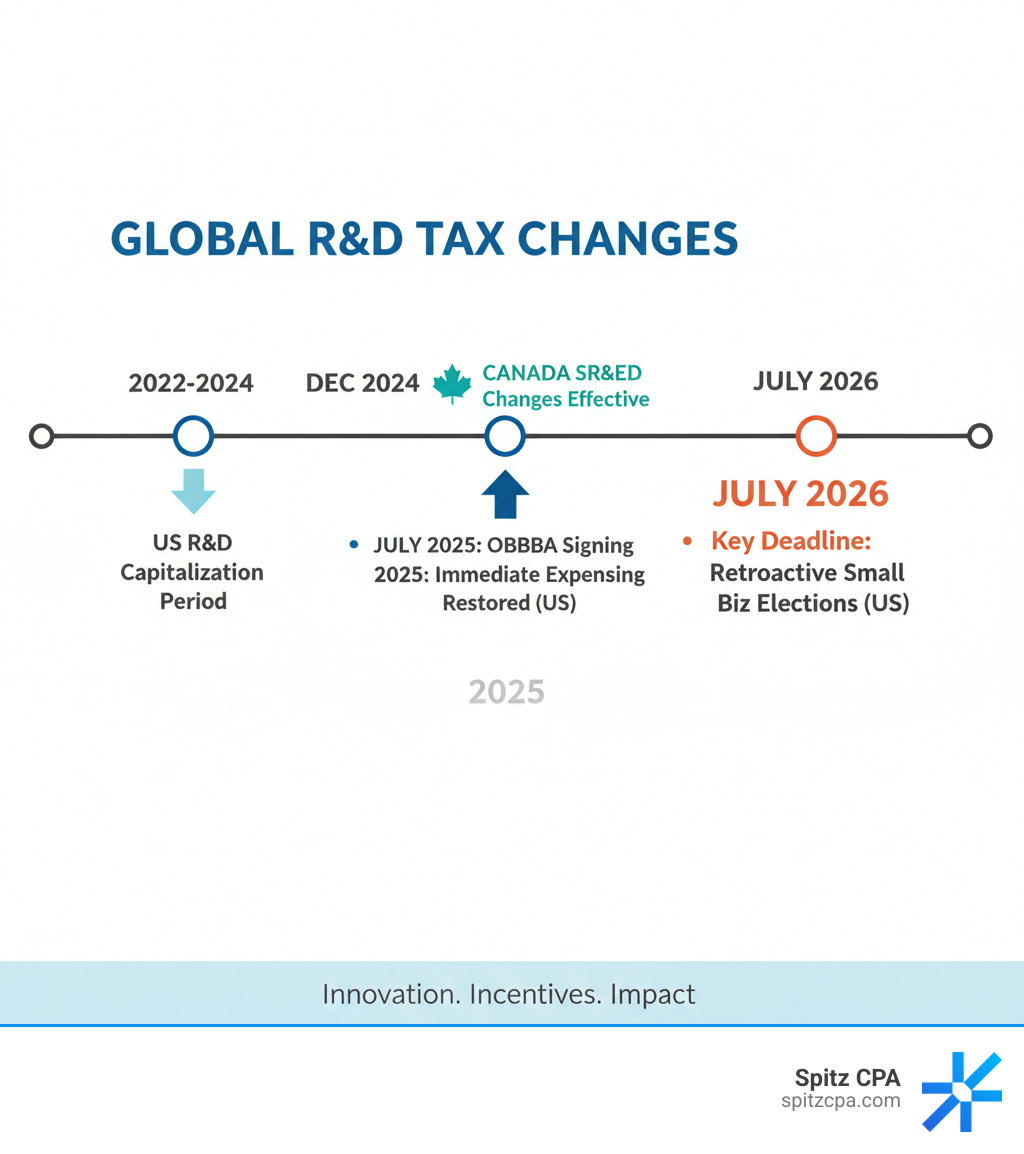
- United States: The One Big Beautiful Bill Act (OBBBA) restores immediate deduction of domestic R&D expenses for 2025, reversing the painful 2022-2024 capitalization rules. It also offers retroactive relief, allowing small businesses to amend past returns for refunds.
- Canada: The SR&ED program is getting a $1.9 billion boost, increasing credit limits, expanding eligibility to public corporations, and making capital expenditures eligible again.
- Global Impact: The EU and UK have also updated regulations, affecting international R&D agreements and cost eligibility.
These changes are a lifeline for companies that saw cash flow crushed by the previous rules. Whether you’re a software developer, manufacturer, or biotech firm, understanding these updates is critical. I’m Michael J. Spitz, and with over 15 years of corporate accounting experience, I help businesses steer complex R&D regulations to maximize their benefits. Acting quickly is key, as some opportunities have strict deadlines.
Learn more about R&D tax incentives:
US R&D Overhaul: The One Big Beautiful Bill Act (OBBBA)
The One Big Beautiful Bill Act (OBBBA), signed into law on July 4, 2025, is a game-changer for American businesses. It fixes the frustrating R&D tax rules from the 2017 Tax Cuts and Jobs Act (TCJA), which forced businesses to capitalize and amortize R&D costs over five years, crushing cash flow for innovators.
The OBBBA adds Section 174A to the Internal Revenue Code, restoring immediate expensing for domestic R&D. However, a key distinction of the new r&d rules is the geographic split: R&D conducted within the United States can be deducted immediately, while foreign R&D expenses still face a 15-year amortization schedule. You can review the full legislative text at the One Big Beautiful Bill Act and see how this fits into your Business Tax Strategies.
Immediate R&D Expensing is Back for 2025
Starting with tax years after December 31, 2024, you can deduct all domestic R&D expenses in the year you incur them. This returns us to the pre-2022 rules that encourage innovation. For added flexibility, you can still elect to amortize these expenses over 60 months or longer. This is treated as an automatic accounting method change, so you don’t need to file the complex Form 3115.

Retroactive Relief: A Second Chance for 2022-2024
The OBBBA also provides a valuable look-back opportunity for the painful 2022-2024 tax years.
- Small Businesses: If your business had average annual gross receipts of $31 million or less during 2022-2024, you can file amended returns to apply the new immediate deduction rules to those years. This can result in significant tax refunds. The deadline for this retroactive election is July 6, 2026.
- All Other Taxpayers: You can elect to deduct any remaining unamortized domestic R&D expenditures from 2022-2024. You can either take the entire balance as a one-year accelerated deduction in 2025 or spread it ratably over 2025 and 2026.
This retroactive relief is a major tax refund opportunity. Our R&D Tax Services team can help you steer these options to maximize your benefit.
Updated Reporting and State Tax Implications
New tax laws bring new reporting. The IRS has updated Form 6765 for 2024-2025, adding Sections E, F, and G for more detailed R&D reporting. Section G requires listing business components for at least 80% of your Qualified Research Expenses (QREs). However, exemptions exist for small businesses using the payroll tax offset and those with QREs under $1.5 million and gross receipts under $50 million. For details, see IRS guidance on Section 174.

Be aware of state tax conformity. Not all states automatically adopt federal changes. States with “static conformity” may still require you to capitalize R&D costs, meaning you’ll need to track expenses differently for federal and state returns. This complexity, along with rules for partnerships, makes professional guidance essential to maximize your total benefit.
Canada’s SR&ED Program: Understanding the New R&D Rules
Canada is making impressive moves to support innovation. The 2024 Fall Economic Statement announced a $1.9 billion investment over six years to improve the Scientific Research and Experimental Development (SR&ED) program. These changes take effect for tax years beginning on or after December 16, 2024.
A major change is the return of eligibility for capital expenditures. Since 2014, businesses could not claim capital costs under SR&ED. Now, for property and leases acquired on or after December 16, 2024, these costs are once again eligible for both the income deduction and investment tax credit. This is a green light for companies that have been holding off on purchasing new R&D equipment or facilities. See an R&D Tax Credits Example to understand the potential impact.

Increased Limits and Expanded Eligibility
The SR&ED program improvements provide a substantial boost to Canadian innovators:
- For Canadian-Controlled Private Corporations (CCPCs): The expenditure limit for the improved 35% federal credit rate is increasing by 50%, from $3 million to $4.5 million. This allows for up to $1.575 million in fully refundable tax credits.
- For Canadian Public Corporations: In a game-changing move, public corporations now qualify for the improved refundable credit on up to $4.5 million of qualifying SR&ED expenditures. Previously, they were limited to a 15% non-refundable credit.
- For Growing Businesses: The taxable capital phase-out thresholds are rising. The range is now $15 million to $75 million (up from $10M-$50M), allowing larger CCPCs to access the improved credit as they scale.
These changes provide sustainable, non-dilutive funding that rewards innovation and encourages reinvestment.
Provincial R&D Credits: A Snapshot
In addition to the federal SR&ED program, many Canadian provinces and territories offer their own R&D tax credits that can be stacked for even greater benefits. These programs vary, but they create powerful incentives to conduct R&D in Canada.
Provinces like Alberta, British Columbia, Manitoba, and Saskatchewan offer a mix of refundable and non-refundable credits. The Atlantic provinces—New Brunswick, Newfoundland and Labrador, and Nova Scotia—are particularly generous with fully refundable 15% credits. Ontario has a multi-layered system with several credits, including the refundable OITC and OBRITC. Quebec operates its own distinct R&D tax credit programs with unique rules, which you can explore at Scientific Research and Experimental Development – Quebec. Even Yukon offers a refundable credit.
Understanding how federal and provincial credits work together is crucial. In some cases, you can recover over 60% of your R&D costs through these combined incentives.
A Global Perspective on New R&D Rules
Innovation is global, and so are R&D tax incentives. Beyond the major changes in the U.S. and Canada, businesses operating internationally must watch for evolving R&D regulations in Europe and specific sectors like U.S. defense contracting.
EU and UK R&D Agreement Changes
The European Commission revised its R&D Block Exemption Regulation (R&D BER) effective July 1, 2023. These rules make it easier for companies to collaborate on innovation while maintaining fair competition. For agreements between competitors, the combined market share generally can’t exceed 25%. The new rules also clarify how agreements with certain restrictive clauses can still partially qualify, signaling a pro-collaboration stance from regulators. You can learn more from The New Block Exemption Regulation.
Meanwhile, the United Kingdom merged its R&D schemes into a single program for accounting periods starting on or after April 1, 2024. The new scheme offers a net cash benefit of 15-16.2%, with a more generous credit of up to 27% for R&D-intensive small and medium-sized enterprises (SMEs). The UK has also tightened rules on claiming for overseas R&D expenditure, generally restricting it unless geographical or legal factors make it necessary to perform the work abroad. This change is designed to keep R&D investment within the UK.
Impact on US Defense Contractors (DFARS)
Businesses working with the U.S. Department of Defense (DoD) must follow the Defense Federal Acquisition Regulation Supplement (DFARS). Under DFARS 231.205-18, costs for Independent Research and Development (IR&D) must align with DoD technology needs to be allowable.
Major contractors (those allocating over $11 million in IR&D/B&P costs to covered contracts) are required to report their IR&D projects to the Defense Technical Information Center (DTIC) to ensure cost allowability. While not mandatory for smaller contractors, voluntary reporting is encouraged to give the DoD visibility into private sector innovation. These rules ensure transparency and strategic alignment between contractor R&D and national security objectives.
Your Action Plan: Maximizing Benefits from the New Rules
With so many changes, you need a clear action plan to benefit from these changes. Taking the right steps now can secure substantial refunds and deductions for your business. Our team of R&D tax experts can guide you through the process.

Identifying Qualifying Expenses and Activities
First, you must identify what qualifies as R&D. The IRS uses a specific 4-part test (detailed in our FAQ section) to determine eligibility. Once you identify qualifying activities, you must track the associated expenses. R&D is not just for labs; it includes developing new products, improving processes, and creating innovative software.
| Category | Eligible R&D Costs (Examples) | Ineligible R&D Costs (Examples) |
|---|---|---|
| Employee Wages | Salaries of engineers, scientists, software developers directly involved in R&D. | Wages for routine quality control, market research, administrative tasks, or foreign R&D for US immediate expensing. |
| Supplies | Materials consumed or used in the R&D process (e.g., prototypes, chemicals). | Materials used for general production, marketing, or general administrative purposes. |
| Contract Research | 65% of amounts paid to third parties for qualified research. | Payments for non-qualified research, R&D for foreign entities (for US immediate expensing), or where the taxpayer does not retain substantial rights. |
| Cloud Computing | Costs for cloud computing services directly used in R&D (e.g., AI modeling, software development tools). | Cloud services for routine business operations, website hosting, or non-R&D data storage. |
Documentation is critical. Maintain project notes, timesheets, and records of technical challenges to build a strong claim.
Strategic Steps for Startups and Small Businesses
These new rules offer powerful opportunities for smaller businesses.
- Payroll Tax Offset: If your business has gross receipts under $5 million and is less than five years old, you can apply up to $500,000 of your R&D credit against payroll taxes. This is a game-changer for pre-profit startups, providing vital non-dilutive funding.
- Retroactive Relief: If your business had average gross receipts under $31 million for 2022-2024, you can amend those returns for potentially significant refunds. The deadline is July 6, 2026.
To claim these benefits, you must demonstrate that you bear the financial risk of the research and retain substantial rights to the results. This is especially important if you receive government funding. Start keeping contemporaneous records now—don’t wait until tax time. Integrating R&D planning into your overall strategy is essential for Tax Planning for Entrepreneurs.
US R&D Overhaul: The One Big Beautiful Bill Act (OBBBA)
The One Big Beautiful Bill Act (OBBBA), signed July 4, 2025, fixes the TCJA’s Section 174 capitalization rules by adding IRC Section 174A: domestic R&D is immediately deductible again, while foreign R&D remains on a 15-year amortization. See the One Big Beautiful Bill Act and how this fits into your Business Tax Strategies.
Immediate R&D Expensing is Back for 2025
For tax years beginning after December 31, 2024, you can expense U.S. R&D costs immediately or elect 60+ month amortization. The choice is an automatic accounting method change (no Form 3115).
Retroactive Relief: A Second Chance for 2022-2024
- Small businesses (average annual gross receipts of $31M or less for 2022–2024) may amend those returns by July 6, 2026, to apply immediate expensing.
- All taxpayers can deduct remaining unamortized domestic 2022–2024 costs in 2025 (or split over 2025–2026).
Get help evaluating options with our R&D Tax Services.
Updated Reporting and State Tax Implications
Form 6765 (2024–2025) adds Sections E, F, and G. Section G lists business components covering at least 80% of QREs (with exemptions for the payroll tax offset and smaller filers). See IRS guidance on Section 174.
State conformity varies and may still require capitalization in some states. BBA partnerships generally need an AAR to implement retroactive changes.
Canada’s SR&ED Program: Understanding the New R&D Rules
Canada’s 2024 Fall Economic Statement proposes $1.9B over six years to improve SR&ED, effective for tax years beginning on or after December 16, 2024. Capital expenditures (for property and leases acquired on/after that date) are again eligible. See our R&D Tax Credits Example.
Increased Limits and Expanded Eligibility
- CCPCs: Expenditure limit for the improved 35% rate rises from $3M to $4.5M (up to $1.575M refundable).
- Public corporations: Now eligible for the improved refundable credit on up to $4.5M of qualifying SR&ED.
- Phase-out thresholds: Increase to taxable capital of $15M–$75M.
Provincial R&D Credits: A Snapshot
Federal SR&ED stacks with provincial credits for stronger combined benefits. Programs across provinces (e.g., Alberta, British Columbia, Ontario, Quebec) can materially increase refunds or offsets. Quebec’s distinct regime has unique rules: Scientific Research and Experimental Development – Quebec.
A Global Perspective on New R&D Rules
If you operate across borders, align your tax strategy with evolving EU, UK, and U.S. defense rules to keep incentives and compliance in sync.
EU and UK R&D Agreement Changes
The EU’s revised R&D Block Exemption Regulation (effective July 1, 2023–June 30, 2035) facilitates collaboration: competitor agreements generally need combined market share at or below 25%, and severable “excluded restrictions” won’t taint an otherwise qualifying agreement. Details: The New Block Exemption Regulation.
The UK merged its R&D schemes for periods starting on/after April 1, 2024, delivering a net benefit around 15–16.2%, with up to 27% for R&D‑intensive SMEs (ERIS). Rules tighten on overseas costs, and the general approach clarifies who claims for contracted‑out R&D.
Impact on US Defense Contractors (DFARS)
Under DFARS 231.205-18, IR&D costs must align with DoD needs. Major contractors (allocating >$11M of IR&D/B&P in the prior year) must report IR&D projects to DTIC for cost allowability.
Your Action Plan: Maximizing Benefits from the New Rules
Act now to secure refunds and optimize cash flow. Our R&D tax experts can help you design a compliant, value‑focused plan.
Identifying Qualifying Expenses and Activities
Use the IRS 4-part test and keep contemporaneous records. Typical categories include wages, supplies, contract research, software, and certain cloud costs. For Canada, eligible capital expenditures resume for property and leases acquired on/after Dec 16, 2024.
| Category | Eligible R&D Costs (Examples) | Ineligible R&D Costs (Examples) |
|---|---|---|
| Employee Wages | Direct R&D time for engineers, scientists, developers. | Routine QA, market research, admin. |
| Supplies | Prototypes, materials consumed in experiments. | Production or marketing materials. |
| Contract Research | 65% of qualified third‑party research where you retain rights. | Work without substantial rights or non‑qualified research. |
| Cloud Computing | Environments/tools used directly in R&D. | General hosting or non‑R&D storage. |
| Software Development | New or improved software (subject to Section 174 rules). | Routine maintenance; internal-use software failing extra tests. |
| Capital Expenditures | Canada: property/leases acquired on/after Dec 16, 2024. | Generally ineligible for U.S. credit (though deductible under 174A). |
Strategic Steps for Startups and Small Businesses
- Retroactive relief: If average receipts were under $31M (2022–2024), consider amending by July 6, 2026.
- Payroll tax offset: If receipts are under $5M and you’re within five tax years of first receipts, use up to $500,000 of credit against payroll taxes.
- Documentation: Show financial risk and substantial rights (especially with grants). Build this into ongoing processes and Tax Planning for Entrepreneurs.
Frequently Asked Questions about the New R&D Tax Rules
Is the R&D tax credit (Section 41) the same as R&D expensing (Section 174)?
No, they are two distinct but complementary tax incentives. Understanding the difference is key to maximizing your benefits.
- Section 174 (R&D Deduction): This governs how you treat R&D costs. The new rules allow you to deduct domestic R&D costs immediately, which reduces your taxable income.
- Section 41 (R&D Tax Credit): This is a dollar-for-dollar credit against your tax liability, calculated as a percentage of your Qualified Research Expenses (QREs). A deduction reduces your taxable income, while a credit directly reduces your tax bill.
You can generally use both. However, you typically must reduce your Section 174 deduction by the amount of the Section 41 credit claimed. A strategic choice must be made, often involving an election for a reduced credit.
Can I retroactively claim these new benefits for past years?
Yes, in some cases, which could lead to significant refunds.
- For U.S. Small Businesses: If your business had average annual gross receipts under $31 million for 2022-2024, you can amend your returns for those years by July 6, 2026, to apply the new immediate deduction rules.
- For All U.S. Taxpayers: You can elect to deduct any remaining unamortized domestic R&D costs from 2022-2024. You can take the full amount in 2025 or spread it over 2025 and 2026.
- For Canadian Businesses: The new SR&ED rules are not retroactive, but you can always review past years for unclaimed expenses.
How do I know if my business activities qualify for the R&D credit?
In the U.S., your activities must pass the IRS’s “4-Part Test” for qualified research. You must meet all four criteria:
- Permitted Purpose: The activity must aim to develop a new or improved product, process, software, or formula.
- Technological in Nature: The research must rely on principles of hard sciences like engineering, computer science, or biological sciences.
- Elimination of Uncertainty: The activity must be intended to eliminate technical uncertainty regarding a component’s capability, method, or design.
- Process of Experimentation: You must use a systematic process of evaluating alternatives, such as modeling, simulation, or systematic trial and error.
Many activities, from software development to manufacturing improvements, can qualify. For a deeper dive, see our R&D Tax Experts Complete Guide.
Conclusion
The new r&d rules in the U.S. and Canada mark a turning point for innovative businesses. After years of challenging tax policies, the landscape has shifted decisively in your favor.
In the U.S., the OBBBA’s restoration of immediate R&D expensing and the retroactive relief options for 2022-2024 can inject significant cash back into your business. For small businesses, the opportunity to amend past returns for refunds is too valuable to ignore. In Canada, the improved SR&ED program provides a more robust funding environment than ever before, especially when combined with provincial credits.
However, these opportunities come with complexity. Navigating state tax conformity, new reporting requirements, and documentation rules requires careful planning. Missing a deadline or an election could mean leaving significant money on the table.
This is where strategic guidance is essential. At Spitz CPA, Michael J. Spitz and our team use over 15 years of experience to help businesses steer these complex rules and turn them into a competitive advantage. We understand the technical details and the practical steps needed to maximize your benefits while ensuring compliance.
The time to act is now. The deadlines are real, and the potential benefits are substantial.


