


The Real Cost of Managing Payroll In-House (And What to Do Instead)
Outsourced payroll services give business owners a way to hand off one of the most time-consuming, error-prone, and compliance-heavy tasks in running a company — so they can focus on actually growing it. In short: a third-party provider takes over your payroll processing, tax filing, and regulatory compliance, while you stay in control of the big decisions and final approvals.
If you want the quick version: payroll outsourcing typically costs between $30 and $100 per employee per month, reduces your risk of IRS penalties (which can range from 2% to 15% of unpaid taxes), and frees up significant administrative time — nearly two-thirds of business leaders currently spend 11 or more hours per week on HR administration alone. For most small and mid-sized businesses, the math strongly favors outsourcing over doing it in-house.
But the decision isn’t purely financial. It’s about what happens when payroll goes wrong. According to a 2022 EY study, fixing a single payroll error costs an average of $291 — and a 2017 Workforce Institute survey found that nearly half of employees start looking for a new job after just two payroll mistakes. The stakes are real, the complexity is growing, and the pressure on internal teams is mounting. The IRS assessed $26.8 billion in civil penalties on employment tax returns in fiscal year 2024 alone — a number that should give any business owner pause.
This guide walks through exactly how outsourced payroll works, what it costs, what to look for in a provider, and how to decide if it’s the right move for your business.
My name is Michael J. Spitz, a CPA with over 15 years of corporate accounting experience managing payroll, compliance, and financial operations across industries ranging from software technology to health services. At Spitz CPA, I work directly with business owners across the greater Phoenix area and nationwide to implement outsourced payroll services that reduce risk, improve accuracy, and give leadership teams back their time. To help you navigate these options, we offer comprehensive HR & Payroll services, guide you in selecting the right Payroll processing software, and help you determine if partnering with a PEO company for payroll is the best fit for your organization.
What is Payroll Outsourcing and How Does It Work?

At its core, payroll outsourcing is the strategic delegation of your entire payroll administration to an external specialist. Instead of tasking an internal manager with running calculations, tracking hours, and managing tax forms, you partner with a dedicated professional who handles the operational heavy lifting. This setup goes far beyond simple data entry, encompassing the active management of wage calculations, tax withholdings, direct deposit execution, employee benefits deductions, and year-end reporting. By moving these technical tasks outside your organization, you convert a highly complex administrative process into a streamlined utility.
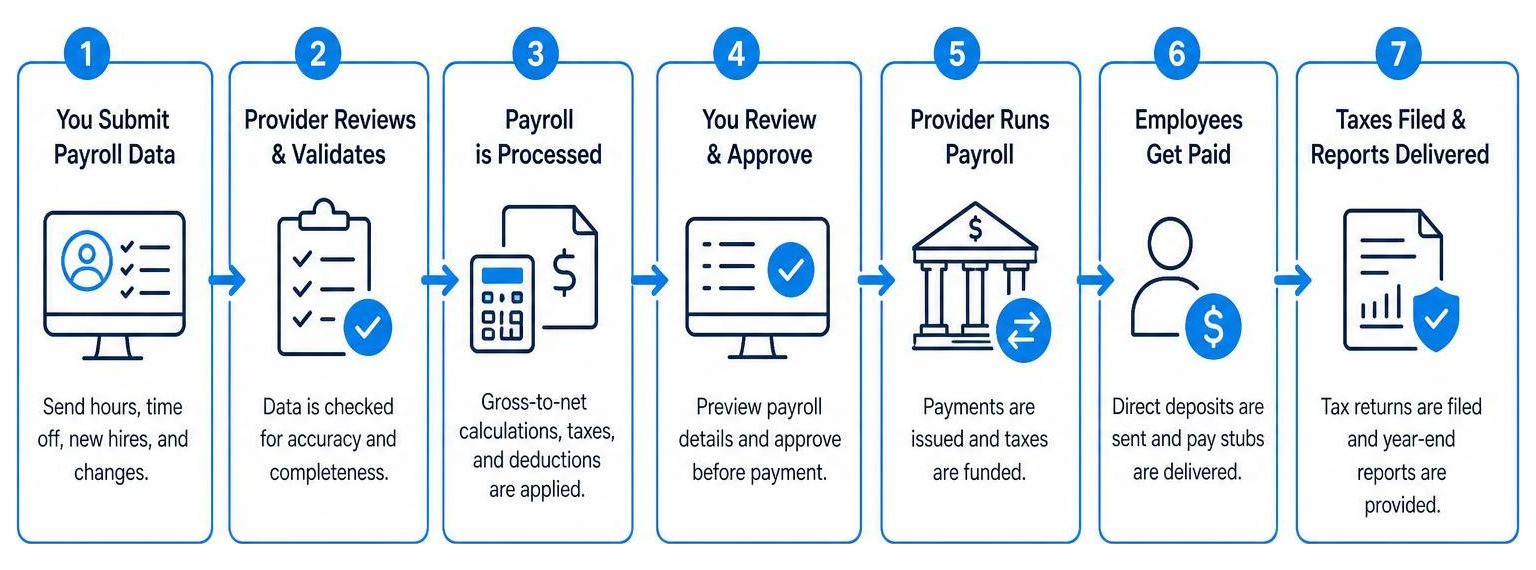
To understand how this functions on a practical level, it is helpful to look at the entire lifecycle of a pay run. The process begins when the employer submits standard workforce data, such as hours worked, approved time-off requests, and any changes in compensation. The outsourcing provider then utilizes advanced systems to run gross-to-net calculations, factoring in specific tax brackets, voluntary benefits deductions, and involuntary wage attachments. Once the calculations are complete, the provider generates a detailed payroll preview for the employer to review and approve, ensuring that absolute control remains in the hands of the business owner before any funds are moved.
Once final approval is granted, the provider executes the financial and administrative tasks required to complete the cycle. This includes initiating direct deposits, generating electronic pay stubs, and setting aside the precise tax amounts owed to municipal, state, and federal agencies. The provider also handles the ongoing generation and filing of quarterly tax returns and year-end documentation, keeping the business aligned with the latest regulatory standards. For a deeper look into how these automated workflows fit into your broader business operations, you can explore The Ultimate Guide to Payroll Processing Solutions.
To visualize how these steps flow together seamlessly from data submission to tax filing, the following process map illustrates the standard cycle of an outsourced payroll relationship.
The Mechanics of Outsourced Payroll Services
The technical execution of payroll requires absolute precision, particularly when managing diverse payment methods and complex deductions. Modern outsourced systems rely heavily on automated clearing house networks to process direct deposits, ensuring that employees receive their funds reliably on designated pay dates. Setting up these pathways requires careful coordination of routing numbers, banking accounts, and authorization forms. To understand the step-by-step setup of this critical payment method, you can reference The Ultimate Guide to Setting Up Payroll Direct Deposit.
Beyond standard direct deposits, the mechanics of payroll involve intricate gross-to-net calculations that must account for varying regional regulations. Providers must calculate federal insurance contributions, federal unemployment taxes, and state-specific withholdings like the Arizona Department of Revenue requirements. When employees have court-ordered wage garnishments, child support allocations, or student loan repayments, the provider must mathematically isolate these funds and route them to the appropriate state agencies within strict legal windows, eliminating the risk of non-compliance penalties for the employer.
Split Responsibilities: Employer vs. Provider
A common misconception is that outsourcing payroll completely absolves an employer of all operational involvement. In reality, the relationship is a partnership defined by a clear split of responsibilities. The employer remains the primary source of truth, responsible for the initial accuracy of employee hours, classification statuses, and compensation adjustments. The outsourcing provider cannot guess if an employee worked overtime or changed their voluntary retirement contribution, meaning the business must maintain clean internal records to feed into the system.
The provider’s role is to act as the processing and compliance engine, taking the validated data and applying complex regulatory formulas to it. While the provider manages the heavy lifting of tax calculations, filings, and direct deposit distribution, the employer must perform a final validation of the payroll preview. This final sign-off ensures that any operational anomalies are caught before funds leave the business bank account. To gain a clearer understanding of how these roles divide between your internal team and your external partners, read The Complete Guide to the HR and Payroll Administrator Role.
In-House Payroll vs. Outsourcing
When comparing in-house payroll management to outsourcing, the differences in control, compliance risk, software costs, and staff overhead become stark. In-house management gives an organization absolute, immediate control over every step of the process, but it introduces massive compliance risks, as internal staff must constantly monitor shifting local, state, and federal tax laws. This model also requires significant software licensing fees for specialized Payroll Processing Software and creates a single point of failure if your primary payroll administrator suddenly leaves the company.
Outsourcing, by contrast, shifts the burden of compliance monitoring to dedicated experts, drastically reducing the risk of costly errors and IRS audits. While it requires an upfront service fee, it eliminates the need for expensive internal software licenses and the overhead of maintaining full-time payroll staff. This model provides built-in business continuity, ensuring that your payroll runs smoothly every cycle regardless of internal staffing changes. For a comprehensive breakdown of how these two approaches compare across different business stages, you can consult the CPA Payroll Services Complete Guide.
The Key Benefits of Outsourcing Payroll

Transitioning to an outsourced model delivers immediate advantages that ripple across your entire organization, from the executive suite to the front lines. By leveraging specialized expertise and advanced technology, businesses can elevate their operational security, improve employee satisfaction, and protect themselves against compliance infractions. The peace of mind that comes from knowing your tax filings are handled accurately allows leadership to focus entirely on core business growth. To explore how these advantages can be tailored to your specific organizational needs, you can review our dedicated resource on HR Payroll Services.
One of the most noticeable improvements occurs in employee engagement, driven by the introduction of modern self-service portals. Instead of inundating your administrative team with repetitive requests for past pay stubs, W-2 forms, or tax withholding updates, employees can securely log into an online platform to retrieve this information independently. This instant access improves transparency, builds trust, and significantly reduces the daily administrative friction that often bogs down growing companies.
Time Savings and Administrative Efficiency
For many small and mid-sized businesses, the sheer volume of hours spent on manual payroll calculations and data entry is a major barrier to growth. When internal teams are forced to spend a quarter of their workweek managing spreadsheets, tracking PTO accruals, and manually keying in hours, strategic initiatives are inevitably pushed to the side. Outsourcing these repetitive tasks recovers this lost time, allowing your HR and finance professionals to redirect their energy toward high-impact projects like talent acquisition, employee development, and operational scaling. To see how your business can break free from these manual bottlenecks, read Stop the Spreadsheet Madness with Better Payroll Processing for Small Businesses.
Compliance Support and Error Reduction
Navigating the labyrinth of modern tax regulations is an exhausting task, particularly for businesses operating across municipal boundaries or employing remote workers in different jurisdictions. With tax authorities actively sharing data and increasing audit activities, the margin for error has never been smaller. Outsourcing providers employ dedicated compliance teams who proactively monitor legislative changes, ensuring that your tax rates and filing procedures are updated in real time. This continuous oversight protects your business from costly filing delays, incorrect deductions, and the severe civil penalties that the IRS and state authorities assess each year. If you have experienced payroll discrepancies in the past, you can learn how to resolve them quickly by reading Fix Payroll Errors Fast and Stay Compliant.
Integrating Benefits with Outsourced Payroll Services
A significant operational advantage of modern payroll outsourcing is the ability to seamlessly integrate your payroll processing with benefits administration. When retirement plan contributions, health insurance premiums, and HSA allocations are managed in separate, siloed systems, the risk of data mismatch errors rises dramatically. Integrated platforms ensure that deductions are calculated automatically based on real-time benefit selections, eliminating the need for manual double-entry. This synchronized approach ensures that elective employee deductions are accurately withheld and routed to insurance carriers and retirement accounts on time, every time. To understand how to build a unified system for your team, explore the options outlined by leading Payroll and Benefits Companies.
The Cost of Outsourced Payroll Services
Understanding the financial investment required for payroll outsourcing is essential for performing an accurate cost-benefit analysis. While some business owners hesitate at the prospect of an ongoing monthly service fee, a detailed examination reveals that outsourcing is highly cost-effective when compared to the combined costs of software licensing, internal labor, and potential compliance penalties. To help you navigate these financial considerations and select the optimal model for your organization, we have developed a guide on How to Choose the Right CPA Payroll Service for Your Business.
Typical Pricing Structures and Models
The cost of outsourcing payroll is generally structured around a few standard pricing models, allowing businesses to select a framework that aligns with their operational scale. The most common structure is the Per Employee Per Month model, where businesses pay a flat base fee combined with a variable rate of $30 to $100 per worker. Other providers utilize a per-payroll-run model, which is highly beneficial for companies with simple, bi-weekly schedules but can become costly for those with frequent off-cycle pay runs. Some firms offer flat monthly fees for unlimited runs within a specific tier, while smaller startups often opt for pay-as-you-go structures to keep costs tightly aligned with their immediate hiring needs.
Hidden Costs vs. Long-Term Savings
When evaluating payroll proposals, it is critical to look beyond the basic processing fees to identify potential hidden costs. Some lower-tier providers advertise incredibly low base rates but charge separate, substantial fees for initial software setup, year-end W-2 and 1099 generation, multi-state tax account setups, and even standard customer support. Reputable providers, particularly specialized CPA firms, maintain absolute pricing transparency, bundling these essential services into a predictable, comprehensive rate.
The long-term savings of a transparent, professional payroll partnership far outweigh the upfront processing fees. When you factor in the elimination of internal administrative labor, the reduction of expensive software subscription costs, and the avoidance of the average $291 error-correction fee, the return on investment becomes clear. Most importantly, having a dedicated professional manage your filings serves as a financial shield, protecting your business from IRS civil penalties that can easily reach thousands of dollars for a single late deposit.
Frequently Asked Questions about Payroll Outsourcing
What is the difference between a full-service payroll provider and a PEO?
The primary difference between a full-service payroll provider and a Professional Employer Organization lies in the legal relationship established with your workforce. A full-service payroll provider acts strictly as an administrative processor, managing your calculations, tax filings, and direct deposits while your business remains the sole employer of record and retains all legal employment liabilities.
A PEO, by contrast, operates under a co-employment model where they share certain employer responsibilities and act as the employer of record for tax and benefits purposes. This co-employment structure allows PEOs to bundle health insurance, retirement plans, and workers’ compensation under their larger corporate umbrella, which can provide small businesses with access to enterprise-level benefits. However, this model also requires the business to cede a degree of administrative control and pay higher fees, making it essential to carefully evaluate your organizational goals before partnering with a PEO Company for Payroll.
Who is legally responsible for payroll tax compliance and errors?
Under standard third-party payroll arrangements, the employer remains ultimately responsible for the timely payment of withheld income taxes, Social Security, Medicare, and Federal Unemployment taxes. Even if you contract with a third-party payroll service provider or a reporting agent, the IRS and state authorities hold your business legally liable if the provider fails to make the required deposits. The primary exception to this rule occurs when a business partners with a Certified Professional Employer Organization that has met rigorous IRS financial and reporting standards, which can shift certain federal employment tax liabilities directly to the CPEO.
To protect your business from administrative defaults or fraudulent activity, it is critical to regularly monitor your federal and state tax accounts to verify that deposits are being made on your behalf. If you discover that a payroll service provider has failed to deposit your withheld taxes, you must take immediate action by filing an expedited complaint using IRS Form 14157 to initiate an official investigation. For businesses operating in Arizona, staying aligned with the Payroll Service Companies | Arizona Department of Revenue guidelines is essential to ensure that your state-level withholdings and unemployment taxes are filed correctly and securely.
How do businesses transition to an outsourced payroll model?
Transitioning from an in-house payroll setup or a legacy software platform to an outsourced model is a structured process that requires careful planning to prevent operational disruptions. The first step involves establishing a realistic transition timeline, with the ideal migration point occurring at the start of a new calendar or fiscal quarter, as this simplifies the reconciliation of year-to-date tax balances. If a mid-year transition is necessary, your new provider must perform a meticulous historical audit to ensure that all year-to-date wages, tax withholdings, and employee deductions are accurately transferred and reflected on subsequent pay statements.
The onboarding process continues with comprehensive data migration, where the business provides detailed employee records, historical tax filings, active wage garnishments, and direct deposit authorizations to the new partner. The provider then configures the system, establishes secure connections with tax authorities, and runs parallel payroll tests to verify that the automated calculations align perfectly with past runs. Once this testing phase is complete and all data is validated, the business can confidently execute its first active pay run under the new outsourced model.
Conclusion
Managing payroll should not be a weekly source of stress that pulls you away from the strategic work of building your business. By transitioning to outsourced payroll services, you protect your organization from costly compliance errors, reclaim valuable administrative hours, and provide your employees with a modern, reliable payment experience. The key to unlocking these benefits lies in partnering with a professional who combines advanced processing technology with personalized, expert oversight.
At Spitz CPA, we believe that payroll is a critical component of your broader financial health, directly impacting your cash flow, tax planning, and business growth. Led by Michael J. Spitz, our team provides tailored, high-touch payroll solutions designed to meet the unique needs of businesses in Gilbert, Arizona, and across the region. We cut through the administrative noise to deliver the financial clarity and cash flow optimization you need to scale your operations with confidence.
Do not let spreadsheet errors and shifting tax regulations hold your business back. Contact us today to establish a secure, efficient, and compliant payroll foundation that allows your team to focus on what matters most. Get Started with Spitz CPA HR and Payroll Services and take the first step toward long-term peace of mind and operational success.


