


The 20% Tax Deduction Most Small Business Owners Are Leaving on the Table
How to maximize QBI deduction is one of the most important tax questions a small business owner can ask right now — and the answer involves a handful of strategic moves that most people never make.
Here’s a quick summary of the top ways to maximize your QBI deduction:
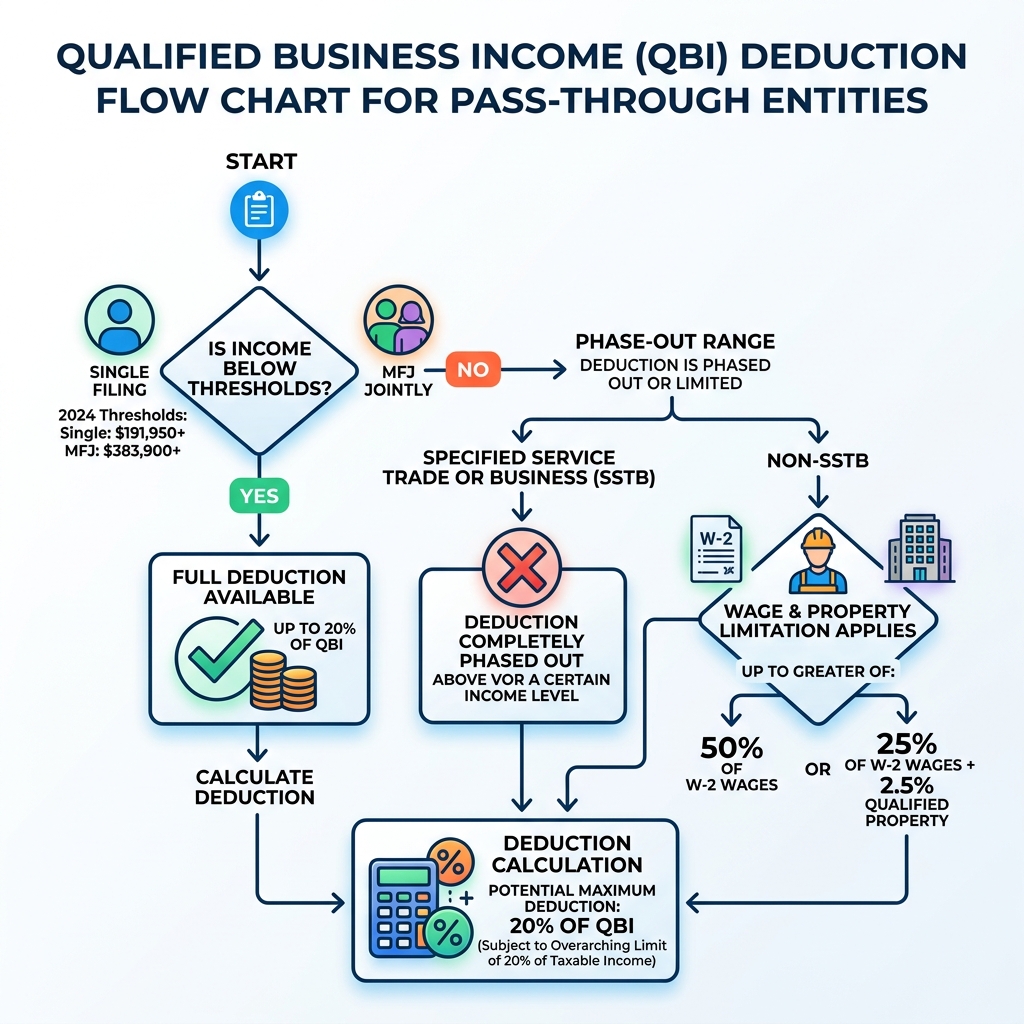
- Stay below income thresholds — For 2024, the deduction phases out starting at $191,950 (single) or $383,900 (married filing jointly)
- Optimize W-2 wages — Above the thresholds, your deduction is limited to the greater of 50% of W-2 wages or 25% of W-2 wages plus 2.5% of qualified property
- Use retirement contributions — SEP-IRA or Solo 401(k) contributions reduce taxable income and can keep you below phase-out thresholds
- Apply the 2/7 Rule for S corps — Pay yourself wages equal to 2/7 of pre-wage business income to unlock the full wage-based limitation
- Aggregate multiple businesses — Combining eligible pass-through entities can pool W-2 wages and qualified property across entities
- Time depreciation carefully — Large Section 179 or bonus depreciation deductions reduce QBI, so weigh the trade-offs before claiming them
- Consider filing separately — For some married couples, filing separately can unlock the deduction when joint income triggers limitations
The QBI deduction — formally called the Section 199A deduction — lets eligible pass-through business owners deduct up to 20% of their qualified business income. That’s a significant tax break. But the rules around it are layered, and the wrong moves can shrink or eliminate your deduction entirely.
I’m Michael J. Spitz, a CPA with over 15 years of corporate accounting experience working across industries from software and health services to property management — and helping business owners navigate these complex tax rules is a core part of the tax planning work I do. Read on for a complete breakdown of every strategy worth knowing.
How to maximize qbi deduction basics:
Understanding the Basics of Section 199A Eligibility
To start our journey into the specifics of Section 199A, we first need to identify who is invited to the party. The Section 199A deduction was designed specifically for “pass-through” entities. Unlike C corporations, which are taxed at the corporate level, pass-through entities “pass” their income through to the owners’ individual tax returns.
Eligible structures include:
- Sole proprietorships (including independent contractors and freelancers)
- Partnerships
- S corporations
- Limited Liability Companies (LLCs) treated as any of the above
- Certain trusts and estates
According to the Qualified business income deduction | Internal Revenue Service, the deduction is generally equal to 20% of your qualified business income plus 20% of qualified REIT dividends and publicly traded partnership (PTP) income. It’s important to note that this is a “below-the-line” deduction, meaning it reduces your taxable income but does not reduce your adjusted gross income (AGI) or your self-employment tax. For more foundational insights, check out our more info about tax planning resources.
Identifying Specified Service Trades or Businesses (SSTB)
This is where the IRS gets a bit picky. Not all businesses are treated equally under Section 199A. The IRS separates businesses into two categories: General Businesses and Specified Service Trades or Businesses (SSTBs).
An SSTB is any trade or business involving the performance of services in the fields of:
- Health (doctors, dentists, nurses)
- Law (attorneys, paralegals)
- Accounting (CPAs, bookkeepers)
- Actuarial science
- Performing arts
- Consulting
- Athletics
- Financial services and brokerage services
- Any business where the principal asset is the reputation or skill of one or more of its employees or owners (think celebrity endorsements or licensing your likeness)
If you are an SSTB owner, your ability to claim the deduction is subject to strict phase-out rules once your income exceeds certain thresholds. If your taxable income is too high, your QBI deduction for an SSTB drops to zero.
What Counts as Qualified Business Income (QBI)?
QBI is the net amount of qualified items of income, gain, deduction, and loss from any qualified trade or business. Essentially, it is your business’s net profit. However, it only includes items from a domestic (U.S.-based) trade or business.
It is just as important to know what isn’t QBI. Excluded items include:
- Short-term and long-term capital gains or losses
- Dividends and interest income (unless allocable to the trade or business)
- Wages paid to an S corp owner
- Guaranteed payments paid to a partner for services rendered
- Income earned outside the United States

Strategic Income Management: How to Maximize QBI Deduction Thresholds
The most straightforward way to protect your 20% write-off is to manage your total taxable income. The IRS sets “thresholds” every year. If your taxable income (before the QBI deduction) is below the threshold, you generally get the full 20% deduction regardless of whether you are an SSTB or how much you pay in wages.
Once you cross the threshold, the deduction begins to “phase out” or become limited by W-2 wages and property. For 2024 and 2025, these numbers are moving targets due to inflation adjustments.
| Filing Status | 2024 Phase-in Threshold | 2024 Full Phase-out | 2025 Phase-in Threshold | 2025 Full Phase-out |
|---|---|---|---|---|
| Single / Head of Household | $191,950 | $241,950 | $197,300 | $272,300 |
| Married Filing Jointly | $383,900 | $483,900 | $394,600 | $544,600 |
If you are an SSTB owner and your income exceeds the “Full Phase-out” amount, your deduction is gone. If you are a non-SSTB owner, your deduction isn’t necessarily gone, but it becomes limited by the “Wages and Property” tests we will discuss later.
Using Retirement Contributions to Maximize QBI Deduction
If you find yourself hovering just above the threshold, you don’t have to just sit there and watch your deduction disappear. One of our favorite “secrets” for optimizing your tax position is using retirement contributions to “buy down” your taxable income.
By contributing to a SEP-IRA, a Solo 401(k), or a defined benefit plan, you reduce your taxable income. This can pull you back below the threshold, potentially unlocking a QBI deduction worth thousands of dollars.
For example, in one case study, a business owner made a SEP plan contribution of $27,950. This move reduced their taxable income just enough to fall below the SSTB phase-out threshold. The result? They secured a QBI deduction of $5,366 and achieved total tax savings of over $11,000. That’s a massive return on investment for simply moving money from your business bank account to your retirement account. You can explore more info about business tax strategies to see how this fits into a broader plan.
The Pros and Cons of Married Filing Separately
Usually, we recommend married couples file jointly to take advantage of lower tax brackets and higher credits. However, when it comes to the QBI deduction, filing separately can occasionally be a winning move.
Imagine a scenario where one spouse has a high-earning W-2 job and the other spouse has a small consulting business (an SSTB) with modest profit. If they file jointly, their combined income might blow past the QBI thresholds, eliminating the deduction for the consulting business. If they file separately, the consulting spouse might fall well below the $191,950 threshold, capturing the full 20% deduction.
The “con” here is that you might lose out on other benefits, like the Child and Dependent Care Credit or the ability to take certain itemized deductions. We always run the numbers both ways to ensure the QBI savings outweigh the lost credits. You can see more on this in our guide to stop overpaying with these itemized deduction examples.
Advanced Tactics for High-Earners: Wages and Property Limitations
If your income is above the thresholds and you are not an SSTB, your deduction is limited to the greater of:
- 50% of the W-2 wages paid by the business, or
- 25% of the W-2 wages plus 2.5% of the unadjusted basis immediately after acquisition (UBIA) of qualified property.
Qualified property generally includes tangible, depreciable property (like machinery, equipment, or real estate) used in the business. This “Property Test” is a lifesaver for capital-intensive businesses like manufacturing or real estate rentals that might not have a huge payroll but own significant assets.
Optimizing S Corp Salaries with the 2/7 Rule
For S corporation owners, your own salary counts as W-2 wages. This creates a fascinating balancing act. On one hand, you want a low salary to avoid payroll taxes (FICA). On the other hand, you need a high enough salary to avoid the QBI wage limitation.
The “2/7 Rule” is a mathematical shortcut to find the sweet spot. If you pay yourself wages equal to 2/7 (roughly 28.5%) of your business income before wages, your 50% wage limit will exactly equal 20% of your remaining QBI.
Let’s look at the numbers. If your business earns $1,000,000:
- Using a low $50,000 salary: Your QBI is $950,000. 20% of that is $190,000. However, your 50% wage limit is only $25,000. Your deduction is capped at $25,000.
- Using the 2/7 Rule ($285,714 salary): Your QBI is $714,286. 20% of that is $142,857. Your 50% wage limit is also $142,857. You get the full deduction!
Even though you pay more in payroll taxes on the higher salary, the QBI tax savings often far outweigh the cost. In this $1M example, the additional QBI deduction of $117,857 could equate to tax savings of $43,607 at the 37% tax bracket. This is a cornerstone of best S-Corp tax planning strategies.
Aggregating Businesses to Maximize QBI Deduction
If you own multiple businesses, you might have one entity with high profits but no employees (low wage limit) and another entity with lots of employees but low profits (high wage limit). Separately, neither gets a great QBI deduction.
By electing to aggregate these businesses, you can treat them as a single unit for QBI purposes. This allows you to “share” the wages and property from one business to unlock the deduction for the other.
To aggregate, you must meet certain IRS tests:
- The same person or group must own at least 50% of each business.
- The businesses must share a commonality (e.g., they provide products/services that are typically offered together, or they share centralized business elements like HR or accounting).
- None of the businesses can be an SSTB.
Balancing Depreciation and the 20% Write-Off
Every business owner loves a big fat depreciation deduction. Taking Section 179 or bonus depreciation allows you to write off the full cost of equipment in year one. While this lowers your overall taxable income (good), it also lowers your QBI (potentially bad).
If you are already below the income thresholds, a big depreciation deduction might be overkill. It reduces your QBI, which in turn reduces your 20% QBI deduction. In some cases, it’s actually better to take standard depreciation (MACRS) over several years to preserve a higher QBI deduction today, especially since the QBI deduction is scheduled to expire soon. We help our clients maximize tax deductions by threading this needle carefully.
Managing Real Estate and Rental Activities
Can landlords join the QBI party? Yes, but there are hoops to jump through. To qualify, your rental activity must rise to the level of a “trade or business.”
The IRS provided a “Safe Harbor” (Notice 2019-07) to help real estate investors. To qualify for the safe harbor, you must:
- Maintain separate books and records for each rental activity.
- Perform at least 250 hours of “rental services” per year (this includes advertising, negotiating leases, verifying tenant info, and daily repairs).
- Maintain contemporaneous records (logs, time reports) proving these hours.
Triple-net leases (where the tenant pays taxes, insurance, and maintenance) and property used as a residence by the owner generally do not qualify. However, even if you don’t meet the safe harbor, you may still qualify as a trade or business under broader tax law definitions. See our small business tax deductions guide for more on real estate.
Frequently Asked Questions about QBI Optimization
Is the QBI deduction permanent or will it expire?
This is the billion-dollar question. As it stands, the QBI deduction was created by the Tax Cuts and Jobs Act (TCJA) and is scheduled to sunset after December 31, 2025.
However, there has been significant legislative movement. The “One Big Beautiful Bill” (OBBB), reportedly signed in July 2025, aims to make the QBI deduction permanent. It also introduces a new $400 minimum deduction for qualifying businesses starting in 2026, even if they have low income. While this is great news, we still recommend maximizing the deduction in 2024 and 2025 under the current rules just in case of future political shifts.
How do W-2 wages affect my deduction if I am an SSTB?
If you are an SSTB owner and you are below the income threshold ($191,950 single / $383,900 joint for 2024), W-2 wages don’t matter — you get the full 20%.
If you are in the “Phase-out” range, your W-2 wages and property will be used to calculate a limited deduction. However, once you cross the “Full Phase-out” threshold ($241,950 single / $483,900 joint), your deduction is completely disallowed, regardless of how many employees you have or how much you pay them. This is why income management (like retirement contributions) is so critical for doctors, lawyers, and accountants.
Can I claim QBI if I take the standard deduction?
Yes! This is one of the best features of Section 199A. You do not need to itemize your deductions to claim the QBI deduction. It is available to you whether you take the standard deduction or itemize. You will typically use Form 8995 or 8995-A to report it on your tax return. For more on managing your business finances, see mastering your money with smart tax planning.
Conclusion
Maximizing the QBI deduction isn’t just about checking a box on your tax return; it’s about proactive, year-round strategy. Whether it’s applying the 2/7 Rule to your S corp salary, aggregating your various LLCs, or timing your equipment purchases to protect your profit margins, the moves you make today will dictate how much of your hard-earned money stays in your pocket.
At Spitz CPA, we specialize in helping small business owners in Gilbert, AZ, and across Arizona find financial clarity. We don’t just look at where your business has been; we look at where it’s going and how to get you there with the least amount of tax friction possible. Michael J. Spitz and our team are ready to help you clean up your accounting and implement these high-level tax strategies to help your business grow.
Don’t leave your 20% deduction to chance. Get expert help with tax services and let’s make sure you’re capturing every dollar you’re entitled to before the rules change again.


