


Understanding Qualified Research Activities: Your Gateway to Tax Savings
Qualified research activities are specific types of business activities that meet IRS criteria and make your company eligible for the federal Research and Development (R&D) tax credit—a dollar-for-dollar reduction in your tax bill. If your business develops new or improved products, processes, software, or techniques, you could be missing out on tax savings of up to 20% of qualifying costs.
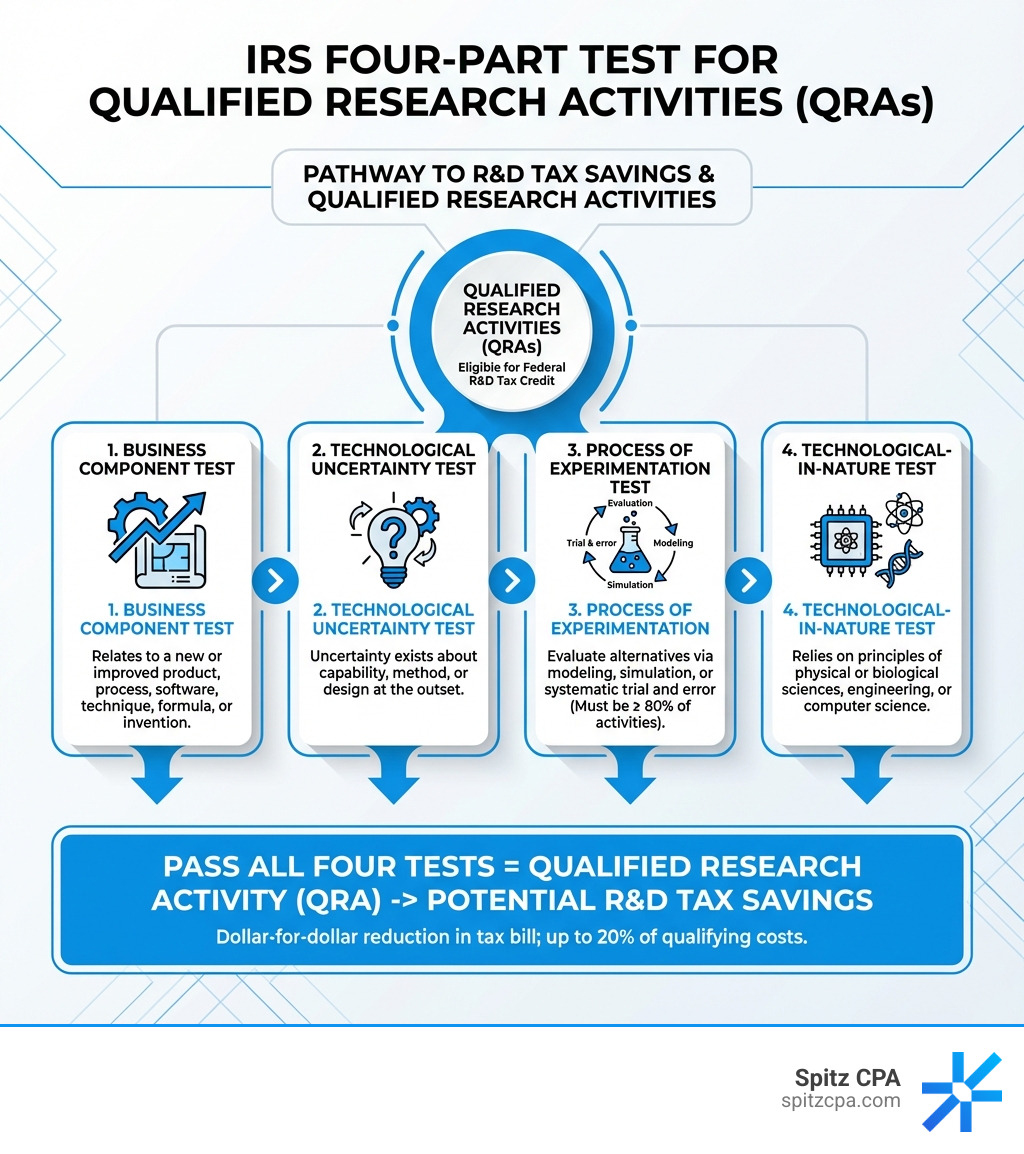
To qualify for the R&D tax credit, your activities must pass the IRS Four-Part Test:
- Business Component Test – Research relates to a new or improved product, process, software, technique, formula, or invention
- Technological Uncertainty Test – You face uncertainty about capability, method, or design at the outset
- Process of Experimentation Test – You evaluate alternatives through modeling, simulation, or systematic trial and error (must be at least 80% of activities)
- Technological-in-Nature Test – Research relies on principles of physical or biological sciences, engineering, or computer science
It’s tax time, and if your company is engaged in any form of research and development, you should be asking: Are we taking full advantage of the R&D Tax Credit? One common misconception is that participants must wear lab coats and use test tubes to qualify. In reality, the definition of R&D for tax credit purposes is fairly broad, covering everything from software development to manufacturing process improvements.
The credit was implemented by the IRS in 1981 to incentivize innovation. Federal and state R&D Tax Credits can amount to as much as 20% of qualifying costs. For qualifying start-ups with no federal tax liability, the credit can offset payroll taxes up to $250,000 for a maximum of five years.
I’m Michael J. Spitz, and with over 15 years of corporate accounting experience, I’ve helped businesses across industries—from software technology and AdTech to telecom and health services—steer complex tax provisions, including identifying and documenting Qualified research activities that maximize their R&D tax credits. My focus on attention to detail and compliance ensures your business captures every eligible dollar while staying audit-ready.
Basic vocabulary related to qualified research:
Defining Qualified Research Activities: The IRS Four-Part Test
To open up the R&D tax credit, your activities must first meet the strict definition of Qualified Research Activities (QRAs) as outlined by the IRS. This isn’t about wearing lab coats (though that’s fine too!) but about a systematic approach to innovation. The IRS provides a “Four-Part Test” that all activities must pass. Think of it as a checklist for innovation that the tax authorities recognize. Understanding this test is the crucial first step to claiming your rightful tax savings. More info about R&D tax credit rules

The Business Component Test
The first hurdle is the Business Component Test. This test requires that your research activities are aimed at developing a new or improved “business component.” What’s a business component? It’s a broad term that can refer to a product, process, software, technique, formula, or invention that you intend to sell, lease, license, or use in your trade or business.
The key here is the “purpose requirement” – your research must seek to create a new or improved function, performance, reliability, or quality for that business component. For example, simply changing the color of a widget for style reasons wouldn’t qualify, but redesigning a painting process to accommodate a new paint color, where technical uncertainty exists, could. The focus is on technical advancement, not just aesthetic or marketing changes.
The Technological Uncertainty Test
Our journey through the Four-Part Test continues with the Technological Uncertainty Test. This test asks: were you uncertain about the capability or method for developing or improving your business component, or about its appropriate design, at the outset of your research activities? If you knew exactly how to achieve your goal from the start, there was no uncertainty, and thus, no qualified research.
The uncertainty must be “technological” in nature. This means it’s about a lack of knowledge regarding scientific or engineering principles, not just market research or business risk. For instance, if you’re trying to integrate a new material into a product and aren’t sure if it will perform as expected, that’s technological uncertainty. If you’re unsure if customers will buy it, that’s market uncertainty, which doesn’t qualify. The activities must be directed at “finding information” to eliminate this uncertainty. Audit Techniques Guide for R&D Credits
The Process of Experimentation Test
Once you’ve identified a technological uncertainty, the Process of Experimentation Test comes into play. This criterion dictates that your research must involve a systematic process of evaluating alternatives to resolve that uncertainty. This isn’t just random tinkering; it’s a deliberate and structured approach.
This process can include various methods such as modeling, simulation, systematic trial and error, or hypothesis testing. The goal is to prove or disprove hypotheses related to your design or methodology. For example, if you’re developing a new shredding blade for food products and are uncertain about the best material and design, systematic trial and error to test different prototypes would satisfy this test.
A critical aspect of this test is the “substantially all” rule: 80 percent or more of your research activities, measured on a cost or other consistently applied reasonable basis, must constitute elements of a process of experimentation for a qualified purpose. This means a significant portion of your time and resources must be dedicated to this systematic evaluation.
The Technological-in-Nature Test
Finally, the Technological-in-Nature Test ensures that your research relies on fundamental principles of the “hard sciences.” This means the process of experimentation must fundamentally rely on principles of the physical or biological sciences, engineering, or computer science.
This distinguishes eligible R&D from research in areas like social sciences, arts, or humanities. For example, developing a new algorithm for data analysis relies on computer science, making it technological in nature. However, conducting a survey on consumer preferences, while valuable for business, would not qualify under this test as it falls under social science research. This test focuses on the scientific rigor and technical foundations of your experimental process.
Identifying Qualifying vs. Non-Qualifying Activities and Expenses
Now that we’ve steerd the Four-Part Test, the next step is to apply these principles to your daily operations and the associated costs. It’s not always black and white, but understanding common examples of what counts and what doesn’t is crucial for maximizing your R&D tax credit. We want to make sure you’re capturing every eligible dollar! R&D Tax Credit Calculation Complete Guide
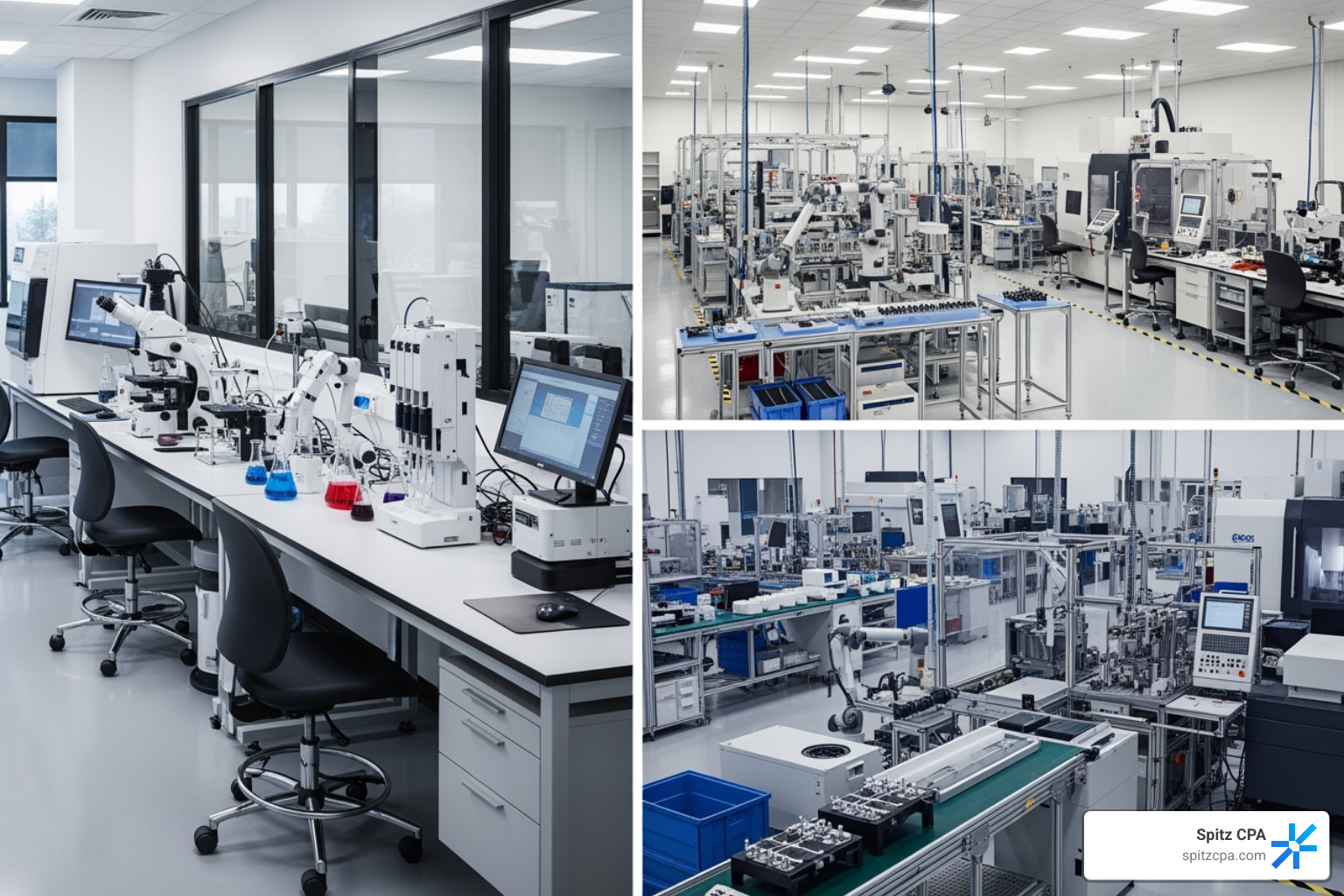
Examples of Typical Qualified Research Activities
Many businesses perform qualifying activities without even realizing it. Here are some common examples that often meet the IRS criteria:
- Developing prototypes and models: Creating physical or digital models to test new designs or concepts.
- Engineering new architecture: Designing the underlying structure for a new product, process, or software system.
- Evaluating feasibility: Conducting studies or experiments to determine if a new idea is technically possible.
- Beta testing: Rigorously testing new software or products to identify and resolve technical issues before commercial release.
- CAD or 3D modeling: Using advanced software to design and simulate new components or products.
- Developing new formulas: Experimenting with ingredients or compounds to create new products (e.g., in food science, chemicals).
- Improving manufacturing processes: Implementing changes to a production line to increase efficiency, reduce waste, or improve product quality, provided there’s technical uncertainty and experimentation involved.
- Developing new or improved software: This is a huge area for many businesses, especially in Arizona’s growing tech sector. If you’re building software with new features, functions, or performance capabilities, it very likely contains qualified research.
Even activities like technical design reviews, participating in technical meetings, documenting research results, or maintaining research equipment can qualify, provided they directly support the core research.
Specifically Excluded Activities
Just as important as knowing what qualifies is understanding what doesn’t. The IRS explicitly excludes several types of activities from being considered qualified research:
- Market research, surveys, or routine data collection: These are generally considered administrative or marketing functions, not technological research.
- Routine testing or quality control: While essential for business, these activities typically don’t involve finding new information or resolving technological uncertainty.
- Adaptation of existing components: Simply modifying an existing product for a particular customer’s needs without significant technical uncertainty or experimentation usually doesn’t qualify.
- Duplication of existing products: Reproducing an existing product or process without adding technological improvements is excluded.
- Research after commercial production: Once a product is ready for commercial sale, most subsequent activities are excluded. However, there are exceptions (which we’ll explore later) for significant improvements or troubleshooting that meet the Four-Part Test.
- Management studies or efficiency surveys: Research into business management techniques, personnel management, or social sciences is generally excluded.
- Foreign research: Research conducted outside the United States and its territories.
- Funded research: If your research is funded by another entity and you don’t retain substantial rights to the research, it generally doesn’t qualify for your business.
It’s important to note that while attending trade shows and conferences is generally considered market research, an exception might apply if we’re using the trade show to demonstrate and evaluate a prototype as a planned phase of its development process. For instance, taking a magnetic floor sweeper prototype to a machine show to test its ability to pick up steel chips and assess durability would be a qualifying activity. What is R&D in Business?
The Three Categories of Qualified Research Expenses (QREs)
Once we’ve identified Qualified research activities, we then look at the expenses associated with them. The R&D tax credit is calculated based on these “Qualified Research Expenses” (QREs), which fall into three main categories:
Wages for Qualified Services: This is often the largest component. Wages paid to employees who perform “qualified services” in Arizona are eligible. Qualified services include:
- Engaging in qualified research: Directly performing the research activities (e.g., a software engineer coding a new algorithm, a scientist conducting experiments).
- Directly supervising qualified research: First-line managers who directly oversee employees performing qualified research. Higher-level management generally doesn’t qualify unless they also perform direct supervision.
- Directly supporting qualified research: Employees who provide direct assistance to those engaging in or supervising research (e.g., a lab technician cleaning equipment, a machinist fabricating an experimental part, a clerk compiling research data). General administrative staff like payroll personnel or accountants typically do not qualify.
Wages are generally defined as remuneration subject to withholding, which usually corresponds to the W-2 Box 1 amount. If an employee performs both qualified and non-qualified services, only the portion of wages attributable to qualified services is eligible.
Supplies Used in Qualified Research: These are tangible items (not land or depreciable property) consumed or used up during the research process. Examples include chemicals, raw materials for prototypes, or components for experimental products. Importantly, general overhead items like utilities for general lighting are usually excluded, but extraordinary utility costs directly related to specialized research equipment could qualify.
Contract Research Expenses: This covers amounts paid to individuals or organizations (not your employees) to perform qualified research on your behalf. The general rule is that 65% of these expenses can be claimed. However, if the research is performed by a qualified research consortium, 75% may be included. For these expenses to qualify, a written agreement must be in place before the research begins, explicitly stating that the research is performed on your behalf, and you must bear the expense even if the research is unsuccessful. If the payment is contingent on the success of the research, only the non-contingent portion qualifies. 26 CFR § 1.41-2 – Qualified research expenses.
Navigating Advanced R&D Tax Credit Rules
The R&D tax credit isn’t just for straightforward lab work. It includes several specific provisions and advanced concepts that can significantly impact your claim, especially for software companies, startups, and corporate groups operating in Arizona and beyond. Understanding these nuances can be the difference between a good tax credit and a great one! New R&D Rules
Special Rules for Software Development
Given Arizona’s thriving tech industry, special attention to software development rules is essential. Software development can certainly qualify, but internal-use software (IUS) faces a higher bar. IUS is software developed primarily for a taxpayer’s internal general and administrative functions (like financial management or HR). To qualify, IUS must meet the general four-part test and pass a “High Threshold of Innovation Test,” which requires it to:
- Be innovative: The software must result in a reduction in cost or improvement in speed or other measure that is substantial and economically significant.
- Involve significant economic risk: The taxpayer must commit substantial resources to the development, and there must be substantial uncertainty that the resources will be recovered.
- Not be commercially available: No comparable software can be purchased, leased, or licensed and used for the intended purpose without modifications that would satisfy the first two tests.
However, there are exceptions. Software developed for use in providing noncomputer services to customers can qualify if it provides new, competitive features that are not otherwise available. Also, dual-function software (DFS), which serves both internal and external purposes, may have qualifying portions. The implementation of AI software, for instance, can qualify if it meets the four-part test, involving custom machine learning models, experimenting with neural network structures, or optimizing algorithms. Routine implementation of off-the-shelf AI tools without customization, however, typically does not qualify.
Understanding Key Concepts: Shrinking-Back, Substantially All, and Patent Safe Harbor
Beyond the core tests, several concepts fine-tune how we apply the rules:
- Shrinking-Back Rule: If an entire business component (like a whole product) doesn’t meet the “substantially all” requirement of the Process of Experimentation Test, we can “shrink back” and apply the test to a smaller, more fundamental component. For example, if a new vehicle doesn’t entirely qualify, perhaps the development of its new engine component does. This allows us to identify eligible research at a more basic level.
- Substantially All Requirement: As mentioned, 80% or more of your research activities must constitute elements of a process of experimentation. This isn’t just for the overall project; it applies to each qualified research activity. If an employee spends 80% or more of their time on qualified services, all their wages can be included. If less than 80%, we must prorate based on actual time spent.
- Patent Safe Harbor: The issuance of a patent (excluding design patents) by the U.S. Patent and Trademark Office is considered conclusive evidence that your research satisfies the “findy” requirement of the Technological Uncertainty Test. It confirms that you’ve obtained knowledge that exceeds, expands, or refines common knowledge. While a patent isn’t a prerequisite for the credit, it certainly simplifies demonstrating eligibility for that specific aspect.
Controlled Groups and the ‘Single Taxpayer’ Concept
For groups of companies, such as those with a parent company and subsidiaries, the IRS treats them as a “single taxpayer” for R&D tax credit purposes. This means we aggregate the Qualified research activities and expenses of all members to compute one credit for the entire group.
- Aggregation Rules: The definition of a controlled group for R&D credit purposes is similar to other tax definitions (parent-subsidiary, brother-sister) but uses a “more than 50 percent” ownership threshold, rather than the “80 percent or more” typically seen in other contexts.
- Intragroup Research: When one member performs research on behalf of another member within the same controlled group, the performing member claims the in-house research expenses (wages, supplies). Payments between members for this research are generally disregarded. This prevents the same expense from being counted twice or being subject to the 65% contract research limitation.
- Foreign Parent Involvement: If a foreign parent company funds a U.S. subsidiary’s research, and the U.S. subsidiary incurs the wages, the U.S. subsidiary can claim the QREs. Reimbursements from the foreign parent are disregarded. However, if the foreign parent pays its employees directly for work in the U.S. and then invoices the U.S. subsidiary, the QREs belong to the foreign parent, which may not yield a U.S. tax benefit if the parent isn’t a U.S. taxpayer.
- Substantial Rights: A key factor in determining which entity performs research “on behalf of” another is who retains “substantial rights” in the research. We look at agreements and corporate documents to see who ultimately owns the rights to the intellectual property developed.
Payroll Tax Credit for Qualified Small Businesses
For qualified small businesses and startups in Arizona, the R&D tax credit offers an exciting benefit: it can be used to offset payroll taxes, even if you don’t have federal income tax liability yet. This is a game-changer for growing companies.
An eligible small business must have less than $5 million in gross receipts for the current tax year and no gross receipts for any tax year preceding the five-tax-year period ending with the current tax year. If you meet these criteria, you can elect to apply up to $500,000 of your R&D credit against your employer’s portion of Social Security taxes, for a maximum of five years. This effectively turns a future tax benefit into immediate cash flow, which can be reinvested directly into your operations. R&D Cash Credit
Frequently Asked Questions about Qualified Research Activities
Understanding Qualified research activities can feel like navigating a maze, so we’ve compiled some frequently asked questions to shed more light on common scenarios.
What’s the difference between basic research, applied research, and experimental development?
These terms describe different stages of the research process, and all can potentially involve qualifying research:
- Basic Research: This aims to advance scientific knowledge without a specific practical application in mind. Think of it as pure science, often conducted in academic settings, like studying a newly finded virus to understand its fundamental characteristics.
- Applied Research: This builds on basic research with a practical application as its goal. For instance, developing a vaccine against that new virus by exploiting its characteristics would be applied research.
- Experimental Development: This is the systematic work, drawing on existing knowledge gained from research and practical experience, directed at producing new materials, products, or processes, or improving existing ones. This often involves prototyping, testing, and refining. Scaling up and optimizing processes for large-scale, rapid production of a vaccine is a good example of experimental development.
“Support work” can also be eligible if it directly supports these three types of research and is commensurate with their needs. This includes activities like engineering, design, data collection, and testing that directly aid the core research effort.
Can activities after a product is launched ever qualify?
Generally, no. The IRS explicitly excludes “research after commercial production” from Qualified research activities. This means once a product, process, or software is ready for commercial sale or use, activities related to its routine maintenance, debugging, or minor cosmetic changes typically won’t qualify.
However, there are important exceptions:
- Significant Improvements: If you undertake new research to significantly improve the function, performance, reliability, or quality of an already produced component, that new research can qualify. For example, developing a new generation of software with entirely new features, even after the first version is launched, could qualify.
- Debugging for Technical Uncertainty: If substantial technical uncertainty remains after commercial production, and you engage in a process of experimentation to resolve it, those activities might qualify. This is different from routine bug fixes.
- Clinical Testing: For pharmaceutical products, clinical testing prior to commercial production in the U.S. is not considered research after commercial production, even if the product is available elsewhere.
The key is whether the activity still meets the Four-Part Test, particularly the Technological Uncertainty and Process of Experimentation criteria, even after commercialization.
What kind of documentation do I need to support my claim?
Documentation is paramount for substantiating your R&D tax credit claim. The IRS requires you to maintain records in sufficient form and detail to support your expenditures and the qualified nature of your research. We always advise our clients to keep:
- Contemporaneous Documentation: Records created at the time the research was performed. This is the gold standard.
- Project Plans and Proposals: Outlining the objectives, technical uncertainties, and planned experiments.
- Test Results and Data Analysis: Showing the iterative process of experimentation and how uncertainties were addressed.
- Meeting Notes and Agendas: Documenting technical discussions, challenges, and solutions.
- Employee Time Tracking: Detailed records of hours spent by employees on specific Qualified research activities. This is critical for wage calculations.
- Payroll Records: W-2s and other payroll documentation.
- Invoices and Receipts: For supplies and contract research expenses.
- Contracts and Agreements: Especially for contract research, detailing the scope of work, ownership of rights, and payment terms.
- Job Descriptions and Resumes: To demonstrate the technical qualifications of employees involved.
- Technical Specifications and Designs: Showing the evolution and improvements of your business component.
The more thoroughly you document your process, the smoother your claim will be, and the better prepared you’ll be in case of an IRS audit.
Open up Your R&D Tax Savings
Understanding what constitutes Qualified research activities is the key to open uping substantial tax savings that can be reinvested into your business for further growth and innovation. While the rules are complex, the potential benefits—from improved cash flow to a stronger competitive edge—are significant. Navigating these regulations requires expertise. The team at Spitz CPA, led by Michael J. Spitz, specializes in helping businesses identify, document, and claim the R&D tax credits they rightfully deserve. To see how our R&D Tax Services can benefit your company, contact us today.


