


Maximize Your Innovation Investment with Expert R&D Tax Credit Guidance
Finding qualified r and d tax experts can open up significant savings that many businesses leave on the table. When searching for the right R&D tax credit consultant, look for these key qualities:
Key Qualities of Top R&D Tax Experts:
- Multidisciplinary teams including CPAs, engineers, and attorneys
- A proven track record with audit defense and IRS compliance
- Industry-specific knowledge across manufacturing, software, and biotech
- Technology-driven processes using AI and project management tools
- Transparent fee structures with free initial consultations
- Comprehensive documentation that satisfies current IRS requirements
The R&D tax credit provides a dollar-for-dollar reduction in tax liability for qualified research activities, yet industry data shows more than 65% of eligible companies fail to take full advantage of this federal incentive.
Why businesses need specialized R&D tax experts:
Many general accounting firms lack the technical expertise to identify all qualifying activities or steer the complex four-part test required by the IRS. Specialized firms use advanced technologies and unique methodologies to generate larger credits and ensure smoother audits.
Recent legislative changes, including Section 174 capitalization requirements, have made expert guidance even more critical. As one tax professional noted, “the tax environment for innovators has never been both so good, and so complex.”
I’m Michael J. Spitz, a CPA with over 15 years of corporate accounting experience. My background in strategic financial modeling and compliance positions me to guide you toward qualified r and d tax experts who can maximize your innovation investments and improve cash flow.
Understanding the R&D Tax Credit: Are You Leaving Money on the Table?
Many businesses are sitting on thousands of dollars in tax savings without realizing it, all because of the Research and Development (R&D) Tax Credit. This isn’t an obscure loophole; it’s a permanent federal incentive designed to reward companies for investing in innovation. It provides a dollar-for-dollar reduction against your tax liability.
A common misconception is that the credit is only for scientists in lab coats. In reality, if your business develops new products, improves processes, creates software, or finds better ways to operate, you might qualify. The scope includes manufacturing firms improving production lines, software developers building apps, architects designing innovative structures, and even food companies creating new recipes. The common thread is solving technical problems and eliminating uncertainty.
This credit is a game-changer for cash flow. It directly reduces your tax bill, and for startups, it can even offset payroll taxes, putting money back in your pocket before you’re profitable. Understanding these credits is crucial for financial optimization. You can learn more about managing your business finances in our small business accounting guide.
The Crucial Four-Part Test for Qualification
The IRS uses a specific Four-Part Test to separate legitimate R&D from everyday business operations.

- Permitted Purpose Test: The goal must be to create a new or improved product, process, or software.
- Technological in Nature Test: The work must rely on hard sciences like engineering, computer science, or biology.
- Elimination of Uncertainty Test: The activity must aim to resolve technical uncertainty about a capability, method, or design.
- Process of Experimentation Test: The process must involve systematic testing, evaluation of alternatives, and refinement.
Qualified Research Expenses (QREs) include wages for research staff, supplies used in development, and 65% of contractor costs. Common qualifying activities are developing software, improving manufacturing processes, designing products, and creating prototypes.
Who Qualifies? A Broader Scope Than You Think
The R&D Tax Credit has a surprisingly broad reach, benefiting startups, small businesses, and established companies.
- Manufacturing companies often qualify by developing new products or improving production methods.
- Software development is a massive opportunity, with activities like building new applications or platforms often qualifying.
- Architecture and engineering firms can claim credits for designing innovative building systems or developing new structural approaches.
- Biotechnology companies are natural fits, with work ranging from developing new treatments to creating research methodologies. For more on this, see this biotechnology conference discussion.
- Food science companies can qualify when developing new formulations or improving preservation techniques.
The key isn’t the industry but the approach to solving technical problems. R and d tax experts can identify qualifying activities that aren’t immediately obvious, such as building a custom inventory system or perfecting a production process. If your business is trying to innovate, you might be leaving money on the table.
Why Your Business Needs R&D Tax Experts to Maximize Savings
Attempting to claim R&D tax credits without specialized help is like performing a complex task without the right tools. While your accounting team may be great at day-to-day finances, the R&D tax credit is a different beast, requiring r and d tax experts who live and breathe its complexities.

R&D tax credits involve technical analysis, changing regulations, and meticulous documentation that can make or break your claim. Most businesses leave substantial money on the table because they don’t know what qualifies. We’ve seen companies find six-figure credits after years of missing out—money that could have funded new equipment, staff, or growth initiatives.
| Feature | In-House (General Accountant) | General CPA Firm | Specialized R&D Firm |
|---|---|---|---|
| Expertise Level | Basic tax knowledge, limited R&D focus | General tax, some R&D understanding | Deep R&D tax law, technical, industry-specific |
| Team Composition | Accountant(s) | CPAs, possibly a tax manager | Multidisciplinary (CPAs, engineers, attorneys) |
| Credit Maximization | Often misses opportunities, lower credits | May identify some, but not exhaustive | Maximizes every eligible dollar, higher credits |
| Audit Readiness | Limited documentation, higher audit risk | Basic documentation, moderate audit risk | Exam-ready claims, robust documentation, lower audit risk |
| Time Commitment | High for your team | Moderate for your team | Minimal for your team, efficient process |
| Cost | Appears low, but high opportunity cost | Moderate | Higher upfront, but high ROI and audit peace of mind |
| Technology Use | Basic accounting software | Standard tax software | Advanced AI, proprietary tools, project management integration |
The Specialist Advantage: In-House vs. General CPA vs. R&D Expert
R and d tax experts bring multidisciplinary teams of engineers, scientists, and attorneys who understand your technical challenges and can translate them into tax savings. This industry-specific knowledge is crucial, as they know how to identify qualifying activities—even failed experiments—that a generalist might overlook.
General CPAs often miss opportunities by viewing your business through a traditional accounting lens, potentially misclassifying qualifying wages or supplies. Specialists provide comprehensive documentation that meets IRS standards, leading to higher claim success and fewer headaches. For help with your overall tax strategy, our tax services can build a comprehensive plan.
How R&D Tax Experts Ensure Audit-Proof Claims
R&D tax credit claims face increased IRS scrutiny, but experts prepare for this from the start. The key is contemporaneous documentation—capturing R&D activities as they happen. Specialists help establish systems to track project plans, notes, and time data.
They also stay current on case law precedent and evolving tax laws to structure your claim for success. When filing Form 6765, their precision prevents errors that could trigger an audit. Specialists provide audit-ready deliverables designed to withstand scrutiny, giving you a bulletproof case if the IRS ever comes knocking. Working with r and d tax experts transforms a risky process into a strategic advantage, delivering maximum credits with minimum stress.
Navigating the R&D Tax Credit Process and Landscape
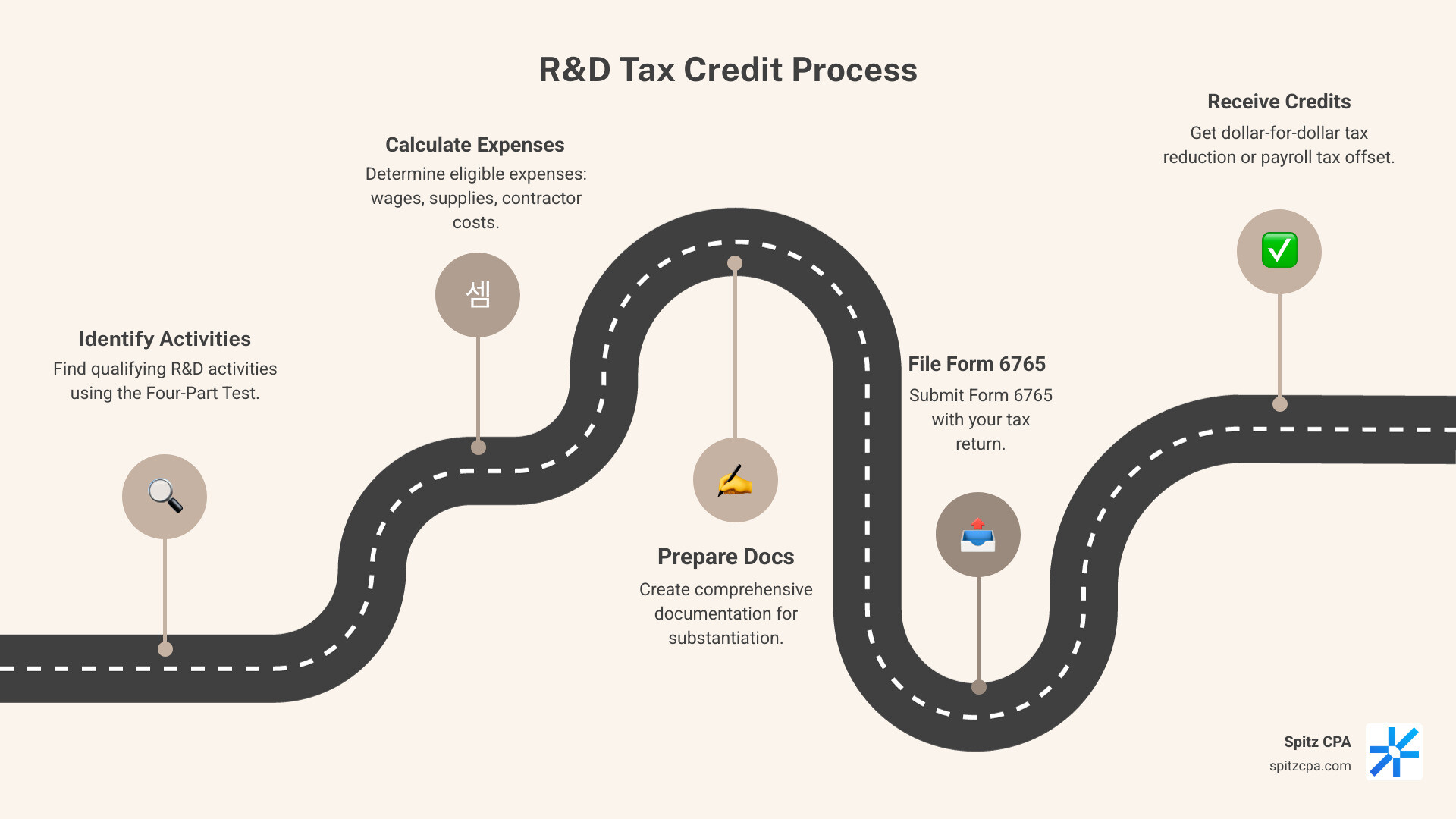
The R&D Tax Credit process can seem complex, but it follows a clear path, especially with an experienced guide. The rules are constantly changing, making expert guidance and technology essential. For a broader look at managing your finances, see our insights on tax planning.

The typical application process unfolds in these key stages:
- Initial Consultation: Experts conduct a free eligibility assessment to identify potential R&D activities.
- Data Collection & Interviews: Specialists work with your technical team (engineers, developers) to pinpoint and document qualifying activities by reviewing financial records, W-2s, and project data.
- Credit Calculation: All Qualified Research Expenses (QREs) are tallied to determine the final federal and state tax credit amount.
- Report Generation: A comprehensive report is created, detailing how your activities meet the Four-Part Test, providing a solid backbone for your claim.
- Filing & Defense: The credit is claimed on IRS Form 6765. Experts can also amend prior-year returns and provide full support in case of an IRS audit. The entire process typically takes two to six weeks.
The Evolving Role of Technology and AI
Technology and AI are revolutionizing the R&D tax credit process, making it more efficient and accurate. AI-powered data analysis can sift through financial and project data to quickly spot qualifying expenses. Project management integration with tools like Jira or GitHub allows for real-time capture of eligible activities. Automated surveys, document analysis tools, and AI-improved documentation create stronger, audit-ready claims with less disruption to your team. This is especially vital in complex fields like medical device automation. For more on this, see this discussion on medical device automation credits.
Key Legislative Updates and Their Impact
The R&D tax credit law is constantly evolving, and staying current is critical.
- The PATH Act of 2015: This made the R&D credit permanent and allowed eligible small businesses to offset the Alternative Minimum Tax (AMT). It also created the popular payroll tax offset for qualified startups, providing a crucial cash flow boost.
- Section 174 Capitalization (from TCJA 2017): A major change effective in 2022 requires companies to amortize R&D expenses over five years (for domestic research) instead of deducting them immediately. This can significantly impact cash flow and taxable income, making expert guidance essential.
- State-Level Credits: Over 30 states offer their own R&D credits, which can be stacked with the federal credit for even greater savings.
This ever-changing landscape highlights why you need r and d tax experts who stay on top of every update.
How to Find and Select the Right Partner
Choosing the right r and d tax experts is a critical decision. It’s not just about filling out a form; it’s about finding a partner who understands your business, innovation, and the intricacies of tax law.

Our firm, Spitz CPA, helps businesses improve cash flow and achieve growth through personalized guidance. For specialized services like R&D tax credits, we believe in connecting you with the best possible partners.
What to Look for When Choosing R&D Tax Experts
When vetting potential r and d tax experts, look for:
- Experience and Track Record: A proven history of success with claims in your industry.
- Team Composition: A multidisciplinary team of CPAs, engineers, and tax attorneys.
- Industry Expertise: Specific experience with businesses like yours to identify unique qualifying activities.
- Transparent Process: A clearly outlined methodology from assessment to filing and audit support.
- Client Engagement: A process that minimizes the time demand on your team.
- Audit Support Guarantee: A clear commitment to defending your claim if it’s audited.
Understanding Common Fee Structures
R&D tax credit service fees vary. Understanding the models helps you choose a partner that fits your budget and risk tolerance.
- Contingency Fees: The most common model, where the firm charges a percentage of the credit received. You don’t pay if no credits are found.
- Fixed Fees: A flat fee for the service, providing cost certainty upfront.
- Hybrid Models: A combination of a small upfront fee and a lower contingency percentage.
- No Out-of-Pocket Costs: Some firms only invoice after you receive the benefit of the credit.
Always clarify the fee structure upfront. The return on investment (ROI) for these services is often substantial, with savings far exceeding the fees. To explore how we can help with your overall business needs, including connecting you with specialists, visit our services page.
Conclusion: Fund Your Future Innovation Today
The R&D Tax Credit is one of the most generous yet underused opportunities for innovative businesses. Many companies leave substantial savings on the table because they don’t realize they qualify or can’t steer the complex claim process.
As we’ve explored, r and d tax experts are essential for maximizing this credit. They bring the specialized knowledge needed to apply the Four-Part Test, steer legislative changes like Section 174 capitalization, and build an audit-proof claim.
The success stories are compelling: a medical device manufacturer doubling their credit, an online platform funding its next growth phase, and a startup preserving capital with the payroll tax offset. These results come from partnering with qualified experts who combine technical and tax law knowledge.
Reclaiming this capital allows for strategic reinvestment in new research, hiring, and equipment. It provides the cash flow to take calculated risks on breakthrough innovations. In today’s complex tax environment, the value of expert guidance—powered by AI tools and deep legislative knowledge—is higher than ever. They handle the heavy lifting so you can focus on growing your business.
Don’t let complexity prevent you from claiming the benefits you’ve earned. The opportunity to fund your future growth is waiting.
Ready to find your potential savings and connect with the expertise you need? Open up your tax savings with our expert guidance today. At Spitz CPA, we’re committed to helping you achieve financial clarity and significant growth through personalized guidance that puts your success first.


