


Why the R&D Tax Credit is America’s Most Overlooked Business Incentive
The r and d tax rebate offers dollar-for-dollar tax savings for research and development activities. It’s a powerful incentive not limited to science labs, yet many businesses miss out because they don’t realize their everyday problem-solving qualifies.
Key Aspects:
- Direct Tax Reduction: Reduces your tax liability dollar-for-dollar.
- Broad Eligibility: Available to all business sizes across 75+ industries, including manufacturing, software, and agriculture.
- Payroll Tax Offset: Qualified small businesses can apply the credit against payroll taxes.
- Qualifying Activities: Includes developing new products, improving processes, creating software, and experimenting with new materials.
The R&D Tax Credit was enacted in 1981 to encourage American innovation. The credit applies to activities that are technological in nature, involve experimentation, and aim to eliminate uncertainty. Recent legislative changes have made the credit more accessible but also more complex, making expert guidance crucial.
I’m Michael J. Spitz, and with over 15 years of corporate accounting experience, I help businesses identify and claim these valuable credits, often uncovering substantial savings.
Related R&D tax terms:
What is the R&D Tax Credit and Who Can Claim It?
The r and d tax rebate, officially the Credit for Increasing Research Activities under 26 U.S. Code §41, is a government incentive for innovation. It provides a dollar-for-dollar reduction in your tax bill for qualified expenses spent on improving products, processes, formulas, or software. For example, $10,000 in qualifying expenses could yield up to a $2,000 direct tax credit.
Originally a temporary measure in 1981, the credit’s success in spurring innovation led Congress to make it permanent with the PATH Act of 2015. This allows businesses to plan long-term R&D investments with confidence. Today, the credit is a key driver of economic growth and helps improve a company’s overall Business Financial Health Check.
Who is Eligible to Claim?
The R&D Tax Credit is surprisingly accessible. Eligibility is not limited to large corporations or businesses with dedicated labs.
- Business Size & Type: Any size business can claim the credit, including C-corporations, S-corporations, and LLCs.
- Startups & Profitability: Both startups and established companies can benefit. Profitability is not required; credits can be carried forward for up to 20 years, and some small businesses can use them against payroll taxes.
- Location: The qualifying R&D activities must occur within the United States. Foreign-owned companies with U.S. operations can also typically claim the federal credit.
Key Benefits for Your Business
The R&D tax credit delivers transformative benefits for business growth.
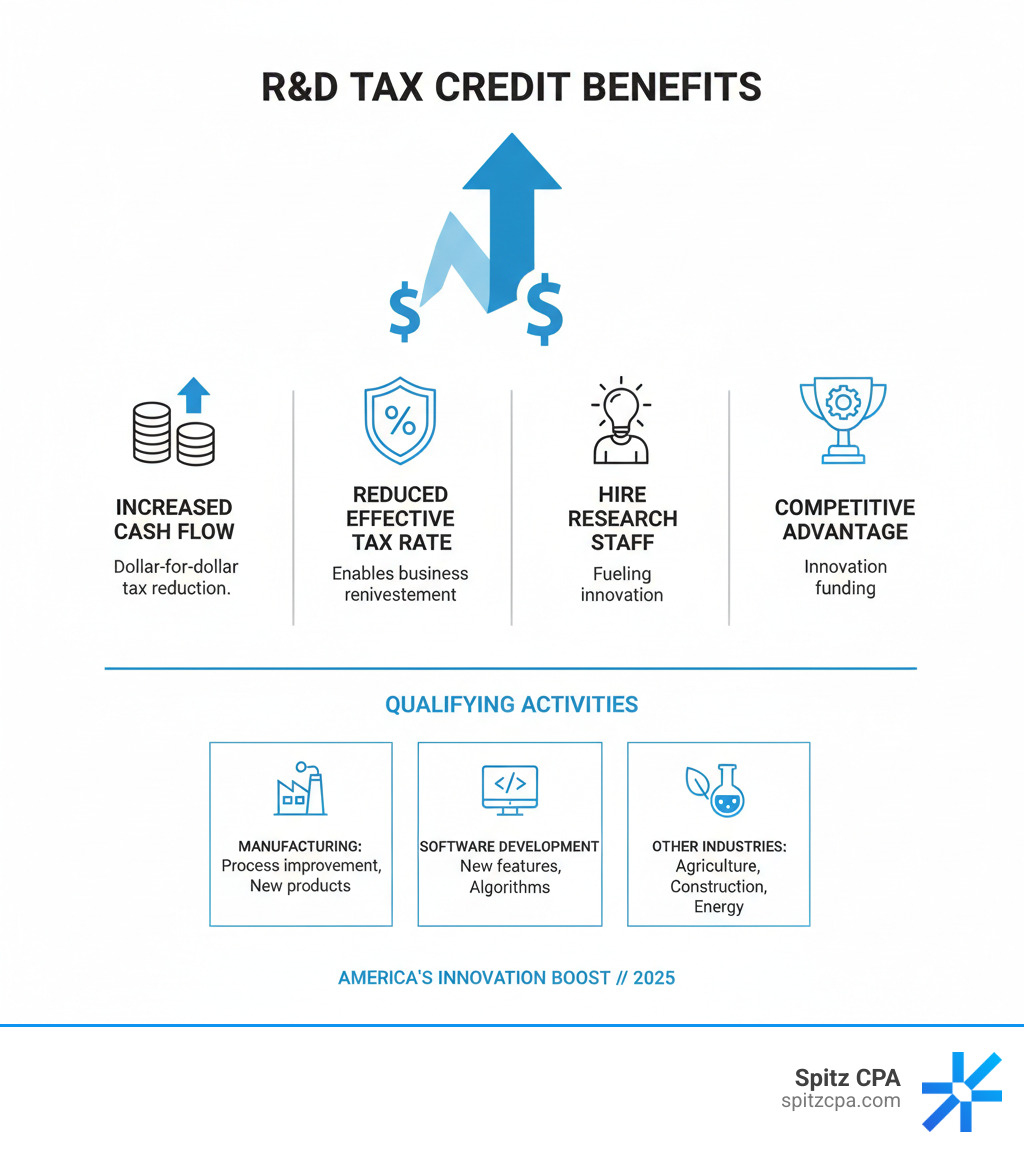
The primary benefit is the dollar-for-dollar tax reduction. Unlike a deduction, which only reduces taxable income, a credit directly slashes your final tax bill. This immediate tax savings creates increased cash flow to fund operations, handle expenses, or seize new opportunities.
A reduced effective tax rate improves financial metrics and makes your business more attractive to investors. The extra capital enables businesses to hire more staff, particularly skilled employees who can drive further innovation.
Many businesses reinvest the savings directly back into R&D, creating a virtuous cycle of innovation funded by tax savings. This provides a significant competitive advantage, allowing you to innovate faster than competitors paying higher taxes.
Flexible provisions add more value. Carryforward provisions allow unused credits to roll forward for up to 20 years, while lookback opportunities let you claim credits for prior years. These benefits work together to help you Improve Business Profitability and build a stronger foundation for growth.
Qualifying for the Credit: Activities, Expenses, and Industry Examples

Many business owners mistakenly believe the r and d tax rebate is only for scientists. In reality, valuable R&D occurs in everyday settings like factory floors and software offices. The key is understanding what the IRS considers “qualified research,” which involves systematically solving technical problems.
The IRS Four-Part Test for Qualified Research
To qualify, an activity must meet all four parts of the IRS test:
- Permitted Purpose Test: The goal must be to create a new or improved product, process, or software, enhancing its function, performance, reliability, or quality.
- Technological in Nature Test: The work must rely on principles of hard sciences like engineering, computer science, or biology.
- Elimination of Uncertainty Test: You must be trying to resolve technical uncertainties at the outset. If you don’t know the optimal design or method, you likely meet this test.
- Process of Experimentation Test: You must use a systematic process of testing and evaluation, such as modeling, simulation, or trial and error, to evaluate alternatives.
The IRS Research Credit Audit Techniques Guide offers more detail, but the core concept is solving technical problems scientifically.
What are Qualified Research Expenses (QREs)?
Once you identify qualifying activities, you must track the associated costs. The IRS defines qualified research expenses as:
- Employee wages: For employees performing, supervising, or directly supporting qualified research. If an employee spends at least 80% of their time on R&D, 100% of their wages can qualify.
- Supplies and materials: Costs of tangible items consumed during the research process, such as prototypes or testing materials.
- Cloud computing costs: Expenses for cloud services used directly for qualified research activities.
- Contract research expenses: Typically, 65% of payments to third parties hired to conduct research on your behalf.
Proper documentation is critical. We help clients in Gilbert, AZ and throughout Arizona establish systems to track these expenses accurately.
Examples of Qualifying Activities by Industry
The R&D Tax Credit applies across many sectors. Here are common examples of how industries qualify for the r and d tax rebate:
- Manufacturing & Fabrication: Developing new production processes, creating prototypes, or experimenting with new materials to improve quality.
- Software Development: Designing new algorithms, developing innovative architecture, creating new features, or integrating complex systems.
- Life Sciences & Pharma: Conducting clinical trials, formulating new drugs, developing medical devices, and improving biotechnology.
- Agriculture & Food: Hybridizing crops for better yields, developing new food formulas, or improving processing techniques.
- Architecture & Engineering: Developing unique structural designs, creating energy-efficient building systems, or designing complex infrastructure.
How to Calculate and Claim Your R and D Tax Rebate

Once you’ve identified qualifying activities and expenses, the next step is calculating and claiming your r and d tax rebate. This process is crucial for maximizing your savings, and choosing the right calculation method is key.
Calculating Your Credit: Regular vs. Alternative Simplified Credit (ASC)
The IRS offers two methods for calculating your credit. The choice can significantly impact your final credit amount.
The Regular Credit (RC) offers a 20% credit on qualified research expenses (QREs) that exceed a complex base amount. However, calculating this base requires historical R&D spending data from the 1980s, which is often unavailable for newer businesses.
The Alternative Simplified Credit (ASC) is more accessible. It calculates the credit as 14% of the current year’s QREs that exceed 50% of the average QREs from the prior three years. If you have no QREs in the prior three years, the credit is 6% of the current year’s QREs.
| Feature | Regular Credit (RC) | Alternative Simplified Credit (ASC) |
|---|---|---|
| Calculation | 20% of QREs over a complex base amount | 14% of QREs over 50% of the average QREs for the prior 3 years |
| Base Period | Requires historical data from the 1980s | Requires data from the last 3 years |
| Complexity | High | Lower |
| Benefit | Potentially higher for established companies | Often better for startups or companies with inconsistent R&D spend |
The ASC method is often better for startups and businesses without extensive historical records. Our RD Tax Credit Calculation: A Complete Guide provides more detail.
The Critical Role of Documentation
Documentation can make or break your R&D tax credit claim. The IRS requires contemporaneous documentation—records created at the time the work was performed—to substantiate your claim. Key documents include:
- Project records: Detail project objectives, technical uncertainties, and the experimentation process.
- Employee time tracking: Show how much time employees spent on specific qualified research activities.
- Technical narratives: Written explanations of how your projects meet the IRS’s four-part test.
- Financial records: Invoices for supplies, materials, and contract research, plus detailed payroll data.
Without this documentation, your claim is vulnerable in an audit. Working with RD Tax Experts ensures your claim is audit-ready.
Filing Your Claim
The credit is claimed using IRS Form 6765, Credit for Increasing Research Activities, filed with your annual federal income tax return. The form has sections for the Regular Credit (Section A), ASC (Section B), and the payroll tax election for qualified small businesses (Section D). Accurate reporting of QREs, backed by solid evidence, is essential. For new entrepreneurs, resources like our Small Business Accounting 101: A Guide for New Entrepreneurs can help clarify the process.
Advanced Strategies and Recent Legislative Changes
The r and d tax rebate landscape has evolved, creating new challenges and opportunities. Understanding these changes is key to maximizing your savings.
The Impact of Section 174 Amortization
A significant change from the Tax Cuts and Jobs Act (TCJA) has impacted many businesses. Starting in 2022, Section 174 requires all research and experimental expenses to be capitalized and amortized. Domestic R&D expenses must be spread over five years, and foreign R&D expenses over 15 years. This eliminates the immediate deduction, which can lead to a higher taxable income.
This change makes the r and d tax rebate even more critical for offsetting the increased tax burden. While there is bipartisan support for reversing this rule, for now, it remains a key consideration for Business Tax Strategies.
Using the R and D Tax Rebate Against Payroll Taxes
This is a game-changing strategy for startups. A Qualified Small Business (QSB) can use the R&D Tax Credit to reduce its payroll taxes instead of income taxes.
To qualify as a QSB, your business must have gross receipts under $5 million for the tax year and have been generating revenue for no more than five years. If you meet these criteria, you can apply up to $500,000 of your federal R&D Tax Credit against your FICA taxes annually.
This election is made on Section D of IRS Form 6765, following guidance from IRS Notice 2017-23. It provides immediate cash flow relief and is a fundamental part of Tax Planning for Entrepreneurs.
Claiming Credits for Prior Years and State Differences
Many businesses qualify for the r and d tax rebate without realizing it. You can often go back and claim credits for prior years through a “lookback study.” Generally, you can file amended returns for the three open tax years before the current one, potentially recovering substantial refunds.
Additionally, many states offer their own R&D tax credits. For example, Arizona has its own Research & Development Tax Credit Program. Each state has unique eligibility criteria and credit rates, so investigating your state’s program can provide another layer of savings. This is where expertise in Development Tax Rebate strategies is invaluable.
Frequently Asked Questions about the R&D Tax Credit
Here are answers to common questions about the r and d tax rebate.
What are common reasons R&D tax credit claims fail?
Claims most often fail due to poor documentation. Without contemporaneous records proving your work, the IRS may deny the credit. Other common mistakes include misinterpreting the four-part test, including non-qualified expenses, failing to link costs to specific projects, and not demonstrating a clear process of experimentation.
Is the R&D tax credit a deduction or a credit?
It is a credit, which is more valuable than a deduction. A credit reduces your tax liability dollar-for-dollar, whereas a deduction only reduces your taxable income. For example, a $10,000 credit saves you $10,000 in taxes. Under I.R.C. §280C, you must reduce your R&D expense deduction by the amount of the credit claimed to prevent a double tax benefit.
How far back can I claim the R&D tax credit?
You can generally claim the credit for prior years by filing amended returns in what is known as a lookback study. The typical lookback period covers the three open tax years from the date you filed the original return. This allows businesses to recover significant refunds for credits they were eligible for but never claimed. Acting promptly is key, as the window for amending older returns closes over time.
Maximize Your Savings with Expert Guidance

The r and d tax rebate is a valuable opportunity that can return thousands of dollars to your company annually. However, many business owners are overwhelmed by the complex rules and documentation requirements. Proving your work meets the IRS’s specific criteria is as important as performing the innovation itself.
This is where expert guidance is essential. At Spitz CPA, Michael J. Spitz and our team specialize in tax incentives like the R&D Tax Credit. We analyze your operations to identify all qualifying activities and build a comprehensive, audit-ready documentation package.
Our RD Tax Services team acts as your strategic partner to:
- Uncover hidden credits in your daily operations.
- Steer complex regulations, including the four-part test and Section 174 amortization.
- Build robust documentation to substantiate your claim.
- Optimize your credit calculation to maximize your savings.
This process directly translates to increased cash flow that you can reinvest in your business to fund further growth and innovation.
Don’t let complexity prevent you from claiming the savings your business has earned. The credit is designed to reward your hard work.
Schedule a consultation with us today to explore your eligibility and find how much your business could save. Let us help you turn your ingenuity into tangible tax savings.
Contact us for expert tax services and let’s open up your business’s full potential.


