


Why R&D Cash Credits Are Your Innovation Payback
An r&d cash credit is a government incentive providing a dollar-for-dollar tax reduction or cash payment to businesses that invest in research and development. This credit can lower your tax liability or, for qualifying startups, provide direct cash payments to offset payroll taxes.
Key R&D Cash Credit Benefits:
- 9-14% return on every dollar of qualified research expenses
- Up to $500,000 in payroll tax offsets for startups annually
- Available across all industries – not just tech companies
- Claims possible for 3 prior years through amended returns
- 36 states offer additional R&D tax credits
The R&D tax credit is one of the most valuable incentives available, yet many businesses miss out because they don’t understand what qualifies or how to claim it. If your business develops new processes, creates software, or improves products through experimentation, your efforts likely qualify for significant savings, especially since the PATH Act of 2015 made the credit permanent and expanded access for small businesses.
I’m Michael J. Spitz, and with over 15 years of corporate accounting experience across software technology, manufacturing, and other R&D-intensive industries, I’ve helped numerous clients steer the complexities of claiming their r&d cash credit benefits. My expertise in financial modeling, compliance, and strategic tax planning ensures businesses maximize their innovation rewards while maintaining proper documentation for audit defense.
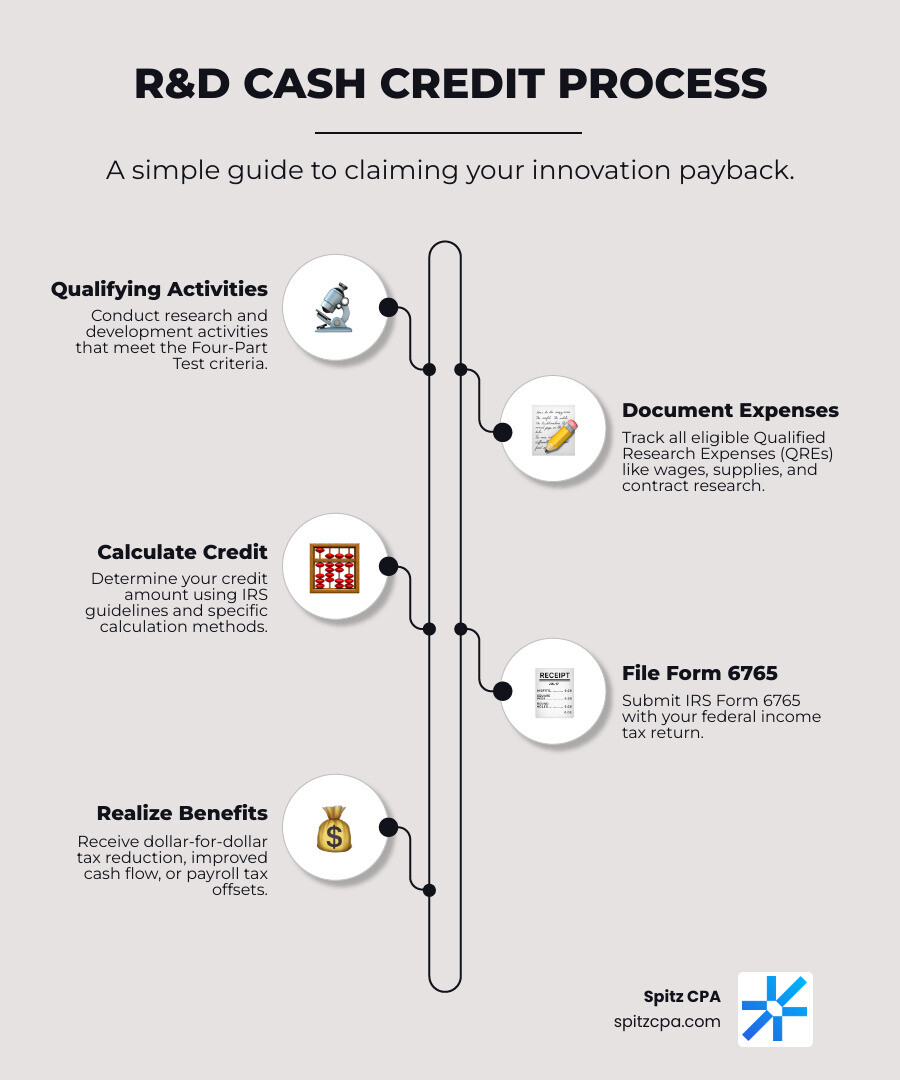
Simple guide to r&d cash credit terms:
Understanding the R&D Tax Credit: What It Is and Who Qualifies
What if the government rewarded you for the hard work of solving technical problems, tweaking manufacturing processes, or debugging code? That’s exactly what the r&d cash credit does.

Officially the Credit for Increasing Research Activities (IRC Section 41), this federal incentive was made permanent by the PATH Act of 2015. This act solidified the credit’s availability and improved its benefits for startups and small businesses. The beauty of the system is that it rewards the attempt to innovate, whether your experiment succeeds or fails. For comprehensive guidance, explore our Tax Planning for Entrepreneurs resources.
The Core Purpose of the R&D Tax Credit
The r&d cash credit exists to spur domestic growth by keeping innovation in the United States. It encourages companies to take on expensive and uncertain R&D projects by rewarding technical problem-solving and the creation of high-paying STEM jobs. This investment helps build a workforce that keeps America competitive globally.
Who is Eligible to Claim?
Eligibility is refreshingly straightforward and not limited to companies with lab coats. The credit is activity-based, not industry-specific. To qualify, you must:
- Conduct U.S.-based activities.
- Be a company subject to tax (including federal income or payroll taxes).
This means manufacturers improving production lines, software companies debugging code, or even bakeries developing new preservation methods could qualify. I’ve worked with clients across all industries, from architecture to agriculture. Both startups and established companies can claim the credit if they are innovating.
Special Rules for Startups and Small Businesses
The PATH Act created game-changing rules for smaller businesses, allowing them to benefit from the r&d cash credit even before becoming profitable.
Qualified small businesses (less than $5 million in gross receipts for the year and no gross receipts before the last five years) can apply R&D credits directly against their payroll taxes. This payroll tax offset provides immediate cash flow relief.
- The annual limit increased from $250,000 to $500,000 for tax years beginning in 2023.
- The offset now applies to both employer-paid FICA and Medicare taxes.
An Alternative Minimum Tax (AMT) offset is also available for companies with less than $50 million in average annual gross receipts over the previous three years, allowing them to use R&D credits to offset AMT.
This means you can monetize credits pre-profitability, giving you cash to reinvest in innovation, hire talent, or fund operations during critical growth phases. As Michael J. Spitz often explains, this is about claiming the rewards you’ve already earned through your innovative work.
Qualifying Activities and Expenses: What Counts Towards Your Credit?
The key to open uping your r&d cash credit is recognizing the qualifying research and development you’re already doing. If you’re systematically working to solve technical problems or improve products and processes through experimentation, you are likely performing qualifying R&D.

The IRS uses a Four-Part Test to determine what counts. Many routine engineering and software development tasks qualify if they meet these criteria. Your goal might be to make things better, faster, or cheaper by resolving technical uncertainties. For a detailed look at calculations, see our R&D Tax Credit Calculation: The Complete Guide.
The Four-Part Test for Qualifying Activities
Every qualifying activity must pass this test:
- Permitted Purpose: The goal must be to create a new or improved product, process, software, or formula by enhancing its function, performance, reliability, or quality.
- Technological in Nature: The research must rely on hard sciences like engineering, computer science, or physical or biological sciences.
- Elimination of Uncertainty: At the project’s outset, there must have been real uncertainty about the capability, method, or appropriate design.
- Process of Experimentation: You must use a systematic process of testing and evaluating alternatives (e.g., modeling, simulation, trial and error) to eliminate the uncertainty.
Internal use software projects face a heightened three-part test requiring significant economic risk, innovativeness, and commercial unavailability.
What Expenses Qualify for the Credit?
Once you identify qualifying activities, you can tally the Qualified Research Expenses (QREs):
- Employee wages: For employees directly performing, supervising, or supporting qualified research. This is often the largest category.
- Supply costs: Tangible items used and consumed during R&D, including materials for testing and prototypes. For manufacturers, pilot models (prototypes, samples, test runs) can significantly boost the credit.
- Contract research expenses: 65% of payments to U.S.-based third parties for qualified research (or 75% for research consortia).
- Cloud computing costs: Expenses for cloud platforms and data acquisition integral to the research process.
- Computer lease/rental costs: For equipment used in the R&D process.
Maintaining excellent records of these expenses is crucial for substantiating your claim.
Examples of Qualifying R&D Across Industries
Qualifying R&D is incredibly diverse:
- Manufacturing: Experimenting with alternative materials, designing new tooling for efficiency, or developing processes to reduce scrap.
- Software Development: Developing new algorithms, integrating legacy systems with new tech, or resolving technical uncertainties in an iterative development process.
- Engineering: Researching new materials for components or developing innovative design processes for energy efficiency.
- Agricultural Technology: Experimenting with new crop varieties, testing innovative irrigation techniques, or developing pest control methods.
- Biotechnology: Developing new drugs, experimenting with new reagents, or improving medical devices.
The common thread is the systematic effort to resolve technical challenges through experimentation.
Maximizing Your R&D Cash Credit: The Claim Process and Key Benefits
Turning your innovation into r&d cash credit benefits requires careful documentation and strategic filing. This final step in your innovation journey can lead to tangible cash flow improvements and is a cornerstone of effective Business Tax Strategies.

How to Claim Your R&D cash credit
The claiming process becomes manageable with a structured approach:
- Record Keeping: Maintain comprehensive documentation for each project, including technical challenges, experimentation processes, and tracked employee time. This is the foundation of a successful claim.
- Identifying QREs: Carefully categorize and track all qualifying employee wages, supply costs, and contract research payments.
- Filing Form 6765: This IRS form, “Credit for Increasing Research Activities,” is where you report your calculations and supporting information.
- Amending Prior-Year Returns: You can generally claim missed R&D credits for the previous three open tax years, potentially recovering significant refunds.
- Substantiation: Have rock-solid evidence ready to defend your claim if the IRS reviews it.
At Spitz CPA, our R&D Tax Services help clients prepare robust, defensible documentation to maximize their claims.
The Financial Benefits of an R&D cash credit
The advantages extend far beyond a simple tax reduction:
- Dollar-for-Dollar Tax Offset: Credits directly reduce your tax bill, making them more powerful than deductions.
- High Return on Investment: Businesses often see a 9-14% return on every qualified dollar of research expense.
- Improved Cash Flow: Profitable companies have more cash for reinvestment, while startups can use the payroll tax offset for immediate cash savings.
- Payroll Tax Savings for Startups: Qualifying small businesses can use up to $500,000 annually in credits against payroll taxes, providing a lifeline during early growth.
- Increased Business Valuation: Documented R&D and tax credits demonstrate innovation and smart financial management, making your business more attractive to investors.
Federal vs. State Credits: A Dual Opportunity
Don’t stop at the federal credit. Over 35 states offer their own state-level incentives, which often follow federal guidelines but may have unique features.
For our clients in Gilbert and across Arizona, the Arizona R&D tax credit offers an additional non-refundable income tax credit for qualified research expenses conducted in the state. It’s calculated based on the increase in research expenses over a base amount. Understanding how state programs like Arizona’s R&D Program work with the federal credit is key to maximizing your total return on innovation.
Global Perspectives: How the US R&D Credit Compares to the UK
Comparing the U.S. r&d cash credit to international incentives, like those in the UK, reveals different philosophies for encouraging innovation. The U.S. rewards doing more R&D, while the UK traditionally rewarded the total amount of R&D.

For a deeper look at international policies, the UK government guidelines on R&D offer comprehensive details on their evolving system.
The US Incremental Credit System
The U.S. r&d cash credit is unique because it’s an incremental system. The credit is based on the increase in your R&D spending over a historical baseline, not your total spending. This approach rewards increased R&D spend, encouraging companies to continuously push innovation rather than maintain the status quo. Businesses can choose between a regular vs. simplified credit calculation, offering flexibility to maximize the benefit based on their R&D history.
The UK Volume-Based System
The UK has traditionally used a volume-based system, rewarding the total amount of qualifying R&D expenditure. Their system has undergone significant changes, but this core difference remains.
- Historical Schemes: The SME Scheme was very generous for small and medium-sized enterprises, while the RDEC Scheme served larger companies.
- New Merged Regime (2024): As of April 1, 2024, the UK has moved most companies to a single, merged credit system. A special, more generous regime remains for R&D-intensive, loss-making SMEs.
The UK’s focus on total qualifying expenditure can be simpler to calculate, but the U.S. incremental approach creates a powerful incentive for continuous growth in R&D investment.
Frequently Asked Questions about R&D Tax Credits
Over my years helping businesses with the r&d cash credit, I’ve noticed the same questions come up time and again. Here are the answers to the most common ones.
Can I claim the R&D tax credit for a project that failed?
Yes, absolutely. This is one of the most misunderstood aspects of the r&d cash credit. The IRS rewards the process of experimentation, not the outcome. What matters is that you systematically worked to solve a technical problem and documented your efforts, regardless of whether the project succeeded or failed. Failure is often a key part of the innovation journey.
Can I claim R&D tax credits for prior years?
Yes. This is a major opportunity for many businesses. You can generally amend tax returns for the previous three open tax years to claim credits you missed. We often help clients uncover substantial refunds from past R&D activities they didn’t realize qualified. Don’t let past oversights cost you money that is rightfully yours.
Is the R&D tax credit only for technology and pharmaceutical companies?
This is the biggest myth about the credit. The truth is that the credit is activity-based, not industry-specific. It doesn’t matter if you’re making software or sandwiches; if your work meets the Four-Part Test, you likely qualify. I’ve helped clients in manufacturing, food production, construction, agriculture, and engineering claim significant credits. If you are trying to eliminate technical uncertainty through systematic experimentation, you are likely doing R&D.
Conclusion: Turn Your Innovation into a Financial Asset
Your innovation is a valuable asset. The r&d cash credit is a powerful tool to turn your R&D efforts into significant financial rewards, improving cash flow and providing a competitive advantage. You are already investing in making your products and processes better; it’s time to get rewarded for it.
With benefits like dollar-for-dollar tax reductions and up to $500,000 in annual payroll tax offsets for startups, the financial impact can be transformative.
However, navigating the Four-Part Test and creating the required documentation demands expertise. Poor documentation can turn a valuable credit into a missed opportunity or an audit risk. The importance of proper documentation cannot be overstated, as it forms the foundation of a defensible claim.
Your innovative efforts are already happening. The question is whether you’re getting properly rewarded. Don’t let another tax year pass without exploring this significant source of cash flow.
Ready to turn your innovation into a financial asset? Explore our expert tax services and find how Michael J. Spitz and the Spitz CPA team can help you maximize your r&d cash credit benefits while ensuring bulletproof compliance.


