


Why Understanding R&D Tax Credit Rules Can Save Your Business Thousands
R&d tax credit rules can open up significant tax savings for businesses conducting research and development activities. Here’s what every business owner needs to know:
Key R&D Tax Credit Rules:
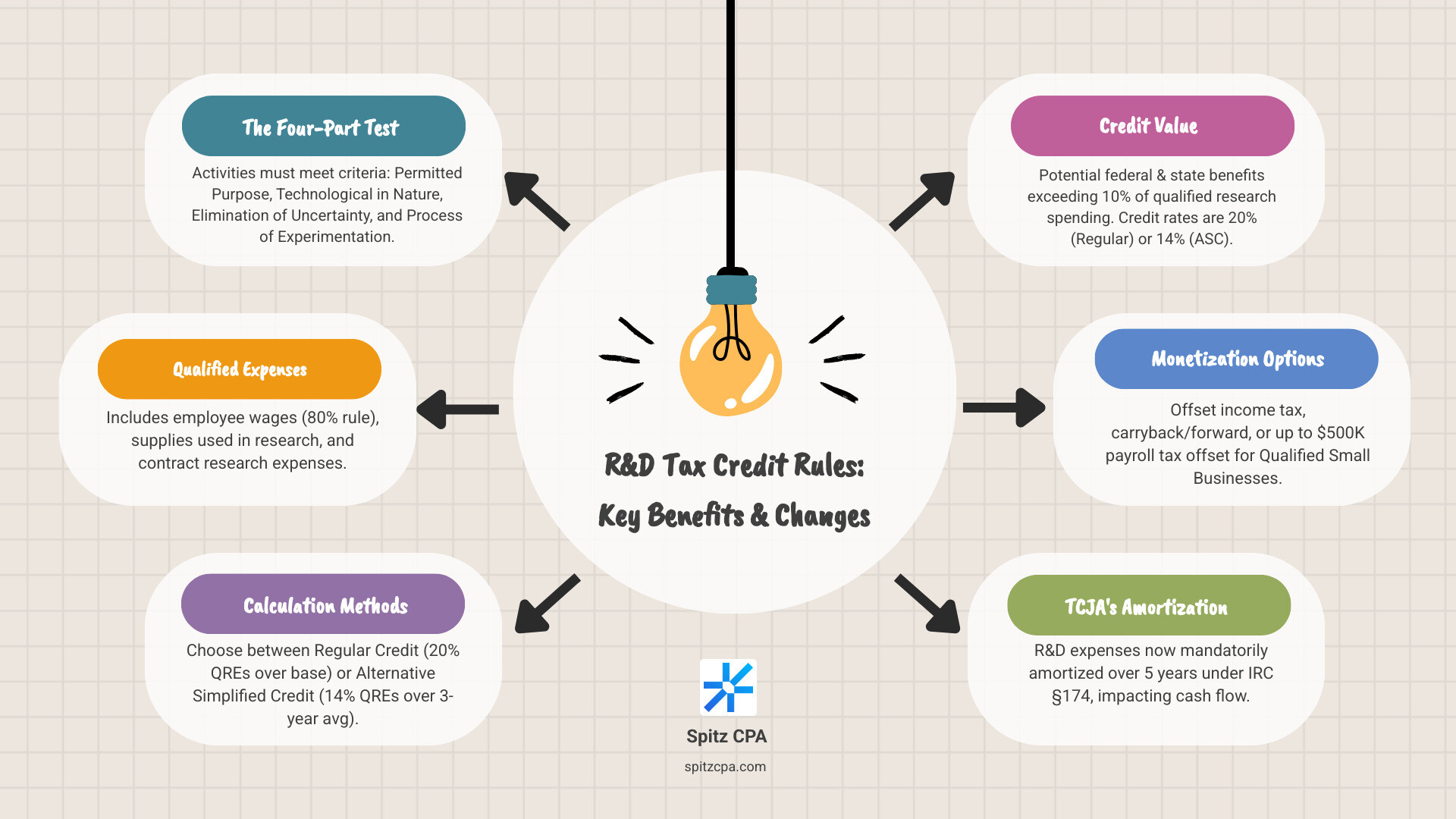
- Four-Part Test Required: Activities must meet permitted purpose, technological nature, elimination of uncertainty, and process of experimentation
- Qualified Expenses Include: Employee wages (80% rule applies), supplies, contract research, computer leasing costs
- Credit Amount: 20% of qualified expenses over base amount (Regular Method) or 14% over 50% of 3-year average (Alternative Simplified Credit)
- Eligible Businesses: Corporations, pass-through entities, startups – not limited to tech companies
- Excluded Activities: Post-commercial production research, routine testing, foreign research, market surveys
The R&D tax credit represents one of the most valuable yet underused tax incentives available to American businesses. Originally introduced in the Economic Recovery Tax Act of 1981 and made permanent by the PATH Act of 2015, this credit was designed to encourage domestic innovation and research spending.
For many businesses, the credit can result in federal and state tax benefits exceeding 10% of qualified research spending. Recent changes under the Tax Cuts and Jobs Act have made understanding these rules even more critical, as R&D expenses must now be amortized over five years instead of immediately deducted.
This comprehensive guide will walk you through the essential rules, from qualifying activities and eligible expenses to calculation methods and documentation requirements. Whether you’re a startup developing new software or a manufacturer improving production processes, understanding these rules could mean the difference between paying unnecessary taxes and reinvesting those funds into growing your business.
I’m Michael J. Spitz, and with over 15 years of corporate accounting experience across technology, manufacturing, and other R&D-intensive industries, I’ve helped numerous businesses steer these complex regulations to maximize their tax savings. My expertise in financial modeling, compliance, and strategic tax planning allows me to guide businesses through these intricate regulations while ensuring they capture every dollar of credit they’re entitled to claim.
Learn more about the R&D tax credit:
What is the R&D Tax Credit and Who is Eligible?
The Research & Development Tax Credit isn’t just another tax break – it’s one of the most powerful tools Congress created to keep American innovation competitive. Officially called the Credit for Increasing Research Activities under Section 41 of the tax code, this incentive rewards businesses for doing what they already love: creating better products, improving processes, and solving tough problems.
The story begins with the Economic Recovery Tax Act of 1981, when lawmakers recognized that American companies needed encouragement to invest in research and development. For decades, businesses dealt with the frustrating cycle of the credit expiring and getting renewed at the last minute. That uncertainty made it hard to plan long-term R&D projects.
Everything changed with the PATH Act of 2015, which finally made the R&D tax credit a permanent tax provision. No more wondering if Congress would renew it – the credit was here to stay. This permanence gave businesses the confidence to make serious, long-term investments in innovation.
Here’s what many business owners don’t realize: the r&d tax credit rules have evolved far beyond the stereotypical image of scientists in white lab coats. While pharmaceutical and biotech companies were early adopters, today’s credit applies to any business engaged in qualifying research activities. The purpose to increase US research spending has opened doors for manufacturers improving production lines, software companies developing new features, and even restaurants perfecting recipes.
The broadened scope beyond tech and pharma means your business might qualify even if you’ve never thought of yourself as being in “research and development.” We’ve helped manufacturing companies claim credits for testing new materials, architectural firms for designing energy-efficient buildings, and agricultural businesses for developing better growing techniques.
Startups and small businesses get special treatment under these rules. If you’re a qualified small business, you can actually use the credit to offset payroll taxes – a game-changer when you’re not yet profitable enough to owe significant income taxes. For comprehensive planning around these opportunities, consider how R&D credits fit into your broader Business Tax Strategies.
The Credit vs. R&D Deductions
Let’s clear up something that confuses many business owners: the difference between a tax credit and a deduction. A deduction reduces your taxable income, while a credit reduces your actual tax bill dollar-for-dollar. If you’re in a 25% tax bracket, a $1,000 deduction saves you $250 in taxes. But a $1,000 credit saves you the full $1,000. Credits are almost always more valuable.
The landscape got more complicated with recent tax law changes. The Tax Cuts and Jobs Act (TCJA) brought significant changes to how R&D expenses are handled. Starting in 2022, businesses can no longer immediately expense their R&D costs. Instead, they must use Section 174 amortization, spreading domestic R&D expenses over 5-year amortization periods.
This immediate expensing vs. credit distinction matters more now than ever. While you’re forced to amortize your R&D expenses instead of deducting them immediately, you can still claim the R&D tax credit for those same activities. The credit becomes even more valuable when you can’t get the immediate deduction you used to enjoy.
Understanding how these pieces work together can significantly impact your tax strategy. For a detailed breakdown of how credits and deductions interact, check out our guide on R&D Tax Credits and Deductions Explained.
Who Can Claim the R&D Tax Credit?
The beauty of the r&d tax credit rules is their inclusivity. Corporations of all sizes can claim the credit, from Fortune 500 companies to small family businesses. Pass-through entities like S-Corps, partnerships, and LLCs can pass the credit through to their owners, making it accessible to businesses regardless of their structure.
Startups get particularly attractive benefits. Qualified small businesses with less than $5 million in gross receipts and within five years of their first sale can use up to $500,000 of their R&D credit to offset payroll taxes. This nontax profit motive requirement simply means you need to be genuinely trying to make money, not just conducting research for fun.
The industries that can benefit might surprise you. Beyond traditional manufacturing and software development, we’ve helped clients in agriculture claim credits for developing new growing techniques, architecture firms for designing innovative building systems, and engineering companies for creating better processes.
The key isn’t what industry you’re in – it’s what you’re trying to accomplish. If you’re systematically working to eliminate technical uncertainty and improve your products or processes, you might qualify. The r&d tax credit rules focus on the nature of your activities, not the label on your business card.
Understanding the Core R&D Tax Credit Rules

Getting the r&d tax credit rules right can make or break your claim. These rules aren’t suggestions – they’re strict IRS requirements outlined in Section 41 of the Internal Revenue Code that determine whether your innovation activities actually qualify for this valuable credit.
Think of it this way: you might be doing groundbreaking work, but if you can’t prove it meets the IRS’s specific criteria, you won’t see a penny. This is where solid documentation becomes your best friend. Every experiment, every failed prototype, every breakthrough moment needs to be recorded properly to support your claim.
The good news? Once you understand these core r&d tax credit rules, you’ll have a clear roadmap for both qualifying activities and maximizing your credit.
What Are the Specific R&D Tax Credit Rules for Qualifying Activities?
The IRS doesn’t mess around when it comes to defining “qualified research.” They use what’s called the Four-Part Test – and your activities must pass all four parts to qualify. This test gets applied to each “business component,” which is basically whatever you’re developing or improving: a product, process, software, formula, technique, or invention.
Here’s where it gets interesting: if your overall product doesn’t meet the test, you can use the “shrinking back” rule to apply the test at the most significant sub-component level. This flexibility has saved many claims from being completely rejected.
The Four-Part Test breaks down like this:
Permitted Purpose means your research must aim to create something new or improved in terms of function, performance, quality, or reliability. Sorry, but making something prettier or doing routine quality checks won’t cut it here.
Technological in Nature requires your research to rely on principles from engineering, computer science, physical sciences, or biological sciences. You need a scientific approach to solve technical challenges – gut feelings and hunches don’t count.
Elimination of Uncertainty is about resolving genuine technical unknowns regarding capability, method, or design. If you already know how to achieve your desired outcome, it’s not research in the IRS’s eyes.
Process of Experimentation means substantially all your research activities must involve systematic trial and error, testing, modeling, or simulation to evaluate alternatives and resolve technical uncertainties.
The IRS provides detailed guidance on these requirements, and you can find comprehensive information about qualified research expenses directly from their audit techniques guide.
What Expenses and Activities are Eligible?
Once your activities pass the Four-Part Test, you need to identify your Qualified Research Expenses (QREs) – these form the foundation of your credit calculation. Understanding which expenses qualify can significantly impact the size of your credit.
Employee wages represent the biggest opportunity for most businesses. This includes wages for employees performing qualified services: direct research, direct supervision of research, and direct support of research activities. Here’s where the 80% rule becomes incredibly valuable – if at least 80% of an employee’s time is spent on qualified R&D activities, you can include 100% of their wages as QREs. This simplifies tracking for your dedicated R&D team members.
Supplies cover the cost of materials used and consumed in qualified research. Think prototype materials, testing supplies, or experimental components – but not equipment that lasts beyond the tax year.
Computer leasing costs include amounts paid for leasing or renting computers used in qualified research. This has expanded to include cloud computing costs for development environments, which is great news for software companies.
Contract research expenses allow you to include payments made to third parties for conducting qualified research on your behalf. Generally, 65% of these amounts qualify as QREs, giving you credit for outsourced R&D work.
For a practical look at how these expenses add up in real situations, check out our detailed R&D Tax Credits Example that shows the calculation process step by step.
What is Explicitly Excluded from the Credit?
Knowing what doesn’t qualify is just as crucial as understanding what does. The IRS has clear exclusions that can trip up even experienced businesses if they’re not careful.
Research after commercial production is a big one – once your product or process is ready for sale, further improvements generally don’t qualify. Adaptation of existing components to meet specific customer requirements typically won’t qualify unless significant technological innovation is involved.
Reverse engineering activities aimed at figuring out how a competitor’s product works are explicitly excluded. The same goes for surveys, market research, and routine quality control – these might be valuable business activities, but they won’t earn you R&D credits.
Foreign research conducted outside the United States is excluded, as is research in social sciences, arts, or humanities. Funded research where you’re compensated or don’t retain substantial rights to the results also won’t qualify – this is particularly important for government contractors to understand.
These exclusions help focus the credit on genuine domestic innovation that creates new knowledge and capabilities. Understanding them upfront can save you from pursuing non-qualifying activities and help ensure your claims stand up to IRS scrutiny.
Calculating, Claiming, and Monetizing Your R&D Credit

Once you’ve identified your qualifying activities and expenses, the real excitement begins – calculating your actual credit and figuring out how to put that money to work for your business. This is where understanding these rules transforms from theory into tangible tax savings.
The calculation process involves choosing the right method for your situation, staying current with legislative changes, and building bulletproof documentation. Most importantly, you’ll want to develop a smart strategy for monetizing your credit to maximize cash flow and business growth.
How is the R&D Tax Credit Calculated?
Choosing between the two main calculation methods can make a substantial difference in your credit amount. Think of it like choosing between two different routes to the same destination – one might get you there faster and with more money in your pocket.
The Regular Credit Method calculates your credit as 20% of your qualified research expenses (QREs) over a base amount. The base amount is typically your average QREs from the prior three years, multiplied by a fixed-base percentage. This method tends to work better for companies with consistent or growing R&D spending patterns over time.
The Alternative Simplified Credit (ASC) Method offers a more straightforward approach: 14% of your current year QREs that exceed 50% of your average QREs from the prior three years. This method often benefits newer companies or those with fluctuating R&D spending, as it doesn’t require the complex base-amount calculations.
The beauty of these rules is that you can choose the method that gives you the larger credit each year. Most businesses find the ASC method easier to calculate and understand, which is why it’s become increasingly popular. However, running both calculations ensures you’re maximizing your benefit.
For a detailed walkthrough of these calculations with real-world examples, check out our comprehensive guide: R&D Tax Credit Calculation: A Complete Guide.
How Do Recent Legislative Changes Impact the Rules?
The Tax Cuts and Jobs Act (TCJA) created a significant shift in how R&D expenses are treated, making the credit even more valuable than before. Starting in 2022, businesses must now amortize their R&D expenses under IRC Section 174 over five years instead of deducting them immediately.
This change has created a cash flow challenge for many businesses. Imagine spending $100,000 on R&D activities but only being able to deduct $20,000 per year for five years. That’s a significant impact on your tax liability and available cash.
The good news? The R&D tax credit provides immediate relief from this mandatory amortization. While you’re spreading your deductions over five years, the credit still gives you an immediate benefit based on your current year’s qualified expenses. This makes understanding and claiming the credit more critical than ever for maintaining healthy cash flow.
Congress has proposed legislation to restore immediate expensing of R&D costs, but until that happens, the credit remains one of the best tools for offsetting the impact of these changes.
What Documentation is Required to Support a Claim?
Here’s where many businesses stumble – not because they don’t qualify, but because they don’t have the right paperwork when the IRS comes calling. Contemporaneous documentation is your best friend when it comes to defending your R&D tax credit claim.
Project accounting records should clearly track which expenses relate to specific R&D projects. This isn’t just about having receipts – it’s about creating a clear trail that connects your spending to your qualifying activities.
Payroll records and detailed timesheets are essential for supporting wage claims, especially when applying the 80% rule. If you’re claiming that an employee spent most of their time on R&D, you need documentation to back that up.
Technical narratives that describe your R&D projects, the uncertainties you faced, and the experimentation process you used are crucial. Think of these as the story of your innovation – they should clearly demonstrate how your work meets the Four-Part Test.
Test results, prototypes, and design documents provide tangible evidence of your experimentation process. Screenshots, lab notes, failed prototypes, and iteration records all help paint the picture of genuine research and development.
The IRS has specific guidance on what they look for during audits. Their Research Credit Claims Audit Techniques Guide provides valuable insight into their review process and can help you prepare accordingly.
How Can Businesses Use the Credit?
The R&D tax credit offers several powerful ways to improve your business’s financial position. The primary use is offsetting your federal income tax liability dollar for dollar. If you owe $50,000 in federal taxes and have a $30,000 R&D credit, your tax bill drops to $20,000.
But what if your credit exceeds your tax liability? The rules provide flexibility here. You can carry the credit back one year to get a refund from previous taxes paid, or carry it forward for up to 20 years to offset future tax obligations.
For startups and newer companies with limited tax liability, there’s an especially valuable provision. Qualified Small Businesses (QSBs) can use up to $500,000 of their R&D credit to offset payroll taxes instead of income taxes. To qualify as a QSB, your business must have less than $5 million in gross receipts and be within five years of your first gross receipt.
This payroll tax offset can be a game-changer for growing companies that are investing heavily in R&D but haven’t yet reached profitability. Instead of waiting years to use the credit, you can get immediate cash flow benefits by reducing your quarterly payroll tax payments.
The key is developing a strategic approach that aligns with your business’s financial situation and growth plans. Whether you’re using the credit to reduce current taxes, generate refunds, or offset payroll obligations, understanding these options helps you maximize the benefit and improve your company’s financial health.


