


More Than Just Labs and Beakers
The r&d tax credits example many business owners think of involves scientists in white coats mixing chemicals or engineers building rockets. But the reality is far more exciting – and profitable – for everyday businesses.
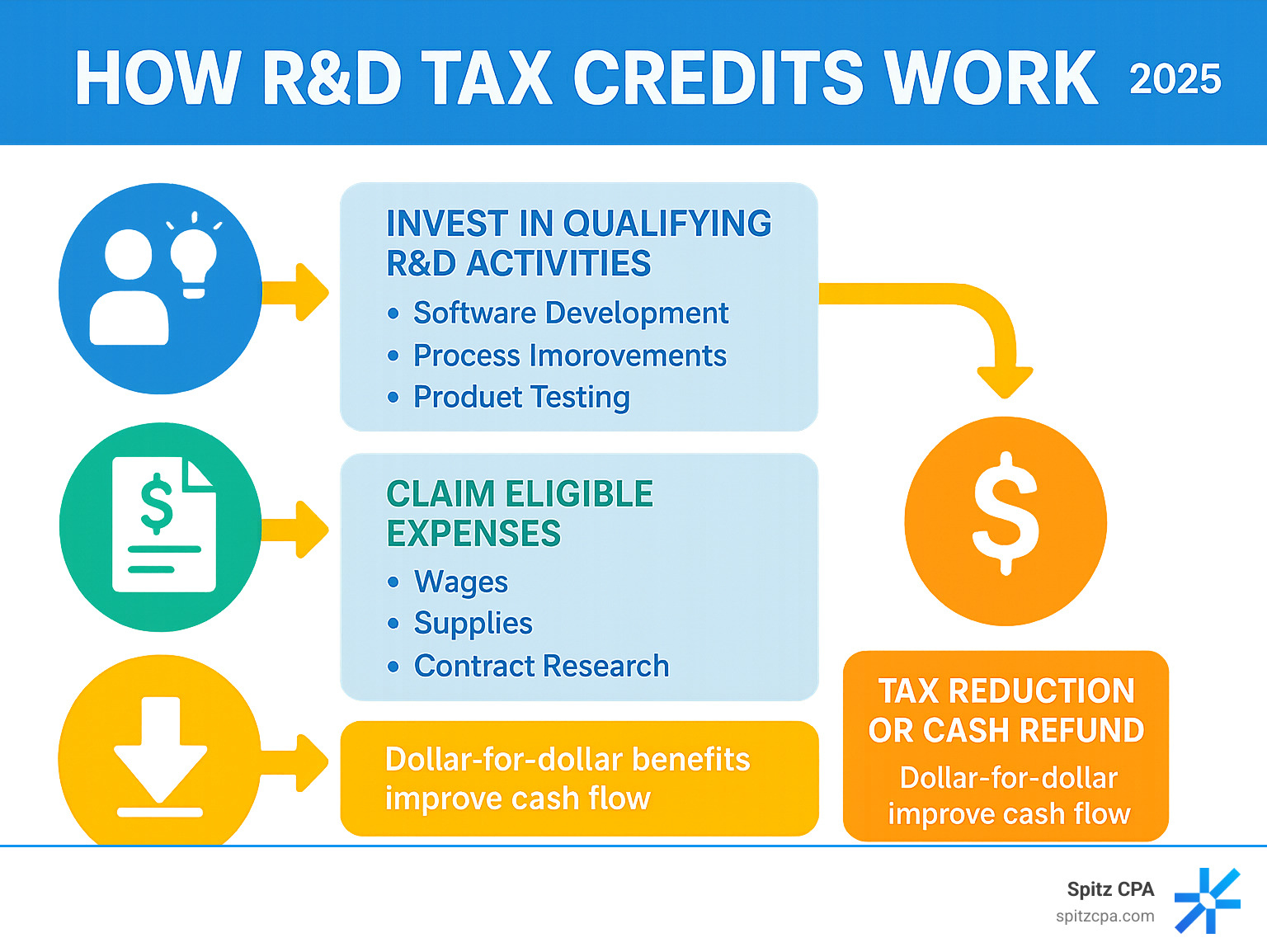
Quick R&D Tax Credit Examples:
- Software Development: Building new APIs, improving app performance, or developing cybersecurity features
- Manufacturing: Testing new materials, automating processes, or designing custom machinery
- Architecture: Creating energy-efficient building designs or developing seismic-safe structures
- Engineering: Optimizing HVAC systems, designing electrical equipment, or improving production processes
The R&D tax credit isn’t just for groundbreaking inventions. It rewards the process of innovation, whether you succeed or fail. Small tweaks to existing products, failed experiments, and process improvements all qualify.
Here’s what surprises most business owners: 91% of R&D claims were accepted in Canada’s 2023-2024 fiscal year, and businesses spent $20.7 billion on R&D wages alone in 2022. These aren’t just tech giants – they’re companies like yours solving everyday technical problems.
The credit can be substantial. Canadian-controlled private corporations can claim a 35% refundable tax credit on eligible R&D costs, while larger corporations get a 15% non-refundable credit. In the US, qualified small businesses can use up to $500,000 to offset payroll taxes.
As Michael J. Spitz with 15+ years of corporate accounting experience across software, telecom, and technology industries, I’ve helped numerous businesses identify qualifying R&D activities they never knew existed. My expertise in r&d tax credits example identification has helped companies turn their innovation efforts into significant tax savings and improved cash flow.
Do You Qualify? The Four-Part Test for R&D Activities

Here’s the exciting truth about R&D tax credits: your business probably qualifies for more than you think. The IRS uses a straightforward “Four-Part Test” to determine if your activities count as qualified research. Don’t worry – you don’t need a PhD or a lab coat to pass.
I’ve seen countless r&d tax credits example cases where business owners assumed they didn’t qualify, only to find their everyday problem-solving activities were worth thousands in tax credits. Small businesses, startups, and even failed projects can absolutely qualify. In fact, some of my most successful claims have been for companies that thought their innovations were “too ordinary” to count.
The beauty of this credit is that it rewards the process of innovation, not just breakthrough findies. Whether you’re improving an existing product or developing something entirely new, the Four-Part Test helps determine if your activities qualify.
If you’re just starting your entrepreneurial journey and want to understand how R&D credits fit into your overall financial strategy, check out our Small Business Accounting 101: A Guide for New Entrepreneurs.
Let’s walk through each part of this test together:
The Permitted Purpose Test
This first test asks a simple question: are you trying to make something new or improved? Your research must aim to develop or improve a business component – whether that’s a product, process, software, formula, technique, or invention.
The key word here is “improved.” You don’t need to invent the next iPhone. Maybe you’re enhancing your software’s performance, making your manufacturing process more reliable, or boosting your product’s quality. All of these count.
I’ve helped clients claim credits for everything from tweaking a mobile app’s user interface to refining a bakery’s dough recipe. The test isn’t about the size of the improvement – it’s about the intention to make something genuinely better.
The Technological in Nature Test
Don’t let the fancy name scare you. This test simply ensures your work involves hard sciences, engineering, computer science, physics, chemistry, or biology. You’re using systematic, technical approaches to solve problems – not just creative brainstorming.
Think about it this way: if you’re writing code to solve a technical challenge, testing new materials in your manufacturing process, or designing energy-efficient systems, you’re likely meeting this test. The goal is eliminating uncertainty through technological methods, not artistic creativity.
The Elimination of Uncertainty Test
Here’s where things get interesting. This test recognizes that true innovation involves venturing into the unknown. You must be dealing with capability uncertainty (can this even be done?), methodology uncertainty (how should we do this?), or design uncertainty (what’s the best approach?).
The magic happens in that space between “we think this might work” and “we know exactly how to do this.” If you’re engaging in systematic trial and error because you genuinely don’t know the outcome, you’re probably meeting this criterion.
I love this part of the test because it validates what every innovator knows: uncertainty isn’t a weakness – it’s where breakthroughs happen.
The Process of Experimentation Test
This final test is about your methodology. You must be evaluating alternatives through systematic approaches like modeling, simulation, or systematic testing. You’re forming hypotheses, testing them, and refining your approach based on results.
The beautiful part? Both success and failure count equally. That prototype that didn’t work? Those three different approaches you tried before finding the right one? All qualify.
This systematic experimentation is what separates true R&D from routine business activities. It’s the difference between following a known recipe and experimenting with ingredients to create something better.
Real-World R&D Tax Credits Example by Industry

Here’s where things get exciting. Once you understand the four-part test, you’ll start seeing r&d tax credits example opportunities everywhere in your business. The secret is recognizing that innovation doesn’t require a lab coat – it happens every day when you’re solving technical problems.
Let me share some real-world examples from industries I’ve worked with. You might be surprised to find that activities you consider “just part of the job” could actually qualify for significant tax credits.
Technology and Software Development R&D Tax Credits Example
If you’re in tech, you’re practically swimming in R&D opportunities. The cloud computing market in Canada alone was worth $38.59 billion in 2024, and most of that investment involved qualifying research activities.
Think about it – every time you develop new algorithms to improve search results or create better user recommendations, you’re doing R&D. When you’re building APIs to integrate with other platforms, you’re eliminating technical uncertainty about how different systems will communicate.
Cybersecurity improvements are another goldmine. Developing new methods to protect against emerging threats? That’s textbook R&D. The same goes for cloud computing infrastructure projects where you’re designing new solutions or optimizing existing ones for better performance.
Even UI/UX improvements can qualify when you’re experimenting with new designs to boost app performance or user engagement. Your beta testing processes, where you systematically identify and resolve technical issues, are perfect examples of the experimentation test in action.
Here’s something interesting – Congress explicitly included software development in Section 174’s definition of R&D, which strengthens the case for these types of claims. Whether you’re doing back-end development with languages like C++ or Java, or building core infrastructure for new platforms, these activities often meet all four criteria.
Manufacturing and Prototyping R&D Tax Credits Example
Manufacturing might seem straightforward, but it’s actually packed with innovation opportunities. Manufacturers can claim credits up to 13% of eligible spending on new and improved products and processes.
Process automation is a classic r&d tax credits example. When you’re developing new production methods to reduce waste or improve quality, you’re solving technical uncertainties through systematic experimentation. Robotics integration follows the same pattern – designing or modifying robotic systems involves plenty of trial and error.
New material testing is another area where manufacturers often qualify without realizing it. Experimenting with different composites or raw materials to find better options involves genuine research. Your CAD/CAM design improvements count too, especially when you’re creating prototypes or optimizing manufacturing processes.
Medical device manufacturing is particularly strong for R&D credits. Activities like developing engineering drawings for new devices, performing CAD modeling, or creating 3D printed components for next-generation equipment all qualify. Even developing microprocessor software for medical devices meets the technological requirements.
The key is documenting your systematic approach to solving these technical challenges. Whether you’re improving production efficiency through machinery modifications or developing prototypes of entirely new products, the experimentation process is what matters.
Architecture and Engineering
Don’t overlook architecture and engineering – these fields are constantly pushing boundaries to create more efficient and resilient structures.
Energy-efficient building design is a perfect r&d tax credits example. When you’re developing innovative facade systems or experimenting with new approaches to reduce energy consumption, you’re eliminating uncertainty about performance and feasibility.
HVAC system optimization involves serious technical challenges. Designing and testing advanced systems for better efficiency or air quality requires systematic experimentation with different configurations and components.
Seismic-safe structures present complex engineering problems. Testing new building elements or construction methods to exceed standard earthquake requirements involves genuine research into materials science and structural engineering.
Even testing new construction materials qualifies when you’re evaluating performance, durability, or environmental impact. The systematic process of comparing alternatives and refining your approach based on results hits all four test criteria.
For mechanical engineers, custom machinery design for specific manufacturing processes often involves solving unique technical challenges. Chemical engineers developing new processes for material production or waste reduction are doing qualifying research too.
The common thread across all these examples is solving technical problems through systematic experimentation. Whether your project succeeds or fails, the research process itself can generate valuable tax credits.
For more information about how our accounting services can help you identify and claim these opportunities, visit: More info about our Accounting services.
Nailing Your Claim: Eligible Expenses and Documentation

You’ve identified your qualifying R&D activities – now comes the crucial part: properly claiming them. This is where many businesses stumble, either by missing eligible expenses or failing to document their work properly. The difference between a successful claim and a missed opportunity often comes down to understanding what counts and keeping the right records.
Think of it this way: the IRS wants to see that you’re genuinely innovating, not just doing regular business activities. Your documentation tells that story. For strategic guidance on maximizing these opportunities, our resource on Tax Planning for Entrepreneurs offers valuable insights.
What Expenses Can You Claim?
The IRS calls them Qualified Research Expenses (QREs), but I prefer to think of them as “innovation costs.” These are the real dollars you’ve spent pushing boundaries and solving technical challenges.
Employee wages typically make up the biggest chunk of any r&d tax credits example claim. Here’s what makes this particularly interesting: if at least 80% of an employee’s time goes toward qualified research activities, you can claim 100% of their wages. No need to split hairs over every hour. Our research shows that 75% of companies’ R&D spending goes directly to workers’ salaries, making this often your most valuable category.
Raw materials and supplies used in your research process are straightforward winners. Whether you’re testing new materials for a manufacturing process or buying servers for software development, these costs add up quickly. The key is that they must be consumed or transformed during the research process.
Contract research costs get special treatment. When you hire an unrelated third party to conduct research on your behalf, you can typically claim 65% of those payments. If you’re working with a related company, it’s usually 100% of the costs, assuming they also qualify for the credit.
Cloud computing expenses for R&D reflect how innovation happens today. If you’re using cloud services directly for qualifying research projects – whether that’s running simulations, testing software, or storing research data – these costs can often be included in your claim.
The Importance of Documentation
Here’s the reality: if you can’t prove it happened, it didn’t happen in the IRS’s eyes. But good documentation isn’t just about audit protection – it’s about maximizing your claim by capturing all the innovation work you’re actually doing.
Contemporaneous records are your best friend. This means documenting activities as they happen, not months later when you’re preparing your tax return. Time-tracking logs that show employees’ hours spent on specific R&D projects create a clear trail from wages to qualified activities.
Project plans and notes tell the story of your innovation journey. Keep records of technical challenges you identified, hypotheses you tested, and solutions you tried. Design documents, meeting minutes, and even informal notes about “what if we tried this?” moments all contribute to building your case.
Test results matter whether they show success or failure. The credit rewards the process of experimentation, not just breakthrough moments. Document your simulations, analyses, and testing outcomes. Those “failed” experiments often represent some of your most valuable qualifying activities.
Invoices and receipts provide the financial backbone of your claim. Payroll records, supply invoices, and third-party research contracts all need to be readily available and clearly linked to specific qualifying projects.
For software development teams, version control logs like Git commits can be goldmines of documentation. They show the iterative process of development, the technical challenges you encountered, and how you systematically worked through solutions.
Common Mistakes to Avoid
I’ve seen businesses leave significant money on the table because of preventable mistakes. The most common error is misidentifying qualified activities. Don’t think too narrowly about what counts as R&D. That process improvement project, the failed prototype, or the software bug that took weeks to solve – these might all qualify if they meet the four-part test.
Poor or missing documentation kills more claims than any other factor. The best time to start documenting is right now, with whatever projects you’re currently working on. Don’t try to recreate records after the fact – it’s obvious and ineffective.
Many businesses make the mistake of overlooking smaller qualifying projects. Innovation doesn’t always happen in big, obvious chunks. Sometimes it’s the accumulation of small improvements and experiments that creates the most substantial claims.
Perhaps the biggest missed opportunity is ignoring failed projects. This bears repeating because it’s so counterintuitive: the R&D credit rewards the process of trying, not just succeeding. If you experimented, tested, and learned something – even if the project ultimately didn’t work – those activities and expenses can still qualify.
Finally, not staying updated on regulations can cost you. R&D tax rules evolve, and what worked last year might not be optimal this year. Working with professionals who stay current on these changes ensures you’re maximizing your opportunities while staying compliant.
The Fine Print: Key Tax Rules in the US and Canada
Understanding how R&D tax credits work in your country can mean the difference between leaving thousands on the table or maximizing your innovation investment. The rules vary significantly between the US and Canada, and even within states and provinces, so let’s break down what you need to know.
For comprehensive support navigating these complex regulations and maximizing your r&d tax credits example opportunities, explore our dedicated tax services: More info about our Tax Services.
R&D Tax Rules in the United States
The US R&D tax landscape underwent a major shift in 2022 that caught many businesses off guard. While the R&D tax credit under I.R.C. §41 remains a powerful incentive, new amortization rules under I.R.C. §174 have changed the game entirely.
Here’s what happened: Before 2022, you could deduct R&D expenses immediately in the year you incurred them. Starting January 1, 2022, the Tax Cuts and Jobs Act forced businesses to capitalize and amortize these expenses over five years for domestic research (15 years for foreign research). This means your taxable income goes up significantly in the first year, even though your actual cash flow hasn’t changed.
The good news? The R&D tax credit becomes even more valuable in this new environment. While you’re paying more in taxes due to the amortization requirement, the credit can provide crucial relief by directly reducing your tax liability dollar-for-dollar.
Recent legislative updates offer hope for change. The American Innovation and R&D Competitiveness Act of 2025 aims to restore immediate deductibility, but until that passes, the current rules remain in effect.
Don’t forget about the look-back period either. If you missed claiming R&D credits in previous years, you can often amend returns going back several years. The IRS even provided a transition period through January 2024 to “perfect” insufficient claims, showing they recognize how complex these rules can be.
For qualified small businesses (those with less than $5 million in gross receipts), there’s an especially attractive feature: you can use up to $500,000 of your R&D credit to offset payroll taxes. This is huge for startups and growing companies that might not have income tax liability but are definitely paying payroll taxes.
How R&D Credits Work in Canada
Canada takes a different approach with its Scientific Research and Experimental Development (SR&ED) program, and frankly, it’s often more generous than the US system. The program is administered by the Canada Revenue Agency and offers some of the most attractive R&D incentives in the world.
Canadian-controlled private corporations (CCPCs) hit the jackpot with a 35% refundable tax credit on eligible R&D costs. That means if you spend $100,000 on qualifying research, you get $35,000 back – even if you don’t owe any taxes. Larger corporations still benefit with a 15% non-refundable credit.
The critical deadline to remember is 18 months from your tax year-end to file Form T661 with your T2 corporate return. Miss this deadline, and you lose the opportunity forever. I’ve seen too many businesses find this the hard way.
Provincial and territorial credits can stack on top of the federal program, creating even more savings. British Columbia offers a 10% refundable credit for CCPCs, while New Brunswick and Nova Scotia provide 15% fully refundable credits. Quebec has one of the most complex but potentially rewarding systems, with rates ranging from 14% to 30% depending on your activities and business size.
Alberta takes a unique approach with their Innovation Employment Grant (IEG), offering up to 20% in fully refundable grants through a tiered system. Ontario has multiple distinct credits including the Ontario Innovation Tax Credit (OITC) at 8% refundable.
Some provinces like Saskatchewan cap their refundable credits at $1 million, while others like Manitoba offer partial refundability. The key is understanding how your provincial program works alongside the federal SR&ED credit.
Northwest Territories, Nunavut, and Prince Edward Island don’t currently offer provincial R&D tax credits, so businesses there rely solely on the federal program.
The beauty of the Canadian system is its alignment between federal and provincial programs. Most provinces use similar eligibility criteria to the federal SR&ED program, making it easier to claim multiple credits for the same activities.
Frequently Asked Questions about R&D Tax Credits
After helping countless businesses find their r&d tax credits example opportunities, I’ve noticed the same questions come up again and again. Let me address the most common concerns that might be holding you back from claiming these valuable credits.
Do I need to invent something groundbreaking to qualify?
Absolutely not! This is the biggest myth I encounter, and it’s costing businesses thousands in unclaimed credits. You don’t need to cure cancer or invent the next iPhone to qualify.
The reality is much more exciting for everyday businesses. Small improvements count. Did you spend time figuring out how to make your manufacturing process 10% more efficient? That could qualify. Are you tweaking your software to load faster or testing different materials to make your product more durable? These process improvements are exactly what the credit is designed to reward.
The key is that you’re solving technical challenges through experimentation. Maybe you tried three different approaches to reduce customer wait times on your website. Even if only one worked, all that testing and refinement could be eligible. Quality improvements like reducing defects in your products or making your service more reliable are prime examples of qualifying activities.
Can my small business or startup claim the R&D tax credit?
Yes, and this might be even more important for you than larger companies! There’s no size requirement for R&D tax credits. Whether you’re a solo entrepreneur working from your garage or a growing company with 50 employees, you can claim these credits.
For startups, there’s an especially sweet deal. In the US, qualified small businesses can use up to $500,000 of their R&D credit as a payroll tax offset. This means even if you don’t owe income taxes yet, you can still get cash back by reducing what you pay in FICA and Medicare taxes. It’s crucial for early-stage cash flow when every dollar counts.
Don’t dismiss your projects as too small. I’ve seen companies claim credits for developing a simple mobile app feature or improving a basic manufacturing jig. Even “small” projects qualify if they involve technical uncertainty and experimentation.
What if my R&D project was not successful?
Here’s some great news: failed projects are still claimable! The R&D tax credit isn’t about rewarding success – it’s about rewarding the process of innovation.
Think about it this way: if you spent six months and $50,000 trying to develop a new product feature that didn’t work out, you still gained valuable knowledge. You learned what doesn’t work, which is just as important as finding what does. The experimentation is key, not the outcome.
I always tell my clients to document the effort, even when projects don’t pan out. Keep records of what you tried, why you tried it, and what you learned. The IRS and CRA understand that innovation involves risk and failure. Both successes and failures count toward your credit calculation.
In fact, some of the most innovative companies have the highest failure rates because they’re pushing boundaries. That willingness to experiment and fail is exactly what these tax incentives are designed to encourage.
Conclusion: Turn Your Innovation into a Financial Asset
After exploring these r&d tax credits examples across industries, one thing becomes crystal clear: innovation happens everywhere, not just in traditional labs. Your software bug fixes, manufacturing tweaks, and process improvements aren’t just business necessities – they’re valuable financial assets waiting to be claimed.
The beauty of R&D tax credits lies in their accessibility. Whether you’re a startup founder debugging code at 2 AM or a manufacturer testing new materials, your problem-solving efforts likely qualify. We’ve seen clients find thousands of dollars in credits from projects they considered “routine maintenance.”
Don’t let these opportunities slip away. The four-part test isn’t designed to exclude businesses – it’s a roadmap to help you identify qualifying activities. Failed experiments count. Small improvements matter. Even that frustrating project that didn’t work out as planned can still put money back in your pocket.
The key is taking action. Start reviewing your recent projects through the lens of the four-part test. Document your processes, track your expenses, and remember that both successes and failures contribute to your R&D story.
At Spitz CPA, we’ve helped countless businesses transform their innovation efforts into real cash flow improvements. We understand that tax regulations can feel overwhelming, especially when you’re focused on growing your business. That’s why we specialize in making complex tax concepts simple and finding every legitimate opportunity for savings.
Your commitment to solving problems and improving your products or processes deserves recognition – and reward. Let us help you turn that innovation into a financial asset that strengthens your business’s future.
Open up your business’s potential with our expert tax services.


