


Opening Innovation with R&D Tax Credits
R&d tax experts help businesses access substantial government incentives for their innovation activities.
- Purpose: R&D tax credits reduce your tax burden or provide cash refunds for qualifying research and development.
- Potential Value: Companies can receive significant portions of qualifying expenses back, with some programs offering up to 68% (e.g., Canadian CCPCs).
- Expert Role: Specialists identify qualifying activities, maximize claims, handle documentation, and provide audit defense.
- Common Industries: Software development, manufacturing, engineering, biotech, and many others qualify.
- Key Benefit: Transform innovation investments into immediate tax savings or cash flow.
The tax environment for innovators is both highly rewarding and complex. With programs like Canada’s SR&ED offering massive refundable credits and similar incentives worldwide, the opportunity is significant. However, navigating the technical requirements and documentation standards requires specialized expertise to not only qualify but also maximize claims while ensuring audit-proof compliance.
I’m Michael J. Spitz, and with over 15 years of corporate accounting experience in innovation-driven industries, I understand how r&d tax experts can transform your business’s financial position. My background in strategic financial decisions and complex compliance provides unique insight into optimizing R&D tax credits.
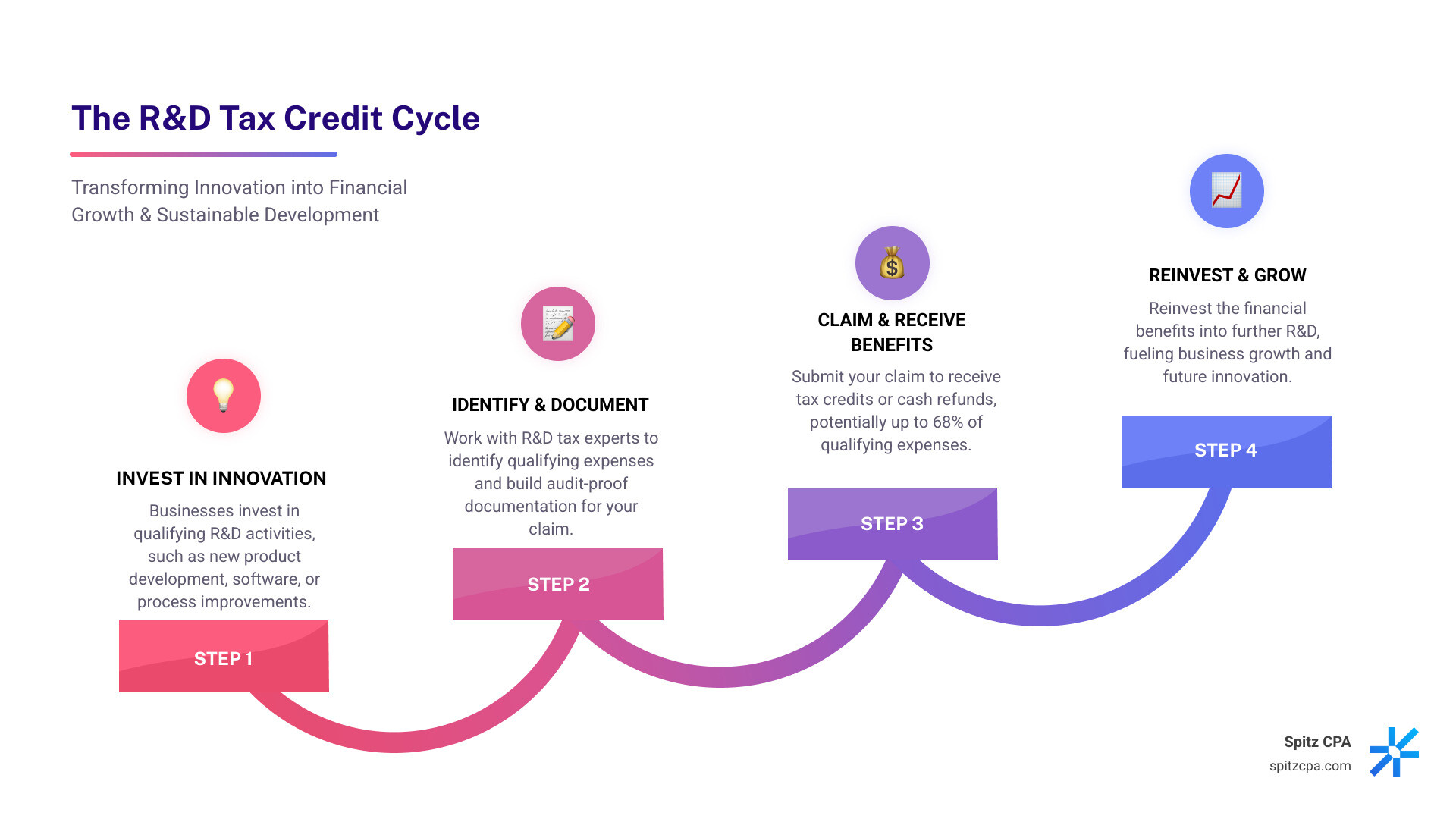
Explaining R&D Tax Credits: Eligibility and Qualification
R&D tax credits are designed to fuel innovation by refunding a portion of your research and development spending. When you invest in solving technical problems or creating something new, the government helps cover part of that cost through tax reductions or cash refunds. For many businesses, this means getting back 35 to 68 cents on every dollar spent on qualifying activities.
Qualification hinges on a few core principles:
- Technical Uncertainty: You were trying to figure out something that wasn’t obvious, like developing a new algorithm or a custom manufacturing process.
- Process of Experimentation: You used a systematic process of investigation, forming hypotheses, running tests, and analyzing results.
- Permitted Purpose: Your work was aimed at creating or improving a product, process, or technique.
- Technological Information: The goal was to generate information that advances your field, even if the project ultimately failed.
The largest qualifying expenses are often employee wages for engineers, developers, and researchers. Contractor costs for specialized R&D and supplies and materials consumed during experimentation also qualify.
Understanding these fundamentals is crucial. For businesses looking to optimize their overall financial strategy, our small business accounting services can help ensure you’re capturing every opportunity.

Who is Eligible for R&D Tax Credits?
R&D tax credits are available to a much wider range of businesses than most people realize. Startups working on their first product, established businesses refining processes, and foreign-owned companies with domestic R&D operations can all qualify.
Many industries have substantial qualifying activities:
- Manufacturing: Developing new production techniques or materials.
- Software Development: Building new applications or solving technical challenges through code.
- Engineering: Pushing boundaries in aerospace, civil, mechanical, or other disciplines.
- Biotech: Engaging in pharmaceutical research or medical device development.
We’ve also helped clients in construction, agriculture, and even food service claim credits. The key insight from r&d tax experts is this: it’s not about your industry, but your activities. If you’re systematically trying to overcome technical uncertainties, you likely qualify.
What Types of Projects and Activities Qualify?
Qualifying activities center on systematic investigation to resolve technical uncertainties.
- New product development is a primary qualifier, including all iterations and prototypes.
- Process improvement work, such as optimizing a manufacturing line or developing a new quality control method, often qualifies.
- Software development is a broad qualifier, covering new algorithms, custom applications, and significant improvements that solve technical problems.
- Prototyping and testing cycles represent systematic experimentation and are goldmines for credits.
A key point that surprises many is that failed or abandoned projects can be your strongest qualifiers. A project that fails often provides clear evidence of the significant technical challenges these programs are designed to support. The focus is on your process of experimentation, not commercial success. Whether you’re developing new algorithms, formulating new materials, or designing new manufacturing processes, the common thread is systematic investigation aimed at technological advancement.
The Crucial Role of R&D Tax Experts in Maximizing Your Claim
Many businesses leave thousands of dollars on the table because navigating R&D tax credit programs is complex. This is where r&d tax experts become game-changers. We bring specialized experience to transform a confusing process into a streamlined one that maximizes your benefits.
Working with skilled r&d tax experts means you gain partners focused on claim maximization. We identify every eligible dollar and present your case in the strongest possible way. The complexity of R&D tax regulations, with differing federal and state/provincial rules and changing audit procedures, makes expert guidance essential for avoiding costly mistakes.
Experts provide peace of mind and significant time savings. You can focus on innovation while knowing your claim is prepared correctly, is audit-ready, and is part of your overall strategic planning.

How R&D tax experts steer complex regulations
The world of R&D tax credits changes constantly. Specialized r&d tax experts stay ahead of these shifts.
- Identifying qualifying activities: We uncover qualifying work you might overlook as “normal business operations” through detailed discussions with your technical teams.
- Documentation strategy: We help you build systems to capture the right information contemporaneously, which is critical for substantiating claims, especially for programs like Canada’s SR&ED.
- Calculating qualified expenditures: We ensure precision in calculating costs for employees, contractors, and materials based on specific tax rules.
- Navigating legislative changes: We provide strategic guidance on major shifts like the Section 174 capitalization rules in the US, which impact cash flow and make credits even more valuable.
Choosing the right R&D tax experts for your business
Finding the right partner is crucial. Look for these qualities:
- Specialized knowledge: You want experts who live and breathe R&D tax credits, not generalists.
- Technical expertise: The best firms combine tax professionals with engineers and scientists who can understand your work.
- Transparent pricing: Many firms work on contingency, aligning their success with yours.
- Success rate and audit defense: Top firms have high success rates and a strong record of defending claims during audits.
- A holistic approach: The best experts help build a long-term R&D tax strategy, not just a one-off claim.
For broader financial planning that complements your R&D tax strategy, explore our tax planning for entrepreneurs services.
The Impact of Technology and AI in Modern Claims
Technology and AI are revolutionizing how r&d tax experts prepare claims, increasing speed and accuracy. AI-driven platforms automate data collection from payroll and project management systems like Jira or GitHub, eliminating tedious manual work. This allows for real-time tracking of R&D activities and contemporaneous documentation. The result is a more efficient process that produces stronger, more comprehensive, and audit-ready claims, freeing up your technical teams to focus on innovation.
The Application and Audit Process: A Step-by-Step Guide
Once you’ve identified qualifying activities and expenses, the application process begins. While specifics vary by jurisdiction, the general flow is consistent.
- Initial Consultation: We start with workshops to understand your business and R&D activities.
- Information Collation: We systematically gather technical and financial information for your R&D projects.
- Report Preparation: Our r&d tax experts prepare a comprehensive claim report, including technical write-ups and a financial breakdown of expenditures.
- Submission: The completed forms (e.g., Form 6765 for the US, Form T-661 for Canada) and supporting documents are submitted with your company’s tax return.
- Processing & Approval: The tax authority reviews your application. Processing times vary, but it’s wise to be prepared for potential delays.

Essential Documentation for a Bulletproof Claim
Meticulous documentation is the key to a successful claim and audit defense. Tax authorities require “contemporaneous records” created at the time the R&D was performed.
Essential documentation includes:
- Project plans and technical specifications
- Test results, data, and prototype records
- Meeting notes discussing R&D challenges
- Payroll records detailing time spent on R&D
- Invoices for materials and contract research
- Version control logs for software development
- Project narratives describing the work and uncertainties
We work with clients to ensure clear evidence links all claimed expenditures to eligible R&D activities.
Common Pitfalls to Avoid
Avoiding common mistakes is crucial for a successful claim.
- Poor Documentation: The biggest reason claims fail is a lack of clear, contemporaneous records.
- Claiming Non-Qualifying Activities: Including routine work that doesn’t involve technical uncertainty or experimentation.
- Miscalculating Expenses: Incorrectly quantifying eligible costs can lead to an undervalued claim or an audit.
- Missing Deadlines: Each program has strict submission deadlines.
- Inadequate Technical Descriptions: Failing to clearly articulate the technical challenges and systematic approach.
- Assuming Success is Required: Overlooking valuable claims from failed or abandoned R&D projects.
Navigating a Tax Audit with Confidence
The prospect of an audit can be unsettling, but with expert support, it’s manageable. While most claims are processed without issue, it’s always best to be prepared.
If your claim is selected for review, r&d tax experts act as your primary contact with the tax authority (e.g., CRA or IRS). We handle all communications and provide the robust documentation needed to substantiate the claim. This defense is built on the meticulous preparation done from the start. Even when audits occur, experienced experts have a high success rate in recovering the vast majority of the claimed value, ensuring your ongoing R&D processes remain compliant for the future.
Frequently Asked Questions about R&D Tax Credits
As r&d tax experts, we frequently address the same questions from businesses exploring these powerful incentives. Here are answers to the most common ones.
What are the potential financial benefits of claiming R&D tax credits?
The financial impact can be transformative. These credits provide a dollar-for-dollar direct tax reduction. Better yet, many credits are refundable, meaning if the credit exceeds your tax liability, the government sends you a check for the difference. This is especially true for a Canadian Controlled Private Corporation (CCPC) or certain startups.
The numbers can be significant. Canada’s SR&ED program can return up to 68% of qualifying expenses, and we’ve helped businesses secure over $500,000 in refundable credits. This increased cash flow can be reinvested to hire staff, purchase equipment, and accelerate innovation, fueling future growth.
Can I claim credits for projects that were not successful?
Yes, absolutely. The tax authorities are not focused on commercial success but on whether you followed a systematic process of experimentation to resolve technological uncertainty.
In fact, failed projects often make for stronger claims. They provide clear evidence that you were pushing boundaries and facing genuine technical challenges that required experimentation. Those abandoned prototypes and unsuccessful projects represent some of your most valuable R&D tax credit opportunities.
How does the Quebec R&D tax credit compare to other incentives?
Quebec’s R&D tax credit program is one of the most generous in the world, especially for small and medium-sized enterprises. A key advantage is that Quebec credits can be stacked with federal SR&ED credits, creating a combined rate that is highly competitive globally.
When making international comparisons, the benefits become clear. The US offers valuable credits, but recent Section 174 capitalization rules have added complexity. The UK and Australia also have strong incentive programs. However, the combination of generosity, refundability, and stackable incentives in Canada, particularly in Quebec, makes its R&D support system stand out. Understanding the specific benefits available in your jurisdiction is why partnering with experienced r&d tax experts is so critical.
Conclusion: Partnering for Innovation and Growth
R&D tax credits are a powerful tool for funding innovation, reducing your tax burden, and boosting cash flow. They are the government’s way of rewarding companies for pushing technological boundaries.
However, the process is complex. Identifying qualifying activities, preparing detailed documentation, and navigating tax laws requires specialized knowledge. This is why partnering with r&d tax experts is not just a good idea—it’s essential for maximizing your claim while ensuring compliance.
By entrusting your R&D tax credit claims to experts, you secure every eligible dollar and gain the peace of mind to focus on what you do best: innovating and growing your business.
At Spitz CPA, we understand the intricate landscape of R&D tax credits. We provide the expert guidance to untangle these complexities and open up your company’s full potential. For businesses in Gilbert, AZ, and across Arizona, our goal is to help you improve cash flow, achieve financial clarity, and drive significant growth.


