


Why R&D Tax Services Are Essential for Growing Businesses
R&D tax services help innovative companies claim valuable tax credits for their research and development activities. These specialized services can significantly reduce your tax burden and provide cash flow improvements to fuel further innovation. Key services include eligibility assessments, documentation preparation, claim submissions, audit support, and strategic planning.
Research and development tax incentives exist in many countries. In Canada, the SR&ED program offers deductions and investment tax credits, with SMEs receiving an average of approximately £81K annually. In the US, companies claim federal credits through IRS Form 6765, with additional state-level incentives available.
However, claiming these credits requires navigating complex rules and maintaining detailed documentation. Many businesses miss opportunities or face audits due to inadequate preparation.
As Michael J. Spitz, I bring over 15 years of corporate accounting experience helping businesses optimize their tax strategies. My expertise in R&D tax services ensures companies maximize their innovation incentives while maintaining full compliance.
R&d tax services helpful reading:
Understanding the Core Concepts of R&D Tax Credits
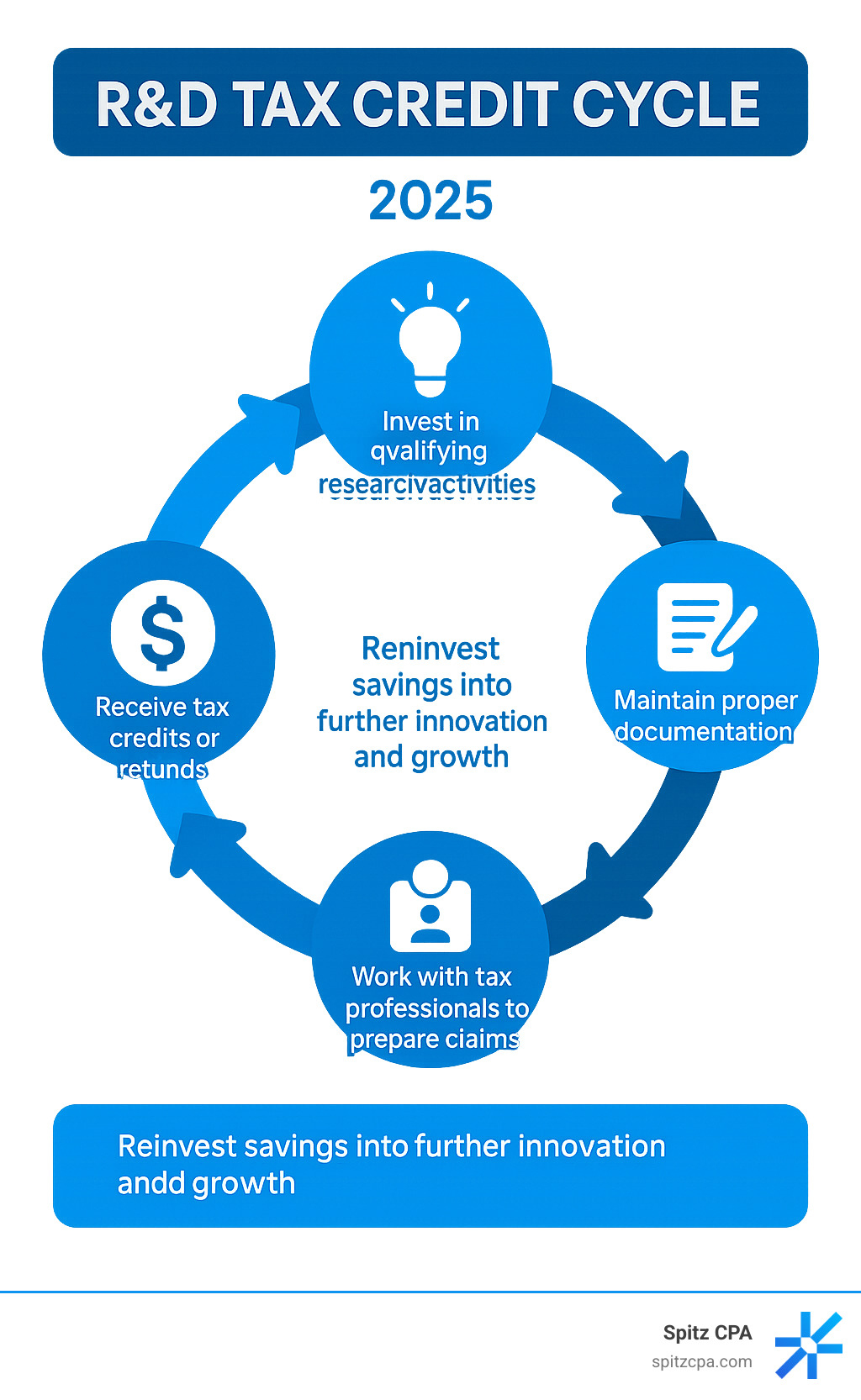
R&D tax credits are the government’s way of rewarding innovation. These incentives create a powerful benefit: they fuel innovation by providing resources for more research, reduce your tax liability directly, and improve cash flow, especially with refundable credits. This creates a self-reinforcing cycle where tax savings fund more innovation. Understanding these credits is essential for effective Tax Planning for Entrepreneurs.
What might surprise you is that qualifying activities extend far beyond traditional lab research. Software development and process improvement activities often qualify. If you’re solving technical problems to improve the function, performance, reliability, or quality of a business component, you are likely performing qualifying R&D work.
What is the Four-Part Test for Eligibility?
Tax authorities use a four-part test to determine if your activities qualify:
- Technical Uncertainty: You must demonstrate that you faced technical challenges where the solution was not readily available or known.
- Process of Experimentation: You need to show a systematic process of testing, modeling, or simulation to resolve the uncertainty.
- Technological in Nature: Your work must be based on principles of physical sciences, biological sciences, engineering, or computer science.
- Permitted Purpose: The goal must be to create a new or improved product, process, software, or formula, focusing on function, performance, reliability, or quality.
Meeting these criteria is key; the commercial success of the project is not. Failed experiments often qualify because the focus is on the systematic attempt to resolve technical uncertainty.
How R&D Tax Credits Work
Understanding the mechanics of R&D tax services highlights the value of professional guidance. The system offers two main benefits:
- Deduction against income: This works like other business expenses, reducing your taxable income. A $100,000 R&D deduction in a 25% tax bracket saves you $25,000.
- Investment Tax Credit (ITC): This is more powerful, as it reduces your tax bill dollar-for-dollar. A $25,000 ITC saves you exactly $25,000 in taxes.
Credits can be refundable or non-refundable. Refundable credits can result in a cash payment from the government if the credit exceeds your tax liability. Non-refundable credits reduce your tax bill to zero and can often be carried forward to future years.
For a practical example of how these calculations work, check out our detailed R&D Tax Credits Example.
A Deep Dive into Canada’s SR&ED Program
Canada’s Scientific Research and Experimental Development (SR&ED) program is one of the most generous R&D tax incentive programs in the world. Administered by the Canada Revenue Agency (CRA), this federal program is accessible to corporations, individuals, trusts, and partnerships.

The SR&ED program provides both a deduction against income and valuable investment tax credits (ITCs). For many smaller businesses, these credits are refundable, meaning you can receive cash back from the government. Success depends on properly linking eligible R&D work to the expenses claimed, which is why professional R&D tax services are critical. For official guidelines, always check the Federal SR&ED program information from the CRA.
Federal vs. Provincial & Territorial Credits
Most provinces and territories offer their own R&D tax credits that work alongside the federal SR&ED program. The CRA administers most of these provincial credits, simplifying the filing process. However, the interaction between federal and provincial credits is complex. Provincial credits can be treated as government assistance, which may reduce your eligible federal expenses. This is where an expert can ensure your claims are coordinated and maximized across both levels.
Provincial Spotlight: Rates and Refundability
Each province offers unique R&D tax credits, creating a layered system of benefits. Rates and refundability vary significantly:
- Generous Refundable Credits: Provinces like New Brunswick, Nova Scotia, and Yukon offer fully refundable credits around 15%. Saskatchewan provides a 10% refundable credit for CCPCs on the first $1 million of expenditures.
- Variable & Tiered Rates: Alberta’s Innovation Employment Grant (IEG) offers rates from 8% to 20% to reward increased R&D spending.
- Straightforward & Complex Systems: British Columbia has a 10% refundable credit for CCPCs, while Ontario features multiple programs (OITC, OBRITC, ORDTC) with distinct rules.
Navigating this landscape requires expertise. For details on specific programs, like the More on the Nova Scotia R&D Tax Credit, it’s worth reviewing provincial legislation.
R&D Tax Credits Around the Globe: A Comparative Look
Innovation is global, and so are R&D tax incentives. For multinational companies, understanding international differences is crucial for maximizing innovation funding. Countries constantly adjust their R&D tax schemes to stay competitive, and the complexity varies dramatically.

Key Differences in Major Economies
Here is a brief comparison of schemes in four key economies:
- Canada (CRA): The SR&ED program offers generous refundable credits for private corporations and non-refundable credits for larger companies, stacked with provincial incentives.
- United States (IRS): The federal credit is primarily non-refundable, but startups can offset payroll taxes. Rates vary, and many states offer additional credits.
- United Kingdom (HMRC): Features two main schemes—the SME scheme for smaller businesses (with some refundability) and the RDEC for larger companies.
- Australia (ATO/AusIndustry): The R&D Tax Incentive can provide significant refundable benefits for SMEs and distinguishes between “core” and “supporting” R&D activities.
Key agencies, credit types, and rates differ substantially, and rules are constantly changing.
Navigating US R&D Tax Credits
For businesses in the United States, the federal R&D tax credit is claimed using IRS Form 6765, but recent changes have increased complexity.
A major shift is Section 174 capitalization, which now requires businesses to capitalize and amortize R&D costs over five years (domestic) or fifteen years (foreign), impacting cash flow. However, the Start-up Payroll Tax Offset allows qualified small businesses without income tax liability to use federal R&D credits to offset payroll taxes, providing a direct cash benefit.
State-level credits add another layer of opportunity. Arizona has updated its R&D calculation methods to align with the federal approach. Minnesota is introducing a new refund option, and Texas has increased its R&D credit benefits.
Staying current with these federal and state changes is essential. As Michael J. Spitz, I see how easily businesses miss opportunities. Professional R&D tax services ensure you capture every benefit while maintaining compliance. For the latest federal updates, refer to the IRS guidance on Form 6765.
The Value of Professional R&D Tax Services
Running a business is demanding enough without mastering intricate R&D tax legislation. Professional R&D tax services act as your specialized guides, with a mission to maximize your benefits, ensure compliance, and steer the complexities of R&D tax law.
Beyond filing claims, we provide crucial audit support and help identify other innovation funding opportunities, like government grants. This deep specialization means we’ve seen every scenario and can help you open up significant benefits.
How R&D Tax Services Maximize Your Claim

Maximizing your claim requires a deep understanding of both your technical work and tax law. Professional R&D tax services achieve this by:
- Thorough Claim Preparation: We review all activities to ensure every eligible project and expenditure is captured, often uncovering qualifying work that businesses overlook.
- Compelling Technical Narratives: We translate your complex projects into clear narratives that meet tax authority requirements, working with your technical staff to highlight the innovation.
- Detailed Financial Costing: We identify and quantify all associated costs, including salaries, contractor fees, materials, and overhead, to ensure nothing is missed.
- Identifying All Qualifying Expenditures: Our expertise helps find hidden opportunities in software development, process improvements, and even failed experiments that still qualify for credits.
As Michael J. Spitz, I bring over 15 years of corporate accounting experience to ensure your calculations are both thorough and compliant. For a comprehensive look at how these calculations work, see our R&D Tax Credit Calculation: Complete Guide.
Common Pitfalls and How an Expert Helps
The path to claiming R&D tax credits is filled with traps that can lead to rejected claims, audits, or missed opportunities. An expert helps you avoid:
- Poor Documentation: We help you build systems to create the clear, contemporaneous records that tax authorities demand.
- Misinterpreting Eligibility: We apply our expertise to correctly identify qualifying activities you might have missed and exclude those that don’t meet the strict definitions.
- Missing Deadlines: We manage the rigid submission windows to ensure you never forfeit benefits.
- Failing Audits: We provide robust audit support and representation, standing by your side throughout any inquiry.
- Inadequate Linkage: We ensure a clear connection is demonstrated between your eligible work and the specific costs claimed.
Our R&D tax services are designed to help you sidestep these traps. For broader insights, our Small Business Accounting 101: A Guide for New Entrepreneurs offers valuable guidance.
Frequently Asked Questions about R&D Tax Services
When businesses first explore R&D tax credits, they often have similar questions. Here are answers to the most common ones.
What types of documentation are essential for an R&D claim?
To substantiate your claim, you need contemporaneous documentation that tells the story of your innovation. Essential records include:
- Project plans outlining objectives and technical uncertainties.
- Technical specifications and test results (both successes and failures).
- Financial records like payroll data and contractor invoices to link costs to projects.
- Supporting documents such as meeting minutes, lab notebooks, and emails that show technical discussions.
Records created during the project are far more valuable than those reconstructed later.
Can I claim R&D tax credits for a failed project?
Absolutely yes! This is a common misconception about R&D tax services. R&D tax credits recognize that innovation involves risk. What matters is not commercial success, but whether you followed a genuine process of experimentation to resolve technical uncertainty. If your project met the four-part test, its expenditures typically qualify, regardless of the outcome. Failed experiments provide valuable data and are a key part of the R&D process.
How do I choose the right provider for R&D tax services?
Choosing the right partner is critical. Look for these key attributes:
- Proven Experience: Seek a firm with a long track record specifically in R&D tax credits.
- Technical Expertise: The best providers combine tax professionals with engineers or scientists who understand your technical work.
- Transparent Fee Structure: Ensure you understand how they charge, whether it’s a contingency or fixed fee.
- Success Rate: Look for testimonials or case studies that demonstrate consistent results across different industries.
- Comprehensive Audit Support: Your partner should be able to confidently defend your claim if questions arise.
As Michael J. Spitz, I bring over 15 years of corporate accounting experience to help businesses maximize their R&D tax benefits. At Spitz CPA, we provide personalized guidance to help you achieve significant growth.
Conclusion
Innovation drives business success, but claiming the tax credits you deserve shouldn’t drain your energy or resources. R&D tax services are more than just paperwork assistance – they’re your gateway to recovering significant funds that can fuel your next breakthrough.
The world of R&D tax credits is intricate, with eligibility rules that vary by country, documentation requirements that demand precision, and tax legislation that seems to change faster than your latest product iteration. What looks straightforward on paper often reveals layers of complexity that can trip up even the most organized businesses.
This is exactly why partnering with experienced R&D tax services makes such a difference. When you work with specialists who understand both the technical aspects of your innovation work and the nuances of tax law, you’re not just filing a claim – you’re maximizing every dollar you’re entitled to receive.
At Spitz CPA, we’ve seen businesses transform when they recover substantial R&D credits they didn’t even know they qualified for. Software companies find their debugging processes qualify. Manufacturers realize their efficiency improvements count. Startups learn their failed experiments are actually valuable for tax purposes.
Our approach is comprehensive yet personal. We dig deep into your operations to identify qualifying activities others might miss. We prepare bulletproof documentation that stands up to scrutiny. Most importantly, we handle the complexity so you can stay focused on what drives your business forward.
As Michael J. Spitz, I bring over 15 years of corporate accounting experience to ensure your R&D investments translate into maximum tax benefits. We believe your innovation deserves every advantage – and that includes claiming every credit available to you.
Ready to turn your R&D investments into cash flow improvements?
Open up your innovation potential with our expert tax services


