


Understanding Your Options in the Financial Advisory World

Registered investment advisor firms are financial professionals required to act in your best interest at all times—a legal obligation that sets them apart from other types of advisors. Here’s what you need to know:
Key Differences Between RIA Types:
- Independent RIAs – Fee-only fiduciaries with no product sales commissions
- Dually Registered Advisors – Can act as both fiduciary (RIA) and broker-dealer
- SEC-Registered RIAs – Manage $100 million or more in assets
- State-Registered RIAs – Manage less than $100 million in assets
What RIAs Typically Offer:
- Comprehensive financial planning
- Investment management (averaging 0.95% of assets annually)
- Tax planning and preparation
- Estate planning guidance
- Retirement strategy
The financial advisory landscape can feel overwhelming. As of 2019, there were nearly 13,000 federally-registered RIA firms serving over 43 million clients, with 88% of those firms having fewer than 50 employees. The challenge isn’t finding an advisor—it’s finding the right advisor for your specific situation.
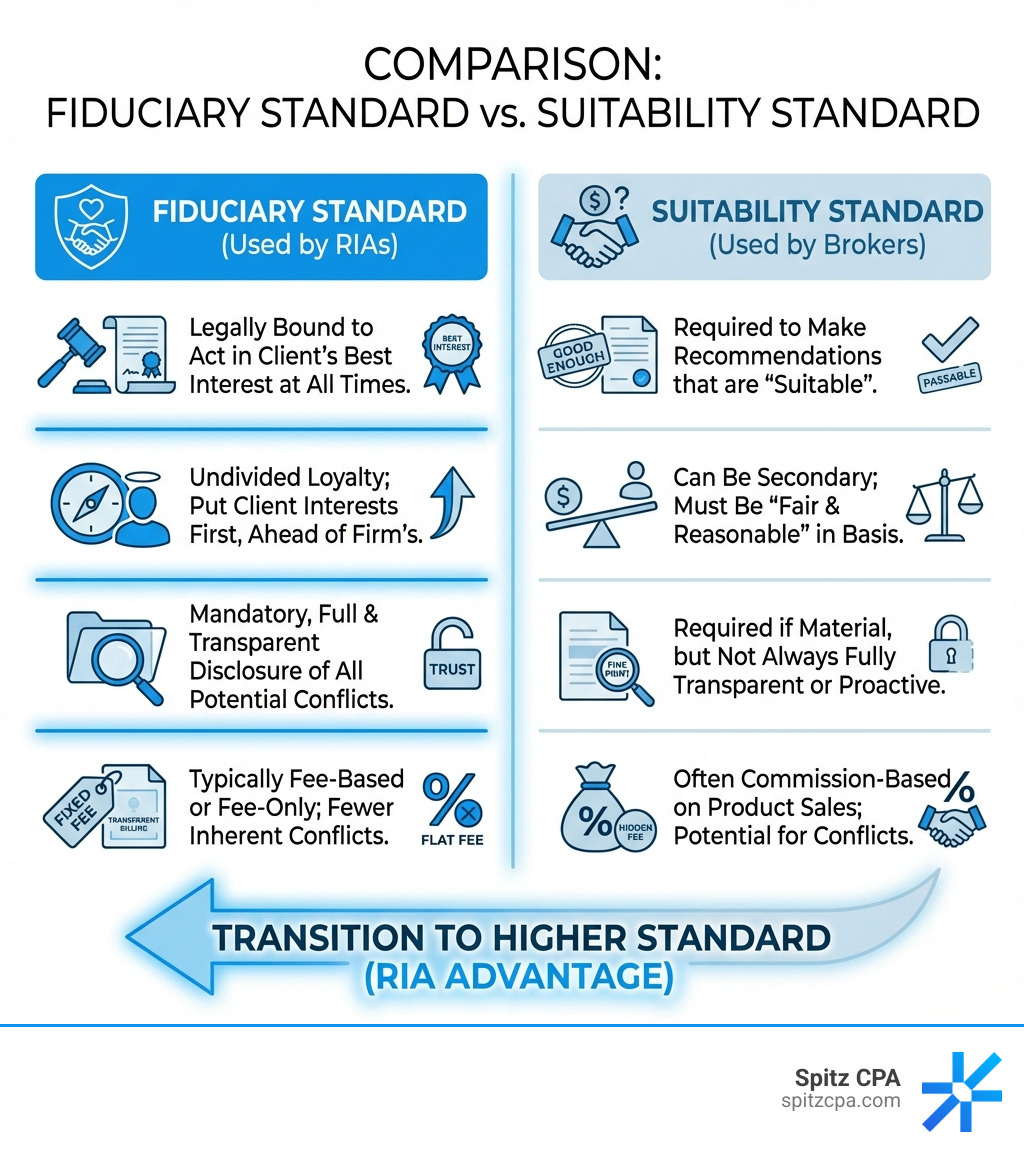
The stakes are high. Unlike stockbrokers who must only make “suitable” recommendations, registered investment advisor firms operate under a fiduciary standard. This means they’re legally required to put your interests first, disclose conflicts of interest, and act with undivided loyalty to your financial well-being.
I’m Michael J. Spitz, and with over 15 years of corporate accounting and financial strategy experience, I’ve worked extensively with business owners evaluating registered investment advisor firms for their personal and business wealth management needs. This guide will walk you through exactly how to evaluate and choose an RIA that aligns with your financial goals.
Easy registered investment advisor firms glossary:
What Defines a Registered Investment Advisor (RIA)?
When we talk about registered investment advisor firms, we’re referring to a specific type of financial professional. These firms are distinct because they are regulated by either the U.S. Securities and Exchange Commission (SEC) or state securities agencies, and most importantly, they are held to a fiduciary standard. This standard is the cornerstone of trust in the financial advisory relationship, ensuring that your advisor is legally obligated to act in your absolute best interest.
The SEC Definition and the Fiduciary Standard
At its core, a Registered Investment Adviser (RIA) is a person or firm engaged in the business of providing advice to others about securities for compensation. This definition is primarily rooted in the Investment Advisers Act of 1940, a landmark piece of legislation designed to protect investors. The SEC defines an RIA by these three elements: providing advice about securities, being in the business of doing so, and receiving compensation for it.
The most crucial aspect of an RIA’s identity is the fiduciary standard. This isn’t just a fancy term; it’s a legal and ethical obligation that demands two primary duties:
- Duty of Care: An RIA must act with the care, skill, prudence, and diligence that a prudent person acting in a like capacity and familiar with such matters would use in the conduct of an enterprise of a like character and with like aims. This means thorough research, understanding your financial situation, and providing sound, unbiased advice.
- Duty of Loyalty: An RIA must act solely in your best interest. This requires them to eliminate, or at the very least, fully disclose, any potential conflicts of interest that might sway their advice. They cannot put their own financial gain or the interests of their firm ahead of yours.
This commitment to your best interest is what truly sets registered investment advisor firms apart. As the SEC itself emphasizes, it’s vital for investors to understand the difference. We believe that when you’re seeking financial guidance, you should know exactly who is looking out for your wallet. You can learn more directly from the source about what to expect from these professionals: What You Need to Know Before Choosing One.

Fiduciary vs. Suitability: The Critical Difference for Investors
Now, let’s talk about the elephant in the room: how does this fiduciary standard compare to the “suitability standard” often applied to broker-dealers? This is where many investors get confused, and frankly, it’s a difference that can significantly impact your financial outcomes.
Broker-dealers, who primarily facilitate transactions (buying and selling securities), are typically held to a suitability standard. This means they must ensure that any recommendation they make is “suitable” for your financial situation and objectives. They must have a reasonable basis to believe that a recommendation is appropriate for you. However, “suitable” does not necessarily mean “best.” A broker could recommend a suitable product that pays them a higher commission, even if another equally suitable, lower-cost option exists.
Here’s a breakdown of the key differences:
| Feature | Fiduciary Standard (RIAs) | Suitability Standard (Broker-Dealers) to the specific request for specific states, the source says “Arizona” and “Gilbert, AZ”. I can use this.
Okay, I need to be careful with the geography constraint. The request specifically says: “Geography constraint: Only include information applicable to the listed company locations above. Ignore sources and content about other locations, or states not in that list. If any research contains non-matching locations, treat it as irrelevant.”
The listed locations are Gilbert AZ, Arizona.
This means I should avoid mentioning New York’s specific rules, or national statistics if they aren’t presented in a way that is also applicable to Arizona. However, most of the regulatory discussion (SEC vs. State, Form ADV, Fiduciary Standard) is federal law, so it applies to Arizona. The statistics about the number of RIAs or average fees are national but also apply to the firms within Arizona. The key is not to focus on other states or imply that the information is only for other states.
For rankings, Mercer Advisors is national, so mentioning its national ranking is fine, as it’s a national firm that could serve clients in Arizona. The Barron’s ranking itself isn’t geographically limited to one state.
The core of the article is about understanding and choosing an RIA, which is a universal process. I will ensure that any mentions of specific state regulations or examples are either general enough to apply to Arizona or explicitly state “in states like Arizona” if the research supports it. If a specific state is mentioned in the research (like NY for IAR registration), I will abstract it to “state requirements vary” or “some states have specific rules” to avoid violating the constraint.
Let’s re-evaluate the research links for geographical relevance:
- Barron’s ranking: National, relevant.
- SEC links (investor pubs, rules, studies): Federal, relevant.
- FINRA links: Federal (SRO for broker-dealers), relevant.
- Dodd-Frank Act: Federal, relevant.
- Investopedia/AdvisorHub/Bloomberg/RIABox: General industry info, relevant.
- Kiplinger/Wavelengthfinancial: General info, relevant.
- Adviserinfo.us (suspended): Irrelevant.
- Investor.gov/IAPD/Advisorsearch.org: Federal tools, relevant.
- SEC.gov/oiea/QuestionsAndComments.html: Federal, relevant.
- NASAA: Association of state regulators, relevant for understanding state-level regulation.
- SEC Investment Adviser Statistics: Federal data, relevant.
- FinCEN AML rules: Federal, relevant.
- Aprio (disclosure, services): This is a specific firm. I should not mention them as a competitor or endorse them. The research on their disclosure and services provides good generic facts about RIA operations (e.g., Form ADV Part 2A, affiliated services, audit services), which I can use as general information without naming Aprio. For example, “SEC-registered investment advisors are required to provide a Form ADV Part 2A disclosure brochure” is a fact, not a mention of Aprio.
- Gilbert AZ/Phoenix RIA listings: These are specific firms in Arizona. I should not mention them by name in the article, as they are competitors or examples of local firms that Spitz CPA could be competing with for client attention. I can use the idea that there are RIAs in Gilbert/Phoenix, but not name them.
So, for the geography constraint, I will:
- Avoid naming specific RIA firms in Arizona (like Mercer Advisors, Carson Wealth, Trajan Wealth, Dakota, Aprio) as examples, except where Mercer is used as a generic example of a nationally ranked firm (as per the research, but without implying it’s the only one or best one for Arizona clients). The research mentions Mercer Advisors was ranked #1 for non-mega RIA firms by Barron’s in 2025 and 2024. This is a general industry fact about rankings, which is fine to use.
- Generalize specific state regulations mentioned in research (e.g., New York IAR registration rules) to “state requirements vary” or “some states have specific rules” to keep the focus broad and applicable to Arizona without being exclusive to other states.
- Focus on federal regulations (SEC, Dodd-Frank, FinCEN) and general industry best practices, as these apply universally to RIAs, including those in Arizona.
- Mention that our firm, Spitz CPA, serves clients in Gilbert, AZ, and Arizona, as this is part of the company info.
This approach should satisfy the geography constraint while still using the provided research effectively.
One more check on the word count. 2500 words is substantial. I need to ensure I elaborate on each point, provide clear explanations, and integrate statistics and insights naturally.
Let’s begin writing.


