


Why a Registered Investment Advisor Search Matters Before You Invest
A registered investment advisor search is your first line of defense against investment fraud and financial mismanagement. Before entrusting anyone with your hard-earned money, you need to verify their credentials, check their disciplinary history, and understand exactly how they’re regulated.
Quick Answer: How to Search for a Registered Investment Advisor
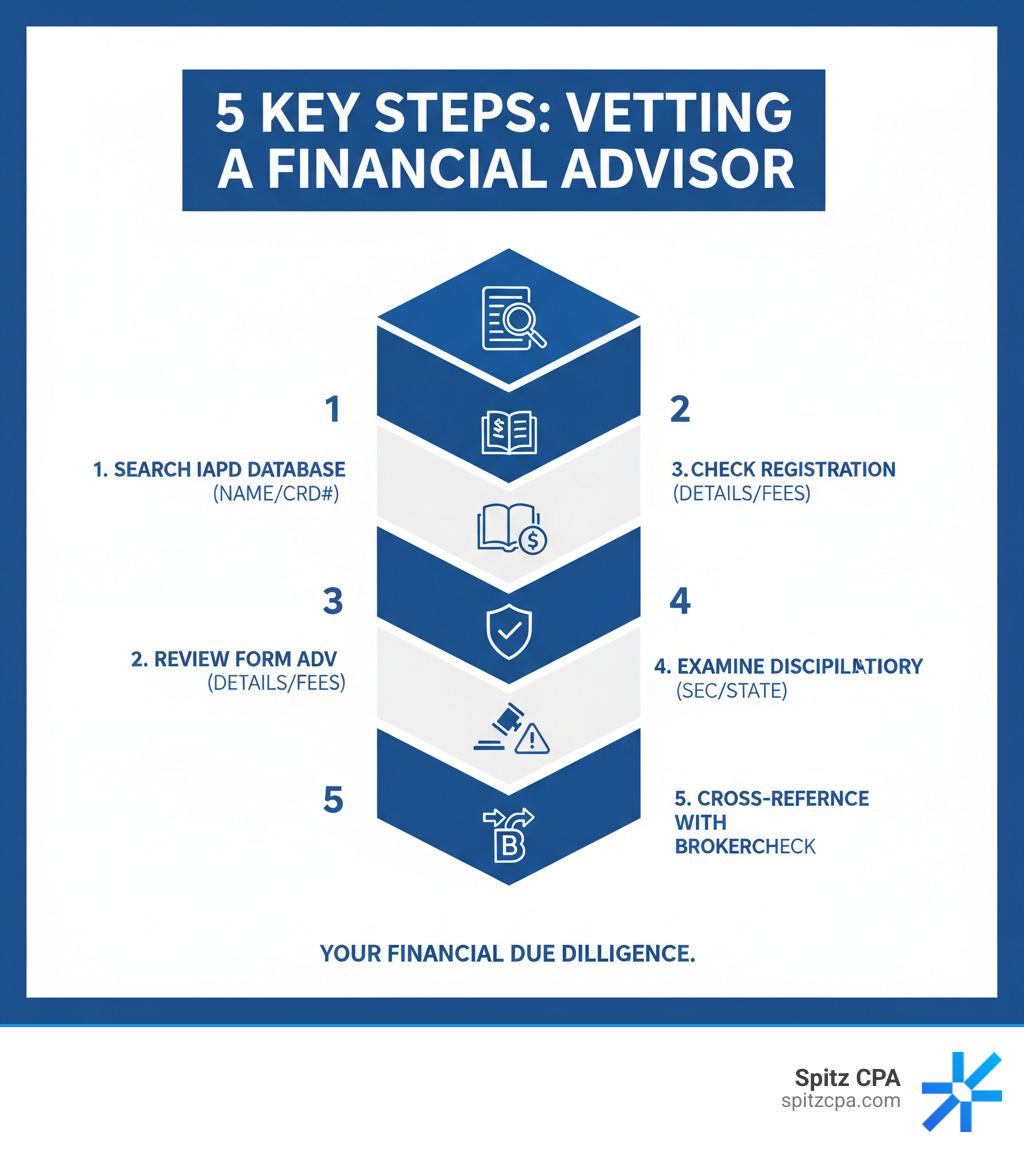
- Visit the IAPD website at www.adviserinfo.sec.gov
- Search by name, CRD number, or location to find the advisor or firm
- Review their Form ADV for business details, fees, and services
- Check registration status (Approved, Terminated, Revoked, etc.)
- Review disciplinary history for any regulatory actions or complaints
- Use BrokerCheck at brokercheck.finra.org if they’re also a broker
- Verify their regulator (SEC or state securities authority)
According to the SEC, unlicensed, unregistered persons commit much of the investment fraud in the United States. That’s why conducting a thorough background check isn’t optional—it’s essential. The Investment Adviser Public Disclosure (IAPD) website and FINRA’s BrokerCheck are free tools that give you instant access to registration information, employment history, and any red flags in an advisor’s past.
The stakes are high. Investment advisers oversee trillions of dollars. For business owners growing their wealth or entrepreneurs planning for retirement, the right financial professional can mean the difference between reaching your goals and losing your nest egg.
The verification process is straightforward. The IAPD database contains information on thousands of registered investment advisor firms, searchable by name, location, or registration number. Form ADV, a required filing, reveals everything from fee structures to disciplinary actions.
I’m Michael J. Spitz. With over 15 years of corporate accounting and financial experience, I’ve helped countless business owners steer complex financial decisions, including how to properly vet potential investment advisors. Understanding these verification tools is crucial for protecting your assets.
Understanding the Key Verification Tools
Two essential, free tools make your registered investment advisor search possible: the Investment Adviser Public Disclosure (IAPD) website and FINRA’s BrokerCheck. These resources provide a window into a financial professional’s background, empowering you to make informed decisions.
The IAPD website, managed by the SEC and state securities authorities, provides detailed information on registered investment advisers (RIAs) and their representatives (IARs). It contains their registration status, employment history, disciplinary actions, and Form ADV filings, which reveal how an advisor operates and charges for services.
BrokerCheck, managed by the Financial Industry Regulatory Authority (FINRA), focuses on brokers and brokerage firms that buy and sell securities for clients. It provides information on their licensing, employment history, and any regulatory issues or customer complaints.
Conveniently, the IAPD database searches both systems at once. This gives you a complete picture, which is helpful as many professionals are dually registered as both investment advisers and brokers. For a comprehensive guide, the SEC offers an excellent resource at Using IAPD | Investor.gov.
IAPD vs. BrokerCheck: Which Tool Do You Need?
Understanding the distinction between these tools is crucial for an effective search.
Use IAPD for researching professionals who provide investment advice, financial planning, or wealth management. These RIAs are regulated by the SEC or state authorities. IAPD provides their Form ADV, detailing business operations, fees, services, and disciplinary history.
Use BrokerCheck for researching brokers and firms that execute trades and sell securities. FINRA, an independent regulator, maintains their registration status, employment history, regulatory actions, and customer complaints.
The key difference? Investment advisers have a fiduciary duty to act in your best interest at all times. Brokers are held to a suitability standard, meaning their recommendations must be appropriate for your situation but not necessarily the absolute best option available.
| Feature/Tool | IAPD (Investment Adviser Public Disclosure) | BrokerCheck (FINRA) |
|---|---|---|
| Primary Focus | Registered Investment Advisers (RIAs) and their representatives (IARs) | Brokers, brokerage firms, and their representatives |
| Regulators | SEC and state securities authorities | FINRA (for brokers), but links to IAPD for RIAs |
| Key Info | Form ADV filings, registration status, business operations, disciplinary history, fees, services | Registration status, employment history, regulatory actions, investment-related arbitrations, complaints |
| When to Use | When seeking advice on managing investments, financial planning, wealth management | When buying/selling specific securities (stocks, bonds, mutual funds) or working with a broker |
| Use Both If… | The professional offers both investment advice and also sells securities. Many professionals wear two hats! | |
| Limitations | May not detail civil litigation unrelated to investments; primarily focuses on advisory roles | Does not cover non-investment-related civil litigation or certain criminal matters (unless felonies or investment-related misdemeanors) |
When should you use both tools? Use both when a professional is dually registered, offering both advisory and brokerage services. This gives you a complete view of their background.
Both tools have limitations. They may not show all civil litigation or certain criminal matters. For the most thorough background check, supplement your search on these platforms with a general internet search or by contacting your state securities regulator directly.
Taking the time to use these verification tools before you invest is one of the smartest financial decisions you can make.
Your Step-by-Step Guide to a Registered Investment Advisor Search
Let’s walk through the process of a thorough registered investment advisor search. This due diligence ensures you’re working with a legitimate, trustworthy, and competent professional.

This is a background check on who will handle your money. Finding the right licensed professional is critical for growing your business’s wealth or planning for retirement. At Spitz CPA, we empower clients with the knowledge to make smart decisions, including how to properly vet the financial professionals you’re considering.
Starting Your Search on the IAPD Website
The Investment Adviser Public Disclosure (IAPD) website is where your detective work begins.
Start at the official Investment Adviser Public Disclosure portal. You can search by an individual name or a firm name. The most precise method is using a CRD number, a unique identifier for each professional and firm. An SEC file number works similarly for SEC-registered firms.
If you’re starting from scratch, the location-based search helps you find local advisors by city, state, or ZIP code, such as an advisor in Gilbert, AZ. Once you click on a name, you’ll be taken to their detailed report. If you run into technical issues, you can call 240-386-4848 for support.
For those seeking comprehensive financial guidance that goes hand-in-hand with solid investment planning, take a look at our range of Services at Spitz CPA.
Decoding Form ADV: An Advisor’s Report Card
Form ADV is the most important document in your search. Every RIA firm must file this complete professional disclosure with the SEC and state authorities. It details how an advisor operates, their fees, and any regulatory history.
Form ADV Part 1 contains firm details: business operations, ownership, Assets Under Management (AUM), office locations, and, most importantly, any disciplinary history. Review this section carefully.
Form ADV Part 2, the “brochure,” is written in plain English. It outlines services offered, fee structures (e.g., percentage of assets, hourly, or flat fee), and helps you spot potential conflicts of interest. It also discloses investment strategies, conflicts of interest, and the backgrounds of key employees. A transparent advisor will be clear in this section.
Pay special attention to fee structures and disclosed conflicts. At Spitz CPA, we often help clients make sense of complex financial details. We even offer Accounting Clean Up Services to ensure your own financial records are in pristine shape before you engage with any investment advisor.
Interpreting Registration Status and Disclosures
On the IAPD website, the first thing to check is the registration status. This tells you if an advisor is currently authorized to operate.
- Approved is the status you want to see. It means the firm or individual is currently registered and authorized.
- Termination Requested, Terminated, or Withdrawn statuses indicate an adviser is ending or has ended their registration in a state, which is not necessarily a red flag.
- Revoked is a major red flag. It means a regulator has stripped the adviser’s authorization, usually for serious violations or misconduct.
Always click on the “Registration Status” hyperlink for details and effective dates.
Beyond status, carefully review any disciplinary events or disclosures. These mandatory reports can range from customer complaints to serious regulatory actions, civil judgments, or criminal charges. Read the details. A disclosure requires investigation but isn’t an automatic disqualification. Context is key: was it a minor, resolved error, or is there a pattern of serious misconduct?
For formal actions, you can use the SEC Action Lookup tool. This can provide additional context about any disciplinary history you find, which is a key part of conducting a comprehensive background check.
SEC vs. State-Registered Advisors: Who’s in Charge?
Understanding who regulates an investment advisor—the SEC or a state authority—is a key part of your registered investment advisor search. The answer impacts how you find information.

Investment advisers are regulated at the federal level by the SEC or at the state level by state securities authorities. The distinction depends on the firm’s size, measured by its Regulatory Assets Under Management (RAUM). Generally, the SEC oversees larger firms, while states regulate smaller ones, but there are exceptions.
The Key Differences in Your Registered Investment Advisor Search
The primary dividing line is $100 million in RAUM. Firms with more than this amount generally register with the SEC, while smaller firms register with their state securities authority.
Even large, SEC-registered firms must make “Notice Filings” in states where they have clients. This involves sending a copy of their Form ADV to the state regulator, keeping them informed.
Firms with less than $100 million in RAUM are typically state-registered. If they have clients in multiple states, they must register in each one, which is common for advisors serving a specific region like the Phoenix metro area.
If you’re exploring comprehensive financial guidance that goes beyond just investment advice, our Business Tax Strategies services can complement your overall wealth management approach.
Understanding Your Advisor’s Regulatory Body
Knowing your advisor’s regulator is important for oversight and recourse. This information is easy to find. The simplest way to find out is to ask the advisor directly. A legitimate professional will tell you if they are SEC- or state-registered. You can also find this information in the IAPD report or by using the search tool on the SEC’s Investor.gov website.
For state-specific inquiries, the North American Securities Administrators Association (NASAA) provides contact information for your state’s securities authority at Contact Your Regulator.
There are exceptions to the RAUM rule. Certain advisers must register with the SEC regardless of AUM, including advisers to mutual funds and certain pension consultants. Mid-sized advisers (between $25 million and $100 million in RAUM) must register with the SEC if their home state doesn’t require registration. Internet advisers and advisers required to register in 15 or more states can also choose to register with the SEC for efficiency.
Even if a firm is SEC-registered, individual states may still license the firm’s representatives. This dual oversight ensures both the firm and its advisors meet local requirements. For more information, the SEC’s Investor.gov provides excellent resources on Investment Adviser Registration | Investor.gov.
This regulatory landscape may seem complex, but that’s why this level of due diligence matters. It’s about understanding the system designed to protect your interests.
Frequently Asked Questions about Registered Investment Advisor Searches
Here are answers to common questions that come up during a registered investment advisor search.
What is the difference between a Registered Investment Advisor (RIA) and a broker?
This is a critical distinction. A Registered Investment Advisor (RIA) has a fiduciary duty, meaning they are legally required to act in your best interest. They must disclose any conflicts of interest and recommend what is best for you, not what earns them the highest commission. RIAs typically charge fees based on a percentage of assets, an hourly rate, or a flat fee.
Brokers operate under a suitability standard. Their recommendations must be appropriate for your situation but aren’t required to be the absolute best option. They often earn commissions from selling specific investment products, which can create potential conflicts of interest.
Many professionals are dually registered, acting as both an RIA and a broker. It’s important to ask which role they are in when they give you advice.
At Spitz CPA, we help business owners understand these distinctions. Whether you’re aligning personal investments with your business tax strategies or ensuring your advisor has your best interests at heart, knowing this difference is crucial.
What does it mean if an advisor has a “disclosure” on their record?
If you find a “disclosure” on a Form ADV or BrokerCheck report, don’t ignore it. A disclosure is a required report of an event, ranging from minor to very serious.
- Minor disclosures could include resolved customer service complaints or small settlements made without admitting wrongdoing.
- Serious disclosures include regulatory actions (fines, suspensions), civil judgments from lawsuits, or criminal charges.
The key is to read the details of any disclosure. Assess what happened, when it occurred, the outcome, and whether there is a pattern of issues. Context matters enormously.
If you’re unsure how to interpret a disclosure, that’s the kind of question we help clients think through. At Spitz CPA, we believe in thorough due diligence, whether you’re vetting an advisor or reviewing your own records through our accounting clean-up services.
How can I find historical data or information about an advisor?
Digging into historical data is a smart move when vetting an advisor. These records are publicly available through several sources:
- The IAPD website maintains historical Form ADV filings, allowing you to track changes in an advisor’s business, fees, and disclosures over time.
- For a deeper dive, the SEC provides downloadable data files of Investment Adviser Information Reports in .csv format, with data going back to 2001.
- The SEC Action Lookup tool is invaluable for finding formal SEC enforcement actions against individuals.
- FINRA maintains a public list of barred brokers, which is a massive red flag indicating serious violations.
- State securities regulators maintain their own records. Contact your state regulator through NASAA’s Contact Your Regulator directory for local insights.
At Spitz CPA, we understand that business owners need to approach financial relationships with diligence. Whether you’re vetting a potential advisor or seeking integrated financial services, thorough research is always time well spent.
Conclusion
Your registered investment advisor search is a critical safeguard against potential fraud or mismanagement. It’s the foundation of your investment strategy.
This guide has equipped you with the tools and knowledge for proper due diligence. You can now use IAPD and BrokerCheck, decode Form ADV, and understand the regulatory landscape to vet who you trust with your money.

According to the SEC, unlicensed and unregistered individuals commit much of the investment fraud in the United States. Verification is essential. A thorough registered investment advisor search not only protects you but also helps you find the right advisor—one whose philosophy, fees, and experience align with your goals.
Verifying credentials isn’t a one-time event. It’s wise to periodically review your advisor’s status and any new disclosures. Financial relationships require ongoing attention.
For business owners, the stakes are even higher, as personal wealth and company health are interconnected. Michael J. Spitz and the team at Spitz CPA specialize in providing integrated financial services that bridge the gap between personal wealth management and business financial strategy. We help ensure both sides of your financial life work in harmony for sustainable growth.
Whether you’re just starting your search or conducting due diligence, the time you invest now pays dividends in security and peace of mind. Your financial future deserves a thoroughly vetted, properly registered professional who is legally bound to put your interests first.


