


What You Need to Know About Sales Tax in Gilbert, Arizona
Sales tax in Gilbert, AZ is increasing in 2025, and both residents and business owners need to understand what’s changing. Here’s what you need to know right now:
Key 2025 Changes:
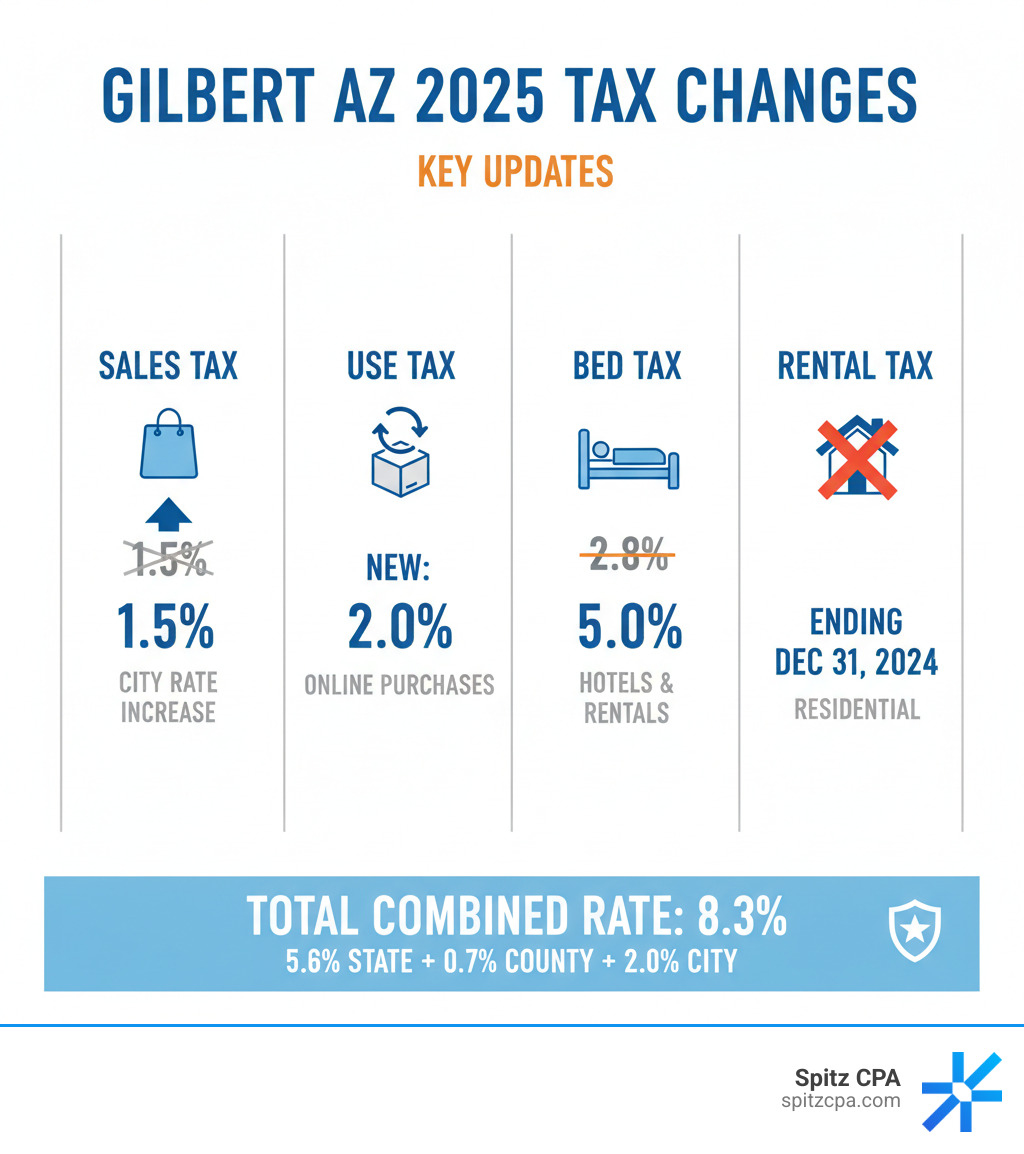
- Combined Sales Tax Rate: 8.3% total (5.6% state + 0.7% county + 2.0% city)
- Gilbert City Rate Increase: From 1.5% to 2.0% (effective January 1, 2025)
- New Use Tax Rate: 2.0% (previously 0%)
- New Bed Tax Rate: 5.0% (increased from 2.8%)
- Residential Rental Tax: Ends December 31, 2024
What This Means for You:
- A $100 purchase will cost 50 cents more in sales tax
- Online purchases from out-of-state vendors now subject to 2.0% use tax
- Hotels and short-term rentals face higher bed tax rates
If you operate a business in Gilbert, you’re responsible for collecting and remitting Transaction Privilege Tax (TPT) to the Arizona Department of Revenue. This applies whether you have a physical location or meet the economic nexus threshold of $100,000 in Arizona sales.
Gilbert doesn’t impose a primary property tax, so these sales tax increases will fund critical infrastructure projects for Parks, Police, and Fire departments. The town expects to generate approximately $55 million annually from these changes.
I’m Michael J. Spitz, and with over 15 years of corporate accounting experience, I’ve helped businesses steer complex sales tax obligations in Gilbert, AZ and optimize their tax strategies. Understanding these 2025 changes is crucial for maintaining compliance and avoiding unexpected liabilities.
Understanding the 2025 Gilbert, AZ Sales Tax Rate Changes
Understanding Gilbert’s 2025 sales tax changes doesn’t have to be complicated. The Town of Gilbert is adjusting its sales tax rates, and knowing what’s changing will help you plan ahead, whether you’re running a business or shopping around town.
Starting January 1, 2025, Gilbert’s tax landscape is shifting in three key areas: sales tax, use tax, and bed tax. These changes affect everyone from restaurant owners to hotel guests, and they’re all part of Gilbert’s plan to fund essential services and infrastructure improvements.

The New Combined Sales Tax Rate
When you make a purchase in Gilbert starting in 2025, you’ll pay a combined sales tax rate of 8.3%. Understanding its components is key.
The rate combines three parts: the 5.6% Arizona state rate, the 0.7% Maricopa County rate, and Gilbert’s 2.0% city rate. The city’s portion is increasing by 0.5% from its previous 1.5%.
For example, a $500 television will now have $41.50 in sales tax, up from $39.00—a $2.50 difference. While modest for one purchase, this adds up for businesses processing many transactions.
To calculate the tax, simply multiply your purchase amount by 0.083.
Key Dates and New City-Specific Rates
Mark your calendar: January 1, 2025 is when everything changes. The Gilbert Town Council approved these increases at their October 22, 2024 meeting, giving businesses and residents time to prepare.
Beyond the sales tax increase, Gilbert is also introducing a use tax and raising its bed tax.
The Gilbert city sales tax increase from 1.5% to 2.0% applies to most taxable goods and services you’ll encounter daily. Whether you’re buying groceries (the taxable kind), dining out, or purchasing supplies for your business, this new rate takes effect on New Year’s Day.
Gilbert is also introducing a use tax at 2.0%. This applies when you buy something from an out-of-state vendor who doesn’t collect Arizona sales tax. If you order office supplies online from a company without a physical presence in Arizona, you’re technically responsible for paying this use tax. Arizona calls this the Transaction Privilege Tax (TPT), and it’s the state’s version of sales tax—though technically, it’s a tax on the privilege of doing business rather than on the sale itself.
The bed tax increase from 2.8% to 5.0% is perhaps the most dramatic change. This additional tax applies to hotels, motels, and short-term vacation rentals (stays under 30 days). If you’re in the hospitality business, this change will directly impact your pricing and guest invoices.
For complete details and the most current information, visit the official 2025 Tax Rates page on Gilbert’s website. Having accurate information from the source helps you stay compliant and avoid surprises.
Why the Increase? How Gilbert Will Use the New Tax Revenue
Wondering why Gilbert is raising taxes? The decision stems from the town’s growth to over 280,000 residents and rising inflation. These factors increase the need for expanded services and drive up costs for materials and equipment, prompting the Town Council’s action.
These increases aim to maintain Gilbert’s quality of life. The Town expects to generate approximately $55 million annually from these rate changes, and every dollar has a purpose.
Funding Gilbert’s Future: Critical Infrastructure Projects
Unlike most cities, Gilbert doesn’t have a primary property tax. It relies heavily on sales tax revenue to fund services and projects, making this increase crucial for operations.
Between 2014 and 2023, Gilbert identified 33 high-priority infrastructure projects totaling over $1 billion, with 23 of them (over $700 million) deemed critical and time-sensitive. The new tax revenue will be instrumental in moving these projects forward.
The funds will support crucial improvements in three main areas: Parks and Recreation facilities, Police Department resources for neighborhood safety, and Fire Department equipment and stations for rapid emergency response.
A small portion of the bed tax revenue is restricted for tourism, per state law. The majority, however, will fund general Town needs and infrastructure under Town Council oversight. You can explore the full list of priority projects that will benefit from this funding here: Explore Our Priority Projects.
At Spitz CPA, we believe these infrastructure investments create a thriving business environment. A well-functioning community allows businesses to focus on growth. If you’re looking to optimize your business’s financial health as these changes take effect, we’re here to help you Improve Business Profitability.
How Gilbert’s Tax Rates Compare to Other Valley Cities
Let’s put this increase in perspective. Gilbert’s previous 1.5% city sales tax rate was among the lowest in the Valley. Even at 2.0%, Gilbert remains competitive with its neighbors.
Here’s how Gilbert stacks up against other Valley cities starting in 2025:
| City | Sales Tax Rate (City) | Combined Sales Tax Rate (State + County + City) | Use Tax Rate (City) | Bed Tax Rate (Additional City) |
|---|---|---|---|---|
| Gilbert (2025) | 2.0% | 8.3% | 2.0% | 5.0% |
| Mesa | 1.75% | 8.30% | 1.75% | 5.0% |
| Chandler | 1.5% | 8.10% | 1.5% | 2.9% |
| Glendale | 2.9% | 9.20% | 2.9% | 5.0% |
| Scottsdale | 1.75% | 8.30% | 1.75% | 5.0% |
Note: Combined sales tax rates include Arizona’s 5.6% state tax and Maricopa County’s 0.7% county tax.
As you can see, Gilbert’s new rates are comparable to other Valley cities. The 2.0% city sales tax rate is similar to neighbors like Mesa and Scottsdale, and the 5.0% bed tax aligns with several other municipalities. This allows Gilbert to fund expected services without pricing itself out of the market.
The bottom line? Gilbert is investing in its future while remaining a competitive and attractive place to live, work, and do business.
Navigating Business Compliance for Sales Tax in Gilbert, AZ
If you run a business in Gilbert, staying on top of these tax changes isn’t just about checking boxes—it’s about keeping your business healthy and playing your part in building a stronger community. Arizona’s tax system has its quirks, especially with Transaction Privilege Tax (TPT), but understanding the basics makes it manageable.

Understanding Your Obligations
Let’s clarify what each tax means, as the terms can be confusing.
Transaction Privilege Tax (TPT) is what most people call “sales tax” in Arizona. Technically, it’s a tax on the privilege of doing business in the state, levied on the seller. You are responsible for collecting and remitting it, though it’s usually passed on to customers.
Use Tax is the flip side of the coin. When you or your customers buy from an out-of-state vendor who doesn’t collect Arizona sales tax, use tax is owed on that purchase. With Gilbert’s new 2.0% use tax rate starting January 1, 2025, this becomes much more relevant. For example, if you buy office supplies from an online retailer that doesn’t charge Arizona tax, you must report and pay the 2.0% use tax. The Arizona Department of Revenue has a helpful guide if you want to dive deeper: Understanding Use Tax – Arizona Department of Revenue.
Bed Tax (officially the Transient Lodging Tax) is an additional tax on short-term accommodations (less than 30 days), like hotels and vacation rentals. Gilbert’s rate is increasing from 2.8% to 5.0%. This revenue often supports tourism initiatives.
Understanding these distinctions is key to accurate tax reporting.
Registering for a TPT License and Reporting
The good news is that Gilbert is a “Program City.” This means the Arizona Department of Revenue (AZDOR) is a single point of collection for state, county, and city TPT, which streamlines the process.
To get a TPT license, complete the joint tax application on AZTaxes.gov. You’ll use NAICS codes (North American Industry Classification System) to categorize your business, ensuring you’re assigned the correct tax classifications.
Once you’re licensed, use the region code “GB” when reporting your Gilbert activity. This tells the system where your business transactions occurred. Your returns will be organized by specific business tax classifications, which are reporting codes for different taxable activities.
We’ve helped countless Gilbert businesses with this setup and know that getting it right initially prevents future headaches. If you’re looking for strategic guidance on managing your business tax obligations, our Business Tax Strategies services can help you stay compliant while optimizing your tax position.
What’s Taxable in Gilbert?
The sales tax in Gilbert, AZ applies to a wide range of business activities. Starting January 1, 2025, the standard Gilbert city rate for most activities is 2.0% (up from the previous 1.5%).
Retail sales of physical goods are the most common taxable activity. You’ll collect the 2.0% city tax whether you have a physical store or sell remotely into Gilbert.
Restaurants and bars also fall under TPT at the 2.0% rate, including caterers and food trucks. Commercial property rental, including office, retail, or warehouse space, is also taxable at 2.0%.
Contracting covers various activities including speculative builders, owner/builders, and MRRA activities (maintenance, repair, replacement, and alteration), which generally fall under the 2.0% rate.
The amusements category, which includes theaters, sporting events, and gym memberships, is taxed at 2.0%. Utilities like electric power, water, and gas are taxable, as are communications services.
Hotels and motels pay the standard TPT rates plus an additional 5.0% bed tax (up from 2.8%) for stays under 30 days, making their total tax burden significantly higher.
Don’t forget about use tax—purchases from out-of-state vendors where Arizona TPT wasn’t collected are now subject to Gilbert’s 2.0% use tax.
For the complete picture with all the specific details and any exceptions, the Town of Gilbert Tax Code is your authoritative source. It’s worth bookmarking if you’re doing business in Gilbert.
Filing, Reporting, and Other Tax Considerations
Once you understand your tax obligations, the next step is ensuring you file and pay correctly and on time. Meticulous record-keeping and a clear understanding of the process are essential to prevent issues and costly penalties.

How to File and Pay Your Gilbert Sales Tax
Because Gilbert is a “Program City,” the Arizona Department of Revenue (AZDOR) is your single point of contact. You’ll file and pay Gilbert’s TPT, along with state and county taxes, directly to AZDOR, typically using the State form TPT-1.
The most efficient way to handle your filing is through the AZTaxes.gov portal. This online system lets you manage your TPT license, file returns, and make payments all in one place. File & Pay Online.
Your filing frequency depends on your sales volume. ADOR will assign you to file monthly, quarterly, or annually. Monthly returns are generally due by the 20th of the following month. For example, January 2025 sales would be reported by February 20, 2025. Missing these deadlines can trigger penalties, so marking your calendar is essential.
When you complete your TPT-1 form, remember to use the region code “GB” for all Gilbert activities. This simple code ensures your tax payments are properly allocated to the Town of Gilbert.
We understand that juggling tax deadlines can be overwhelming. That’s why we help businesses set up efficient tracking and reporting systems, keeping your Small Business Accounting organized and stress-free.
Factoring Tax and Handling Exemptions for Sales Tax in Gilbert, AZ
Some businesses prefer to include sales tax in their advertised prices rather than adding it at checkout. This is known as factored tax. While this can simplify pricing for customers, it requires careful calculation on your end.
When you factor tax, you must use a specific factoring formula to correctly calculate the tax amount embedded within your total price. This ensures you remit the right amount to the state. The Arizona Department of Revenue provides detailed guidance on this: TPP 00-1 for factoring info.
Now, let’s talk about exemptions—transactions not subject to sales tax in Gilbert, AZ. Understanding these can save your business money.
Sales for resale are a common exemption. If you sell goods to another business that plans to resell them, the transaction is generally exempt from TPT, provided your customer gives you a valid resale certificate.
Food for home consumption is taxed at 2.00% in Gilbert (effective 2025) but is handled separately from other retail sales and may qualify for different treatment.
A significant change for 2025 involves residential rental tax. The city TPT on long-term residential rentals (30 days or more) ends completely on December 31, 2024. If you own rental properties in Gilbert, you will no longer collect or remit city TPT on those leases starting in 2025.
Getting exemptions right is critical. Incorrectly applying them can lead to over-collecting from customers or under-remitting to the state, creating problems like customer dissatisfaction or audits. When in doubt, consult a tax professional who understands Arizona’s system.
Frequently Asked Questions about Gilbert, AZ Taxes
Tax questions tend to pop up at the most unexpected times—usually right when you’re trying to focus on running your business or managing your household budget. We’ve heard these questions countless times from Gilbert residents and business owners, so let’s tackle the most common ones head-on.
What is happening with the residential rental tax in Gilbert?
If you own rental property in Gilbert, this is one change you’ll want to mark on your calendar. The residential rental tax in Gilbert officially ends on December 31, 2024. This is actually great news for landlords who’ve been collecting city Transaction Privilege Tax on long-term rentals.
Starting January 1, 2025, you’ll no longer need to collect or remit any city TPT on rental income from tenants who stay 30 days or more. This change comes courtesy of Laws 2023, Chapter 204, which specifically addresses long-term lodging arrangements.
Here’s what this means practically: if your business license was solely for reporting residential rental income to the Arizona Department of Revenue, you may not need to renew it for 2025. However, if you have multiple business activities, you’ll still need to maintain your license for those other taxable transactions. We recommend reviewing your specific situation to ensure you’re handling this transition correctly.
Are internet sales taxable in Gilbert?
The short answer is: it depends on where you’re selling from and where you’re buying from. Internet sales have become increasingly complex with the evolution of economic nexus laws, so let’s break this down.
If you operate a business physically located in Gilbert and sell products online to Arizona residents, those sales are absolutely taxable. You’ll need to collect and remit the full sales tax rate—that’s the combined 8.3% including state, county, and city portions.
The situation gets more interesting when you’re purchasing from out-of-state vendors. Arizona has an economic nexus threshold of $100,000 in annual sales. When an out-of-state vendor exceeds this threshold, they’re required to collect and remit Arizona sales tax on your purchases, including Gilbert’s portion. In this case, the tax is automatically handled at checkout, and you don’t need to worry about use tax.
However, if you purchase from a smaller out-of-state vendor who doesn’t meet that $100,000 threshold and doesn’t collect Arizona tax, that’s where Gilbert’s new 2.0% use tax comes into play. As the purchaser, you become responsible for remitting that tax to the state. This applies to both individuals and businesses making untaxed out-of-state purchases.
Remote sellers and marketplace facilitators (like major online marketplaces) that meet the economic nexus threshold must register for a TPT license and collect tax on their Arizona sales. This levels the playing field between brick-and-mortar stores and online retailers.
What is the difference between sales tax and property tax?
This is one of the most fundamental questions we hear, and it’s important to understand because these two taxes operate in completely different spheres of your financial life.
Transaction Privilege Tax (what we commonly call sales tax) is a tax on business transactions. It’s collected every time you make a purchase or a business provides a service. The tax is based on the dollar amount of the transaction, and it’s typically collected at the point of sale. In Gilbert, this is what funds much of the town’s operations and infrastructure improvements.
Property tax, on the other hand, is an annual tax assessed on the real estate you own—your land and buildings. The Maricopa County Assessor’s Office determines the value of your property, and that valuation forms the basis for your tax bill. Property taxes fund essential services like schools, libraries, county infrastructure, and other local government operations.
Here’s something important to note: Gilbert does not impose a primary property tax. This is actually quite unusual and one of the reasons why the town relies so heavily on sales tax revenue for funding its operations and capital projects. When you receive a property tax bill in Gilbert, it’s coming from Maricopa County and other taxing authorities—not from the Town of Gilbert itself.
If you have questions about your property assessment or need to dispute a valuation, you’ll want to reach out directly to the Maricopa County Assessor’s Office. They’re the authority on everything related to property valuations and property tax bills.
Understanding these distinctions helps you better plan your finances, whether you’re a homeowner, a business owner, or both. At Spitz CPA, we help clients steer both transaction-based taxes and property-related financial considerations to create comprehensive tax strategies that work for their unique situations.
Conclusion
Change is never easy, but it’s often necessary for growth. The 2025 adjustments to sales tax in Gilbert, AZ are exactly that—a thoughtful response to the needs of a thriving community. With the combined sales tax rate reaching 8.3%, the introduction of a 2.0% use tax, and the bed tax increasing to 5.0%, these changes will fund the infrastructure projects that keep Gilbert a wonderful place to live and work.
If you’re a business owner, these changes mean it’s time to take a closer look at your tax compliance processes. Are you collecting the right amounts? Filing on time? Understanding which exemptions apply to your situation? These aren’t just administrative details—they’re essential to keeping your business financially healthy and avoiding penalties that can eat into your bottom line.
The good news is that you don’t have to figure this out alone. Proactive tax planning makes all the difference. When you understand your obligations and have systems in place to manage them efficiently, tax season becomes far less stressful. You can focus on what you do best—running and growing your business—while knowing your tax situation is under control.
At Spitz CPA, we’ve spent years helping businesses just like yours steer complex tax situations and find opportunities for savings and growth. Michael J. Spitz brings over 15 years of corporate accounting experience to every client relationship, and our team is passionate about providing the kind of personalized guidance that transforms financial confusion into clarity.
Whether you need help understanding how the new Gilbert sales tax rates affect your specific business, setting up efficient filing systems, or developing comprehensive tax strategies that position you for long-term success, we’re here for you. For expert guidance on your business’s tax obligations and strategies, explore our comprehensive Tax Services. Let’s work together to make 2025 your most financially successful year yet.


