


What Is the List of Itemized Deductions? (And Are You Leaving Money on the Table?)
The list of itemized deductions includes these main categories you can claim on Schedule A of your federal tax return:
| Itemized Deduction | Key Limit or Threshold |
|---|---|
| Medical & Dental Expenses | Expenses exceeding 7.5% of AGI |
| State & Local Taxes (SALT) | $40,000 cap in 2025 (up from $10,000) |
| Home Mortgage Interest | Up to $750,000 in debt (post-Dec 2017) |
| Charitable Contributions | Up to 60% of AGI for cash donations |
| Casualty & Theft Losses | Federally declared disasters only; 10% AGI floor |
| Investment Interest | Limited to net investment income |
| Gambling Losses | Only up to the amount of gambling winnings |
| Other Miscellaneous Items | Amortizable bond premiums, estate tax on IRD, etc. |
Most people leave real money on the table at tax time. Not because they’re doing anything wrong — but because they don’t know what they’re allowed to deduct.
Here’s the reality: in 2017, about 31% of taxpayers itemized their deductions. By 2022, that number had dropped to just 10%. The Tax Cuts and Jobs Act nearly doubled the standard deduction, which pushed millions of people away from itemizing — even some who would have saved more by doing it.
But the tax landscape is shifting again. The 2025 One Big Beautiful Bill Act raised the SALT deduction cap to $40,000, and standard deduction amounts have increased too. That means the math is changing — and it’s worth doing the calculation before you automatically take the easy route.
I’m Michael J. Spitz, a CPA with 15+ years of corporate accounting experience helping businesses and individuals navigate complex tax situations, including identifying every deduction they qualify for. Let’s walk through exactly what’s available to you in 2025 so you can stop overpaying Uncle Sam.
Itemized vs. Standard Deduction: Which Saves You More in 2025?
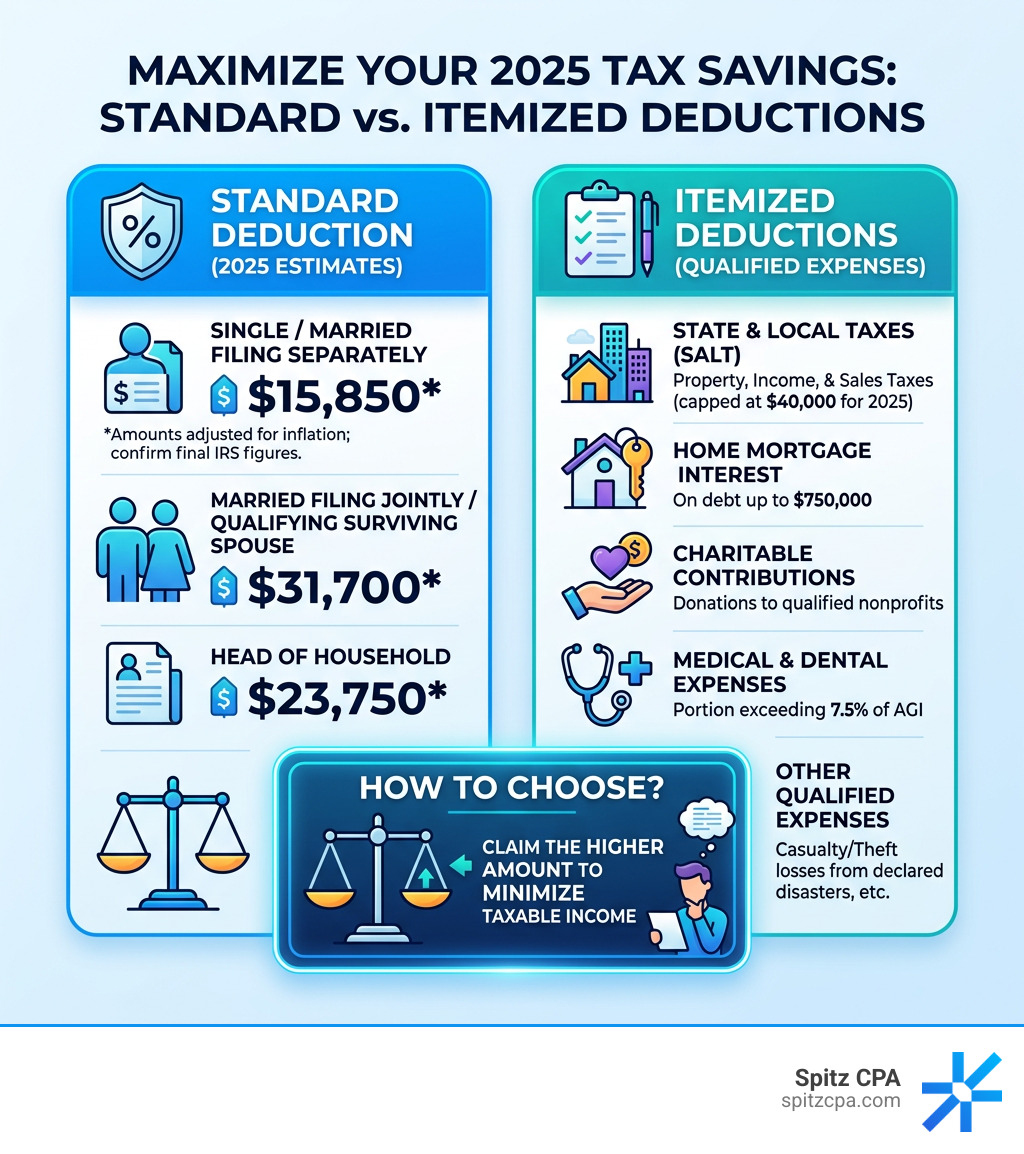
Choosing between itemizing and taking the standard deduction is one of the most important decisions you’ll make on your tax return. Think of the standard deduction as a “freebie” from the IRS—a flat amount you get to subtract from your income regardless of your actual expenses. Itemizing, on the other hand, is like keeping an expense report for your life. You list every qualified expense one-by-one on Schedule A.
To maximize-tax-deductions, the rule of thumb is simple: calculate both and pick the bigger number. For 2025, the standard deduction amounts have been adjusted for inflation, making the “hurdle” even higher for most taxpayers.
2025 Standard Deduction Amounts by Filing Status
| Filing Status | 2025 Standard Deduction Amount |
|---|---|
| Single | $15,750 |
| Married Filing Jointly | $31,500 |
| Head of Household | $23,625 |
| Married Filing Separately | $15,750 |
If you are a married couple in Gilbert, AZ, filing jointly, your list of itemized deductions needs to total more than $31,500 for it to be worth the extra paperwork. If your total is $35,000, you’ve just lowered your taxable income by an extra $3,500 compared to the standard route. Depending on your tax bracket, that could be a thousand dollars or more back in your pocket.
However, there are “standard deduction traps.” For instance, if you are married filing separately and your spouse chooses to itemize, the IRS forces you to itemize too, even if your total is $0. This is why we always look at the big picture for our clients at Spitz CPA.
The Essential List of Itemized Deductions for Your 2025 Return
When we dive into the list of itemized deductions, we are looking at “below-the-line” deductions. These are subtracted from your Adjusted Gross Income (AGI) to arrive at your final taxable income. Because the IRS is famously particular, you must follow the Instructions for Schedule A (Form 1040) to the letter.
Effective tax-planning-strategies often involve “bunching” these deductions—pushing medical procedures or charitable gifts into a single year to blow past the standard deduction threshold.
Unreimbursed Medical and Dental Expenses
This is often the hardest deduction to qualify for because of the “7.5% floor.” You can only deduct the portion of your medical expenses that exceeds 7.5% of your AGI.
For example, if your AGI is $100,000, the first $7,500 of medical bills don’t count for the deduction. If you had $10,000 in surgery costs, you could only deduct $2,500.
What counts?
- Preventative Care: Routine checkups, dental cleanings, and vision exams.
- Major Procedures: Surgeries (non-cosmetic), hospital stays, and lab fees.
- Prescriptions: Insulin and other doctor-prescribed medications (over-the-counter meds generally don’t count).
- Medical Mileage: For 2025, you can deduct 21 cents per mile driven for medical purposes.
- Long-term Care: Premiums for qualified long-term care insurance are deductible, though they are subject to age-based limits. For those 71 or older, the limit is as high as $6,020 in 2025.
- PPE and Aids: The IRS has confirmed that Personal Protective Equipment (PPE) like masks and hand sanitizer used to prevent the spread of Coronavirus are includible. You can also include breast pumps, hearing aids, and even lead-based paint removal.
State and Local Taxes (SALT) and the 2025 Limit
For years, the “SALT cap” was the bane of taxpayers in high-tax areas. Under the Tax Cuts and Jobs Act, you could only deduct a maximum of $10,000 for all state and local taxes combined.
The One Big Beautiful Bill Act (OBBBA) has significantly changed this for 2025. The new cap is $40,000 ($20,000 if married filing separately). This is a massive win for homeowners in Arizona with significant property taxes.
The SALT “Choice”: You have to choose between deducting state and local income taxes or general sales taxes. You can’t do both.
- Income Tax: Usually better if you live in a state with high income tax rates.
- Sales Tax: Often better for residents of states with no income tax, or if you made a major purchase (like a new truck or boat) in Gilbert or Phoenix this year. The IRS provides “Optional Sales Tax Tables” based on your income and location. Arizona residents typically fall under “Local Table B.”
Don’t forget Personal Property Taxes. In Arizona, the portion of your vehicle registration fee based on the value of the car (the VLT) is deductible.
Maximizing Your Housing and Charitable Tax Breaks
For most of our clients at Spitz CPA, the two heaviest hitters on the list of itemized deductions are mortgage interest and charitable giving. These aren’t just tax breaks; they represent your biggest life investments and your values. Integrating these into your business-tax-strategies can create a powerful shield against high tax bills.

Home Mortgage Interest and Debt Limits
The IRS allows you to deduct interest on “acquisition indebtedness”—money borrowed to buy, build, or substantially improve your main or second home.
The Limits:
- Post-2017 Debt: If you took out your mortgage after December 15, 2017, you can only deduct interest on the first $750,000 of debt.
- Grandfathered Debt: If your mortgage is older than that, you’re likely capped at interest on $1 million of debt.
- Home Equity Loans: You can only deduct interest on home equity loans if the money was used to “buy, build, or substantially improve” the home that secures the loan. If you used a HELOC to pay off credit cards or buy a car, that interest is not deductible.
You’ll receive Form 1098 from your lender, which summarizes the interest you paid. If you paid “points” to get a lower interest rate when you bought your home, those are generally deductible in the year you paid them. If you refinanced, you usually have to spread those points out over the life of the loan.
Charitable Contributions and Recordkeeping
The IRS rewards generosity, but they demand proof. You can deduct contributions to qualified 501(c)(3) organizations, including churches, educational institutions, and non-profits.
The Limits:
- Cash: Generally deductible up to 60% of your AGI.
- Appreciated Assets: If you donate stock that has gone up in value, you can often deduct the fair market value and avoid capital gains tax, though the limit is usually 30% of AGI.
- Mileage: If you volunteer, you can deduct 14 cents per mile driven for charitable purposes.
Documentation is Non-Negotiable:
- Under $250: A bank record or a receipt from the charity is enough.
- $250 or More: You must have a “contemporaneous written acknowledgment” from the charity. This letter must state whether you received any goods or services in exchange for the gift. If you got a $50 dinner in exchange for a $100 ticket, you can only deduct $50.
- Non-Cash over $500: You must file Form 8283. If the property is worth more than $5,000, you generally need a formal appraisal.
Specialized Deductions: Casualty Losses and Miscellaneous Items
The “Miscellaneous” section of Schedule A used to be a catch-all for things like union dues and tax prep fees. However, the Tax Cuts and Jobs Act suspended most of those until 2026. Still, there are a few specialized items that remain on the list of itemized deductions.
Disaster Losses and Gambling Rules
Casualty and Theft Losses: Since 2018, you can only deduct personal casualty losses if they are attributable to a federally declared disaster. If a pipe bursts in your kitchen, it’s a headache, but it’s not a tax deduction. If a federally declared wildfire or flood damages your home, it is.
- The Floor: You must subtract $100 from each event.
- The Limit: You can only deduct the portion of the loss that exceeds 10% of your AGI.
Gambling Losses: If you had a lucky streak at the casino, the IRS wants their cut of the winnings. However, you can deduct your gambling losses as an itemized deduction.
- The Catch: You can only deduct losses up to the amount of your winnings. If you won $5,000 but lost $8,000, your deduction is capped at $5,000. You cannot use gambling losses to offset your salary or other income.
For entrepreneurs, tracking these “other” items is a vital part of tax-planning-for-entrepreneurs. Even small miscellaneous items like amortizable bond premiums or Federal estate tax on “Income in Respect of a Decedent” (IRD) can add up.
Frequently Asked Questions about the List of Itemized Deductions
Who is eligible to itemize?
Most U.S. citizens and residents can choose to itemize. However, some people must itemize or are barred from the standard deduction:
- Married Filing Separately: If one spouse itemizes, the other must as well.
- Nonresident Aliens: Generally, nonresident aliens are not eligible for the standard deduction and must itemize their qualified U.S. expenses.
- Dual-Status Aliens: If you were both a nonresident and a resident alien in the same year, special rules apply that usually prevent you from taking the standard deduction.
What documentation is required?
The IRS is an “audit-later” organization. You don’t send your receipts with your return, but you must have them ready if they ask. We recommend keeping:
- Bank Records: Statements showing payments for medical bills or charity.
- Mileage Logs: A simple notebook or app tracking dates and miles for medical and charitable trips.
- Form 1098: For mortgage interest and property taxes paid through escrow.
- Written Acknowledgments: For any charitable gift over $250.
- Form 8283: For non-cash donations over $500.
How does the SALT deduction change in 2025?
The big news for 2025 is the OBBBA provisions. The $10,000 cap that has limited taxpayers for years has been raised to $40,000 ($20,000 for MFS).
- High-Income Phaseout: If your modified AGI is over $500,000 ($250,000 for MFS), the SALT deduction begins to phase down, though it won’t drop below the old $10,000 floor.
- Outlook: This $40,000 limit is currently set to run through 2029.
Conclusion
Navigating the list of itemized deductions doesn’t have to be a source of stress. Whether it’s maximizing your SALT cap under the new 2025 rules or ensuring your charitable heart is reflected accurately on your Schedule A, the goal is always the same: financial clarity and keeping more of what you earn.
At Spitz CPA, we specialize in more than just filling out forms. We offer personalized guidance to help businesses and individuals achieve significant growth—sometimes even a 10x increase in value—through expert accounting clean-up and strategic tax planning.
If you’re tired of wondering if you’re overpaying Uncle Sam, let’s get your books in order and your strategy aligned. I’m Michael J. Spitz, and our team is ready to help you find every dollar you’re entitled to.


