


Why a Growth Strategy is Non-Negotiable
What is strategic business growth?
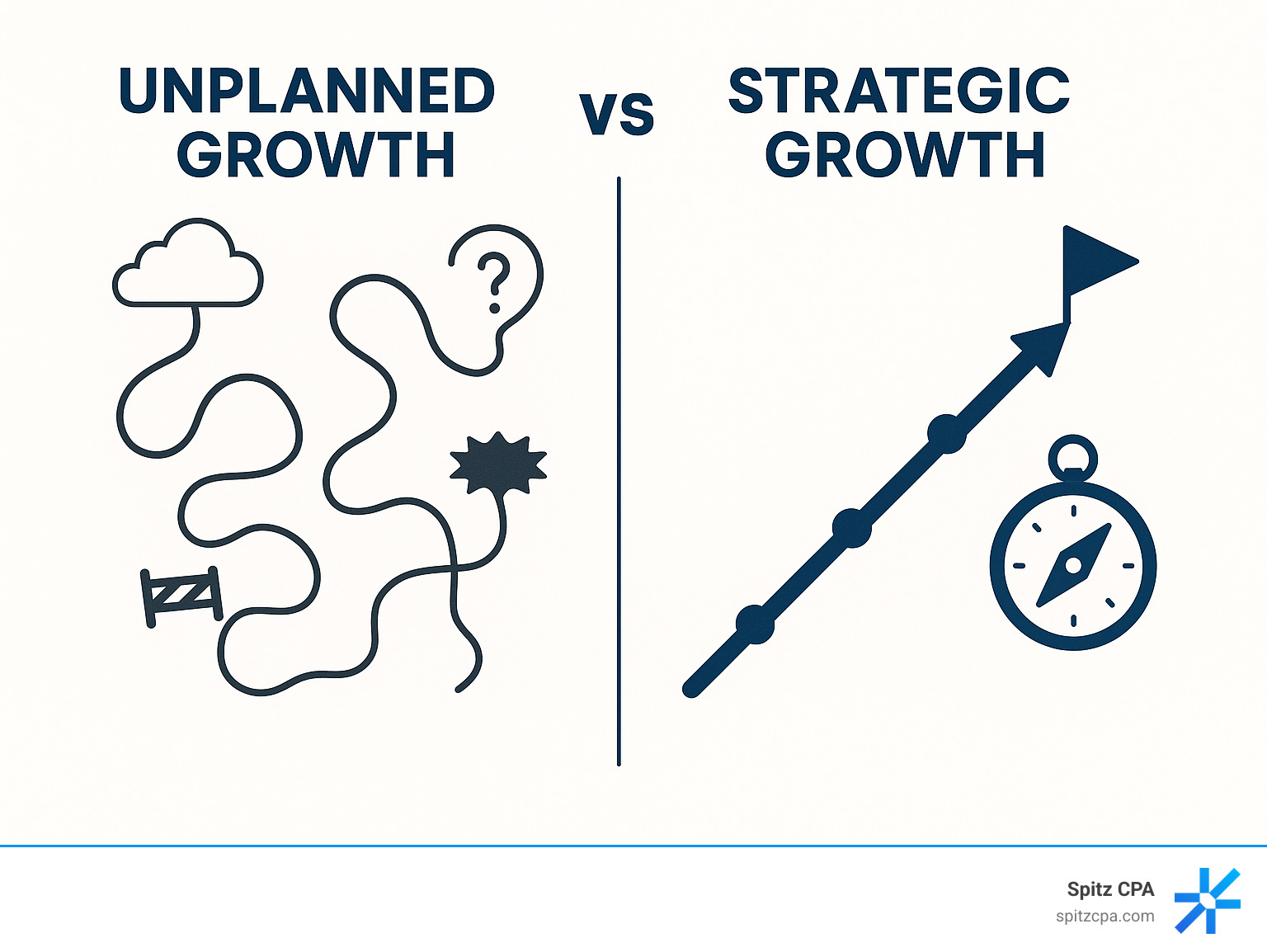
It’s a clear, well-defined plan for your business to expand and succeed over time. This plan outlines precisely how your company will boost revenue, gain market share, grow its customer base, or enter new geographical areas.
Why is it crucial?
- It drives overall business performance and innovation.
- It helps secure essential funding and loans.
- It works to reduce risks and stabilize revenue.
- It ensures you maintain a competitive edge.
Growth is the lifeblood of any successful business. But true strategic business growth isn’t just about getting bigger. It’s about growing smartly and sustainably.
Without a clear plan, your business can easily struggle against market shifts and tough competitors. Many companies face this challenge. In fact, only 25% of companies achieve sustainable growth over time.
Having a well-defined growth plan is key. Businesses with a plan are 260% more likely to launch successfully. They are also 30% more likely to actually grow. If you don’t have a plan, you might lose ground to competitors who do.
This extensive guide will show you how to build that essential roadmap for your business. It’s about setting clear goals and finding the best paths to reach them.
I’m Michael J. Spitz. With over 15 years in corporate accounting, I’ve directly overseen the strategic financial decisions vital for strategic business growth, from fundraising and financial modeling to managing cash flow. My experience helps businesses like yours achieve significant expansion and optimize financial health.
The Strategic Playbook: Four Core Growth Models
When it comes to strategic business growth, where exactly do you start? The best place to begin is with a proven framework that’s been guiding businesses for decades.
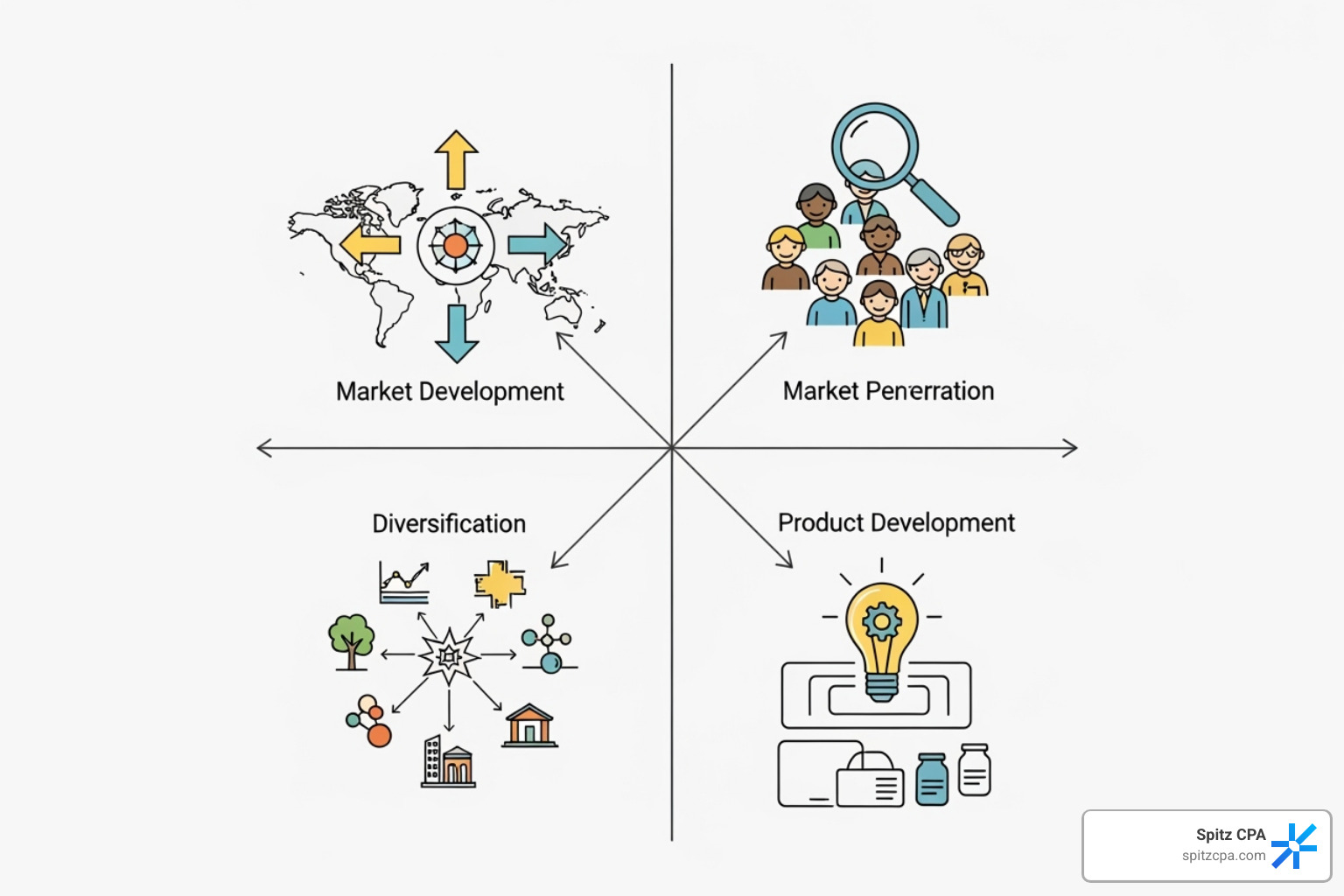
Enter the Ansoff Matrix, created by H. Igor Ansoff back in 1957. Think of it as your growth GPS – it helps you steer different paths while understanding the risks and opportunities ahead. This simple but powerful tool breaks down growth into four distinct strategies, each with its own adventure level.
The beauty of the Ansoff Matrix lies in its simplicity. It doesn’t give you cookie-cutter answers, but it does help you make smart choices based on what your business already has – your people, your resources, and your capabilities.
Market Penetration: Winning Your Current Turf
Market penetration is like becoming the champion of your own neighborhood. You’re working with what you know best – your existing customers and your current services – to grab a bigger slice of the pie.
This approach carries the least risk because you’re playing on familiar turf. You already understand your customers’ needs and how your services solve their problems. The goal is simple: get more market share by selling more to the people who already know and trust you.
Customer retention becomes your secret weapon here. Happy clients don’t just stick around – they become your biggest fans. They’ll recommend you to their business partners, colleagues, and friends. But upset customers? They’ll tell everyone who’ll listen about their bad experience.
Focus on delivering exceptional service every single time. When you promise a deadline, hit it. When you commit to quality, exceed expectations. These efforts build loyalty that translates directly into sustainable growth.
Smart competitive pricing and increased brand visibility also play crucial roles. Gather customer feedback regularly to understand what’s working and what isn’t. This insight helps you refine your approach and strengthen your position in the market.
Our accounting services can help you track important metrics like customer acquisition costs and lifetime value, giving you the financial clarity needed to make these penetration strategies profitable.
Market Development: Expanding Your Reach
Once you’ve conquered your current market, or if you spot untapped opportunities elsewhere, market development becomes your next adventure. You’re taking your proven services to new customer segments or expanding service areas where fresh faces need what you offer.
This strategy requires solid market research and a genuine commitment to understanding client needs in these new territories. What works perfectly for your current clients might need tweaking for different demographics or geographic areas.
For businesses in the U.S., resources like the U.S. Census Bureau’s Business & Economy data and local Small Business Administration (SBA) offices provide valuable data to help you understand new markets. Chambers of commerce and economic development agencies also offer insights that can guide your expansion decisions.
The key is approaching each new market with curiosity and respect. Different regions have different business cultures. Different customer segments have unique pain points and preferences. Success comes from adapting your approach while maintaining the core value that made you successful in the first place.
At Spitz CPA, we understand the financial complexities that come with expansion. How Spitz CPA supports your growth includes providing the strategic advice and financial clarity you need during these exciting but challenging transitions.
Product Development: Innovating for Your Base
Product development is about giving your loyal customers new reasons to love working with you. You’re creating new service offerings or improving existing ones to meet the evolving needs of your current market.
This approach requires investment in expertise and a systematic focus on innovation. Listen carefully to your clients’ feedback. What challenges are they facing that you could help solve? What services do they wish existed but can’t find elsewhere?
Service improvement doesn’t always mean starting from scratch. Sometimes it’s about refining what you already do well. Maybe it’s streamlining your process, adding technology to improve efficiency, or expanding your team’s capabilities in specific areas.
The goal is meeting client needs before they even realize they have them. This proactive approach positions you as a trusted advisor rather than just a service provider.
Did you know that developing new services or improving existing ones might qualify for significant tax benefits? Learn about R&D Tax Credits and find how these credits can help offset the costs of innovation, making your development efforts more profitable.
Diversification: Exploring New Frontiers
Diversification is the boldest move in the strategic business growth playbook. You’re venturing into new services in new markets – essentially starting a new adventure in unfamiliar territory.
This strategy carries the highest risk but also offers the greatest potential rewards. It’s often pursued when businesses see their primary market slowing down or when they spot significant opportunities in completely different areas.
Strategic collaborations can make diversification less risky. Partnering with established players in new markets gives you access to their customer base and expertise while sharing the risks and costs of expansion.
When considering diversification, you’ll need to choose between organic vs. inorganic growth. Here’s how they compare:
| Feature | Organic Growth | Growth by Acquisition |
|---|---|---|
| Method | Building through internal resources | Buying existing businesses |
| Speed | Slower but steady progress | Fast market entry |
| Risk Level | Lower, more predictable | Higher due to integration challenges |
| Control | Complete control over processes | Depends on how well cultures merge |
| Initial Cost | Generally lower upfront investment | Requires significant capital |
| Culture | Natural evolution of your values | Challenge of blending different work styles |
Expanding advisory capabilities through diversification can rapidly grow your business, but success depends heavily on execution. The hardest part of any acquisition isn’t the financial transaction – it’s bringing two different company cultures together into one cohesive team.
Whether you choose organic growth or acquisition, diversification requires careful planning, adequate funding, and often, expert guidance to steer the complexities successfully.
Building Your Engine for Strategic Business Growth
Once we understand the different growth models, the next step is to build the engine that will power our strategic business growth. This isn’t just about choosing a direction; it’s about careful preparation, smart resource allocation, and smooth execution. Think of it like building a race car – you need the right parts, the right team, and the right fuel to win.

Research, Analysis, and a Compelling Value Proposition
Before we make any big moves, we need to know exactly where we stand and where we’re headed. This means rolling up our sleeves and diving into thorough market analysis.
A SWOT analysis is our best friend here. We examine our Strengths, Weaknesses, Opportunities, and Threats to understand both our internal capabilities and the external landscape. This process helps us spot those golden opportunities that perfectly match our company’s strengths.
We dig deep into customer behavior, emerging trends, and what our competitors are up to. Maybe we find that competitors are missing a key service area, or we notice a shift in what customers really want. These insights become the foundation of everything we do next.
Here’s where it gets exciting: crafting a compelling value proposition. This is our promise to customers – the unique benefits we offer that solve their specific pain points. It’s what makes us stand out from the crowd.
When we nail our value proposition, our marketing and sales efforts become laser-focused. Customers immediately understand why they should choose us over anyone else. It’s not about being everything to everyone; it’s about being the perfect solution for the right people.
Setting SMART Goals and Building a Winning Team
Great strategies mean nothing without great execution. This is where SMART goals become our roadmap: Specific, Measurable, Achievable, Relevant, and Time-bound.
Instead of saying “we want to grow,” we get specific: “increase recurring revenue by 15% in the next 12 months by acquiring 20 new enterprise clients.” Now we have something concrete to work toward.
But even the smartest goals won’t happen without the right people and company culture. Here’s a fascinating statistic: changes that engage the entire organization are eight times more likely to succeed. Companies where more than 20% of employees own change initiatives see nearly twice the shareholder returns of their peers.
This means investing in our team through training, mentorship, and real career advancement opportunities. When people feel valued and see a future with us, they become growth champions.
During growth phases, we often need to expand our team strategically. Key roles might include a Growth Marketing Manager to drive customer acquisition, a Sales Development Representative to generate leads, an Operations Manager to streamline processes, a Data Analyst to track our progress, a Product Development Specialist to innovate our offerings, and a Talent Acquisition Specialist to bring in the right people as we scale.
Financial Foundations and Technology Leverage
Growth costs money, and without solid financial management, even the most promising ventures can crash and burn. We need rock-solid cash flow management, careful budgeting, and a clear understanding of our funding options.
Improving cash flow isn’t just about having more money in the bank – it’s actually a growth strategy itself. When we free up capital, we can reinvest it in the areas that drive expansion. Our 12 Month Cash Flow Statement helps project and manage these financial flows. Tools like TD’s cashflow improvement calculator can show us exactly how changes impact our bottom line.
Technology adoption and automation are game-changers too. They streamline operations, cut costs, and boost efficiency, freeing our team to focus on high-value activities that drive growth. From CRM systems to accounting software, the right technology helps us scale effectively and improve customer experiences.
For example, automating sales processes with AI is a perfect example of internal growth – we cut wasteful spending and run a leaner operation while serving customers better.
At Spitz CPA, this is exactly what we help businesses achieve. We improve cash flow, provide financial clarity, and support significant growth through personalized guidance and accounting expertise. When your financial foundation is solid, you can pursue growth opportunities with confidence, knowing the numbers support your ambitions.
Staying Agile: Monitoring, Adapting, and Overcoming Problems
Growth isn’t a “set it and forget it” kind of deal. Strategic business growth is more like tending a garden—you need to keep watering, pruning, and adjusting based on the weather. The most successful businesses are those that stay nimble, keep their eyes on the data, and aren’t afraid to change course when needed.
Tracking Progress and Making Adjustments
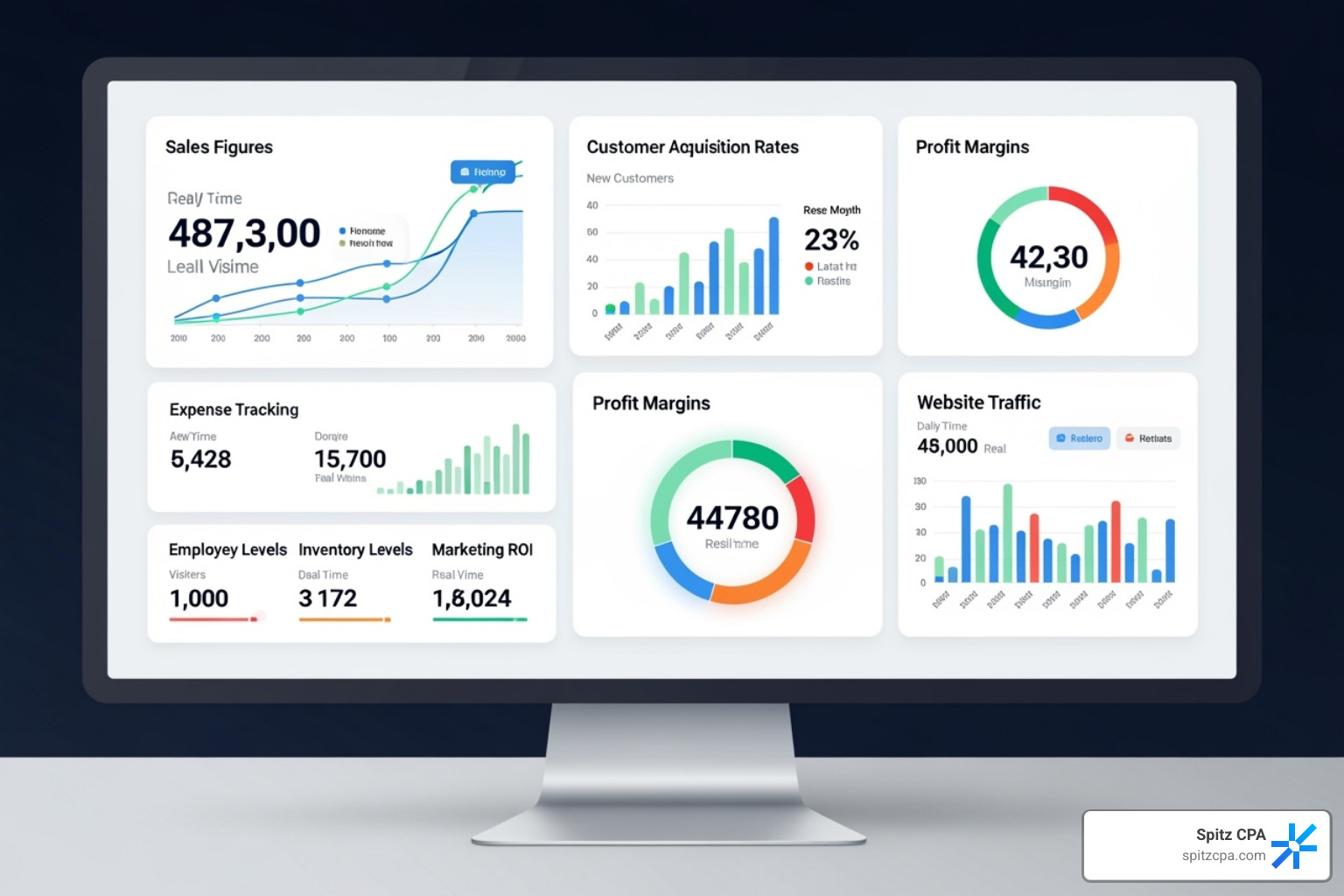
Think of your business metrics like a car’s dashboard. You wouldn’t drive cross-country without checking your fuel gauge, speedometer, and engine temperature, right? The same goes for your growth strategy.
Performance metrics are your best friends here. We’re talking about key performance indicators like revenue growth, customer acquisition costs, customer lifetime value, and employee retention rates. These numbers tell the real story of how your business is performing. Companies that use structured processes in their strategic operations tend to outperform their peers by 70%—that’s not a coincidence.
Regular reviews are where the magic happens. Set up monthly or quarterly check-ins to compare your actual progress against those SMART goals we talked about earlier. Are you hitting your targets? Great! Are you falling short? That’s valuable information too.
The beauty of data analysis is that it takes the guesswork out of decision-making. Maybe you’ll find that your customer acquisition costs are higher than expected, but your customer lifetime value is through the roof. That’s a good problem to have! Or perhaps you’ll find that a particular marketing channel isn’t delivering the results you hoped for.
This iterative improvement approach means you’re constantly fine-tuning your strategy. It’s like adjusting the seasoning while you cook—a little more of this, a little less of that, until you get the perfect recipe for growth. Our financial services can help you set up the reporting systems you need to make these data-driven decisions with confidence.
Overcoming Common Growth Challenges
Let’s be honest—growing a business can feel like juggling flaming torches while riding a unicycle. Every business faces problems, and knowing what to expect can help you prepare for them.
Financial constraints are probably the most common growth killer. You need money to make money, but cash flow can get tight when you’re investing in expansion. This is where solid financial planning becomes your lifeline. Having a clear picture of your cash flow, understanding your funding options, and maintaining healthy financial reserves can make all the difference.
Scaling operations is another tricky beast. What works when you have 10 customers might completely fall apart when you have 100. Your systems, processes, and team structure all need to evolve. Research shows that 67% of well-developed business models stumble during the rollout phase—it’s the execution that trips people up, not the strategy itself.
Market competition never sleeps. Just when you think you’ve found your sweet spot, three new competitors pop up. The key is to stay focused on what makes you unique and keep innovating. Don’t get caught up in price wars—compete on value instead.
Talent acquisition becomes both more critical and more challenging as you grow. You need the right people in the right roles, but finding them (and keeping them) takes effort. Building a strong company culture that people actually want to be part of is your secret weapon here.
If you’re feeling overwhelmed by the financial side of growth, our Small Business Accounting 101 guide can help you get your financial house in order.
Adapting to a Changing Marketplace
Here’s the thing about business—the rules keep changing. Market dynamics shift, economic conditions fluctuate, and new technologies emerge seemingly overnight. What worked brilliantly last year might be completely irrelevant today.
The companies that thrive are the ones that accept agility. They’re not rigid in their approach; they’re responsive. Growth leaders generate 80% more shareholder value over a ten-year period because they’ve mastered the art of adaptation.
Future-proofing your business doesn’t mean predicting the future (nobody has a crystal ball). It means building flexibility into your operations so you can pivot when needed. Maybe that means diversifying your revenue streams, investing in technology that can scale with you, or developing multiple customer segments so you’re not dependent on just one.
Continuous innovation keeps you ahead of the curve. This doesn’t necessarily mean breakthroughs—sometimes it’s the small improvements that make the biggest difference. Listen to your customers, watch your competitors, and stay curious about emerging trends in your industry.
The businesses that survive and thrive are those that stay alert, stay flexible, and aren’t afraid to evolve. It’s not about being perfect from day one; it’s about being willing to learn, adapt, and improve as you go.
Frequently Asked Questions about Business Growth
Let’s tackle some of the most common questions I hear from business owners about strategic business growth. These are the real concerns that keep entrepreneurs up at night, and I want to give you clear, practical answers.
What are the 4 main growth strategies?
When we talk about growth strategies, we’re really talking about the Ansoff Matrix I mentioned earlier. Think of these as your four main pathways to expansion:
Market Penetration is your safest bet – it’s all about getting more from your existing customers with your current products or services. Maybe that means better customer service, competitive pricing, or simply staying more visible in their minds.
Market Development takes your proven offerings to new places or new types of customers. You know your product works, so why not share it with different segments or geographic areas?
Product Development flips that approach – you stick with your loyal customer base but give them something new to love. This is where innovation and listening to customer feedback really pay off.
Diversification is the boldest move, introducing completely new offerings to entirely new markets. It’s risky, but when done right, it can open up incredible opportunities for growth.
What is the difference between organic and inorganic growth?
This is where things get interesting. Organic growth is like nurturing a garden – you’re using your internal resources and capabilities to expand naturally. You’re improving efficiency, developing new services, or finding better ways to serve customers. It’s slower but steady, and you maintain complete control over the process.
Inorganic growth, on the other hand, is more like adding a greenhouse to your property. You’re growing through mergers, acquisitions, or strategic partnerships. It’s faster and can rapidly expand your market share, but it comes with higher risks and integration challenges.
Both approaches have their place in strategic business growth. The key is choosing the right one for your situation and resources.
How important is customer retention for growth?
Here’s something that might surprise you – customer retention is absolutely crucial for sustainable growth, sometimes even more important than constantly chasing new customers.
Cost-effectiveness is the big winner here. It typically costs five times more to acquire a new customer than to keep an existing one happy. When you focus on retention, you’re investing in relationships that already have a foundation.
Repeat business creates that steady revenue stream every business dreams of. These loyal customers become predictable income, which makes planning and forecasting so much easier.
Brand advocacy is where the magic really happens. Happy customers become your best marketing team. As I always say, satisfied customers tell three friends, but angry customers tell 3,000! In today’s connected world, that word-of-mouth can make or break your growth plans.
Your long-term customers also provide invaluable feedback and insights. They’ve seen your business evolve and can offer perspectives that help you improve and innovate.
Building customer loyalty creates a stable foundation that supports all your other growth initiatives. When you know you have a solid base of satisfied customers, you can confidently pursue new opportunities knowing you have that steady income to fall back on.
Conclusion: Your Next Move in the Growth Game
Here’s the truth about strategic business growth: it’s not about hoping for the best or crossing your fingers. It’s about making smart choices, taking deliberate action, and staying flexible when things don’t go exactly as planned (and trust me, they rarely do).
Throughout this guide, we’ve walked through the essential building blocks together. We started with understanding why having a growth plan matters so much—remember, businesses with a plan are 260% more likely to succeed. Then we explored the four core growth models from the Ansoff Matrix, each offering different paths forward depending on where your business stands today.
We’ve covered the nuts and bolts of building your growth engine: conducting thorough research to craft a compelling value proposition, setting those crucial SMART goals, assembling the right team, and getting your financial house in order. We’ve also talked about staying agile—because the business world keeps changing, and we need to change with it.
The common thread through all of this? Financial clarity is your foundation. You can have the most brilliant growth strategy in the world, but without solid financial management and clear cash flow, even the best plans can crumble.
That’s where we come in. I’m Michael J. Spitz, and I’ve spent over 15 years helping businesses steer the financial complexities of growth. At Spitz CPA, we’re passionate about giving you the clarity and confidence you need to make bold moves. Whether it’s cleaning up your accounting systems, improving your cash flow, or providing strategic financial guidance, we’re here to support your growth journey.
Your next move? Don’t wait for the “perfect” moment—it doesn’t exist. Start with where you are, use what you have, and take that first step. Get expert guidance with our Accounting Services today, and let’s turn your growth vision into reality.


