


Why Business Succession Planning Can’t Wait
Succession planning services are professional advisory solutions that help business owners create comprehensive strategies for transferring leadership, ownership, and management of their companies to ensure long-term continuity and maximize value.
Key Components of Succession Planning Services:
- Business valuation and value optimization strategies
- Identification and development of potential successors
- Tax-efficient transfer structures and legal frameworks
- Communication strategies for stakeholders and family members
- Timeline development and implementation support
- Risk management and contingency planning
Here’s a sobering reality: 70% of all businesses fail to survive past the first generation of business owners. Even more concerning, research shows that 60% of these failures stem from a lack of trust or communication, while 25% result from ill-prepared successors.
After years of building your business, weathering economic storms, and making countless sacrifices, the value you’ve created is immense. But without a solid succession plan, that hard work could disappear when you’re no longer at the helm.
The difference between a business that thrives for generations and one that crumbles is often proactive planning versus reactive crisis management. A successful transition requires careful preparation, clear communication, and expert guidance.
I’m Michael J. Spitz. With over 15 years of corporate accounting and financial planning experience, I’ve helped many business owners navigate the complexities of succession planning. My background in strategic finance, fundraising, and business transitions provides unique insight into what makes these plans succeed.
Relevant articles related to succession planning services:
The Core Components of a Comprehensive Succession Plan
Think of your succession plan as the foundation of a house. You wouldn’t build on shaky ground, and you shouldn’t leave your business’s future to chance either. An effective succession plan is a living, breathing strategy that evolves with your business and protects everything you’ve built.
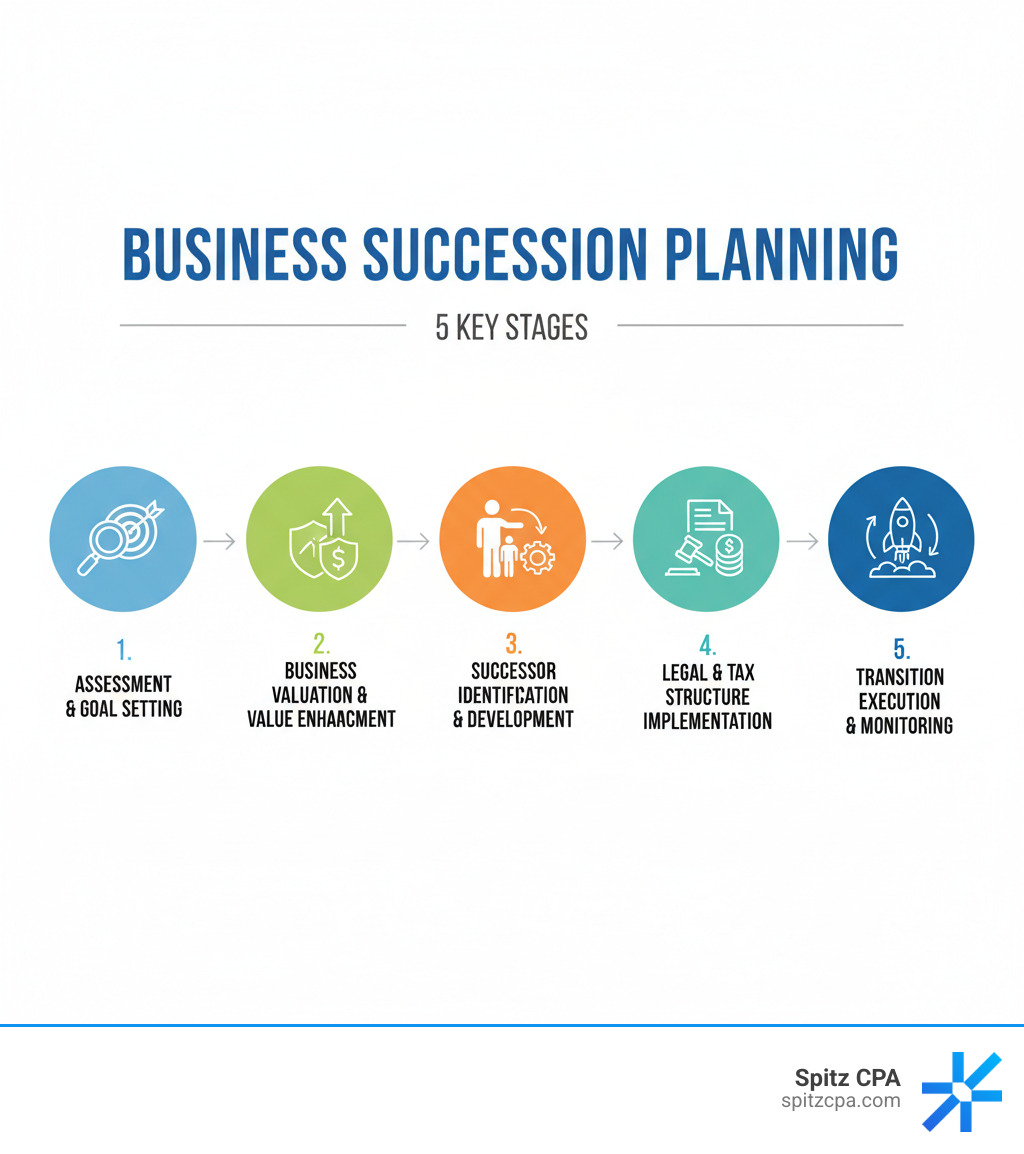
At Spitz CPA, our approach to succession planning is built on five critical pillars that create a comprehensive strategy, leaving nothing to chance.
Business valuation is the cornerstone. We use proven methods to determine your company’s true worth, helping you understand what drives value and how to maximize it for any transition scenario.
Leadership development focuses on the human element. We help you identify and nurture future leaders by assessing potential, providing targeted training, and creating clear growth paths to carry your vision forward.
Financial planning aligns your personal goals with the business transition. We help you plan for retirement, optimize tax strategies, and manage family wealth dynamics. Our Business Financial Health Check is a great starting point.
Legal frameworks are crucial. We work with legal professionals to establish proper structures, like shareholder agreements, ensuring the legal and tax elements are correct to avoid a costly mess. Our expertise in Tax Planning for Entrepreneurs is key here.
A communication strategy ties it all together. Many plans fail due to poor communication. We help you develop a clear plan for all stakeholders, as transparency builds the trust needed for a successful transition.
Identifying and Preparing Potential Successors
Finding the right person to carry on your legacy is a critical step. This person will be stewarding everything you’ve built, so we need to get it right.
First, we help you determine whether to look for successors internally or externally. Internal candidates know your culture, but an external hire might bring needed skills or a fresh perspective.
A skills gap analysis follows, where we honestly assess what your business needs from a leader and compare that to each candidate’s abilities. This allows for targeted development plans.
Mentorship and leadership training are vital. Pairing successors with experienced leaders passes on wisdom that can’t be taught in a book. We supplement this with training in strategic management, financial literacy, and communication to build a complete leadership toolkit.
The result is a personalized development plan for each candidate, with clear objectives, timelines, and resources. For more on this, check out these Common challenges in business succession planning.
Maximizing Business Value for Transition
You want to get the best possible outcome from your life’s work. The same strategies that increase your business’s value also make it stronger and more resilient.
Operational efficiency is often the lowest-hanging fruit. We help streamline processes and eliminate waste. A lean, documented operation is more attractive to buyers and proves the business can run without your constant oversight.
Improving profitability involves more than cutting costs. We analyze your financials to find revenue growth opportunities. A business with consistent, growing profits is far more valuable. We specialize in helping businesses Improve Business Profitability through proven strategies.
Process documentation is vital. Standardized procedures prove your business runs on systems, not just personalities, reducing risk for a successor and showing that success isn’t dependent on one person.
Building a strong management team is a crucial investment. A capable team reduces risk for buyers and gives successors confidence, demonstrating that the business has depth and can thrive independently. Knowing What to Prepare if You’re Selling Your Business is key to a profitable exit.
Navigating the Challenges of Business Succession
Succession planning is rarely smooth sailing. The process is filled with emotional landmines, complex family dynamics, and difficult decisions that can determine your business’s future, which is why professional guidance is so valuable.

I’ve seen countless business owners stumble over the same obstacles. Common pitfalls include:
- Waiting too long: Starting to plan at age 65 is too late for an ideal exit strategy.
- Inaccurate valuation: Emotional attachment often leads owners to misjudge their business’s worth.
- Lack of communication: This is the biggest issue, causing 60% of succession failures due to broken trust.
- Ill-prepared successors: Choosing a successor based on sentiment instead of capability accounts for another 25% of failures.
- Emotional attachment: Letting go of the business you built is incredibly difficult, but clinging too tightly can cause damage.
- Complex family dynamics: Navigating sibling rivalries and the “fair versus equal” debate requires careful handling. For more insight, see these 5 Dynamics in Family Business.
Tailoring Your Plan to Your Business Type
A cookie-cutter succession plan doesn’t work. Your strategy must be custom to your specific business type and industry.
Family-owned businesses require clear governance to separate family and business roles, defining who can work in the business and how conflicts are resolved.
Agribusiness transitions involve land, livestock, and a way of life. Tax implications for land transfers can be significant, and the next generation needs both passion and skills. The TransitionSMART™ assessment can be very helpful here.
Professional practices (law, medical, accounting) must focus on transitioning personal client relationships and intellectual capital, which are their primary assets.
Non-profit organizations also need robust plans. With many boards lacking a formal CEO succession plan, they face leadership risks that can jeopardize their mission. At Spitz CPA, we understand these differences across various Industries.
Ensuring Leadership and Operational Continuity
The goal is seamless continuity, not just an ownership transfer. The business must continue to run smoothly as you hand over the baton.
Phased transitions avoid the shock of sudden change. A gradual handover allows you to mentor your successor as they grow into the role, perhaps by reducing your hours or shifting to a chairman position.
Interim leadership roles can bridge gaps, using a trusted employee or external consultant to maintain stability while permanent leadership is established.
Knowledge transfer is critical. We help structure the process of passing on your invaluable institutional wisdom, from customer relationships to supplier knowledge.
A solid stakeholder communication plan prevents rumors and maintains trust. Reassuring employees, customers, and suppliers is essential for maintaining stability during change. Our expertise in Human Capital Management & Payroll proves invaluable here.
Why You Need Professional Succession Planning Services
Engaging professional advisors for succession planning is an investment in your legacy and peace of mind. You’re so close to your business that an objective perspective is invaluable.

When Michael J. Spitz and our team work with business owners, we provide:
- Objectivity and expertise: We help you step back from the daily grind to make rational decisions, avoiding emotional pitfalls in valuation or successor choice.
- Value maximization: We identify the financial and operational improvements that boost your business’s appeal and sale price.
- Tax minimization: Proper planning can save you hundreds of thousands in taxes. This isn’t DIY territory.
- Legal navigation: We help manage the complex paperwork of shareholder agreements and asset transfers to avoid future problems.
- Dispute mediation: We act as a neutral third party to facilitate difficult family conversations, preserving relationships.
Our full range of Services supports you through this critical phase.
How Professional Advisors Manage Financial and Tax Implications
The financial and tax side of succession planning is complex. Without expert guidance, you risk leaving money on the table or facing unexpected tax bills.
An estate freeze is a powerful technique that locks in your business’s current value for tax purposes, allowing future growth to pass to the next generation with a lower tax burden.
Capital gains tax is a major concern when selling. We help minimize it by structuring the sale over time, using available exemptions, or exploring other strategies.
Shareholder agreements are crucial legal documents that act like insurance. They define how ownership transfers, how value is determined, and what happens in unexpected events, protecting your interests.
Here’s a simplified look at how tax implications can vary with different transition types:
| Transition Type | Primary Tax Consideration for Seller | Potential Tax Minimization Strategy |
|---|---|---|
| Sale to Third Party | Capital Gains Tax on sale proceeds | Installment sale, capital gains exemption utilization, asset vs. share sale. |
| Gift to Family | Gift tax (if applicable), potential deemed disposition capital gains | Estate freeze, careful structuring of ownership transfer. |
| Inheritance | Estate taxes (if applicable), deemed disposition at death | Life insurance to cover taxes, trust planning, post-mortem planning. |
| Management Buyout | Capital Gains Tax, structuring of debt/equity repayment | Vendor financing terms, earn-out structures. |
| ESOP | Capital Gains Tax, potential tax-deferred rollovers | Specific ESOP tax incentives, staggered sales. |
For comprehensive insights into optimizing your tax strategy, explore our Business Tax Strategies and visit our Category: Taxes for more information.
The Role of Professional Advisors in Structuring the Transition
There are multiple ways to transition your business. Our role is to help you choose the path that best aligns with your personal and financial goals.
Family transfers preserve your legacy but can complicate family dynamics and may not yield the highest financial return.
Management buyouts (MBOs) reward loyal employees who already know the business, but they may struggle to raise the necessary capital, potentially requiring you to finance part of the deal.
Employee Stock Ownership Plans (ESOPs) can motivate your team by giving them ownership and offer tax benefits, but they are complex and costly to set up and administer.
Third-party sales usually provide the highest financial return and a clean break, but you lose control over the business’s future and culture.
Mergers can offer new resources and markets, but you risk losing the culture and independence you built.
The right choice depends on your priorities: maximizing financial gain, preserving a legacy, or rewarding employees. Our Financial Services team can help you evaluate each option’s real-world implications.
Frequently Asked Questions about Business Succession
Business owners often come to us with the same concerns and questions about succession planning. Let me address the most common questions we hear at Spitz CPA.
When is the optimal time to start planning for business succession?
The best time to start succession planning is right now, regardless of your age. Ideally, you should begin the formal process three to five years before your desired exit—or even seven to ten years for more complex businesses. This provides ample time for strategic decisions without the pressure of a crisis.
Starting early allows you to:
- Develop successors: Give them time to learn, grow, and prove themselves.
- Maximize business value: Implement strategies that significantly increase your company’s worth.
- Optimize tax strategies: Take full advantage of complex, time-sensitive tax structures.
- Steer family dynamics: Have challenging conversations without being rushed.
Succession planning is not a one-time event; it’s an ongoing process. As we often say, When it Comes to Business Succession Planning, There’s No Time Like the Present.
How does succession planning differ from general estate planning?
Many business owners confuse succession planning with estate planning. While they overlap, they have distinct goals.
Succession planning is for the living. It focuses on the continuity of the business, ensuring a smooth transfer of leadership and operations to keep the company healthy and growing after you step away.
Estate planning deals with the distribution of all your personal assets after death. It uses tools like wills and trusts to carry out your wishes and minimize taxes on your estate.
In short, succession planning is about the future of your business, while estate planning is about the future of your personal wealth. A good succession plan is a critical input for an effective estate plan.
What role does communication play in a successful transition?
Communication is arguably the single most critical factor in a successful transition. Statistics show that 60% of business succession failures stem from a lack of trust or communication—a stark warning for any business owner.
When communication fails, people fill the void with negative assumptions. Employees worry about their jobs, family members feel slighted, and stakeholders lose confidence. This uncertainty can derail even the most technically sound plan.
An effective communication strategy prevents these issues by:
- Managing expectations: Clearly explaining the plan, the reasons behind it, and how it affects everyone.
- Building trust: Transparency is the foundation of trust, which is essential to hold everything together during a period of change.
We help clients develop formal communication plans to ensure honest dialogue happens, concerns are addressed, and everyone feels valued. Neglecting the human element is a recipe for failure, regardless of how technically sound the financial and legal structures might be.
Conclusion: Secure Your Business’s Future Today
Your business is more than just numbers on a balance sheet; it’s the result of your dedication and sacrifice. Whether you’re based in Gilbert, AZ, or serve clients across Arizona, you’ve built something that deserves to last.
The reality is that 70% of businesses fail to survive the first-generation transition. This doesn’t have to be your story. With professional guidance, you can join the 30% that thrive for generations.
A succession plan is more than an exit strategy; it’s a growth strategy. It makes your business resilient and independent, protecting your legacy and giving your family, employees, and customers confidence in the future.
The process is complex, but you don’t have to steer it alone. Michael J. Spitz and our team at Spitz CPA have the expertise to guide you through every step, creating a custom plan for your unique goals.
Don’t let your life’s work become a statistic. The time to plan is now. Let’s work together to secure a bright future for the business you’ve built.
Contact us for expert accounting services and let’s start crafting your succession strategy today.


