


When Your Startup’s Books Are a Mess, Every Big Decision Gets Harder
Accounting cleanup for startups is the process of going back through your financial records — sometimes months or years of them — to enter missing transactions, reconcile bank accounts, correct misclassified expenses, and ensure your books accurately reflect what actually happened in your business. In short, it transforms a chaotic financial history into a clean, reliable baseline your team, your investors, and your auditors can actually trust.
If you’re a founder staring down a fundraising round, a due diligence request, or even just a gnawing sense that your numbers don’t quite add up, here is what you need to know right away. A typical accounting cleanup for startups involves reconciling all bank and credit card accounts to actual statements, correcting misclassified or uncategorized transactions, fixing negative balances and unreconciled payables and receivables, applying proper revenue recognition under ASC 606, recording equity instruments like SAFEs and stock options under ASC 718, switching from cash-basis to accrual accounting if needed, and producing clean, GAAP-compliant) financial statements ready for investor review.
The stakes are real. Founders who delay accounting setup until fundraising routinely spend between $40,000 and $150,000 to fix the damage, and messy books have a way of surfacing at the worst possible moment — right when an investor is asking hard questions or a deal is on the line.
This guide walks you through why accounting cleanup matters, what it actually costs, how to do it step by step, and how to build the systems that prevent you from ever needing a major overhaul again.
I’m Michael J. Spitz, a CPA with over 15 years of corporate accounting experience, including extensive work supporting startups through seed rounds, VC due diligence, and the kind of accounting cleanup for startups that turns years of tangled records into investor-ready financials. If you recognize your situation anywhere in the pages ahead, you’re in the right place.
Understanding Accounting Cleanup for Startups and Its Strategic Value
As we enter July 2026, the market for startup financial services is scaling at an unprecedented rate. The global startup accounting services market is projected to reach USD 107.97 billion by 2033, with North America holding a dominant 39.9% market share in 2025. This massive growth reflects a critical reality in the modern venture ecosystem where investors are no longer writing large checks based on pitch decks alone. In the current fundraising environment, institutional investors use your financial statements to scrutinize burn rate, runway, revenue quality, and capital efficiency. If your books are disorganized, it sends a signal that other areas of your business might be equally neglected, which can severely damage your credibility during due diligence.
When we engage in a comprehensive cleanup project, we are not just doing basic historical administrative work. We are building a strategic asset that has a direct impact on your startup’s valuation and deal timelines. During an acquisition or a major funding round, the buying or investing entity will conduct deep financial due diligence that goes far beyond a simple high-level balance sheet. They will request general ledger details, trial balances, bank statements, and product-level revenue breakdowns. If you cannot produce these documents quickly, or if your numbers do not tie out to your actual bank activity, your deal can easily stall or collapse entirely. By executing a thorough ledger sweep, we establish a clean baseline that allows you to present your growth story with absolute confidence. For founders looking to restore financial accuracy and set a strong foundation for scaling, you can find More info about accounting clean up services to prepare your business for its next major milestone.
The True Cost of Cheap Bookkeeping and Delayed Financial Maintenance

Many early-stage founders fall into the trap of choosing the cheapest possible bookkeeping solution or attempting to manage the ledger themselves using basic spreadsheets. While this approach seems cost-effective at the pre-seed stage, it almost always results in deferred pain and much higher expenses down the road. Within the U.S. accounting services for startup market, which was valued at USD 14.34 billion in 2025 and is projected to reach USD 39.09 billion by 2033 with a 13.5% CAGR from 2026 to 2033, bookkeeping alone held a 38.3% revenue share in 2025. This high demand exists because bookkeeping is the absolute foundation of business intelligence, yet many low-cost automated platforms or inexperienced generalist bookkeepers fail to set up startup-specific accounts correctly.
Cheap bookkeeping often works like cheap brakes because you do not realize they are broken until you absolutely need them to work. When you rely on unqualified providers, you often end up paying twice: once for the subpar service that created the errors and a second time for a specialized CPA firm to perform a complex, retroactive cleanup. The time founders spend trying to untangle duplicated bank feeds, uncleared transfers, and random journal entries is time taken away from product development, hiring, and customer acquisition. If you want to understand how professional bookkeeping should function from day one to avoid these compounding errors, you can read More info about bookkeeping services to protect your venture from the hidden costs of cheap financial management.
Common Financial Messes That Require a Ledger Sweep
In our practice supporting businesses throughout Arizona, we regularly encounter several recurring financial errors that distort a startup’s true performance. One of the most common issues is the presence of negative balances on the balance sheet, such as negative accounts payable or negative cash, which is a major red flag indicating that transactions were entered out of order or payments were recorded without matching invoices. Unreconciled bank and credit card accounts are another frequent culprit, where the numbers in the accounting system do not tie to the actual cash in the bank. Furthermore, mismatched categorization of expenses can distort your budget-to-actual variance by 15% to 40%, making it nearly impossible to make accurate forecasting decisions. To learn how to systematically identify and correct these specific balance sheet errors, you can access More info about balance sheet cleanup to regain total control over your general ledger.
The Pitfalls of Neglecting Accounting Cleanup for Startups Before Fundraising
When startups attempt to raise capital with messy books, they face severe consequences that directly impact their bottom line. Investors who discover discrepancies during due diligence will often demand significant valuation haircuts to compensate for the perceived risk of inaccurate financial reporting. In the worst-case scenarios, investors will simply walk away from the deal entirely, assuming that poor financial hygiene reflects systemic operational issues across the entire company. Even if the deal survives, the timeline to close will be delayed by weeks or months as accountants work backward to reconstruct the financial history, which can put the startup in a dangerous cash position if their runway is short. To prevent these deal-killing delays and ensure your business is fully prepared for institutional scrutiny, you can explore More info about CFO services for startups to secure strategic oversight before you begin pitching to investors.
Technical Hurdles in Accounting Cleanup for Startups
Startup accounting involves highly complex technical standards that generalist small business bookkeepers rarely understand. For example, retroactively recording Simple Agreements for Future Equity and modeling their conversion mechanics can cost anywhere from $5,000 to $15,000 in specialized cleanup fees. Implementing proper revenue recognition under ASC 606 for multi-month software subscriptions or milestone-based contracts is another major hurdle, often requiring restatements that cost between $15,000 and $50,000 to execute correctly. Additionally, calculating and backfilling stock-based compensation expenses under ASC 718 can cost $10,000 to $30,000, while navigating the complex capitalization and amortization rules for research and development expenses under Section 174 adds another layer of technical difficulty. For comprehensive support in resolving these advanced technical issues, you can review More info about accounting clean up services to ensure your equity, revenue, and tax positions are fully compliant with GAAP.
A Step-by-Step Guide to the Startup Accounting Cleanup Process

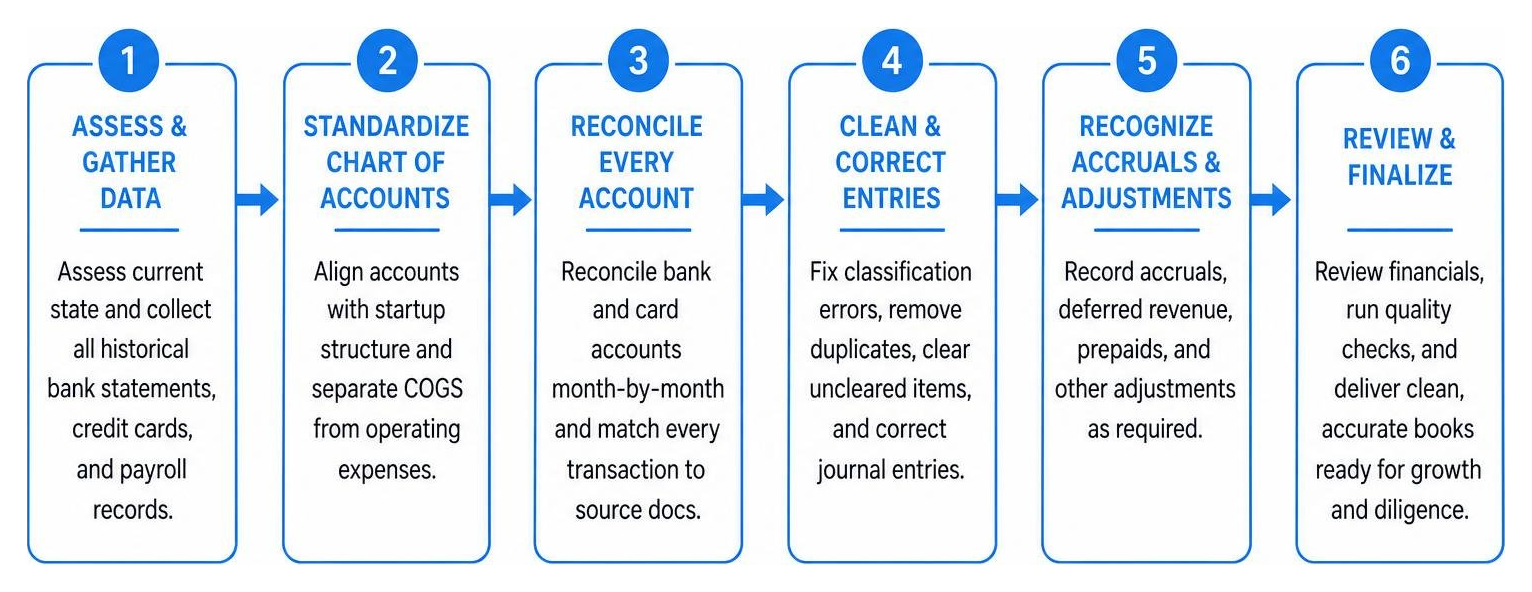
Cleaning up a startup’s financial records requires a highly structured, sequential approach to ensure no errors are missed. We begin by assessing the current state of the books, downloading all historical bank statements, credit card records, and payroll reports from day one of the business. Next, we standardize the chart of accounts, ensuring that cost of goods sold is clearly separated from operating expenses and that overhead is properly categorized into research and development, sales and marketing, and general and administrative departments. Once the structure is in place, we systematically reconcile every bank and credit card account month-by-month, matching every single transaction to its supporting source document and eliminating any generic miscellaneous or uncategorized buckets.
To help visualize this journey, we have outlined the core phases of the cleanup workflow below.
During this process, we also evaluate whether the startup needs to transition from cash-basis to accrual-basis accounting, which is a standard requirement for venture-backed companies. To help you understand the core differences and the adjustments required during a cleanup, we have prepared a comparative overview of both methods.
| Cleanup Area | Cash-Basis Cleanup | Accrual-Basis Cleanup (GAAP) |
|---|---|---|
| Revenue Tracking | Recorded only when cash is received in the bank account. | Recognized when earned, requiring deferred revenue tracking for prepayments. |
| Expense Recording | Recorded only when cash leaves the bank account. | Matched to the period of benefit, requiring prepaid expense amortization. |
| Diligence Readiness | Generally insufficient for institutional venture capital due diligence. | Highly preferred by investors as it reflects true unit economics and margins. |
| Technical Complexity | Low complexity but distorts monthly burn rate and runway metrics. | High complexity requiring specialized ASC 606 and ASC 718 adjustments. |
Deciding Between In-House Cleanup and Specialized Professional Firms
While some founders attempt to tackle the cleanup process in-house to save money, they quickly find themselves trapped in a complex web of accounting standards, bank feed errors, and missing documentation. The DIY approach carries a steep learning curve and a heavy opportunity cost, as every hour a founder spends reconciling transactions is an hour not spent growing the business. Partnering with a specialized CPA firm or utilizing fractional CFO services provides startups with a repeatable, proven process that delivers investor-ready financials with speed and confidence. If you want to understand how high-level financial leadership can guide your company through rapid growth without the overhead of a full-time executive, you can read Why Outsource CFO Services for Startups to learn more about the strategic benefits of external financial expertise.
For early-stage companies, the transition from basic record-keeping to robust financial strategy is a critical milestone. A specialized CPA firm does not just fix historical mistakes; we implement the guardrails, internal controls, and closing procedures that prevent errors from recurring. This ongoing accuracy is essential for maintaining tax compliance, managing cash flow, and proving your business model to potential acquirers or investors. To explore how comprehensive bookkeeping and accounting solutions can support your business as it scales, you can access More info about bookkeeping services to find the right level of support for your startup’s unique operational needs.
Frequently Asked Questions About Startup Bookkeeping Cleanup
To help you navigate this process, we have compiled answers to some of the most common questions we receive from founders regarding startup bookkeeping cleanup and long-term financial management.
How much does a startup accounting cleanup typically cost?
The cost of an accounting cleanup project depends entirely on the volume of transactions, the number of months that need to be caught up, and the complexity of your business model. A simple catch-up project covering three to six months of basic transactions typically ranges from $2,000 to $5,000, while a moderate cleanup covering a full year of activity usually runs between $5,000 and $12,000. However, for fast-growing startups with multiple years of neglected books, complex equity structures, and the need for retroactive GAAP accrual restatements, a full catch-up cleanup can cost anywhere from $40,000 to $150,000.
When should a startup begin the cleanup process relative to fundraising?
You should start your accounting cleanup project at least three to six months before you plan to launch a fundraising round or enter an M&A process. Reconstructing financial history, securing missing source documents, and implementing complex accounting standards like ASC 606 takes time, and attempting to do this under the pressure of active due diligence is a recipe for disaster. Starting early ensures that your books are fully reconciled, audited, and ready the moment an investor requests your financial package.
What tools and systems help prevent future accounting messes?
The most effective way to avoid future cleanup projects is to implement a modern, integrated financial technology stack centered around a robust general ledger system like QuickBooks Online. By pairing your accounting software with automated tools for expense management, payroll, and billing, you can streamline your financial workflows. Utilizing real-time financial data integration can reduce manual entry errors by up to 80%, and when paired with fractional CFO oversight, it can lead to 30% to 50% faster decision-making cycles and 20% to 25% lower year-end audit costs through preemptive compliance.
Conclusion
Accounting cleanup is not merely an administrative chore; it is a vital strategic initiative that protects your startup’s valuation, accelerates your deal timelines, and gives you the financial clarity needed to make confident operational decisions. Under the leadership of Michael J. Spitz, Spitz CPA provides personalized accounting, tax, and financial advisory services designed to help startups in Gilbert, Arizona, and across the state achieve significant growth, including a 10x increase in business value. By combining technical accounting cleanup expertise with forward-looking financial strategy, we help you clear the historical backlog, implement robust financial systems, and build a solid foundation for your next major milestone. If you are ready to clean up your books and gain total financial clarity, you can Get started with our professional services today to secure the expert guidance your business deserves.


