


Why Growing Businesses Are Turning to Virtual Controller Services
Virtual controller services give growing businesses access to senior-level financial oversight — without the cost of a full-time hire.
Here’s what that means in practice:
| What You Get | What It Replaces |
|---|---|
| Remote financial oversight | Full-time in-house controller ($60K–$100K+/year) |
| Monthly reporting & budgeting | Reactive bookkeeping |
| Cash flow management | Guesswork and spreadsheets |
| Compliance & internal controls | Expensive accounting staff overhead |
| Strategic financial guidance | Fragmented advice from multiple sources |
Most businesses in the $2M–$20M revenue range have outgrown basic bookkeeping — but aren’t ready to justify a full-time controller or CFO. That’s the gap these services fill.
As Albert Einstein once said, “The hardest thing in the world to understand is the income tax.” For most business owners, it’s not just taxes — it’s the entire financial picture. Cash flow, budgeting, compliance, profitability — all of it competes for attention while you’re trying to actually run your business.
The result? Financial blind spots. Late reports. Missed opportunities.
A virtual controller brings clarity to that chaos — acting as your dedicated financial manager, working remotely, and plugging directly into your existing operations.
I’m Michael J. Spitz, a CPA with 15+ years of corporate accounting experience spanning financial modeling, FP&A, budgeting, and strategic oversight across industries from software technology to health services — exactly the kind of hands-on background that makes virtual controller services genuinely useful for growing businesses. If you’ve been wondering whether your finances are being managed as strategically as they could be, you’re in the right place.
What Are Virtual Controller Services?
At its core, a virtual controller (also known as an outsourced controller) is a financial expert or team that operates externally to oversee and manage your company’s financial reporting and processes. Unlike a traditional CPA who you might only see during tax season, a virtual controller is a “present-tense” partner. They ensure that what is happening in your business right now is accurate, compliant, and optimized for growth.
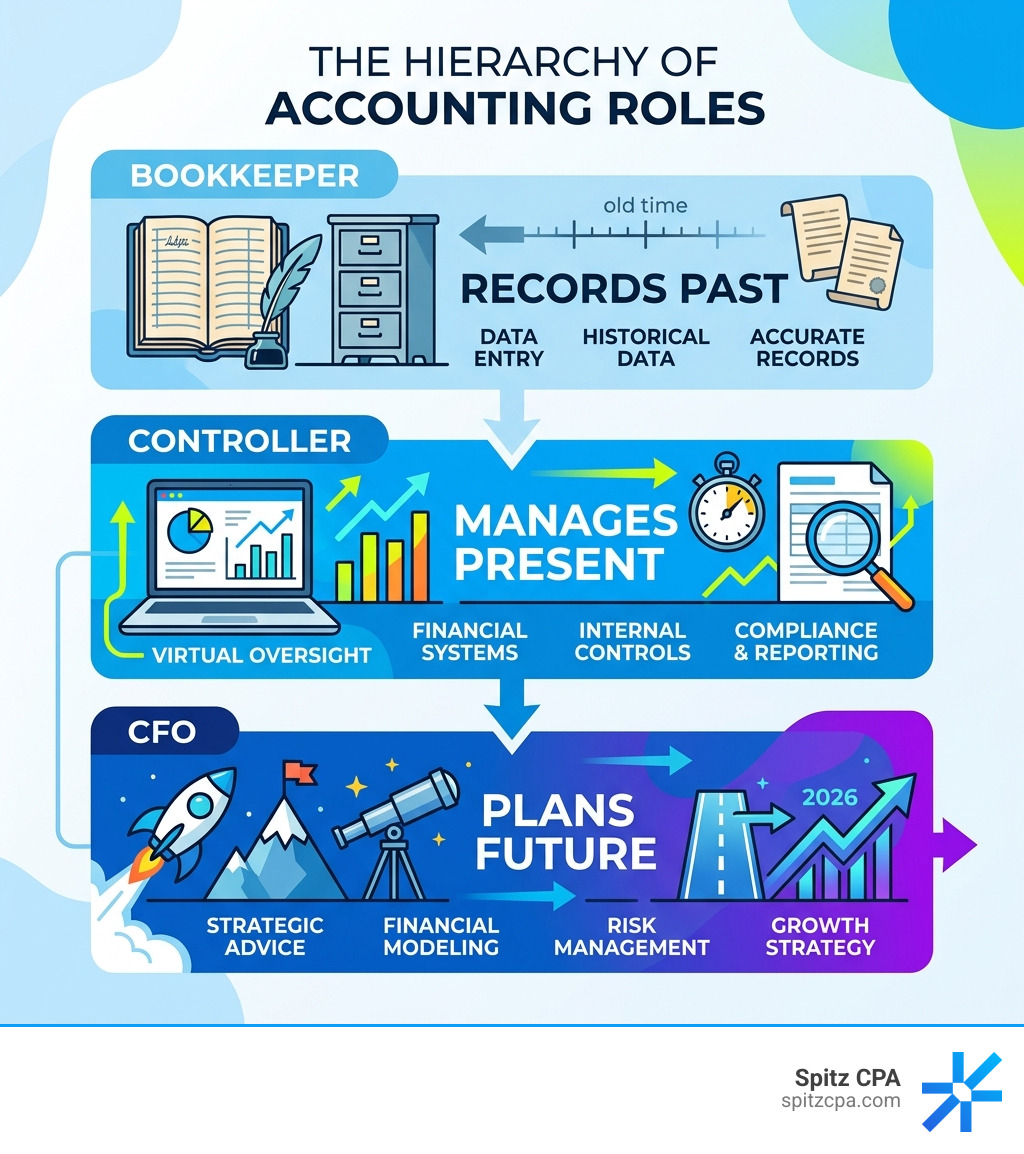
Virtual controller services bridge the gap between basic data entry and high-level strategic planning. While a bookkeeper focuses on recording what happened yesterday, a controller focuses on the integrity of your financial systems today. They provide remote management that ensures your financial health isn’t just a hope, but a documented reality.
One of the most critical aspects of this role is the establishment of internal controls. These are the “checks and balances” that prevent errors, reduce the risk of fraud, and ensure that your financial data is reliable. For many businesses in Gilbert, AZ, and the surrounding areas, moving to a virtual model reveals immediate opportunities to choose the best virtual accounting solutions for your business that streamline workflows and eliminate redundant steps.
Virtual Controller vs. Bookkeeping and In-House Hires
It is common for business owners to confuse the roles within a finance department. However, understanding the difference is key to knowing when to scale. If you are still relying on a bookkeeper to provide strategic advice, or if you are paying a full-time controller a six-figure salary to manage basic reconciliations, your resources aren’t being used effectively.
The Role Comparison Table
| Feature | Bookkeeper | Virtual Controller | In-House Controller |
|---|---|---|---|
| Focus | Recording the past (Data entry) | Managing the present (Accuracy/Oversight) | Managing the present (Full-time) |
| Primary Goal | Balanced books | Reliable reporting & controls | Daily operational management |
| Cost | Low | Moderate (Fractional) | High ($60k – $100k+ base) |
| Strategy | Minimal | High | High |
| Overhead | Low | None | Benefits, Office Space, Taxes |
The shift to virtual controller services is often driven by a need for small business accounting that offers more than just a tax return. By choosing a virtual partner, you achieve significant salary savings and overhead reduction. According to data from the Bureau of Labor Statistics, the median annual wage for financial managers is well into the six-figure range, which highlights why the fractional model is so effective. You get the expertise of a seasoned professional at a fraction of the cost of a full-time hire, and you don’t have to worry about the “hidden costs” like health insurance, 401(k) contributions, or physical office space.
Furthermore, virtual controllers are highly scalable. As your business grows from $1 million to $20 million in revenue, your needs change. A virtual service can adapt its level of involvement without you needing to go through the painful process of hiring, firing, or retraining staff every time you hit a new revenue milestone.
Key Responsibilities of Your Virtual Financial Partner

When you engage with virtual controller services, you aren’t just hiring someone to “look at the numbers.” You are hiring a partner to take over the heavy lifting of your financial department. We focus on several core areas to ensure your business stays healthy:
- Cash Flow Management: We don’t just tell you how much money you have; we help you forecast how much you’ll have in three months. This includes managing accounts payable and receivable to ensure your liquidity remains strong.
- Budgeting and Projections: We help you create a roadmap. By preparing and monitoring budgets, we can see where you are overspending and where you have room to invest.
- Process Streamlining: Many businesses suffer from “accounting clutter.” We implement accounting workflows that reduce manual entry and increase speed.
- Profitability Analysis: We look at your business by service or product line. Which parts of your business are actually making money, and which are just keeping you busy?
- Audit Readiness: Whether it’s a bank audit or a potential investor’s due diligence, we ensure your financial records are organized, transparent, and ready for scrutiny.
Strategic Reporting with Virtual Controllers
The true value of a controller lies in their ability to turn raw data into actionable information. We provide regular variance analysis—comparing your actual performance against your budget—to identify why shifts are happening.
Instead of a 50-page ledger that no one reads, we provide executive summaries and KPI (Key Performance Indicator) tracking. This allows you to make data-driven decisions about pricing, staffing, and capital investments. We don’t just report the news; we help you understand what the news means for your future.
Enhancing Compliance and Oversight
Compliance is often the “silent killer” of growing businesses. Missing a sales tax filing or failing to reconcile a payroll account can lead to massive penalties. These services act as a safeguard. We conduct regular compliance reviews and coordinate with your tax CPA to ensure that year-end filing is a breeze rather than a nightmare. By implementing robust internal controls, we also provide a “second set of eyes” that significantly reduces the risk of employee theft or fraud.
Is Your Business Ready for Virtual Oversight?
Most businesses hit a “financial wall” when they reach certain revenue milestones. Typically, companies begin seeking virtual controller services when they hit around $1 million to $2 million in annual revenue. At this stage, the owner can no longer keep all the numbers in their head, and the complexity of the business begins to outpace the skills of a basic bookkeeper.

If you find that your monthly reports are always late, you’re constantly surprised by your cash balance, or you’re spending more time in spreadsheets than with your customers, you’re ready.
The onboarding process for these services is designed to be thorough but efficient. At Spitz CPA, we typically see businesses fully onboarded in about 6 weeks. This includes a discovery phase, gaining secure system access, and establishing a reporting rhythm that fits your needs. For those just starting out, our CFO for startups complete guide explains how to build this foundation early.
Whether you are a scaling startup or an established company, outsourcing CFO services for startups and controller roles allows for resource optimization that keeps you lean and agile.
Frequently Asked Questions about Virtual Controllers
Can a virtual controller work with my existing bookkeeper?
Absolutely. In fact, this is one of the most common ways we work. If you have a bookkeeper you love, you don’t have to let them go. A virtual controller can act as their manager, providing the high-level oversight and technical guidance they might lack.
We help develop company accounting procedure manuals so that your in-house team knows exactly how to handle daily tasks. This collaborative approach provides you with the peace of mind that comes from a “second set of eyes” without disrupting your existing team dynamics. Our CFO consulting services are often the “missing link” that turns a functional team into a high-performing one.
What technology do virtual controllers use?
Modern virtual controller services rely on secure, cloud-based ecosystems. We are experts in QuickBooks Online and Xero, but we also integrate various automated workflows for accounts payable, expense management, and payroll.
The goal is a paperless, real-time system. This allows you to log in from anywhere and see your financial standing at a glance. We ensure that your data is not only accessible but protected by enterprise-grade cloud security. By using outsourced CFO services technology, we eliminate the need for you to maintain expensive local servers or hardware.
How Much Do These Services Cost?
This is perhaps the biggest “win” for small to mid-sized businesses. Hiring a full-time controller in Arizona can easily cost $100,000 per year when you factor in benefits, taxes, and bonuses.
virtual controller services are typically 50% more cost-effective than an in-house hire. Because the pricing is fractional, you only pay for the level of service you actually need. Whether it’s 4 meetings a month or 8, the ROI is immediate because you gain expert-level insights without the full-time price tag. For more details on budgeting for these roles, check out our affordable outsourced CFO services guide.
Conclusion
The transition from “running a business” to “leading a company” requires a shift in how you handle your finances. You can’t achieve a 10x value increase if you’re stuck in the weeds of daily reconciliations.
At Spitz CPA, we specialize in helping businesses in Gilbert and beyond gain financial freedom through personalized guidance. Whether you need an intensive accounting clean-up or ongoing strategic support, Michael J. Spitz and our team are here to provide the clarity you need to grow.
Don’t let financial complexity hold your vision hostage. Explore our full range of services and take the first step toward a more profitable, organized, and scalable future.
Fun Fact: As Will Rogers once said, “The difference between death and taxes is death doesn’t get worse every time Congress meets.” While we can’t stop Congress, we can certainly make sure your business is prepared for whatever comes your way!


