


Why Tax Planning is Essential for Entrepreneurs
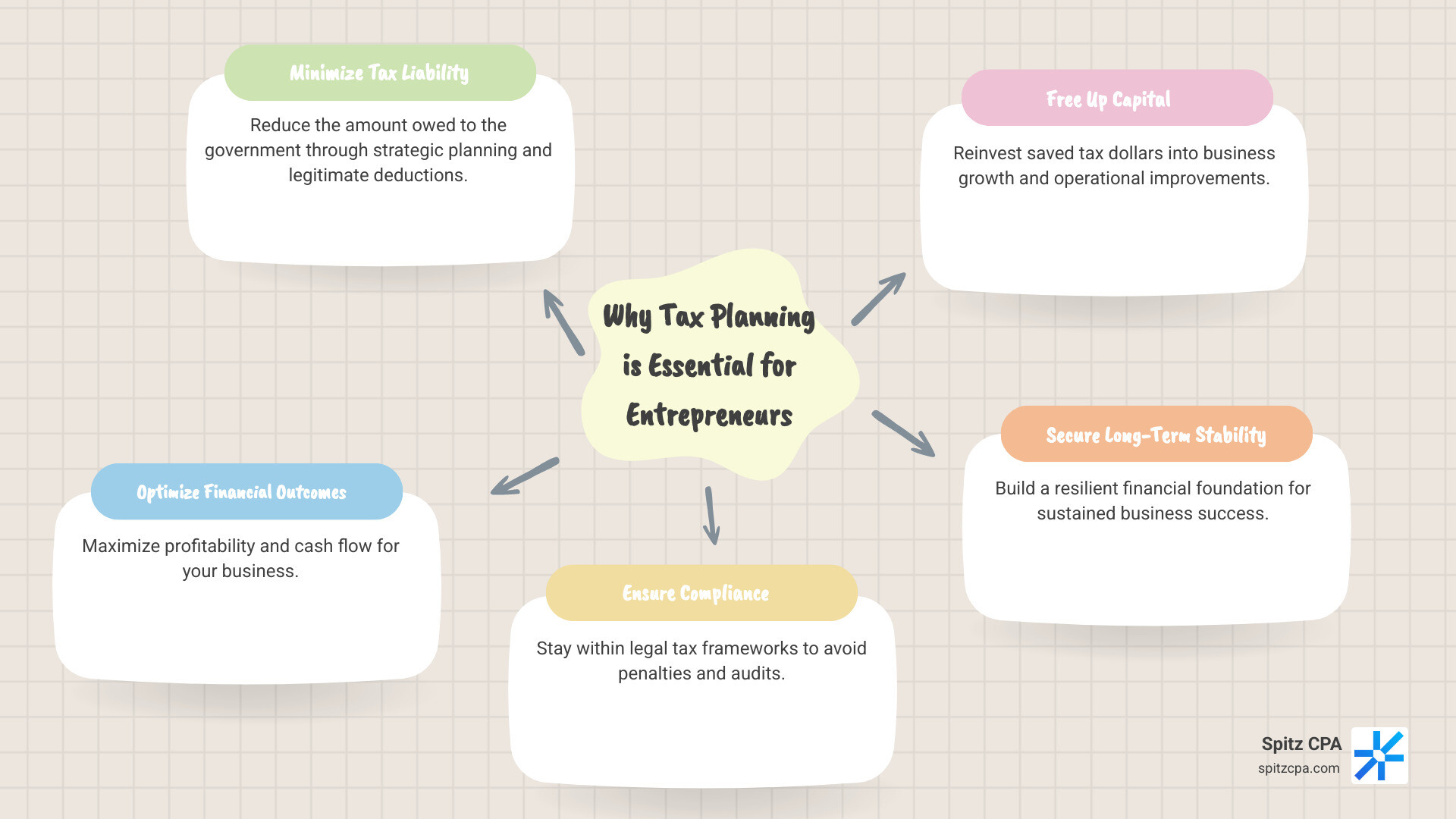
Tax planning for entrepreneurs is essential for:
- Minimizing tax liability.
- Optimizing financial outcomes.
- Ensuring compliance.
- Freeing up capital for growth.
- Securing long-term business stability.
Entrepreneurship is demanding, and among many responsibilities, tax planning can feel daunting. However, it’s one of the most crucial parts of running a business.
Effective tax planning can be the difference between a thriving business and one that struggles. It involves strategically organizing your finances to minimize your tax liability while adhering to the law. For small businesses, the average effective tax rate is around 19.8%, and smart planning helps lower this figure.
I’m Michael J. Spitz, and with over 15 years in corporate accounting, I’ve seen the impact of smart financial decisions. My experience in tax planning for entrepreneurs helps businesses steer complex financial landscapes, from fundraising to daily cash management.
Foundational Tax Strategies: Building a Strong Financial Base
The bedrock of your tax strategy is your business structure. The entity you choose significantly impacts your tax obligations and is one of the most crucial decisions for tax planning for entrepreneurs.

Whether you operate as a sole proprietorship, a partnership, a Limited Liability Company (LLC), an S-Corporation, or a C-Corporation, each has unique tax implications.
Most small businesses, such as sole proprietorships, partnerships, and S-corporations, are “pass-through” entities. This means the business’s income “passes through” to the owners’ personal tax returns. This structure avoids the “double taxation” common to C-Corporations, where profits are taxed at the corporate level and again when distributed to shareholders as dividends.
An LLC is a popular choice for its liability protection and tax flexibility. An LLC can be taxed as a sole proprietorship, a partnership, an S-Corp, or a C-Corp. Each path has different benefits, so understand how an LLC is taxed to align the structure with your financial goals.
Here’s a quick look at how common business structures compare tax-wise:
| Entity Type | Key Tax Implication |
|---|---|
| LLC (Default) | Pass-through taxation. Income/losses reported on owner’s personal tax return (Schedule C, E, or F). Subject to self-employment tax. |
| S-Corporation | Pass-through taxation. Avoids corporate income tax. Owners pay self-employment tax only on salary, not on distributions. Requires reasonable salary. |
| C-Corporation | Subject to corporate income tax (21% flat rate as of 2018). Profits taxed at corporate level, then again when distributed to shareholders (double taxation). |
Master Your Record-Keeping for Maximum Deductions
Effective tax planning for entrepreneurs begins with meticulous record-keeping. You can’t claim deductions or credits without proof, making accurate records of all income, expenses, assets, and liabilities essential. Modern bookkeeping and receipt tracking software simplify this process, helping you categorize transactions and spot every deductible expense. The IRS requires businesses to keep records for up to three years, so staying organized ensures compliance and maximizes opportunities. At Spitz CPA, we can help you implement best practices for record-keeping.
A powerful approach is the “12×12 system,” a commitment to consistent financial review. By checking your finances monthly, you can track income, expenses, and cash flow throughout the year, rather than scrambling at the last minute. This proactive method reduces stress and ensures no deduction is overlooked.
Understand the Qualified Business Income (QBI) Deduction
The Qualified Business Income (QBI) deduction (Section 199A) is a game-changer for many entrepreneurs, allowing eligible self-employed individuals and small business owners to deduct up to 20% of their qualified business income.
This deduction has specific income thresholds and special rules for Specified Service Trade or Businesses (SSTBs), such as health, law, and consulting. If your income exceeds certain limits, the deduction may be phased out or eliminated, particularly for SSTBs.
Crucially, the QBI deduction is set to expire on December 31st, 2025, due to the sunset provisions of the Tax Cuts and Jobs Act (TCJA). Proactive planning is essential to maximize its benefits while available. We monitor all QBI deduction rules to ensure our clients take full advantage.
Key Tax Planning for Entrepreneurs: Maximizing Deductions and Credits
With the foundations covered, let’s explore specific strategies that can reduce what you owe and improve cash flow. Effective tax planning for entrepreneurs means finding every legitimate way to lower your tax bill.

A common opportunity is the home office deduction. To qualify, your home office space must pass the exclusive use rule, meaning it can’t double as a guest room or dining area. You can use the simplified method ($5 per square foot, up to 300 sq. ft. for a $1,500 max deduction) or the actual method. The actual method requires more record-keeping but can yield a larger deduction by calculating the business-use percentage of your home and deducting that portion of mortgage interest, utilities, and other expenses.
Vehicle expenses are another major opportunity. For 2025, the standard mileage rate is 70 cents per mile, meaning 10,000 business miles equals a $7,000 deduction. Alternatively, the actual expense method lets you deduct the business percentage of costs like gas, repairs, and insurance. We recommend calculating both to see which is more beneficial. Meticulous mileage logs are essential, as outlined in the IRS mileage allowance rules.
Capitalize on Equipment and Green Energy Incentives
The Section 179 deduction allows you to accelerate equipment expenses, often letting you deduct the full purchase price of new computers, furniture, or machinery in the year of purchase. For 2024, you can deduct up to $1.22 million in qualifying equipment. This, combined with bonus depreciation (40% for 2025), offers substantial immediate write-offs. The Section 179 Deduction explained guide details what qualifies.
Green energy tax credits offer even more savings. These are credits, not deductions, meaning they reduce your tax bill dollar-for-dollar. Installing solar panels can earn a 30% tax credit, while purchasing a clean commercial vehicle can result in credits up to 30% of the price. Even used clean vehicles can qualify for up to $4,000. The clean commercial vehicle credit can save thousands.
A guide to effective tax planning for entrepreneurs using credits
Tax credits are particularly valuable because they directly reduce your tax bill. Key credits include:
- Work Opportunity Tax Credit (WOTC): Claim up to $9,600 per qualified employee when you hire from certain groups facing employment barriers. The Work Opportunity Tax Credit program runs through December 31, 2025.
- Disabled Access Credit: Covers 50% of eligible expenses (between $250 and $10,250) to make your business accessible, for a maximum credit of $5,000.
- Small Business Health Care Tax Credit: Offsets health insurance costs for businesses with fewer than 25 full-time equivalent employees that pay at least 50% of premiums.
- Retirement Plan Start-Up Costs Tax Credit: Covers up to 100% of startup costs (up to $5,000) for three years, plus an extra $500 annually for including automatic enrollment.
Beyond these, many other legitimate business expenses are deductible, including office rent, professional fees, advertising, employee wages, insurance, software, travel, training, loan interest, and bad debts. The key is documentation; every receipt and every mile adds up to real tax savings when properly tracked.
Advanced Strategies: Income, Retirement, and Future-Proofing
Beyond the basics, advanced strategies involving the timing of income and expenses can significantly reduce your tax bill. These often depend on whether your business uses cash or accrual accounting.

If you use cash-basis accounting and anticipate a lower tax bracket next year, you could delay invoicing to defer income. This strategy, income deferral, shifts that income and its tax liability to a later period. We can help you understand how to defer your tax payments effectively. Conversely, if you expect a higher tax rate, you can accelerate expenses by making necessary purchases or prepaying items like rent before year-end to claim the deduction in the current tax year. Understanding deferred revenue guidelines is key to using these timing strategies for your tax planning for entrepreneurs.
Boost Your Retirement Savings to Lower Your Tax Bill
Retirement planning is a powerful tool for tax planning for entrepreneurs. Contributions to many plans are tax-deductible, reducing your current taxable income while you save for the future. Options include:
- SEP IRA (Simplified Employee Pension IRA): Ideal for the self-employed or small businesses, a SEP IRA allows you to contribute up to 25% of your net self-employment income (up to $70,000 for 2025). These plans are easy to set up and can be funded at tax time for the previous year.
- SIMPLE IRA (Savings Incentive Match Plan for Employees IRA): A good fit for businesses with 100 or fewer employees. For 2025, employees can contribute up to $16,500 ($20,000 if 50 or older), and employers typically make matching contributions.
- Solo 401(k): Often the best choice for a solo entrepreneur (or one with a spouse-employee). You can contribute as both an “employee” (up to $23,500 for 2025, or $31,000 if 50+) and an “employer” (up to 25% of net self-employment income), with a combined 2025 limit of $70,000.
- Defined Benefit Plan: A game-changer for high-income solopreneurs, allowing for aggressive tax deferral with annual pre-tax contributions that can exceed $300,000.
Many of these plans also qualify for the retirement plans startup costs tax credit. Our financial services can help you choose the right strategy.
Advanced tax planning for entrepreneurs: Benefits and Gifting
Smart tax planning for entrepreneurs also involves how you pay your team and manage personal wealth. Offering Fringe Benefits is a win-win: they are tax-deductible for the business and tax-free for employees. This includes health insurance, dependent care, and educational assistance. A CARES Act provision allows employers to help with student loans (up to $5,250 per employee annually, excluded from their income) through 2025. See the IRS guide on eligible fringe benefits.
Gifting Strategies are powerful for estate planning. You can gift parts of your company to family members, spreading income across lower tax brackets, or use the annual gift tax exclusion ($18,000 per recipient for 2024) to transfer wealth tax-free. Advanced strategies like a charitable remainder unitrust can help defer capital gains on asset sales while providing income.
Staying Ahead: Navigating Tax Law Changes and State-Specific Rules
The tax landscape is rarely static. Tax laws change frequently, but unlike the weather, you can prepare for them. Savvy entrepreneurs stay informed to adapt their strategies.

A critical change on the horizon is the expiration of many provisions from The Tax Cuts and Jobs Act (TCJA) at the end of 2025. This could mean higher individual tax rates for many entrepreneurs, a lower standard deduction for high-income earners, and the sunset of the 20% Qualified Business Income (QBI) deduction.
This creates a planning opportunity. If you anticipate higher tax rates in 2026, it might make sense to accelerate income into 2025 to take advantage of the current favorable rates.
State and local tax laws add another layer of complexity to tax planning for entrepreneurs. Pass-Through Entity (PTE) taxes have emerged as a workaround to the $10,000 federal limit on State and Local Tax (SALT) deductions. Many states now allow pass-through entities to pay state income tax at the business level. This payment is then deductible for federal tax purposes, bypassing the SALT cap. As of recently, 35 states have enacted a form of PTE tax, giving entrepreneurs a valuable new tool.
Remote work tax implications have also grown more complex. Having employees in different states can trigger tax obligations in those jurisdictions, including payroll, income, and sales tax nexus. Each state has its own rules, creating a patchwork of regulations that requires careful navigation to avoid unexpected liabilities.
These evolving rules show why staying current is crucial. We stay on top of these developments to provide comprehensive tax services that account for both federal and state-specific nuances, ensuring you’re always compliant while maximizing your opportunities.
Frequently Asked Questions about Tax Planning for Entrepreneurs
Here are answers to common questions about tax planning for entrepreneurs, drawing from years of experience helping business owners optimize their strategies.
How do tax strategies differ for small businesses vs. large corporations?
Small business tax planning focuses on maximizing deductions and simplifying cash flow, dealing with things like home office and vehicle expenses. The strategies are often straightforward but highly effective.
Large corporations, in contrast, manage complex regulations like international tax obligations and transfer pricing across multiple countries. Their scale provides access to specialized incentives like R&D credits, but they also face higher audit risk due to their complexity.
What is the role of a tax advisor in an entrepreneur’s tax planning?
A tax advisor acts as a strategic partner for your business. We don’t use cookie-cutter approaches; instead, we analyze your specific structure, income, and goals to develop personalized tax planning for entrepreneurs strategies.
- Compliance: We ensure you’re always on the right side of constantly changing federal, state, and local tax laws, helping you avoid costly penalties.
- International Expansion: We help steer global tax laws and treaties to prevent double taxation and ensure compliance in all jurisdictions.
- Proactive Planning: We don’t just react to tax law changes; we anticipate them. With the TCJA expiration looming, we’re already helping clients prepare. Our expert tax advice transforms tax obligations from a burden into a strategic advantage.
What are the best practices for record-keeping to support tax deductions?
Good record-keeping is the foundation of your tax strategy. Without proper documentation, even legitimate deductions can be disallowed by the IRS.
- Consistent Review: The 12×12 system—a monthly financial check-in—prevents a year-end scramble and ensures nothing is missed.
- Digital Tools: Use cloud-based accounting software and receipt-tracking apps to automatically categorize expenses and store digital copies of receipts.
- Separate Accounts: Keep business and personal finances completely separate. This simplifies tracking and provides clear documentation for tax purposes.
- Detailed Documentation: Keep organized receipts, invoices, and bank statements. For significant purchases, a brief note on the business purpose can be helpful. The IRS can audit up to three years back, so your records must tell a clear story.
Our bookkeeping services help entrepreneurs implement these best practices, ensuring your records are always audit-ready.
Conclusion
Tax planning for entrepreneurs is not a once-a-year task but an ongoing, year-round strategy. Consistent attention to your finances yields far better results than a last-minute scramble.
The strategies we’ve covered, from choosing the right business structure to maximizing the Qualified Business Income deduction, build on each other to free up cash for reinvestment. Staying ahead of changes like the TCJA expiration in 2025 turns potential obstacles into opportunities.
Effective tax planning transforms your relationship with your finances, replacing dread with financial clarity. This clarity translates directly into business growth. When you’re not losing money to unnecessary taxes, you have more capital for hiring, marketing, or building a stronger cash reserve. I’ve seen businesses achieve remarkable growth, sometimes increasing their value by 10x, when they get their financial house in order.
At Spitz CPA, we believe your hard-earned money should work as hard as you do. Our comprehensive tax services go beyond just filing returns. We partner with you year-round to steer complex tax laws, identify savings, and build strategies that support your long-term goals.
With the right guidance and a proactive approach, tax planning becomes one of your most powerful business tools. Let’s work together to turn your tax obligations into strategic advantages that fuel your success.


